How Wide Should a Vanity Light Be Compared to Your Mirror?
A vanity light should span 70–80% of your mirror’s width — a 36-inch mirror pairs best with a 27–29-inch fixture, according to residential lighting designers. Go narrower and the mirror’s edges stay dark for shaving or makeup; go wider and the fixture overwhelms the wall. This guide covers the full size chart by mirror width, double-vanity math, and where the 80% rule doesn’t apply — sconces and Hollywood-style light bars.
Why Does Vanity Light Width Matter?
Picking the right vanity light size isn’t just about looks — it directly affects how well you can see for shaving, makeup, or skincare. For the full picture on matching any fixture to your space, see our guide to choosing vanity lighting.
When I first renovated my bathroom, I didn’t think much about the size of the vanity light. I picked one that looked nice and called it a day. Big mistake! The light was too small, casting shadows on my face and making it hard to see. That’s when I realized the width of the vanity light compared to the mirror is a game-changer. It affects how evenly the light spreads across your face and how balanced the whole setup looks.
A vanity light that’s too narrow leaves dark spots on either side of the mirror, which isn’t great for tasks like grooming. On the other hand, a light that’s too wide can overwhelm the space or look out of proportion. The goal is to find that sweet spot where the light complements the mirror, lights up your face evenly, and ties the room together. It’s all about balance and function.
The Golden Rule: Vanity Light Width vs. Mirror Width
After some trial and error, I learned there’s a general rule designers swear by: your vanity light should be about 75-80% of the width of your mirror. This isn’t set in stone, but it’s a great starting point. For example, if your mirror is 36 inches wide, aim for a vanity light that’s around 27-29 inches wide. This ensures the light spreads evenly across the mirror without overpowering it.
Why 75-80%? It’s wide enough to illuminate your face properly but leaves a little breathing room on either side, so the light fixture doesn’t look too bulky. I’ve seen this work beautifully in my own bathroom, where I have a 48-inch mirror paired with a 36-inch light. The proportions feel just right, and there are no harsh shadows when I’m getting ready in the morning.
“In my own bathroom, I paired a 48-inch mirror with a 36-inch light bar — right at 75% — and there isn’t a single harsh shadow when I’m getting ready in the morning.”
Here’s a quick guide to help you match your vanity light to your mirror:
| Mirror Width (inches) | Ideal Vanity Light Width (inches) |
|---|---|
| 24 | 18-19 |
| 30 | 22-24 |
| 36 | 27-29 |
| 48 | 36-38 |
| 60 | 45-48 |
This table is a lifesaver when you’re shopping for lights. Keep it handy, and you’ll have a much easier time picking the right size.
What If You Have a Double Vanity?
If you’ve got a double vanity, things get a bit trickier, but don’t worry—I’ve tackled this one too. In my guest bathroom, we have a 60-inch double vanity with two sinks and a long mirror. At first, I thought one big light would do the trick, but it didn’t spread the light evenly over both sinks. That’s when I learned you have two solid options for double vanities.
First, you can use one long vanity light that’s about 75-80% of the mirror’s width, just like with a single vanity. For a 60-inch mirror, a 45-48-inch light works well. This creates a sleek, unified look. Alternatively, you can use two smaller lights, one over each sink. Each light should be about 75-80% of the width of the mirror section above each sink. For example, if your mirror is 60 inches wide, you might use two 18-20-inch lights, spaced evenly.
I went with two lights in my guest bathroom, and it’s been a game-changer. Each person gets their own well-lit space, and it adds a touch of symmetry that looks super polished. Just make sure the lights are centered over each sink to keep things balanced.
Considering the Height of the Vanity Light
While we’re talking width, let’s not forget about height. The placement of your vanity light matters just as much as its size. I learned this the hard way when I hung a light too low and kept bumping my head! The ideal height for a vanity light is about 75-80 inches from the floor to the center of the fixture. This usually puts it at eye level or slightly above, which is perfect for reducing shadows on your face.
If your light is mounted above the mirror, make sure it’s about 3-4 inches above the top of the mirror. This keeps the light from shining directly into your eyes. In my master bathroom, I have a sleek horizontal light bar mounted just above the mirror, and it’s been perfect for both lighting and style.
For lights mounted on either side of the mirror (like sconces), place them at eye level, about 60-66 inches from the floor to the center of the fixture. This creates a flattering frame around the mirror and lights up your face evenly. I tried sconces in my powder room, and they give off such a cozy, spa-like vibe.
Choosing the Right Style for Your Vanity Light
Picking the right size is only half the battle—you also want a light that matches your bathroom’s style. When I was shopping for my vanity light, I spent hours scrolling through options, from modern minimalist bars to vintage-inspired sconces. The width of the light plays a role here too, because a bulky fixture can overwhelm a small mirror, while a tiny light might look lost on a large one.
For a modern bathroom, I love sleek, linear light bars that span most of the mirror’s width. They’re clean and simple, and they spread light evenly. In my own bathroom, I went with a brushed nickel light bar that’s just the right size for my 36-inch mirror. It feels contemporary without being too flashy.
If your bathroom has a more traditional or rustic vibe, consider a multi-bulb vanity light or a pair of sconces. These can add charm and character while still providing plenty of light. Just make sure the total width of the fixture (or fixtures) follows the 75-80% rule.
Best Vanity Light Pick
Ascher 4-Light Vanity Light, Brushed Nickel – $39.99
A 4-bulb brushed nickel bar that lands in the 27-38 inch range this guide’s size chart recommends for 36-48 inch mirrors, with frosted glass shades that soften shadows the way the 75-80% rule is meant to.
- Best for: 36-48 inch mirrors on a standard single vanity
- Why we picked it: Brushed nickel and frosted glass match the linear-bar style this guide recommends for modern bathrooms
- Main drawback: Bulbs not included, and no dimmer built in
Compare more vanity light options
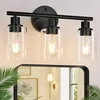 Option 1 Zarbitta 3-Light Black – $29.74
|
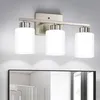 Option 2 FonmYim Brushed Nickel – $34.19
|
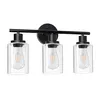 Option 3 Unicozin Modern Black – $29.99
|
As an Amazon Associate we earn from qualifying purchases.
How Many Lumens Do You Need?
Let’s talk brightness for a second. The width of your vanity light affects how much light it can deliver, but the lumens (a measure of light output) are just as important. I made the mistake of choosing a light that was the perfect size but way too dim, and it left my bathroom feeling like a cave.
For a bathroom vanity, aim for 1,500-4,000 lumens, depending on the size of the space. A single vanity with a 24-36-inch mirror usually needs about 1,500-2,000 lumens. For a double vanity, you might need closer to 3,000-4,000 lumens. Most light fixtures list their lumen output, so check the specs before you buy.
I also recommend choosing LED bulbs with a color temperature of 2700K-3000K for a warm, flattering glow. Anything cooler (like 4000K or higher) can feel harsh and clinical, which isn’t the vibe you want in a bathroom.
📊 The IES residential lighting standard calls for at least 20 footcandles of vertical illumination on the face at the vanity, with 700–800 lumens per fixture recommended for task lighting and a color rendering index (CRI) of 90 or higher. — Source: Illuminating Engineering Society, ANSI/IES RP-9-23
What About Odd-Shaped or Custom Mirrors?
Not every mirror is a standard rectangle, and I’ve definitely dealt with this challenge. In my powder room, I have a round mirror that threw me for a loop when it came to picking a light. If you’ve got a circular, oval, or custom-shaped mirror, the 75-80% rule still applies, but you’ll need to measure the mirror’s widest point.
For a round mirror, a single horizontal light bar works well if it’s about 75% of the mirror’s diameter. Alternatively, you can flank the mirror with two sconces for a balanced look. In my powder room, I used two small sconces on either side of my 30-inch round mirror, and it feels elegant and functional.
For irregularly shaped mirrors, focus on the overall width and aim for a light that complements the mirror’s proportions. If you’re unsure, take a step back and visualize how the light will frame the mirror. You can even tape a piece of string to the wall to mimic the light’s width and see how it looks.
Small Bathrooms vs. Large Bathrooms
The size of your bathroom also plays a role in choosing the right vanity light width. In my small guest bathroom, I had to be careful not to pick a light that felt too bulky. A light that’s too wide in a small space can make the room feel cramped. Stick to the 75-80% rule, but lean toward the smaller end of the range if your bathroom is tight on space.
In a larger bathroom, like my master suite, you have more flexibility. A wider light or even multiple fixtures can add drama and fill the space nicely. Just make sure the light doesn’t overpower the mirror or make the room feel unbalanced.
Practical Tips for Installation
Installing a vanity light might sound daunting, but I promise it’s doable with a little planning. When I installed mine, I made sure to check a few things first. Make sure the electrical box is centered above the mirror (or on either side for sconces). If it’s off-center, you might need an electrician to move it, which I had to do in one of my bathrooms.
Also, double-check that your light fixture is rated for bathroom use. Bathrooms are damp environments, so look for fixtures with an IP44 rating or higher to ensure they’re safe. And don’t forget to turn off the power before you start installing—safety first!
If you’re not comfortable with electrical work, hire a professional. It’s worth the peace of mind. I called in an electrician for my double vanity setup, and it saved me a lot of stress.
Mixing and Matching for a Custom Look
One of my favorite things about bathroom design is how you can mix and match to create a unique look. Don’t be afraid to play with different light styles or even combine multiple fixtures. In my friend’s bathroom, she paired a small chandelier-style light with two sconces for a glamorous vibe. The key is to keep the total width in check and make sure the lights work together visually.
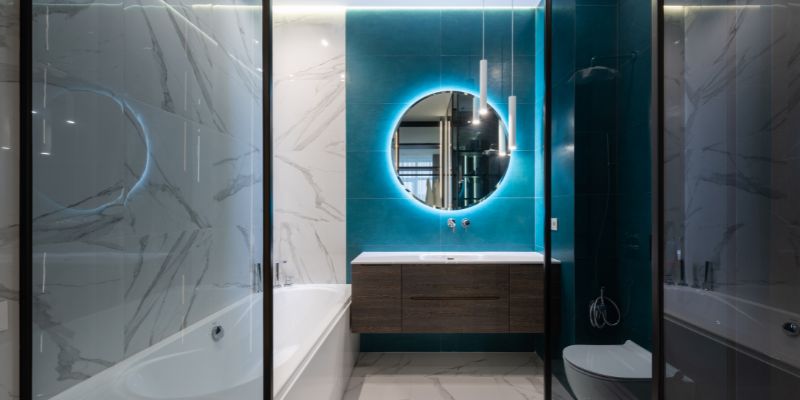
If you’re mixing fixtures, stick to the same finish (like brass or matte black) for a cohesive look. I’ve also seen people use backlit mirrors with smaller vanity lights for a modern, layered effect. Just make sure the combined light output is enough to keep your space bright — that’s where the lumens guidance above comes in.
Common Mistakes to Avoid
I’ve made my fair share of mistakes when it comes to vanity lights, so let me save you some trouble. First, don’t choose a light based on looks alone—always check the width and lumens. Second, avoid placing the light too high or too low, as it can create unflattering shadows. And finally, don’t forget about the mirror’s size when shopping. A light that’s too big or too small can throw off the whole room.
Frequently Asked Questions
What if my vanity light is wider than my mirror?
It’s not ideal, but it can work if the light isn’t too much wider. I’ve seen setups where the light extends a few inches beyond the mirror, and it still looks balanced. Just make sure the extra width doesn’t overpower the space or create glare. Stick to the 75-80% rule whenever possible for the best results.
Should my vanity light run the full width of the mirror?
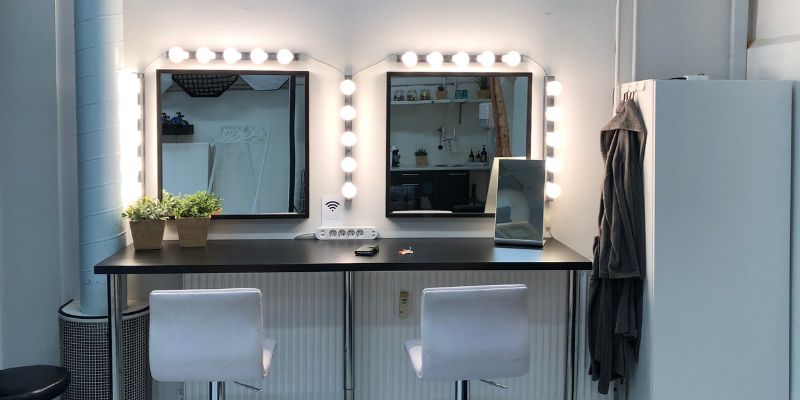
Only for a Hollywood-style vanity look. A light bar that spans the mirror’s full width, or slightly wider, is the accepted exception to the 75-80% rule and is common with bulb-strip mirrors. For a traditional or transitional bathroom, stick to 75-80% so the fixture doesn’t visually overpower the mirror.
Can I use sconces instead of a single vanity light?
Absolutely! Sconces are a great choice, especially for a more elegant or traditional look. I used sconces in my powder room, and they frame the mirror beautifully. Just make sure each sconce is about 75-80% of the mirror’s width (or half the mirror for a double vanity) and placed at eye level.
How do I know if my vanity light is bright enough?
Check the lumens! For a single vanity, aim for 1,500-2,000 lumens. For a double vanity, go for 3,000-4,000 lumens. I made the mistake of buying a dim light once, and it was a nightmare for applying makeup. Also, choose a warm color temperature (2700K-3000K) for a flattering glow.
What if I have a very small bathroom?
In a small bathroom, stick to a light that’s on the smaller side of the 75-80% rule to avoid overwhelming the space. I have a tiny guest bathroom, and a compact light bar worked perfectly. You can also consider wall sconces to save space and add style.
Can I use a backlit mirror with a vanity light?
Yes, and it can look amazing! A backlit mirror adds ambient light, so you might be able to use a slightly smaller vanity light. In my friend’s bathroom, she paired a backlit mirror with a slim light bar, and it’s both practical and stunning. Just make sure the total light output is enough for your needs.
Conclusion
Figuring out how wide your vanity light should be compared to your mirror might seem like a small detail, but it’s one that can transform your bathroom. After experimenting with different setups in my own home, I’ve learned that the 75-80% rule is a reliable guide, whether you’re working with a single vanity, a double sink, or even a quirky round mirror. Pair that with the right brightness, height, and style, and you’ve got a recipe for a bathroom that’s both functional and beautiful.
Take your time when choosing your vanity light—it’s worth the effort to get it right. Measure your mirror, think about your bathroom’s style, and don’t be afraid to mix things up for a custom look. With the tips I’ve shared, you’ll be well on your way to a perfectly lit bathroom that makes getting ready a joy.
Sponsored / affiliate links. As an Amazon Associate I earn from qualifying purchases. I may earn additional commission from eligible campaigns.