Lazy Susan vs Blind Corner Cabinet: Which Works Better?
A Lazy Susan works better for quick access to awkward corner items. A blind corner cabinet can store more total volume if pull-out hardware is added. Pick the wrong one and you waste dead space, bend too far, or pay for a cabinet upgrade that never fits how you cook. This guide compares access, usable storage, and installation risk so you can pick the layout that fits your household’s most-used items.
| Decision factor | Lazy Susan | blind corner cabinet | Winner |
|---|---|---|---|
| Access | Rotating trays bring items to the front fast. | Back corners are harder to reach without accessories. | Lazy Susan |
| Usable storage | Round trays leave some space unused near the walls. | Deeper corner volume is easier to use for bulky items. | blind corner cabinet |
| Heavy-item fit | Best for small items and lighter loads. | Better for pots, pans, and bulkier cookware. | blind corner cabinet |
| Installation complexity | Needs accurate sizing, clear door swing, and hardware alignment. | May need filler strips and optional pull-out hardware. | Lazy Susan |
| Clearance sensitivity | Needs a specific corner footprint and door-clearance checks. | More forgiving when the adjacent run is tight. | blind corner cabinet |
| Cost | Often costs more because of rotating hardware. | Base cabinet is usually simpler, but fillers and pull-outs can add cost. | blind corner cabinet |
| Retrofit-friendliness | Less forgiving if the opening, walls, or doors are out of square. | Usually easier to fit into an existing run with fillers. | blind corner cabinet |
| Mobility friendliness | Easier reach for many users, but still requires a good door swing and tray rotation. | Can work well with pull-out hardware, but the back area stays less direct. | Lazy Susan |
Access and storage trade-Offs
The trade-off is straightforward: a Lazy Susan gives faster access, while a blind corner cabinet gives you deeper storage with more layout options. If your kitchen depends on spices, condiments, or small appliances, the rotating layout usually feels easier. If you need to tuck away larger cookware or fit a tight adjacent run, the blind corner often wins.
Access versus deep storage
A Lazy Susan moves the shelf to you, so the back of the cabinet is no longer a reach problem. A blind corner cabinet keeps more of the corner volume, but without pull-out or swing-out hardware, the farthest zone stays awkward.
What that means in daily use
Say your corner holds olive oil, vinegar, and a few spice jars. A Lazy Susan makes those easy to see and grab. Put a stockpot or stand mixer in the same spot, and the blind corner cabinet becomes more practical because it handles bigger, heavier items better.
Quick verdict by kitchen type
For compact kitchens and frequent access, Lazy Susan is usually the cleaner pick. For storage-heavy layouts, larger cookware, or a tighter adjacent run, blind corner cabinet is often the safer fit. Neither is universal. The right answer depends on what you store and how your corner is built.
What each corner cabinet does
A Lazy Susan corner cabinet uses rotating shelves or trays inside a corner base cabinet footprint. A blind corner cabinet leaves a hidden zone in the corner and uses the accessible front opening for storage, often with deeper space that reaches behind the visible door line.
Lazy Susan corner cabinet
The main advantage is access. Rotating shelf hardware brings items forward, which is why Lazy Susans work best for accessible corner storage of small items. They also tend to fit a storage pattern where you want everyday items visible, not buried.
Blind corner cabinet
The main advantage is layout flexibility. A blind corner cabinet usually offers more layout flexibility than a Lazy Susan, and it can be better when the adjacent run is tight. It also gives you a place for larger appliances like a crockpot or stand mixer.
Where each one fits in a cabinet run
Corner cabinet dimensions matter at the same time as the surrounding run. You need to think about cabinet width and depth, the corner angle, adjacent appliance openings, wall squareness, and door clearance before you commit to either layout.
Which one gives easier access?
Lazy Susan gives easier access in most daily-use kitchens because the shelves rotate toward you. A blind corner cabinet can still be usable, but the back area stays harder to reach unless you add pull-out accessories. That difference matters most when the cabinet holds items you use several times a week.
Reach to back corners
With a Lazy Susan, the farthest item becomes a front-facing item after one turn. With a blind corner cabinet, the back area may stay out of reach, especially if you do not add a pull-out corner organizer. That is why blind corners often feel deeper than they are useful.
Visibility of stored items
Visibility is a major access issue. A round tray can leave items in view, while a deep blind corner can hide them behind the front plane of the cabinet. If you store spices or condiments, that visibility gap matters every day.
Mobility-friendly use
For older adults or anyone with reach limits, easier access usually matters more than total volume. A Lazy Susan is often the better first choice because it reduces deep bending and shoulder reach. A blind corner can still work, but only if the pull-out hardware is smooth and the user can handle the motion.
Which one uses space better?
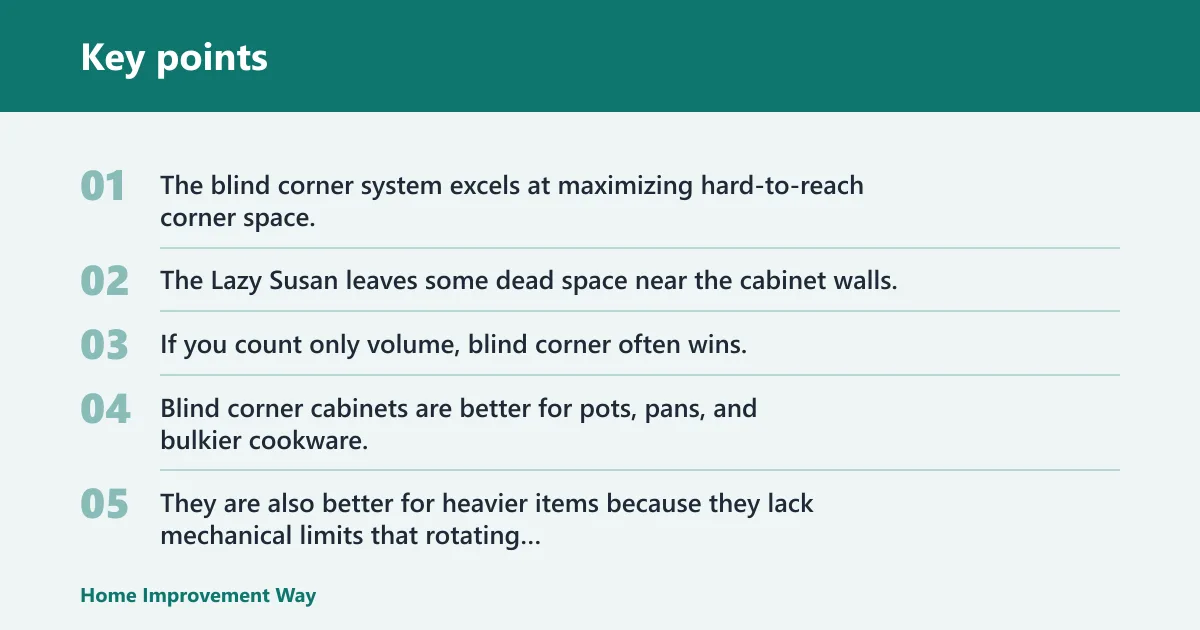
Blind corner cabinet usually uses space better on paper because it captures more of the corner volume. A Lazy Susan gives up some space near the cabinet walls because of its round shape, but that tradeoff can be worth it when easy access matters more than total cubic capacity. Storage quality is not the same as storage quantity.
Usable storage versus dead space
The blind corner system excels at maximizing hard-to-reach corner space. The Lazy Susan leaves some dead space near the cabinet walls, but that loss is partly offset by easier reach and faster retrieval. If you count only volume, blind corner often wins. If you count usable volume, the gap narrows.
Heavy-item fit for pots, pans, and small appliances
Blind corner cabinets are better for pots, pans, and bulkier cookware. They are also better for heavier items because they lack mechanical limits that rotating trays must respect. A blind base cabinet can store larger appliances like a crockpot or stand mixer without asking those items to sit on a turntable.
Effect of cabinet width and depth
Cabinet width and depth affect both options. A Lazy Susan works best when the corner footprint is right and the door swing clears the trays. A blind corner cabinet can absorb a tighter adjacent run, but the visible opening still has to work with the rest of the layout.
Lazy Susan corner cabinet dimensions and clearance
Lazy Susan fit depends on exact measurements. You need the corner base cabinet footprint, the door-clearance path, and the space around adjacent appliance openings. If any one of those is off, the trays can rub, the doors can bind, or the hardware can rotate unevenly.
Corner base cabinet footprint
Measure cabinet run dimensions before ordering. Check the width of the two adjoining runs, the cabinet depth, and the available corner angle. A wall that is slightly out of square can change how a rotating shelf sits, which is why installation precision matters more here than many owners expect.
Rotating shelf hardware
Rotating shelf hardware depends on mechanical components, weight limits, and smooth alignment. If the hardware binds after installation, the turn becomes annoying fast. If the load is too heavy or unevenly distributed, the tray can sag or rub the frame.
Door swing and adjacent appliance openings
Check whether the cabinet doors open fully without hitting a range, dishwasher, or nearby handle. A Lazy Susan needs a specific corner footprint and clear door swing, so the cabinet may fit on paper but fail in the field if the adjacent opening is too tight.
Blind corner cabinet planning details
Blind corner cabinets need more planning around fillers and access accessories. They can fit better in tight runs, but the layout usually needs a kitchen cabinet filler strip beside the adjacent cabinet to allow door swing. Without that space, the front door line can interfere with nearby cabinets or appliances.
Kitchen cabinet filler strip
A filler strip is not wasted space. It can make door swing possible and keep the layout workable beside a blind corner cabinet. The downside is that the strip takes up run length, so the available storage layout changes before you even add shelves or pull-outs.
Pull-out corner organizer
A pull-out corner organizer or swing-out shelf improves access in a blind corner, especially for heavy or bulky items. The tradeoff is cost and complexity. More moving parts mean more installation steps, more adjustment, and more potential for binding if the cabinet opening is not square.
Wall squareness and retrofit limits
Blind corners are usually more forgiving in older kitchens or remodels where the wall is not perfectly square. That is one reason they can be better for retrofit work. Still, if the opening varies too much, even a blind corner can end up with uneven gaps or poor door alignment.
Choose Lazy Susan if… / Choose blind corner cabinet if…
Choose Lazy Susan if your priority is easy reach, frequent use, and a corner that holds small or medium items you grab often. Choose blind corner cabinet if your priority is deeper storage, heavier cookware, or a tighter run where a rotating cabinet would need more clearance than you have.
Choose lazy susan if…
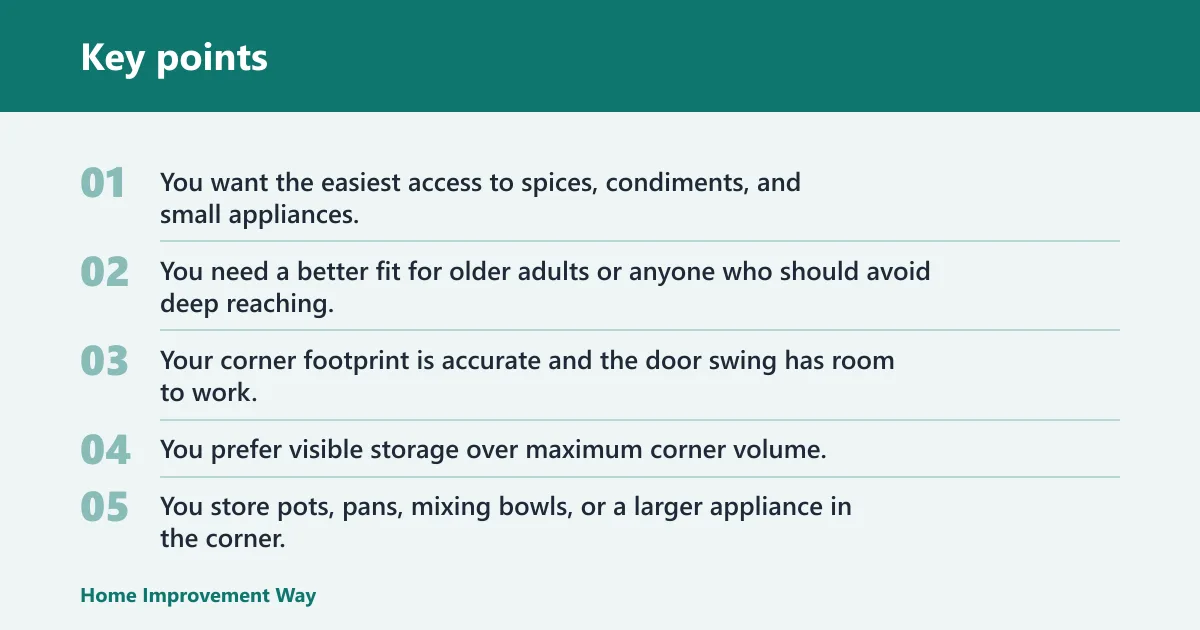
- You want the easiest access to spices, condiments, and small appliances.
- You need a better fit for older adults or anyone who should avoid deep reaching.
- Your corner footprint is accurate and the door swing has room to work.
- You prefer visible storage over maximum corner volume.
Choose blind corner cabinet if…
- You store pots, pans, mixing bowls, or a larger appliance in the corner.
- Your adjacent run is tight and a Lazy Susan would need more clearance.
- You are willing to add pull-out hardware or accept deeper reach into the back.
- You are remodeling or retrofitting and need more layout flexibility.


Corner cabinet decision matrix
This scorecard turns the choice into a practical layout decision. The numbers below are relative scores from 1 to 5, where 5 is better for that criterion. They are meant to help you compare the two options on the same terms, not replace site-specific measurements.
| Criterion | Lazy Susan | blind corner cabinet | Recommended winner |
|---|---|---|---|
| Access | 5 | 2 | Lazy Susan |
| Usable storage | 3 | 5 | blind corner cabinet |
| Heavy-item fit | 2 | 5 | blind corner cabinet |
| Installation complexity | 3 | 2 | Lazy Susan |
| Clearance sensitivity | 2 | 4 | blind corner cabinet |
| Cost | 2 | 3 | blind corner cabinet |
| Retrofit-friendliness | 2 | 4 | blind corner cabinet |
| Mobility friendliness | 4 | 3 | Lazy Susan |
What the matrix says
Lazy Susan wins when access is the top concern. blind corner cabinet wins when storage density, heavy loads, and layout flexibility matter more. The scores also show why pull-out hardware changes the picture: it improves a blind corner, but it does not erase the extra cost or complexity.
Recommended winner by scenario
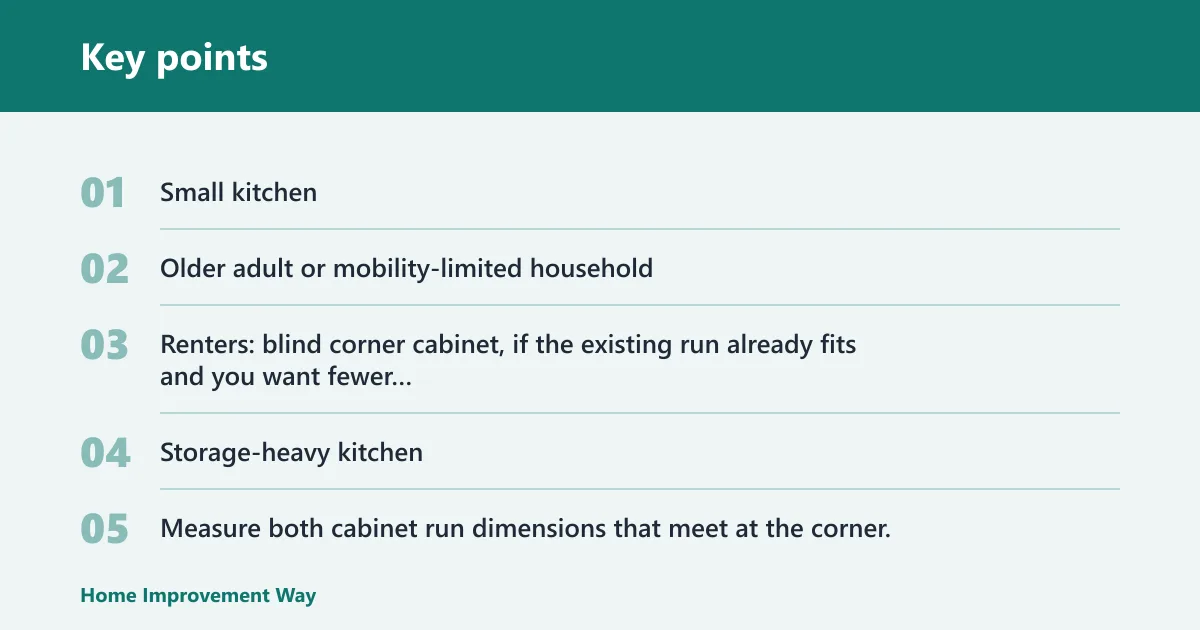
- Small kitchen: Lazy Susan, if the corner can be measured accurately and the door swing is clear.
- Older adult or mobility-limited household: Lazy Susan, because easier access usually matters more than maximum volume.
- Renters: blind corner cabinet, if the existing run already fits and you want fewer moving parts to maintain.
- Storage-heavy kitchen: blind corner cabinet, especially if you need space for pots, pans, or a stand mixer.
What to measure before ordering
- Measure both cabinet run dimensions that meet at the corner.
- Confirm cabinet width, cabinet depth, and the corner angle.
- Check door clearance against adjacent appliance openings.
- Verify wall squareness at the floor and at the cabinet line.
- Decide whether you need a filler strip or pull-out corner organizer.
- List the items the corner will store most often.
Frequently asked questions
Is a Lazy Susan better than a blind corner cabinet?
A Lazy Susan is better when quick access matters most. A blind corner cabinet is better when you need more usable deep storage or a tighter layout fit. If your corner holds daily-use items, the rotating shelves usually make life easier. If it holds bulky cookware, the blind corner often makes more sense.
Which corner cabinet gives easier access to items?
Lazy Susan gives easier access because the shelves rotate toward the opening. That reduces bending and reaching into the back of the cabinet. A blind corner cabinet can become easier to use with pull-out hardware, but the back area still stays less direct than a rotating tray.
Which corner cabinet uses space better?
A blind corner cabinet usually uses space better if you mean total storage volume. It is better at maximizing hard-to-reach corner space and can fit larger appliances or cookware. A Lazy Susan gives up some space near the walls, but it often delivers better day-to-day use of the space it does hold.
Which is cheaper to buy and install, a Lazy Susan or blind corner cabinet?
Lazy Susan often costs more because of rotating hardware. A blind corner cabinet can be cheaper at the base level, but fillers and pull-out systems can narrow that gap fast. The final price depends on whether you are buying a simple cabinet box or adding access hardware and layout pieces.
Which corner cabinet works better for large pots and pans?
blind corner cabinet is usually the better choice for large pots and pans. It handles bulky cookware well and can store heavier items without depending on rotating shelves. A Lazy Susan can work for lighter cookware, but the round shelf shape is less efficient for tall or oversized pieces.
What measurements do I need before ordering a corner cabinet?
You need cabinet run dimensions, cabinet width and depth, the corner angle, adjacent appliance openings, wall squareness, and door-clearance space. Those measurements determine whether the cabinet fits cleanly and whether the doors or trays will bind. For a blind corner, also check whether a filler strip is needed.
Sponsored / affiliate links. As an Amazon Associate I earn from qualifying purchases. I may earn additional commission from eligible campaigns.