Home Depot Kitchen Cabinets vs IKEA Cabinets: What to Compare
Compare kitchen cabinets with IKEA cabinets across five decision points: box construction, sizing, finish options, assembly and installation labor, and replacement parts, because price alone can hide fit issues and labor costs. Pick the wrong line and you may need fillers, miss a deadline, or spend more on installation than on the cabinets themselves. This guide compares IKEA SEKTION, Hampton Bay, and KraftMaid, with the details that affect layout, budget, and long-term ownership.
| Decision factor | kitchen cabinets | IKEA cabinets | Winner |
|---|---|---|---|
| Box material | Hampton Bay is described as particleboard with laminate coating; KraftMaid is described as plywood or furniture board. | SEKTION is described as melamine-coated particleboard. | KraftMaid for construction, IKEA cabinets for consistency |
| Hardware | Varies by line; semi-custom lines commonly use brand-specific or proprietary hardware. | Blum soft-close hinges and drawer runners are listed for SEKTION. | IKEA cabinets |
| Assembly state | Hampton Bay is often assembled or semi-assembled; KraftMaid is delivered assembled. | Flat-packed and assembled on site. | kitchen cabinets for less DIY assembly |
| Size flexibility | Hampton Bay stock sizes are limited; KraftMaid gives more sizing choices. | Fixed modular widths such as 12, 15, 18, 24, 30, and 36 inches. | kitchen cabinets |
| Corner solutions | Depends on the line and dealer-style design options. | SEKTION includes base, wall, pantry, sink, and built-in appliance cabinets. | IKEA cabinets |
| Finish range | Broader across Home Depot’s multiple manufacturers and lines. | More standardized within the system. | kitchen cabinets |
| Warranty | Hampton Bay: 5-year warranty; KraftMaid: lifetime limited warranty. | 25-year warranty. | IKEA cabinets for length; KraftMaid for premium coverage type |
| Typical cost tier | Hampton Bay is budget; KraftMaid is higher priced. | SEKTION sits in a middle-to-value range depending on fronts and drawers. | Hampton Bay for lowest entry cost |
| DIY difficulty | Lower on assembled stock lines; higher on semi-custom planning. | Higher because assembly is part of the job. | kitchen cabinets |
| Install labor risk | Lower for stock assembled cabinets; layout work can still rise on semi-custom jobs. | Higher if the installer must also assemble and tune the system. | kitchen cabinets |
| Best-use case | Budget remodels, style-heavy projects, or buyers who want a broader line spread. | Small kitchens, DIY-first projects, and standardized layouts. | Tie, depending on project type |
| Replacement parts and follow-on changes | Varies by line and manufacturer; more moving parts across retailers and brands. | More consistent part matching inside one system. | IKEA cabinets |
Kitchen cabinets
Box material and back panel thickness
Box material affects rigidity, screw holding, and how well cabinets handle weight and moisture over time. IKEA SEKTION is described as melamine-coated particleboard. Hampton Bay is described as particleboard with laminate coating, while KraftMaid is described as using plywood or furniture board.
Back panel thickness matters because thin backs can flex during transport and installation, and that flex can make leveling harder. A stiffer back panel also helps when you need a cabinet to stay square under a countertop, sink cutout, or wall load.
Hardware and smoothness
Hardware changes daily feel more than many shoppers expect. The comparison page lists Blum soft-close hinges and drawer runners for IKEA SEKTION, which gives you smooth closing and a consistent parts set. Home Depot cabinet lines vary more: Hampton Bay and KraftMaid do not share one hardware package because they are not one cabinet system.
Proprietary hardware can work well, but it raises the stakes when a hinge, runner, or mounting plate fails. Replacement is simplest when the line uses common hardware with broad part support.
Standardization versus line-by-line variety
IKEA uses one modular cabinet system with standardized parts. That makes planning more predictable, especially when you are mixing base, wall, pantry, sink, and built-in appliance cabinets.
Home Depot is a retailer with multiple manufacturers and cabinet lines. That helps if you want more finish and style variety, but it also means you need to compare the exact line, not the store name.
How the comparison changes by project type
If you want the cleanest DIY path, IKEA cabinets usually reward careful planning because the system is standardized. If you want less assembly time, a stock or assembled Home Depot line can reduce labor, especially when the cabinet layout is simple.
If you want a higher-end finish and more sizing or construction options, KraftMaid is the more relevant Home Depot line to compare. Hampton Bay is the budget comparison point, not the premium one.
Which cabinet line is cheaper?
Hampton Bay usually wins on entry price, but the total project cost can rise once you add fillers, end panels, organizers, trim, and install labor. IKEA SEKTION has published examples at $97 for a base cabinet, $78 for a wall cabinet, and $525 for a base cabinet with three drawers, but those numbers do not cover the full room.
A higher-priced line can still cost less to install if it arrives assembled and cuts labor hours. That is where KraftMaid can compete better than its cabinet price suggests, especially in a job that would otherwise need more shop time or professional assembly.
Hidden costs to put in the cart
- End panels for exposed cabinet sides.
- Fillers for wall irregularities and width gaps.
- Toe kicks, trim, and filler strips.
- Drawer inserts, organizers, and pull-outs.
- Installation labor if the cabinet system is not fully assembled.
Say your kitchen has a 24-inch opening beside a range and a 3-inch wall bump-out near the fridge run. A fixed modular system can fit the main run well, then still need fillers and panels to finish the edges cleanly. That extra material is often where the “cheap” cabinet order stops looking cheap.
How do construction and hardware compare?
KraftMaid has the clearest construction advantage on paper because plywood or furniture board generally gives you more material choices than particleboard alone. That does not make every KraftMaid cabinet better for every job, but it does change the durability discussion.
IKEA’s advantage is the system-level consistency of its hardware. If a hinge or runner needs replacement, a standardized platform is easier to match than a mixed retailer lineup with multiple manufacturers.
What back panels do in real use
A thicker, stiffer back panel helps keep a cabinet square before and after installation. That matters most on long runs, heavy drawer banks, and sink bases where out-of-square boxes create alignment problems for doors and countertops.
What Blum hardware changes
Blum soft-close hinges and drawer runners usually mean smoother motion and better long-term adjustment than basic hardware. They also matter when you compare “budget cabinet” to “budget cabinet”: a low price with weak runners can cost more in annoyance and replacement work later.
What should you compare for fit and layout?
Compare the exact widths, depths, and height variants before you compare price. IKEA SEKTION base cabinets are sold in fixed widths like 12, 15, 18, 24, 30, and 36 inches, while wall cabinets are available in 30×14 3/4×30 inches. That regularity helps with planning, but it also means your room must adapt to the system.
Home Depot lines can give you more flexibility at the line level, especially KraftMaid, but not every line solves every gap better. The question is not “which store has more cabinets?” It is “which line gives the right sizes for the opening you already have?”
Common fit failure points
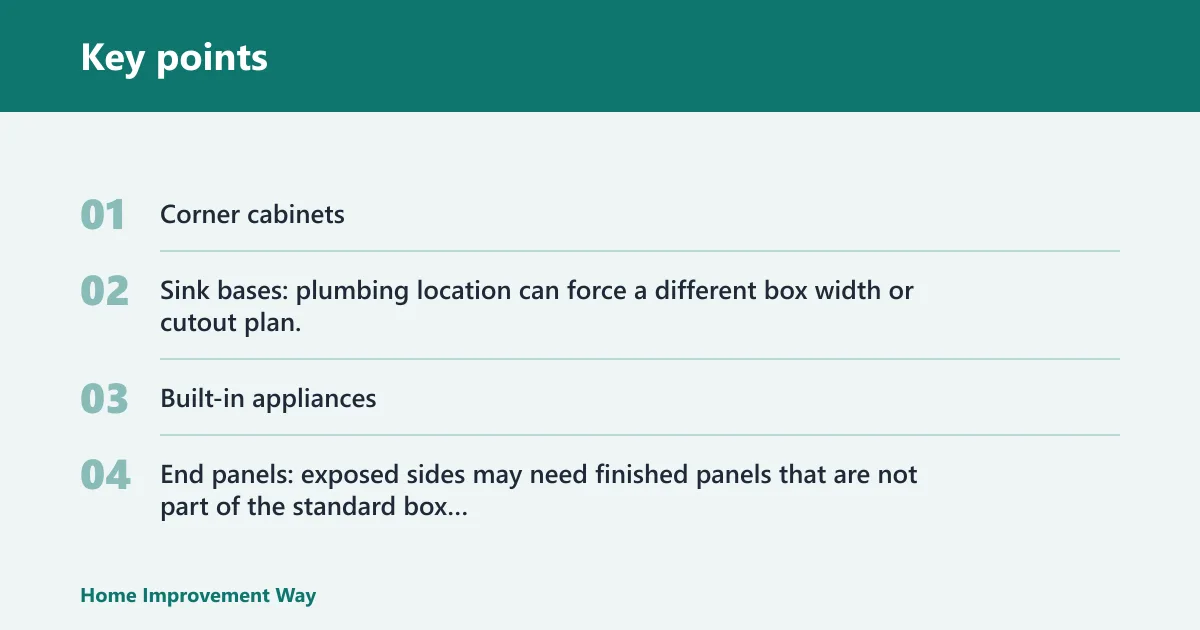
- Corner cabinets: a corner pullout or lazy-susan layout can need extra space that a standard run does not show on paper.
- Sink bases: plumbing location can force a different box width or cutout plan.
- Built-in appliances: ovens, microwaves, and dishwashers need exact opening coordination.
- End panels: exposed sides may need finished panels that are not part of the standard box count.
Suppose you are planning a 10-foot galley kitchen and the fridge wall ends with a 2-inch mismatch after the last cabinet. A fixed system can still work, but only if you budget for fillers from the start. If you do not, the last cabinet may fit on paper and fail in the room.
Are IKEA cabinets worth it if I hire an installer?
Yes, often, if the installer is comfortable with a modular system and you value standardized parts. Hiring labor does not remove the need for planning, but it can reduce the assembly burden that makes IKEA feel harder than an assembled cabinet line.
In those cases, paying for a higher cabinet tier can reduce labor friction.
When standardized parts help a pro job
Installers often move faster when cabinet widths, accessories, and mounting methods repeat across the room. That can help IKEA SEKTION on straightforward layouts where the same parts appear again and again.
When a semi-custom line helps more
If the room is irregular, a semi-custom line like KraftMaid can reduce the need for fillers and awkward transitions. That does not mean it is cheaper; it means the labor model may make more sense for a difficult kitchen.
Choose kitchen cabinets if… / Choose IKEA cabinets if…
Choose kitchen cabinets if you want a budget stock option like Hampton Bay, need more style and finish variety, or are comparing a semi-custom line such as KraftMaid for a more complex layout. Choose IKEA cabinets if you want a standardized modular system, predictable DIY planning, a 25-year warranty, and a layout that fits fixed widths without heavy custom work.
Choose kitchen cabinets if the project is a flip, a rental refresh, or a remodel where lower upfront cabinet cost and assembled delivery matter more than a single unified system. Choose IKEA cabinets if the kitchen is small, you are comfortable with assembly, or you want a repeatable parts system that is easier to plan around.
Choose kitchen cabinets if you need broader line choices and can compare the exact product line, not just the store. Choose IKEA cabinets if you want a cleaner comparison where the system is known in advance and the cabinet sizes, hardware, and warranty are easier to pin down.
Frequently asked questions
Home Depot kitchen cabinets vs IKEA cabinets: which is better?
Neither is better for every project. IKEA cabinets are usually the stronger pick for standardized planning and DIY assembly, while Home Depot cabinets can be better when you want assembled delivery, broader style options, or a semi-custom line like KraftMaid for a harder layout.
Are IKEA kitchen cabinets cheaper than Home Depot?
Sometimes on the sticker price, but not always on the full project. IKEA base units can be priced at $97 and wall units at $78, yet fillers, end panels, accessories, and assembly labor can narrow the gap. Hampton Bay may be cheaper up front on some jobs.
Which cabinets are better quality, IKEA or Home Depot?
Quality depends on the exact line. IKEA SEKTION uses melamine-coated particleboard with Blum soft-close hardware. Hampton Bay is a budget particleboard-and-laminate line, while KraftMaid uses plywood or furniture board and has a lifetime limited warranty. Compare the line, not the retailer.
How does IKEA SEKTION compare to Home Depot Hampton Bay?
SEKTION is a flat-packed modular system with fixed sizes and a 25-year warranty. Hampton Bay is a Home Depot house brand with a 5-year warranty and assembled or semi-assembled options. SEKTION is usually better for standardized DIY planning; Hampton Bay is usually easier if you want less assembly.
Are stock cabinets from Home Depot easier than IKEA to install?
Usually yes, because many stock cabinets arrive assembled or semi-assembled. That cuts assembly time, though it does not remove layout, leveling, or filler work. IKEA can still install well, but the box assembly adds labor that a stock cabinet system often avoids.
Which cabinet system is better for a small kitchen?
IKEA SEKTION often works well in small kitchens because its modular widths make planning predictable and the system includes base, wall, pantry, sink, and built-in appliance cabinets. Home Depot can still be the better choice if a specific stock or semi-custom line solves a tricky opening or corner better.
Sponsored / affiliate links. As an Amazon Associate I earn from qualifying purchases. I may earn additional commission from eligible campaigns.
 KINJOEK Paint Brush 14 Packs 1 Inch, Home Wall Trim House Chip Paintbrush Set, Professional Multi-Purpose Home Repair Tools for DIY Paint Stains Varnishes Glues Acrylics Cabinet Deck Fence Edge Door
 KINJOEK Paint Brush 24 Packs 2 Inch, Home Wall Trim House Chip Paintbrush Set, Professional Multi-Purpose Home Repair Tools for DIY Paint Stains Varnishes Glues Acrylics Cabinet Deck Fence Edge Door