Best Kitchen Cabinets for Resale Value (2026): research shows
The best kitchen cabinets for resale value are simple shaker-style painted wood or wood-look cabinets in white, soft gray, or light wood, sized to match nearby homes and priced below top-tier custom lines. Choose badly and you can spend too much, push the kitchen past neighborhood expectations, and limit buyer appeal. This guide covers the cabinet materials, door styles, colors, and upgrades that buyers notice first.
Quick comparison
| Product | Badge | Best for | Price | ||
|---|---|---|---|---|---|
 |
Kraftsman Cabinetry Hickory Shaker Wall Cabinet 1 DoorKraftsman Cabinetry | Our pick | 12×36 in · Hickory Shaker · RTA | $258.70
Price as of 14 Oct 2026
|
View |
 |
Kisart 30 inch Kitchen Base Cabinet with Soft-Close DrawerKisart | Also great | 30 in base · White Shaker · RTA | $339.99
Price as of 14 Oct 2026
|
View |
 |
Quicklock RTA (Ready-to-Assemble) | Base Kitchen Cabinets –Quicklock Cabinets | Budget pick | 36 in sink base · Raw Maple · RTA | $349.99
Price as of 14 Oct 2026
|
View |
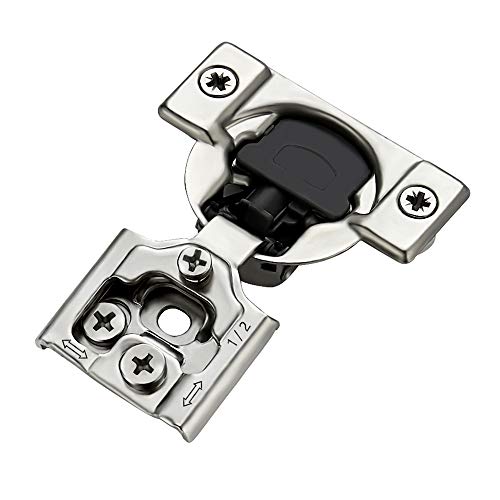 |
Soft Close Hinges for Kitchen Cabinet Hinges, 1/2 InchRavinte | Pair with it | 1/2 in overlay · 10 pack · Soft close | $19.78
Price as of 14 Oct 2026
|
View |
 |
Probrico 20 Pack|Square Cabinet Handles 5 inch HolesProbrico | Upgrade pick | 5 in centers · Brushed Nickel · 20 pack | $27.69
Price as of 14 Oct 2026
|
View |
The biggest resale trade-off is simple: clean, familiar cabinets sell more easily than custom-looking cabinets, but the cabinet box, finish, and hardware often matter more than the door profile alone. Use the table below to match the upgrade level to the home price band, then avoid spending as if the next sale price is guaranteed.
For a quick rule of thumb, white shaker works in the widest range of homes. Flat-panel and warm wood tones can also work, but only when the rest of the kitchen reads intentional and the neighborhood supports the choice.
How we chose
These picks and recommendations prioritize buyer appeal, not designer novelty. The ranking also weighs visible quality cues, such as box rigidity, door alignment, and finish wear.
Construction matters because buyers and inspectors notice damaged boxes, swollen panels, loose hinges, and poor fit faster than they notice a trendier door shape.
Finally, the advice stays tied to neighborhood price point. A cabinet upgrade can help a listing, or it can become over-improvement.
| Home price band | Best cabinet direction | Style | Color | Construction | Upgrade level | Do | Don’t |
|---|---|---|---|---|---|---|---|
| Starter homes | Low-risk refresh | Shaker | White, soft beige, light greige | Stock or semi-custom; plywood preferred if budget allows | Cosmetic replacement or hardware refresh | Replace damaged fronts, add soft-close hinges, use simple pulls | Install custom cabinetry that outprices nearby comps |
| Mid-market homes | Best resale balance | Shaker or restrained flat-panel | White, warm gray, light wood tones | Straight, rigid box with good alignment; plywood favored | Midrange replacement | Choose full-extension drawers and consistent finish quality | Mix glossy trends, ornate doors, and heavy color contrast |
| Higher-end listings | Intentional upgrade only | Flat-panel or refined shaker | Warm white, natural oak, muted stain | Framed or frameless is fine if the fit is precise | Targeted upscale replacement | Match the home’s architecture and keep the palette restrained | Buy the most expensive line just because it is available |
Shaker cabinets: best overall for resale
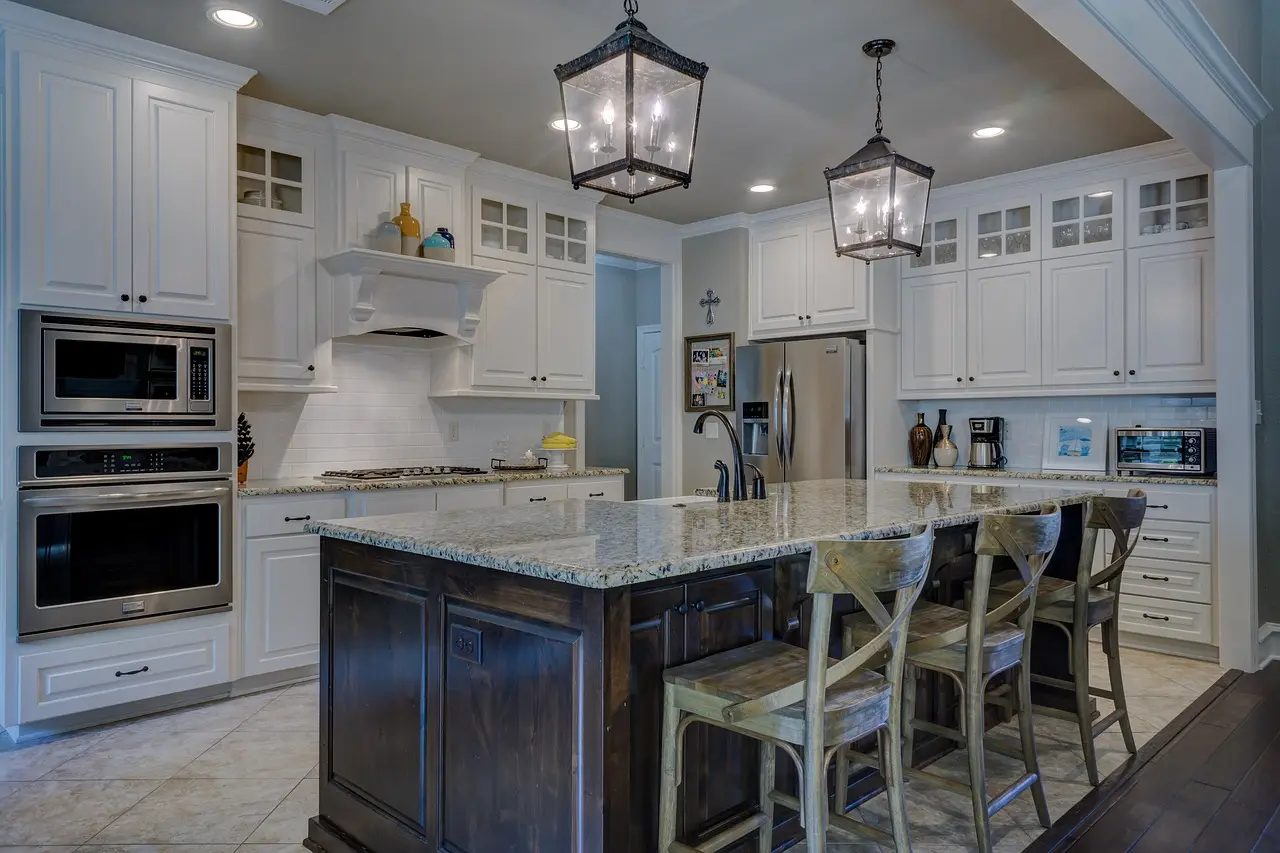
Shaker cabinets are the safest overall resale pick because the five-piece door reads familiar in many kitchens. The style feels neither overly traditional nor overly modern, which helps it fit a wider pool of buyers and reduces the chance that the kitchen feels dated next year.
Why the five-piece door appeals to more buyers
The simple frame-and-panel look gives buyers a clear signal of order and cleanliness without adding visual clutter. It also looks at home beside quartz, granite, laminate, tile, and wood floors, so the kitchen feels easier to picture in personal use.
Where shaker works best
Shaker works best in traditional and transitional kitchens, especially where the home itself does not have a strong architectural theme. In those settings, the style looks familiar and low risk.
When shaker can feel too plain
It can feel too plain in a home with very expressive millwork or a highly modern exterior. In that case, buyers may expect a flatter, cleaner cabinet face, or they may want more refined proportions and better finish quality.
White cabinets: best for bright, broad appeal
White cabinets stay one of the strongest resale colors, especially in smaller kitchens and homes that need a brighter feel. White reflects more light, helps spaces read larger, and pairs with most countertops and flooring without forcing a buyer to redo the whole room mentally.
Why white still sells well
White is easy for buyers to accept because it looks clean and neutral. It also makes wear and damage easier to spot, which can be a drawback, but that same clarity tells buyers the kitchen is not hiding much.
Best pairings with countertops and flooring
White works well with light quartz, warm wood floors, and simple backsplash tile. If the room already has a lot of visual texture, white keeps the cabinet line from feeling busy.
When white can look too stark
White can look too stark when the room lacks warmth, especially under cool lighting or with pale gray tile and chrome-heavy finishes. In that case, soft beige, greige, or light oak can read friendlier.
Best fit: starter homes, condo kitchens, and listings that need more light without a full redesign.
Flat-panel cabinets: best for modern homes
Flat-panel cabinets can support resale in modern homes when the finish quality and surrounding finishes look intentional. The minimalist front reads current, but only when the rest of the kitchen supports that language instead of fighting it.
Why the minimalist front can read current
The plain slab front creates fewer lines, which gives the kitchen a cleaner and more contemporary feel. Buyers who expect updated architecture often respond better to that simplicity than to a decorative door profile.
Which finishes make flat-panel look more expensive
Low-sheen painted finishes, well-detailed wood veneer, and precise edge treatment help flat-panel cabinets read more deliberate. Matte black or brushed metal pulls can work, but only if the rest of the room stays restrained.
When flat-panel hurts resale
Flat-panel can hurt resale in homes that look traditional, cottage-like, or builder-basic in a way that calls for a warmer front. If the style does not match the house, buyers may see the kitchen as trying too hard.
Neutral wood-tone cabinets: best for warmer listings
Neutral cabinet colors such as greige, soft beige, and light wood tones usually reduce buyer resistance better than bold colors. Current buyer preference has also shifted warmer, so a restrained wood tone can feel more current than a cold gray scheme.
Why greige, soft beige, and light wood reduce pushback
These colors soften the room without becoming a trend statement. They give buyers a neutral base while still adding warmth that white sometimes lacks.
How neutral tones compare with white
White still has the broadest appeal, but warm neutrals can feel more livable in larger kitchens and homes with lots of natural texture. Light wood tones also hide minor smudges and fingerprints better than bright white paint.
When darker wood tones feel dated
Darker wood tones can feel dated if the finish is heavily orange, red, or shiny. They often read older than they are, especially when paired with busy granite or dark flooring.
What is the best value kitchen cabinets
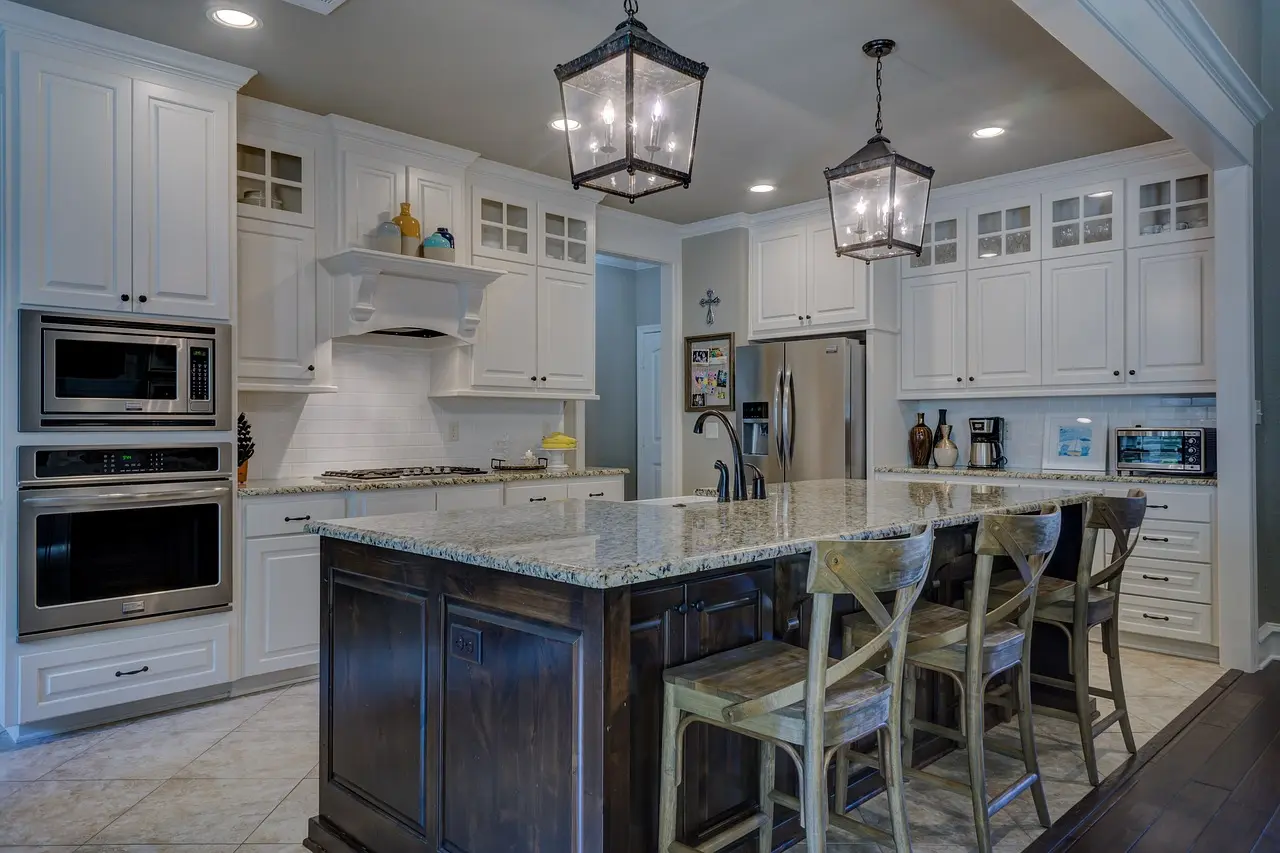
The best value kitchen cabinets are usually stock or semi-custom shaker cabinets in white or a light neutral, built with plywood boxes, solid wood face frames, and soft-close hardware. That mix gives you strong buyer appeal without paying for custom sizing that the market may not reward.
The value is not only in the sticker price. It is also in how little the cabinets force buyers to imagine changing later.
- Start with the home’s price band and nearby sales.
- Choose a familiar style, usually shaker.
- Pick a neutral finish that matches the floor and counters.
- Favor plywood over particleboard where the budget allows.
- Add soft-close hinges and full-extension drawers if the cabinets need a polish.
How much do used cabinets sell for
Used cabinets usually sell for a small fraction of replacement cost, and many sets sell only when the size, condition, and removal timing line up. A common resale range is often around 10% to 30% of what a similar new set would cost, though local demand and condition can push that lower.
Full sets with matching uppers, lowers, and a usable layout tend to do better than partial leftovers. Cabinets with damaged corners, water swelling, or nonstandard sizes lose value fast.
What affects used cabinet price most
Size, condition, finish, and how hard they are to remove all matter. Buyer interest also drops if the cabinets are visibly dated or were installed in a very specific layout.
How much are used cabinets worth
How much used cabinets are worth depends mostly on whether they can be reused as a full run, not on what they originally cost. If the boxes are sound and the finish is current, they may have salvage value; if they are worn or damaged, the practical value may be close to zero.
As a rule, cabinets with intact boxes, straight doors, and complete hardware are the only ones likely to bring meaningful money. The moment the set becomes hard to reconfigure, its worth drops.
Are old kitchen cabinets worth anything
Old kitchen cabinets are worth something only when the boxes are intact, the dimensions are useful, and the style is still acceptable to another buyer. Otherwise, the value is usually in reuse, donation, or avoiding disposal fees rather than in actual sale proceeds.
If the cabinets are structurally sound but visually dated, they may still be useful to a flipper, landlord, or budget remodeler. If they are swollen, chipped, or warped, the salvage value is limited.
Cabinet material and construction quality considerations
Cabinet material matters because plywood generally signals better moisture resistance and edge durability than MDF or particleboard. Cabinet construction also matters because framed and frameless boxes send different quality signals, and buyers notice alignment and rigidity during a walk-through.
Plywood vs MDF vs particleboard
Plywood is usually the safer resale bet because it holds up better around sinks, dishwashers, and heavy use. MDF can work for painted fronts, but it does not handle swelling as well. Particleboard is the least forgiving if moisture reaches the box.
Framed vs frameless
Framed cabinets often read familiar to more buyers because the face frame feels sturdy and helps with alignment. Frameless cabinets can look clean and modern, but they need precise construction to avoid a flimsy impression.
What buyers notice in person
They notice whether doors hang straight, whether drawers glide evenly, and whether the box flexes when opened. Those details often carry more weight than whether the cabinet door has a decorative profile.
Features that make cabinets feel higher-end
Hardware and features such as soft-close hinges and full-extension drawers can improve buyer perception without a full custom spend. These details are small, but they make daily use feel quieter and more controlled, which reads as better quality.
Pulls and knobs matter too. Simple brushed nickel or matte black hardware often looks more coordinated than decorative hardware that pulls the eye away from the cabinet itself.
Soft-close hinges and drawers
Soft-close hardware reduces slamming and suggests that the cabinets were not chosen at the cheapest possible tier. It is one of the highest-return small upgrades when the doors and boxes are still in good shape.
Pulls and knobs
Simple bar pulls suit shaker and flat-panel fronts well, while small knobs can fit more traditional kitchens. Keep the finish consistent across the room so the kitchen feels planned.
What to avoid if you want broad buyer appeal
Bold colors, highly personalized finishes, and overbuilt custom packages can narrow the buyer pool. The risk is not that these choices are always bad. The risk is that they often cost more than the market will reward.
Wear signals that erase value
Dead giveaways include dated doors, damaged boxes, worn hinges, and water-swollen panels. Once buyers see those issues, they often start mentally discounting the whole kitchen.
Trends that can age quickly
Very dark stain, loud painted colors, and glossy finishes often date faster than restrained neutrals. If you are selling soon, the safest choice is usually the quietest one that still looks finished.
Should I buy custom or stock cabinets for resale
For resale, stock or semi-custom cabinets are usually the safer choice unless the home sits in a price band that clearly supports custom work. Custom cabinets can fit better and look more tailored, but they can also overshoot neighborhood expectations and fail to return the added cost.
Buy custom only when the floor plan demands it, the home value justifies it, or the listing already sits in a segment where buyers expect that level of fit and finish.
Resale-value decision matrix
Use this matrix to match cabinet choice to the home, not to the showroom display. The right answer changes with price band, condition, and how much of the kitchen is being touched before listing.
| Scenario | Style | Color | Construction | Upgrade level | Do | Don’t |
|---|---|---|---|---|---|---|
| Starter home, cabinets are intact but dated | Shaker | White or soft beige | Stock plywood if possible | Cosmetic refresh | Paint or replace fronts, add new hardware | Spend on custom boxes |
| Starter home, boxes are damaged or swollen | Shaker | White | Budget stock replacement | Targeted replacement | Replace the failed sections and keep the layout simple | Patch water damage and hope buyers miss it |
| Mid-market home, kitchen feels builder-grade | Shaker or restrained flat-panel | White, warm gray, or light wood | Plywood box preferred | Midrange replacement | Choose full-extension drawers and soft-close hardware | Mix glossy doors with ornate pulls |
| Higher-end home, architecture is modern | Flat-panel or refined shaker | Warm white or natural oak | Precise framed or frameless construction | Upgraded replacement | Use clean lines and quality finishes | Choose the priciest custom line without a fit reason |
Starter homes: what to spend and what to skip
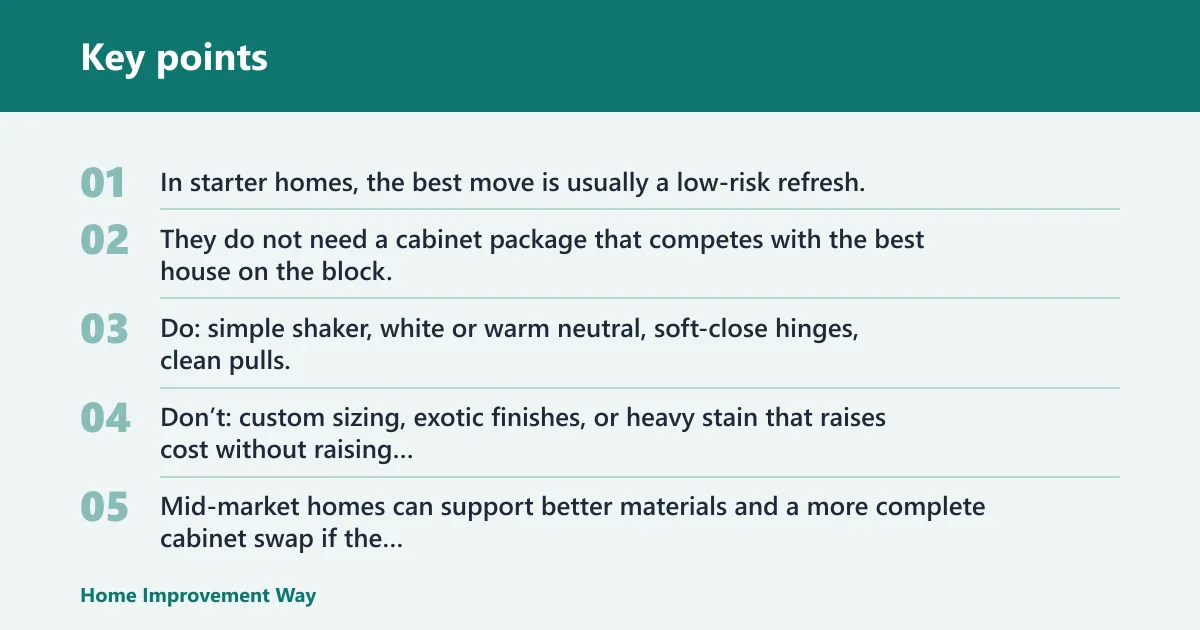
In starter homes, the best move is usually a low-risk refresh. Buyers want clean, current, and functional. They do not need a cabinet package that competes with the best house on the block.
Do: simple shaker, white or warm neutral, soft-close hinges, clean pulls.
Don’t: custom sizing, exotic finishes, or heavy stain that raises cost without raising demand.
Mid-market homes: where midrange upgrades make sense
Mid-market homes can support better materials and a more complete cabinet swap if the existing kitchen is tired. This is where plywood boxes, better hardware, and well-aligned doors can add real perception value.
Do: spend on durable box construction and calm finishes.
Don’t: overdecorate the fronts or buy a designer package that the rest of the home cannot justify.
Higher-end listings: when custom is worth it and when it is not
Custom is worth it when the kitchen layout is awkward, the architecture is specific, or the home’s comp set expects a tailored fit. It is not worth it when custom merely adds cost but the kitchen still reads generic.
Do: use custom only to solve a layout problem or match a strong design language.
Don’t: assume custom automatically increases value dollar for dollar.
Which one should you buy
If you are selling soon and want the safest choice, buy white shaker cabinets with straightforward construction and soft-close hardware. If your home is modern or architecturally specific, flat-panel in a restrained finish can work better. If the kitchen only needs a cosmetic reset, new pulls and hinges may be enough.
If the existing cabinets are damaged, swollen, or badly dated, replacement becomes more defensible. If they are solid but unfashionable, a lower-cost refresh often protects resale better than a full upscale overhaul.
For the products in this roundup, the Kisart white shaker base cabinet is the clearest fit for broad appeal, while the Kraftsman hickory shaker wall cabinet suits warmer, more transitional kitchens. Quicklock’s sink base makes sense when you need a practical replacement piece, and the Ravinte hinges or Probrico pulls are the lowest-risk updates when the boxes are still sound.
Kisart white shaker base cabinet: best for broad resale appeal
This cabinet is the closest match to the safest resale play: a white shaker base cabinet with soft-close hardware and a simple face. Based on the spec sheet and the visible cues buyers tend to reward, it fits the broadest set of kitchens because white, shaker, and practical storage all read familiar.
It is a good fit for starter and mid-market homes where the kitchen needs a clean reset without looking overdesigned. The solid wood doors and DTC soft-close components help it feel more substantial than the cheapest flat-pack options.
The drawback is that a white shaker cabinet can still read generic if the rest of the kitchen is too plain. It also depends on the surrounding finish quality, so a good cabinet cannot rescue worn counters or badly patched floors.
Kraftsman hickory shaker wall cabinet: best for warmer transitional kitchens
This wall cabinet suits buyers who respond to warmer wood tones and a more transitional look. The hickory shaker front keeps the style familiar, while the wood tone can feel more grounded than bright white in the right home.
It makes sense when the kitchen already has wood floors, natural stone, or other warm materials that support a softer palette. The plywood box and soft-close hardware are useful resale cues because they signal better durability where buyers can inspect the cabinet closely.
The main drawback is that hickory can feel too specific if the home needs a brighter, more universal presentation. It is a narrower choice than white, so it works best when the surrounding house style already supports it.
Quicklock shaker sink base cabinet: best for practical replacement work
This sink base is a strong choice when the existing cabinet below the sink is damaged and needs replacement before listing. The water-resistant UV-coated interior is useful in a spot where buyers often worry about leaks, swelling, and past neglect.
It fits a resale repair because the shaker style stays familiar and the made-in-America framing may help some buyers read it as a better-quality piece. For a kitchen that needs one visible problem fixed fast, this is the kind of cabinet that helps more than a flashy upgrade.
The drawback is that a sink base is not a full kitchen solution. By itself, it will not change the whole room’s perception if the doors around it still look tired.
Ravinte soft-close hinges: best for a low-cost resale refresh
These hinges are a smart upgrade when the cabinet boxes are sound but the doors feel cheap or noisy. Soft-close hinges are one of the easiest buyer-visible quality cues to add, and three-way adjustability helps improve door alignment, which buyers do notice.
They make sense for sellers who need a cleaner feel without replacing whole cabinets. In a kitchen with decent fronts and fair boxes, better hinges can make the room feel maintained rather than neglected.
The drawback is simple: hinges do not fix swollen panels, worn finish, or damaged box material. If the cabinets are structurally weak, hardware alone will not carry the room.
Probrico brushed nickel pulls: best for a fast hardware update
These pulls are a practical choice for a quick cosmetic update because brushed nickel is widely accepted and the square bar profile suits shaker cabinets well. Hardware is one of the cheapest ways to make a kitchen feel more finished before listing.
They work best when you want a consistent look across drawers and doors without buying into a trend that may age quickly. The stainless steel construction also helps with the everyday wear buyers can see on contact surfaces.
The drawback is that pulls can only do so much. If the cabinet finish is worn or the door style is mismatched to the house, new hardware will help, but it will not solve the bigger resale issue.
Frequently asked questions
do new cabinets increase home value
New cabinets can improve perceived value, but they do not guarantee a matching sale-price increase. The best return usually comes when the new cabinets fit the home’s price band, the finishes are neutral, and the construction looks better than what buyers expected.
best kitchen cabinet color for resale value
White is still the safest cabinet color for resale value, especially in smaller kitchens or homes that need more light. Warm neutrals such as greige, soft beige, and light wood tones are also strong choices because they reduce buyer resistance without feeling trendy.
which kitchen cabinet style adds the most resale value
Shaker cabinets usually add the most resale value because they appeal to the widest range of buyers. They look familiar in traditional and transitional kitchens, and the simple five-piece door does not lock the room into a narrow design taste.
Sponsored / affiliate links. As an Amazon Associate I earn from qualifying purchases. I may earn additional commission from eligible campaigns.