Range Hood Venting Basics: Ducted, Ductless, Convertible
Choose ducted if you can vent to the outdoors. Choose ductless if an exterior vent is not possible. Choose convertible when you want a hood that can fit either plan during a remodel. Pick the wrong mode and you can end up with lingering odors, grease buildup, more cleaning, and a hood that cannot do the job you expect. This guide compares ducted, ductless, and convertible range hood venting, then maps each option to common kitchen constraints.
What is the difference between ducted, ductless, and convertible range hoods?
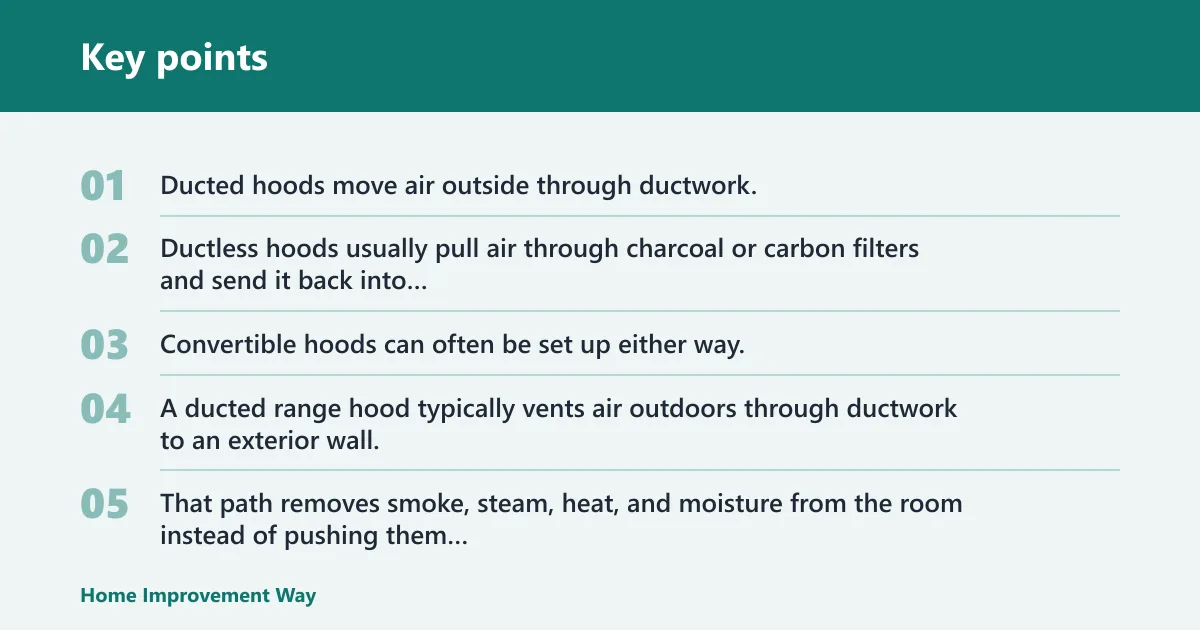


Ducted hoods move air outside through ductwork. Ductless hoods usually pull air through charcoal or carbon filters and send it back into the kitchen. Convertible hoods can often be set up either way, which usually means the hood body supports both modes and you add or remove the parts needed for ducted or recirculating operation.
Ducted hoods
A ducted range hood typically vents air outdoors through ductwork to an exterior wall, roof, or soffit termination. That path removes smoke, steam, heat, and moisture from the room instead of pushing them back inside. For heavy cooking, that is the strongest setup when the layout can support it. When a domestic cooking exhaust system is installed, the IRC requires that it terminate outdoors. [IRC M1503; IMC 505]
Ductless hoods
A ductless range hood is a recirculating system. Air passes through charcoal or carbon filters, then returns to the kitchen. That helps reduce odors and grease, but it does not remove humidity from the room. If you cook often with boiling water, searing, or long simmering, that moisture stays in the space. [ASHRAE 62.2; manufacturer installation guides]
Convertible hoods
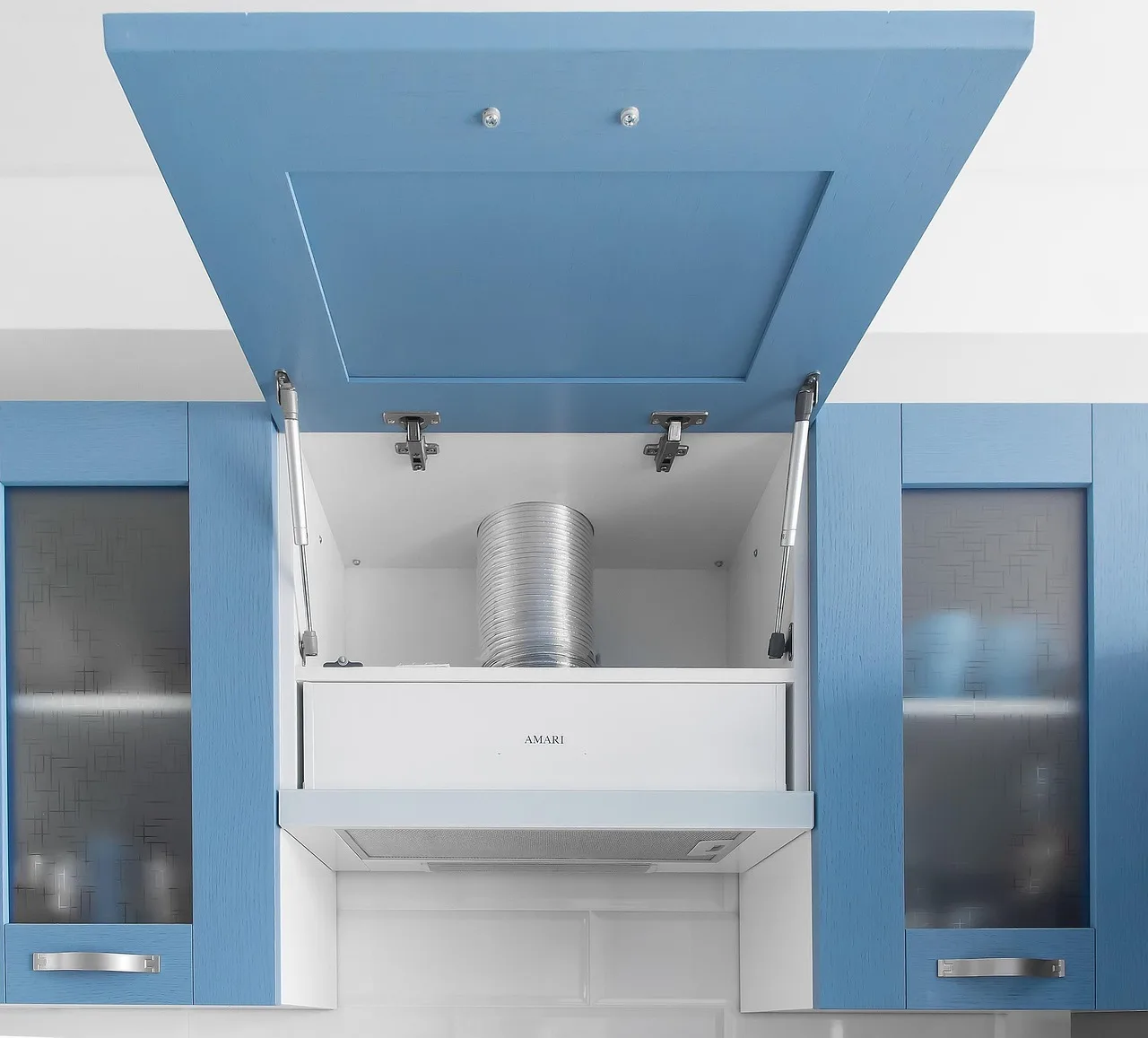
A convertible range hood can switch between ducted and ductless modes. In practice, conversion often means adding a charcoal filter kit for recirculating use, changing the vent cover or top outlet configuration, and changing the internal airflow path so the hood either exhausts outdoors or recirculates air indoors.
That physical difference matters. A convertible hood is not only a marketing label. If the hood is installed in ductless mode, it still depends on filters, and the airflow path changes to support recirculation rather than exterior exhaust.
Which venting option fits your kitchen?
Use ducted when you can route air outside through a short, code-compliant path. Use ductless when exterior venting is blocked by an apartment, condo rules, structural limits, or a remodel that cannot open a path to the exterior. Use convertible when your layout may change later or when you want one hood body to cover two installation paths.
Match the option to the home type
Apartment and condo kitchens often default to ductless because exterior venting is restricted or impossible. Older homes can go either way, but hidden framing, plaster, brick, or finished ceilings may make a duct run hard to add. Remodels are where convertible hoods make the most sense, especially if the final vent path is not settled yet.
Say your condo kitchen has a 30-inch wall-mount hood location but no legal path through a shared exterior wall. A ductless setup may be the only practical choice, even if it needs more filter maintenance and leaves more humidity in the room after cooking pasta or simmering soup.
Venting decision table
Use this matrix to compare kitchen constraints before you buy or install a hood. The columns show how each mode behaves in the real world, not just on a product page.
| Layout constraint | Performance level | Install difficulty | Maintenance burden | Best-use scenario |
|---|---|---|---|---|
| Ducted setup with exterior wall, roof, or soffit access | Highest smoke, steam, heat, and moisture removal | Moderate to high, depending on the run | Low once the duct and cap are sealed | Heavy cooking, remodels with open access, kitchens that need moisture control |
| Ductless setup where exterior venting is blocked | Moderate odor reduction, no humidity removal | Low to moderate | Higher because charcoal filters need replacement | Apartments, condos, finished spaces, short-term compromise installs |
| Convertible hood in a kitchen that may change later | High in ducted mode, moderate in ductless mode | Moderate, because the hood can adapt | Low in ducted mode, higher in ductless mode | Renovations, under-cabinet replacements, wall-mount or insert installs with uncertain routing |
How to score your kitchen before you choose
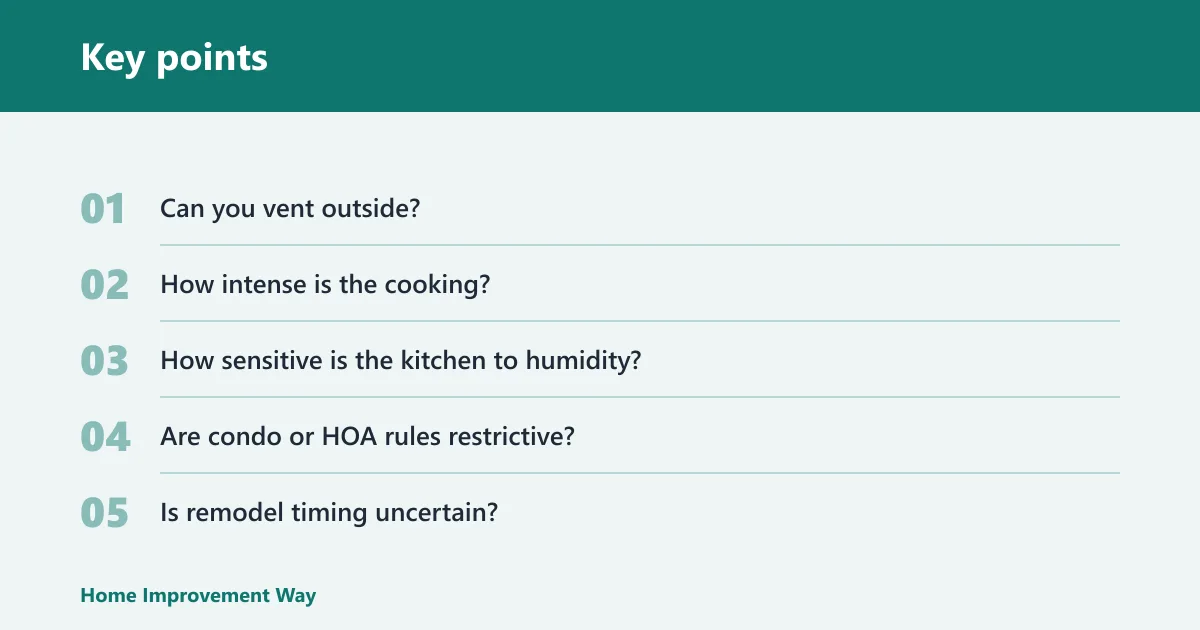
Score each item from 0 to 2. Add the points, then choose the venting mode that best matches the total and the first non-negotiable constraint. If exterior venting is allowed and the score is high, ducted usually wins. If exterior venting is blocked, ductless is the fallback. Convertible is the best hedge when the remodel timing is uncertain.
- Can you vent outside? 2 = yes, short path; 1 = yes, but the run is long or awkward; 0 = no legal or physical path.
- How intense is the cooking? 2 = frequent searing, frying, wok cooking, or high-BTU burners; 1 = mixed use; 0 = light cooking only.
- How sensitive is the kitchen to humidity? 2 = condensation, mold risk, or window sweating matters; 1 = moderate concern; 0 = humidity is not a major issue.
- Are condo or HOA rules restrictive? 2 = no restrictions; 1 = some restrictions or permit review; 0 = exterior changes are blocked.
- Is remodel timing uncertain? 2 = final layout is fixed; 1 = partial remodel; 0 = future changes are likely.
Recommended mode: 7-10 points = ducted; 4-6 points = convertible if future venting is possible, otherwise ductless; 0-3 points = ductless.
How to read the matrix
The performance column matters most. Ducted gives the best cleanup of smoke and moisture because it moves the air outdoors. Ductless gives you the most installation freedom, but it gives up humidity removal. Convertible sits in the middle because its performance depends on which mode you actually use.
The install difficulty column also needs context. A short, straight duct run through an exterior wall can be easier than a recirculating setup if the hood is already designed for it. A long path with several bends is another story. Ductless is often easier because it avoids exterior work, but it still needs correct internal setup and filter access.
Does ducted venting always perform better?
Ducted venting usually performs better because it moves contaminated air outdoors instead of filtering and returning it to the room. That means less odor linger, less steam left in the kitchen, and less heat buildup near the cooktop. Still, real performance depends on duct length, number of bends, duct diameter, and installation quality.
Why duct design changes real performance
Rigid ductwork generally offers lower air resistance than flexible ducting, so it is preferred when performance matters. Flexible ducting can help you work around obstacles, but it typically creates more airflow resistance. More resistance can reduce actual capture and exhaust, especially if the run is long or includes several turns. The IMC also favors smooth, unobstructed exhaust paths and requires that ducts not reduce the exhaust capacity of the hood. [IMC 505.1, 505.2]
For many residential hoods, 6-inch diameter ductwork is the standard starting point. That size is commonly used because many manufacturers specify 6-inch ducts for midrange residential hoods, while larger or higher-CFM hoods may require 7-inch or 8-inch ducting per the installation instructions. Joints should be sealed so air does not leak into cabinets, ceilings, or wall cavities. A well-planned duct path with few bends can outperform a poorly routed system with a stronger fan. [Manufacturer installation manuals; IMC 505]
Exterior terminations matter
An exterior vent cap with a damper is commonly used as part of a ducted setup and can help reduce backdrafts and pest entry. It helps prevent backdrafts and keeps pests from entering through the opening. Wall, roof, and soffit exits all need a proper termination, and each one can bring its own framing and weatherproofing limits. The duct outlet should terminate outdoors, be protected against weather, and not discharge into attics, crawl spaces, or wall cavities. [IRC M1503.3; IMC 505]
Suppose a kitchen has a powerful hood but the duct has two tight bends and a long roof run. In that case, the hood may still remove air outdoors, but the real-world result can be weaker than expected. The fan rating alone does not decide the outcome.
Can a convertible hood work without exterior ducting?
Yes, a convertible hood can work without exterior ducting if it is configured for ductless mode. In that setup, the hood uses a charcoal or carbon filter kit, recirculates the air back into the kitchen, and gives up direct humidity removal. That makes it workable, but not equal to ducted exhaust.
What changes in ductless mode
When a hood is converted, the airflow path changes so air is filtered and sent back into the room. The charcoal filter is the key part. It captures odors and some grease, but it cannot remove water vapor. That means you may still see condensation on cabinets or windows after moist cooking.
Competitors often stop at saying a convertible hood can do both. The important part is what changes inside the hood. The filter kit is added, the vent outlet is redirected or covered, and the hood starts recirculating instead of exhausting outdoors.
When ductless mode is the wrong compromise
Ductless mode is a poor choice when the kitchen regularly produces heavy steam or persistent smoke. It is also weak when the room already has limited ventilation, because odors can linger longer and grease can collect faster on nearby surfaces. If humidity control matters, ductless is the wrong end state, not just a temporary shortcut.
What should you check before choosing or installing one?
Check the route first. If you can run a duct to an exterior wall, roof, or soffit, ducted usually deserves first consideration. If that path is blocked, confirm whether a convertible hood can be installed in ductless mode instead. Also check local building codes, permit rules, and any IRC-related exterior venting requirements before you cut into walls or ceilings.
Installation checks that change the decision
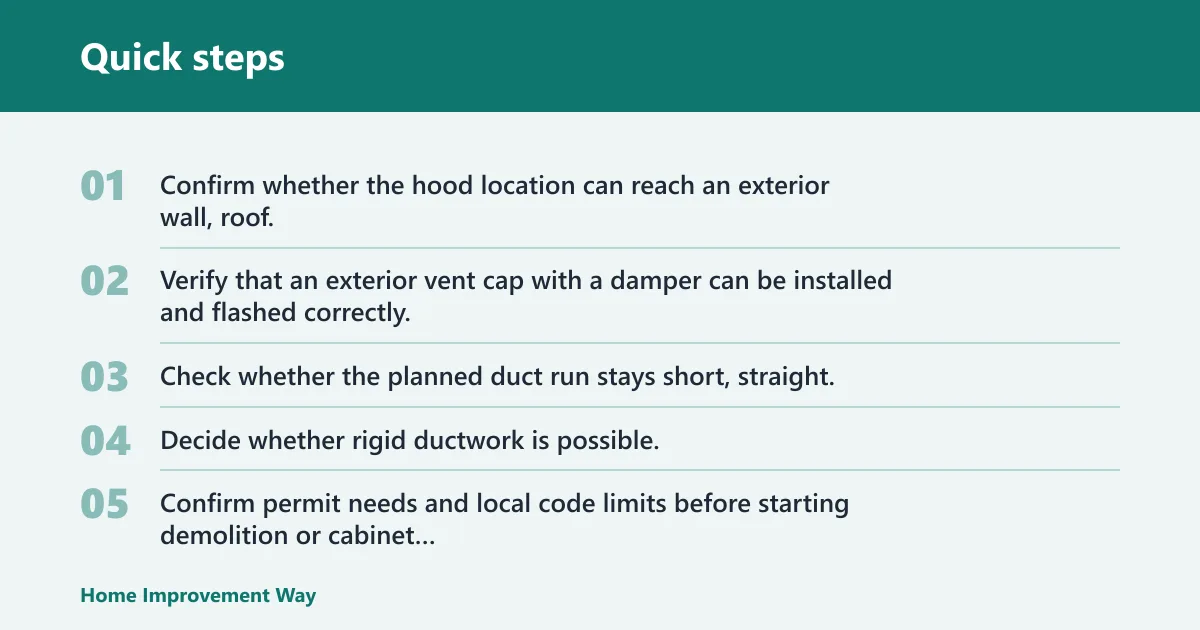
- Confirm whether the hood location can reach an exterior wall, roof, or soffit without violating framing or fire clearance rules.
- Verify that an exterior vent cap with a damper can be installed and flashed correctly.
- Check whether the planned duct run stays short, straight, and close to the recommended about 6-inch diameter where the hood allows it.
- Decide whether rigid ductwork is possible, or whether flexible ducting is the only practical route around obstacles.
- Confirm permit needs and local code limits before starting demolition or cabinet modification.
When flexible ducting is a tradeoff
Flexible ducting is useful when framing, beams, or finished surfaces block a straight path. It is not the first choice for performance. If you can fit rigid ductwork with sealed joints, that is usually the cleaner solution. Flexible material should be treated as a compromise for access, not a default plan.
A common first-timer mistake is buying a hood before checking the roof path. A 36-inch hood may fit the cabinet opening, but the vent may still fail the layout test because a joist, plumbing stack, or soffit detail blocks the route outdoors.
Source-backed product comparison
Instead of leaning on brand examples, compare hoods by the details that installation manuals and specification sheets actually verify: venting mode, duct size, airflow rating, and filter requirements. A 230 CFM under-cabinet unit may suit light cooking, while higher-CFM wall-mount hoods are better for more intense use if the duct path and makeup-air plan can support them. Always match the hood to the installation instructions, not just the headline CFM. For related setup help, see range hood filter maintenance.
- Best for short, code-friendly exterior runs: ducted hoods with rigid ductwork and a listed exterior cap.
- Best for no-vent situations: ductless hoods with manufacturer-approved charcoal filters and a clear replacement schedule.
- Best for uncertain remodels: convertible hoods that can be installed ducted now and recirculating later if needed.
- Best for heavier cooking: the highest-capacity hood that your duct size, termination, and makeup-air plan can support.
Frequently asked questions
Which range hood venting option is best for my kitchen layout?
Use ducted if you have a practical path to an exterior wall, roof, or soffit. Use ductless if that path is blocked by building structure or rules. Use convertible if the kitchen may be remodeled later or if you want one hood that can adapt when the venting plan changes.
Can a convertible range hood be used without exterior ducting?
Yes. In ductless mode, a convertible hood uses charcoal or carbon filters and sends air back into the kitchen. That setup is workable where exterior venting is not possible, but it does not remove humidity. You still need to replace the filters on schedule.
How often do ductless range hood filters need replacement?
Replacement depends on cooking frequency, grease load, and the filter type, but ductless mode always creates a maintenance obligation. Manufacturer guidance commonly ranges from every 3 to 6 months for charcoal filters, with heavy cooking kitchens needing more frequent changes. Always follow the hood’s manual because intervals vary by model and use. [Manufacturer installation guides]
Does ducted venting always perform better than recirculating venting?
Usually yes, because ducted venting removes smoke, steam, heat, and moisture outdoors. But the actual result also depends on duct length, the number of bends, duct diameter, and sealing quality. A poorly installed ducted system can underperform a simpler, well-built run.
What venting option is easiest to install if I cannot run ductwork outside?
Ductless is usually the easiest choice when exterior ducting is not possible. It avoids wall, roof, or soffit work and can fit apartments, condos, and finished homes more easily. The tradeoff is recurring filter replacement and weaker moisture control than a ducted setup.
Are convertible range hoods good for apartments or renovations?
They can be a smart fit when the vent path is uncertain or may change later. In apartments, they may still run in ductless mode if exterior venting is blocked. In renovations, they let you install the hood now and decide later whether to exhaust outdoors.
Sources
- International Residential Code (IRC), Section M1503, domestic kitchen exhaust requirements.
- International Mechanical Code (IMC), Section 505, domestic kitchen exhaust systems.
- International Mechanical Code (IMC), Section 506, exhaust outlet and termination requirements.
- ASHRAE Standard 62.2, ventilation and indoor air quality guidance for residences.
- Range hood manufacturer installation manuals for duct diameter, venting mode, and charcoal filter replacement intervals.
Sponsored / affiliate links. As an Amazon Associate I earn from qualifying purchases. I may earn additional commission from eligible campaigns.