AFCI vs. GFCI Outlets: What Each Protects Against
AFCI outlets or breakers protect against arcing faults that can start electrical fires; GFCI outlets protect against shock from ground faults, and some locations need both. Choose the wrong device, and you leave a circuit open to fire, shock, or a failed code check. This guide explains which hazard each device covers, where each belongs, and when a room or circuit needs AFCI, GFCI, or a dual-function device.
This guide is part of our Electrical outlets guide series.
AFCI vs. GFCI: what hazard are you trying to stop?
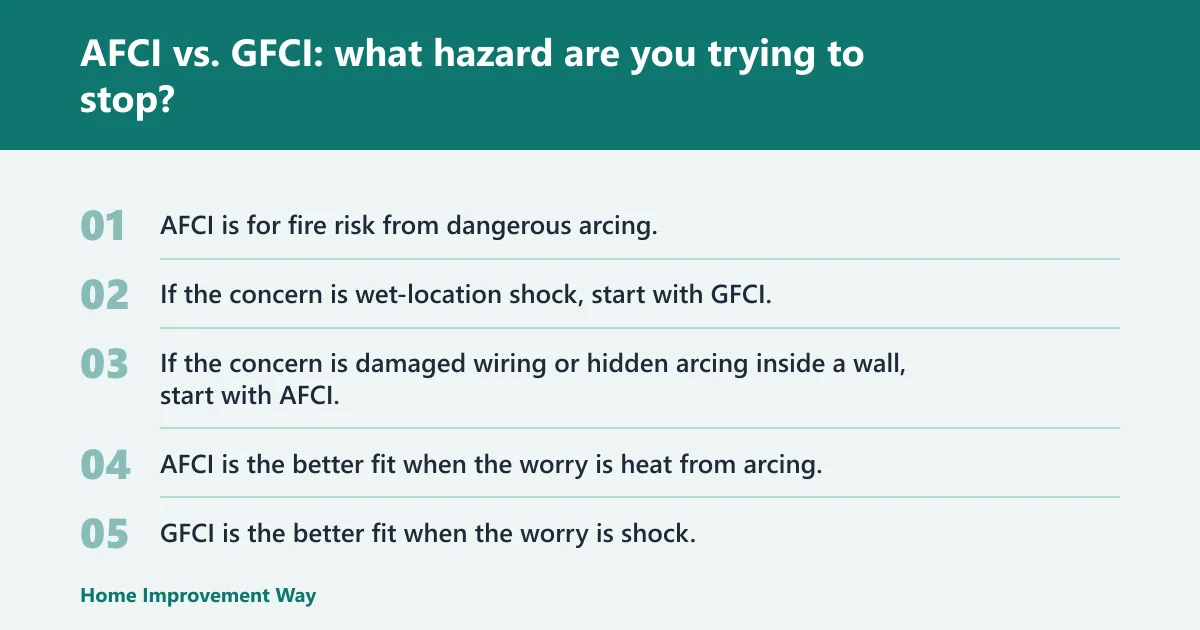


The choice comes down to the hazard. AFCI is for fire risk from dangerous arcing, while GFCI is for shock risk from current leaking to ground or through a person. If the concern is wet-location shock, start with GFCI. If the concern is damaged wiring or hidden arcing inside a wall, start with AFCI.
| Decision factor | AFCI | GFCI outlets: what each one protects against | Winner |
|---|---|---|---|
| Main hazard addressed | Electrical fire from arc fault | Electric shock from ground fault | Tie |
| Best fit location | Bedrooms, living rooms, hallways, closets, family rooms | Bathrooms, kitchens, garages, outdoors, basements, crawl spaces, laundry areas | Tie |
| Typical form factor | Usually breaker form factor | Receptacle or breaker form factor | GFCI outlets: what each one protects against |
| Retrofit flexibility | Often easiest at the panel | Can be added at the outlet or panel | GFCI outlets: what each one protects against |
| Downstream protection | Depends on breaker or wiring layout | Load terminals can protect downstream outlets | GFCI outlets: what each one protects against |
Main hazard addressed
AFCI is the better fit when the worry is heat from arcing, especially from damaged or degraded wiring. GFCI is the better fit when the worry is shock, because it trips when current leaves the intended path. They solve different failure modes.
Best fit location
The room often points to the hazard. Dry living spaces lean toward AFCI because hidden wiring damage is the larger concern, while wet or damp utility spaces lean toward GFCI because contact with grounded surfaces or water raises shock risk. Some rooms fall into both groups.
Typical form factor
GFCI protection is flexible, since it can be a receptacle or a breaker. AFCI is often handled at the breaker, which can make it a practical retrofit when you want coverage for an entire circuit.
Retrofit flexibility
If you are updating a single outlet near a sink or garage door, a GFCI receptacle is often the quickest path. If the goal is to protect an entire branch circuit from arc-fault risk, an AFCI breaker is often more practical than swapping several devices.
Downstream protection
A GFCI receptacle can protect outlets fed from its load terminals, which can matter when one device is expected to cover more than one receptacle. That downstream effect depends on correct line and load wiring.
📊 GFCI trips when there is a 4 to 6 milliamps imbalance between hot and neutral. Source: Familyhandyman.
How GFCI protection works
GFCI means ground-fault circuit interrupter. It protects against shock by watching for a mismatch between hot and neutral, and it trips when that imbalance is 4 to 6 milliamps. That is the signal that current may be leaking to ground, through a tool, or through a person.
What a ground fault is
A ground fault happens when the hot conductor touches a grounded surface or a person, or when a fault lets current escape the intended circuit path. That leakage can energize metal parts on an appliance and create a shock hazard. GFCI devices are built to catch that condition fast.
Receptacle vs. breaker form factor
GFCI protection can live at the receptacle or in the panel as a breaker. Receptacles are common where a single outlet or small group of outlets needs protection, while breakers are useful when one trip point should cover an entire circuit. GFCI receptacles also have Test and Reset buttons.
How AFCI protection works
AFCI means arc-fault circuit interrupter. It is intended to sense dangerous electrical arcing patterns that can form when wiring is damaged, loose, or degraded. Those arcs can reach very high temperatures and ignite nearby material long before a standard breaker sees an overload.
What arc faults look like inside wiring
Arc faults are not normal sparking at a switch. They are irregular electrical discharges caused by a compromised conductor, a loose termination, or damaged cord insulation. AFCI devices look for those signatures because they can signal a fire risk hidden inside the circuit.
Why AFCI is often installed at the breaker
An AFCI breaker can protect the full branch circuit from the panel outward, which is useful when the concern is wiring inside walls or above ceilings. That is one reason AFCI is commonly found as a breaker rather than a receptacle.
Which rooms usually need GFCI, AFCI, or both?
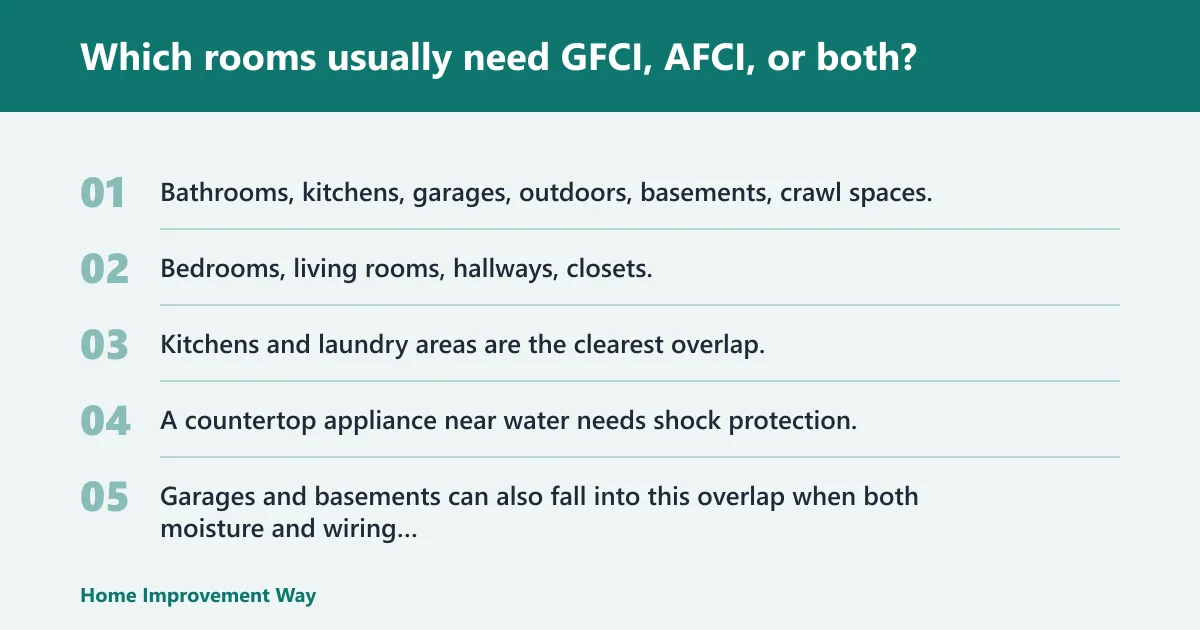
Bathrooms, kitchens, garages, outdoors, basements, crawl spaces, and laundry areas often point first to GFCI because the main concern is shock from moisture, grounded surfaces, or portable appliances. Bedrooms, living rooms, hallways, closets, and family rooms usually point first to AFCI because hidden wiring faults are the bigger fire concern. Mixed-risk rooms often need both.
Mixed-risk rooms
Kitchens and laundry areas are the clearest overlap. A countertop appliance near water needs shock protection, but the branch circuit may also fall under arc-fault requirements depending on the wiring and local code rules. Garages and basements can also fall into this overlap when both moisture and wiring damage are realistic failure cases.
Common first-timer mistake
A common first-timer mistake is buying the device based on the room label alone. The better question is: what hazard are you trying to stop in that exact circuit? A sump pump outlet, a bedroom lamp circuit, and a garage refrigerator outlet can call for different protection even in the same house.
Scenario examples
Say your kitchen has a countertop receptacle near the sink and a toaster starts tripping the circuit. If the trip happens because current is leaking through moisture or a damaged cord, GFCI is the relevant protection. If the problem is hidden damage in the circuit, AFCI may be the bigger issue.
Suppose your basement laundry area feeds a washer, freezer, and a utility sink on nearby outlets. That space has both shock and fire concerns, so a dual-function approach may be the cleaner solution than trying to guess which hazard matters most.
Room-and-hazard decision table
| Common location | Likely hazard | Best protection type | Fastest homeowner check before calling an electrician |
|---|---|---|---|
| Bathroom | Shock from water and grounded surfaces | GFCI | Look for a Test/Reset device at the outlet or panel |
| Kitchen near sink | Shock and possible mixed-risk circuit | GFCI, sometimes both | Check whether the circuit already feeds a GFCI and whether other outlets go dead when it trips |
| Garage | Shock from damp floors, tools, and outdoor-adjacent use | GFCI | Confirm whether the receptacle has Test/Reset buttons |
| Outdoors | Shock from weather exposure | GFCI | Check the outdoor receptacle and any upstream indoor GFCI |
| Basement or crawl space | Shock plus possible hidden wiring issues | GFCI or both | Identify whether the circuit also serves living-space receptacles |
| Laundry area | Shock from appliances and mixed circuit use | GFCI, sometimes both | Look for repeated trips when motor loads start |
| Bedroom | Arc fault from hidden wiring damage | AFCI | Check the breaker panel for AFCI labeling |
| Living room or family room | Arc fault from aging cords, loose terminations, or concealed wiring damage | AFCI | See whether the circuit is already AFCI-protected at the breaker |
| Hallway or closet | Arc fault on a general lighting circuit | AFCI | Inspect the panel for a breaker with a test button |
Can one outlet provide both AFCI and GFCI protection?
Yes. A dual-function device can provide both arc-fault and ground-fault protection on the same circuit. That can make sense when a location has both shock and fire concerns, or when a code-compliant retrofit is easier with one device than with separate panel and receptacle changes.
Breaker-first vs. receptacle-first retrofit choices
If the goal is whole-circuit coverage, a breaker-first approach is usually simpler. If the issue is a single wet-location outlet, a receptacle-first approach may be faster and less disruptive. The right choice depends on how much of the circuit must be protected and whether the panel has space for the right breaker.
When downstream outlets change the decision
GFCI receptacles can protect downstream outlets through the load terminals, which matters if one device must cover several receptacles after it. AFCI protection does not use that same outlet-to-outlet load path in the same way, so a breaker can be the cleaner answer when the whole branch circuit needs arc-fault coverage.
How to test GFCI and AFCI devices
GFCI devices should be tested monthly. Use the Test button to trip the device, then use Reset to restore power. AFCI devices also include a test function on many models, and a repeated trip means you need to look for the underlying circuit problem instead of just resetting it.
Step-by-step test checklist
- Plug in or identify the circuit you want to check.
- Press Test on the GFCI receptacle or breaker.
- Confirm that power drops to the protected outlet or circuit.
- Press Reset to restore power.
- For a GFCI receptacle, use a GFCI receptacle tester when you want to verify wiring and trip behavior.
- If the device trips again right away, stop and inspect the connected loads and wiring path.
When to use a GFCI receptacle tester
A GFCI receptacle tester is useful when you want to verify that a receptacle trips and resets as intended. It can be especially helpful after a replacement or when you want to check a downstream outlet that is supposed to be protected. Be aware that it may not work on ungrounded circuits.
What repeated trips suggest
Repeated GFCI trips often point to leakage, moisture, a damaged cord, or a bad appliance on that circuit. Repeated AFCI trips can point to loose connections, damaged cable, a failing device, or another arcing condition. If the same breaker or receptacle keeps tripping, the circuit needs more than a reset.
Choose GFCI if shock risk is the main concern / choose AFCI if fire risk is the main concern
Choose GFCI if the outlet is in a wet or damp location, near a sink, on a garage or outdoor circuit, or serving appliances where shock is the biggest threat. Choose AFCI if the circuit feeds bedrooms, living spaces, hallways, closets, or other general-use areas where hidden wiring damage is the larger worry. Choose both when the circuit has mixed exposure or local code calls for dual protection.
Choose GFCI if…
Choose GFCI if the receptacle is in a bathroom, kitchen, garage, outdoors, basement, crawl space, or laundry area. Choose it if the main failure scenario is current leaking to ground through water, a metal case, or a person. Choose it if you need receptacle-level protection and downstream outlets may also need coverage.
Choose AFCI if…
Choose AFCI if the circuit is feeding bedrooms, living rooms, hallways, closets, or family rooms. Choose it if the main concern is a damaged conductor, loose splice, or hidden wiring damage that could arc and heat up. Choose it if a breaker-level retrofit is the cleanest way to cover the whole branch circuit.
Choose both if…
Choose both if the room has water exposure and also carries a circuit that local code treats as needing arc-fault protection. Choose both for mixed-risk circuits serving kitchens, laundry areas, basements, or garages when the protection needs are not covered by one device alone. A dual-function breaker or a layered breaker-and-receptacle setup can solve that.
Where code usually requires AFCI and GFCI protection
NEC guidance is location-based, and local code authorities may vary. New construction and certain circuit changes often trigger the current rules, while retrofit work can be handled differently depending on the jurisdiction. That is why room type matters, but local inspection rules still decide the final answer.
What code guidance usually looks like
GFCI protection is commonly used in bathrooms, kitchens, sinks within 6 feet, and outdoors, and it is also used in basements, crawl spaces, garages, and laundry areas. AFCI protection is commonly required in bedrooms, living rooms, hallways, closets, and family rooms. A licensed electrician can tell you whether a repair, replacement, or panel change brings the circuit under a newer requirement.
When to stop and call a licensed electrician
Call an electrician if you have repeated trips, if a GFCI receptacle is wired with unknown line and load conductors, if the panel needs an AFCI breaker swap, or if the circuit may need both protections. Also call if a GFCI receptacle must be installed in a readily accessible location and the box location makes that difficult.
What is the difference between AFCI and GFCI outlets?
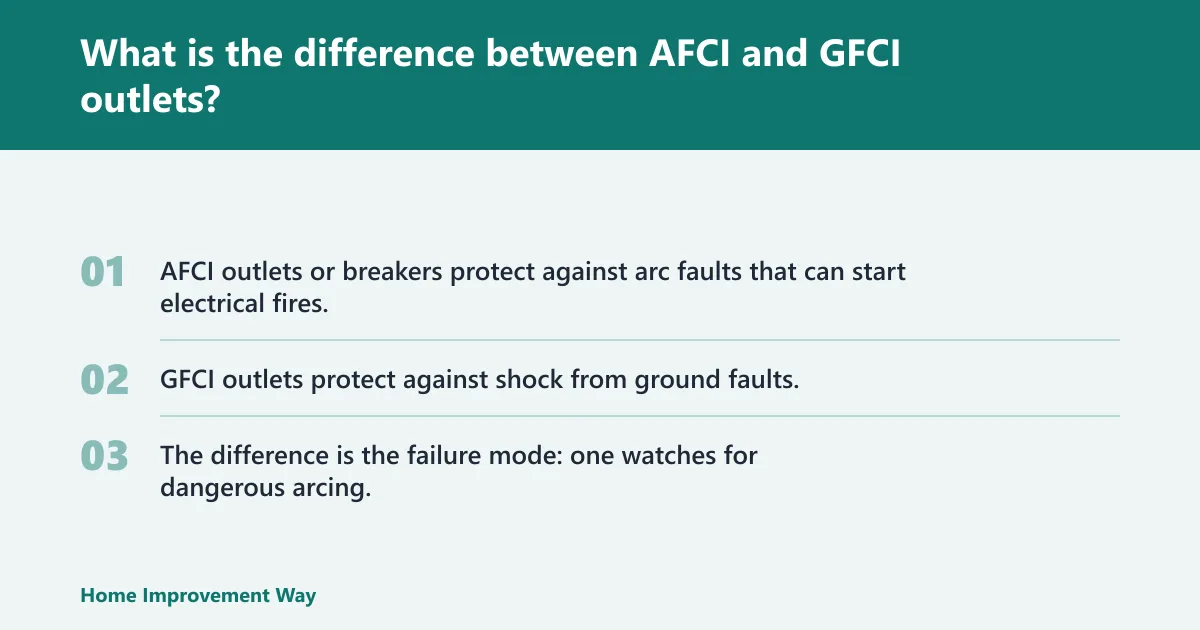
AFCI outlets or breakers protect against arc faults that can start electrical fires. GFCI outlets protect against shock from ground faults. The difference is the failure mode: one watches for dangerous arcing, the other watches for current leaking off the intended path.
Which one protects against electric shock?
GFCI protects against electric shock. It trips when the current leaving on the hot wire does not match the current returning on the neutral, which usually means some current is taking an unsafe path. That is why GFCI belongs in wet or damp locations.
Which one protects against electrical fires?
AFCI protects against electrical fires. It is intended to sense dangerous arcing signatures that can occur in damaged wiring, loose connections, or compromised cords. Those arcs can heat nearby material enough to start a fire before standard overcurrent protection reacts.
Do I need AFCI or GFCI in kitchens and bathrooms?
Bathrooms generally call for GFCI because the main hazard is shock from moisture and grounded surfaces. Kitchens often need GFCI near sinks and countertop receptacles, and some kitchen circuits may also call for AFCI depending on the wiring and local code. Bathrooms are usually shock-first; kitchens can be both.
Can one receptacle provide both AFCI and GFCI protection?
Yes. A dual-function device can provide both protections on one circuit, which is useful in mixed-risk areas or when a retrofit needs a single point of protection. The key is matching the device to the circuit layout, because downstream outlets and the panel location can change the best choice.
How do I test an AFCI or GFCI outlet?
Use the Test and Reset buttons on the device, then confirm that power drops and returns correctly. GFCI devices should be tested monthly. If you want to confirm wiring or downstream coverage, a GFCI receptacle tester can help, but it may not work on ungrounded circuits.
Do GFCI outlets need a ground wire to work?
No. GFCI protection can be installed on older ungrounded circuits and still protect against shock. The device does not rely on the ground wire to sense an imbalance between hot and neutral. That said, grounding is still important where required for equipment and code compliance.
Why does a GFCI keep tripping?
A GFCI that keeps tripping usually sees leakage, moisture, a damaged cord, or a faulty appliance on the circuit. It can also trip if the device is miswired on the line and load terminals. If reset does not hold, the circuit needs troubleshooting rather than repeated resets.
Where are AFCI and GFCI devices required by code?
Code requirements are location-based, and local authorities may vary. GFCI is commonly used in bathrooms, kitchens, garages, outdoors, basements, crawl spaces, and laundry areas. AFCI is commonly required in bedrooms, living rooms, hallways, closets, and family rooms, especially in new construction or certain circuit upgrades.
Should I use a breaker or receptacle for AFCI/GFCI protection?
Use a breaker when you want whole-circuit protection and the panel work is practical. Use a receptacle when the protection goal is centered on one location, especially for GFCI near a sink or other wet area. GFCI can be either receptacle or breaker; AFCI is often the breaker choice.
Sponsored / affiliate links. As an Amazon Associate I earn from qualifying purchases. I may earn additional commission from eligible campaigns.