5 Best Outlets for Garage Workshops (2026): We Compared
For most garage workshops, install 20-amp GFCI-protected 120-volt outlets on at least two circuits, plus a 240-volt circuit for large stationary tools; place a dedicated charging station near those outlets. Too few circuits or poor outlet placement leads to tripped breakers, slow charging, and extension-cord clutter. This guide compares outlet types, breaker sizes, circuit layouts, and charger placement for a practical garage setup.
Best garage outlets for workshops: Receptacles, GFCI protection, and charging layouts
Experience

This guide is written for garage setups that actually need clean outlet planning: a workbench with chargers, a compressor corner, a freezer-adjacent wall, and a wet-prone bay near a slab floor. The layout advice prioritizes the practical details that matter in real garages, including wide outlet spacing, shallow-device fit in standard boxes, tamper-resistant shutters, and when a 20-amp receptacle is appropriate only on a true 20-amp branch circuit. It also treats enclosed charging storage differently from open bench power, which is important when a garage includes a closed appliance garage or cabinet-style charging zone.
For most garage workshops, start with grounded receptacles on the right circuit, add GFCI protection where the garage or local code requires it, and only move to 20-amp receptacles when the branch circuit is built for 20 amps with matching wiring and overcurrent protection. Too few circuits or poor outlet placement leads to tripped breakers, slow charging, and cord clutter.
Quick comparison
| Product | Badge | Best for | Price | ||
|---|---|---|---|---|---|
 |
Leviton 15 Amp, 125 Volt, Duplex Receptacle, ResidentialLeviton | Our pick | 10-pack · 15A · duplex receptacles | $5.60
Price as of 28 Oct 2026
|
View |
 |
ELECTECK 10 Pack 20A GFCI Outlets, TR Self-Test GFIELECTECK | Also great | 10-pack · 20A · GFCI outlets | $63.99
Price as of 28 Oct 2026
|
View |
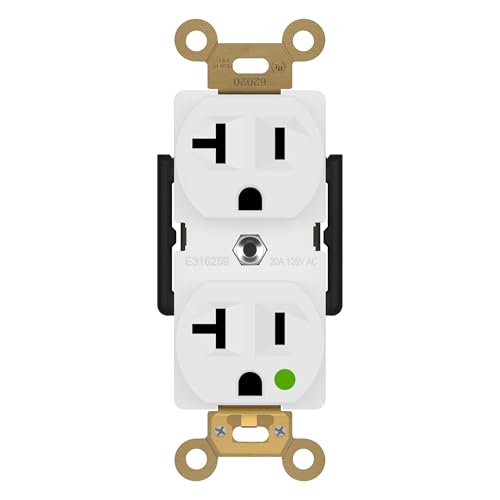 |
ENERLITES Hospital Grade Outlet, Industrial Grade DuplexENERLITES | Upgrade pick | Single · 20A · hospital-grade duplex receptacle | $12.99
Price as of 28 Oct 2026
|
View |
 |
Leviton Slim GFCI Weather & Tamper-Resistant Outlet, 20 Amp, GFWT2-GY, GreyLeviton | Also great | Single · 20A · weather- and tamper-resistant GFCI | $21.00
Price as of 28 Oct 2026
|
View |
 |
TOPGREENER USB Wall Outlet, 4.2A USB Receptacle with TypeTOPGREENER | Pair with it | 6-pack · 20A · USB charging outlets | $54.99
Price as of 28 Oct 2026
|
View |
The right choice depends on what you plug in, not just how many openings you want. Separate outlet face rating, circuit capacity, GFCI protection, and accessory charging before you buy.
How we chose
This guide separates four decisions that often get mixed together: receptacle type, branch-circuit capacity, GFCI need, and accessory charging. That matters because a 20-amp receptacle does not, by itself, make the setup a 20-amp circuit.
We also weighed bench layout, outlet spacing, and whether a product solves a real garage problem such as bulky adapters, charger clutter, or a steel toolbox surface. Convenience features help only after the circuit is sized correctly.
Finally, the picks favor products with clear published specs. Where a feature depends on your wiring or local code, the article says so plainly instead of assuming a fit.
Methodology
The six scenarios in this article were defined to reflect the most common garage decisions: bench chargers, stationary tools, rolling carts, compressor corners, freezer-adjacent bays, and wet-prone garage zones. Those situations cover the places where outlet count, placement, GFCI protection, and circuit sizing are most likely to conflict.
Each scenario was used to test a different planning question. Bench chargers and rolling carts emphasize outlet spacing and plug clearance; compressor corners and freezer-adjacent bays emphasize dedicated load handling; wet-prone zones and enclosed storage emphasize protection type and enclosure fit. That structure keeps the advice tied to a concrete garage task instead of a generic receptacle list.
The product picks were then matched to those use cases using published specs only, such as 15A versus 20A rating, GFCI or tamper-resistant features, USB charging, and shallow or heavy-duty form factors. When an accessory belongs in a narrower role, the guide says so directly.
Garage outlet layout table
| Shop scenario | Outlet type | Amp rating | GFCI need | Circuit advice |
|---|---|---|---|---|
| Bench chargers | Grounded receptacle, preferably wide-spaced around the bench | 15 amp or 20 amp, based on the circuit | Use GFCI if your garage layout or local code requires it | Group chargers on a separate bench circuit so battery packs do not share with heavy tools |
| Stationary tools | Grounded receptacle on a dedicated outlet run | 20 amp only when the branch circuit is built for 20 amps | Usually yes in a garage, especially near concrete floors and damp conditions | Use a dedicated circuit for a saw, planer, or other single high-demand tool |
| Rolling cart | Grounded receptacle with extra clearance for transformer plugs | 15 amp for light-duty cart loads; 20 amp only on a matched circuit | Consider GFCI if the cart moves through wet-prone areas | Place outlets where the cart parks, not where the cord barely reaches |
| Compressor corner | Grounded receptacle, often on a separate branch | 20 amp if the compressor circuit is designed that way | Recommended where garage moisture or wash-down risk exists | Keep compressor load off the same circuit as chargers and bench lights |
| Freezer-adjacent bay | Grounded receptacle with clear access behind the appliance | 15 amp or 20 amp, per the appliance and circuit | Often required in garages that call for GFCI protection | Separate the freezer from tool loads if startup current could trip a shared breaker |
| Wet-prone garage zone | GFCI outlet with grounded receptacle format | 15 amp or 20 amp, matched to the branch circuit | Yes | Keep this zone on a protected circuit and away from extension-cord tangles |
This table gives the layout logic first. It keeps outlet type, circuit capacity, and protection separate so you can place the right hardware in the right zone.
Leviton 5320-WMP: best for light-duty garage receptacle runs
Leviton’s 15 amp duplex receptacle fits basic garage circuits where the load is modest and the goal is reliable grounded power. It is a practical choice for bench lights, phone charging bricks, and lower-demand tool chargers when you already have a proper branch circuit in place.
What stands out is the shallow design, which leaves more wiring room in the electrical box, plus terminal screws and quickwire fit for common copper wire. The double wipe contacts are also meant to improve plug retention and conductivity.
The drawback is simple: this is a standard 15 amp receptacle, so it belongs on a circuit built for that load. It is not the answer for a compressor corner or any setup that truly calls for a 20 amp branch circuit.
ELECTECK 20A GFCI: best for garage moisture protection
ELECTECK’s 20 amp GFCI outlets make sense where the garage needs ground-fault protection and you want a tamper-resistant receptacle with status feedback. That includes damp or wet-prone areas, utility bays, and garage installations that are code-driven to use GFCI protection.
The published details say these are 20A GFCI outlets with self-test and LED indicator feedback. Tamper-resistant shutters add another layer of safety around a busy workspace.
The drawback is that GFCI protection is not the same thing as more usable power. These should be paired with the correct circuit, and they can also add cost and bulk compared with a basic grounded receptacle.
ENERLITES 62020: best for a heavy-duty 20-amp receptacle
ENERLITES’ hospital-grade duplex receptacle fits a true 20 amp branch circuit where you want a heavy-duty 5-20R outlet for workshop equipment. This is the kind of receptacle to consider for a dedicated 20-amp run, not as a generic upgrade on an undersized circuit.
Its body is impact-resistant, and the self-grounding design with protective terminal barriers is aimed at rougher service than a light-duty outlet. Break-off plaster ears can help with positioning during installation.
The drawback is that the product page does not turn this into a garage-specific safety device by itself. You still need the right branch circuit, the right overcurrent protection, and a licensed electrician if the wiring work is outside your scope.
TOPGREENER USB wall outlet: best for bench charging zones
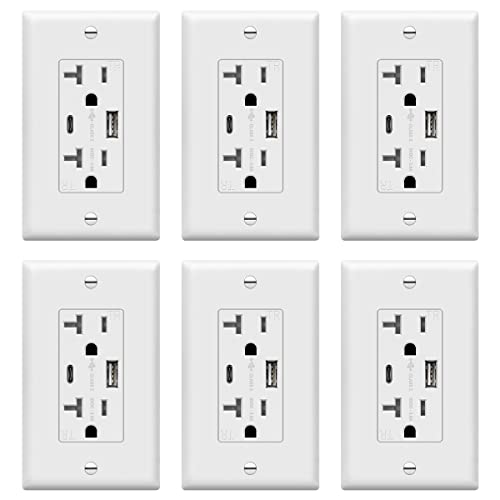
TOPGREENER’s USB wall outlet is useful when you want to charge phones and battery packs without stacking wall warts across every receptacle. The published spec lists Type A and Type C ports, so it suits mixed-device charging at a workbench or gadget shelf.
It is also a tamper-resistant 20 amp USB receptacle, which makes it more flexible than a simple add-on charger cube. For a garage bench, that can reduce adapter clutter and free up the main receptacles for tools.
The drawback is that USB ports are a convenience feature, not a substitute for enough grounded receptacles. If you have a saw, a shop vac, and three chargers running at once, the circuit design still matters more than the USB ports.
Docking Drawer safety outlet: best for enclosed charging storage
Docking Drawer’s appliance-garage safety outlet belongs in enclosed storage or a closed charging cabinet, not as a substitute for open-workbench outlets. The appliance garage safety outlet concept fits the kind of controlled enclosure where you want devices to power down inside a defined storage space, and the product data says the appliance-garage disconnect kit is available in GFCI and non-GFCI versions, with support for up to four devices.
That makes it relevant where the appliance garage solution must stay tied to a closed storage area instead of a general outlet run. The system installs into a double or triple gang junction box, so it is a specific fit for cabinet-style charging, not a broad garage workbench role.
The drawback is that this is more specialized than a standard receptacle. It needs careful planning around the enclosure, the box size, and the intended devices, so it is not the first pick for a basic tool bench.
DEWALT magnetic power strip: best for metal benches and toolboxes
The DEWALT magnetic power strip is useful when you want power attached to a steel toolbox, bench leg, or metal cabinet instead of sitting loose on the floor. The roundup notes six outlets and two USB ports, which gives it more workstation flexibility than a plain strip.
Magnetic mounting helps keep cords where you can reach them, and that matters when chargers, task lights, and small electronics all land in the same zone. For a garage bench, that can be the difference between tidy access and a cord pile on the floor.
The drawback is that magnetic convenience does not solve circuit limits. If the bench already shares power with a compressor or freezer, the strip can still be part of an overloaded setup.
Which one should you buy?
Start with the circuit, then choose the receptacle. If your garage needs a basic replacement or extra bench power, the Leviton 15 amp receptacle is the simplest fit. If the space is damp or code calls for protection, choose the ELECTECK GFCI or the Leviton slim GFCI for weather-prone areas.
For a true 20-amp branch circuit, the ENERLITES 62020 is the clearest receptacle pick because it is built as a 20 amp duplex. Use TOPGREENER when the main problem is charger clutter, and reserve Docking Drawer for enclosed storage or a closed charging compartment.
If you have a steel bench or toolbox, the DEWALT strip is the convenience pick. It helps with placement and access, but it should sit on top of a sound outlet plan, not replace it.
Say your 8-foot bench needs two chargers, a task light, and a small vac. Wide outlet spacing plus one USB receptacle may be enough. Suppose a compressor and a freezer share the same wall; that is a strong sign to separate loads instead of assuming one strip can manage both.
What kind of outlets are best for a garage workshop?
For most garage workshops, the baseline is a grounded receptacle on the right branch circuit, with GFCI protection where the garage or local code calls for it. A 15 amp receptacle suits lighter loads, while a 20 amp receptacle belongs on a true 20 amp branch circuit with matching wiring and breaker protection.
That framing matters because the receptacle face alone does not set usable capacity. A grounded three-prong outlet is the safer modern replacement path in many homes, and GFCI protection adds a needed layer in wet or damp garage zones.
Use the outlet type to match the load. Use the circuit to match the demand.
When do you need a dedicated circuit?
You need a dedicated circuit when one load or one zone would otherwise share power with tools that start hard or run for long periods. That is common for a stationary saw, a compressor corner, or a freezer-adjacent bay where startup current and shared loads can cause breaker trips.
A dedicated circuit is not the same as “more outlets.” It means separating a larger tool or an important appliance from other high-demand devices so the branch is not overloaded.
What belongs to a licensed electrician is any circuit work outside the scope of simple replacement. What belongs to layout planning is deciding which bench, wall, or bay should get its own circuit.
How many outlets should a garage workshop have?
Plan around the bench first, then the floor, then the charging zone. A good workshop layout gives you enough outlets that chargers, lights, and hand tools do not all land on the same receptacle, because that is where clutter and awkward cord runs start.
Wide outlet spacing matters because bulky adapters and transformer plugs can block neighboring receptacles. A wall-wart charger can cover two outlets by itself, so close spacing often creates fewer usable openings than the count suggests.
A power strip with USB charging can help at the bench, but it should sit inside a layout that already has enough grounded receptacles. Say your bench has three chargers and a lamp; one strip may tidy the cords, but it does not replace proper outlet placement.
Which charging accessories are worth it?
A power strip with USB charging is useful when the main job is phones, battery packs, and small electronics. Magnetic mounting is useful when the strip needs to cling to a steel toolbox or bench. Surge protection is helpful when sensitive chargers and electronics share the same workstation.
What to check in product specs is straightforward: outlet count, USB port type, cord length, mounting method, and surge rating if listed. The roundup includes one model with a 45W PD USB-C port and two USB-A ports, another with six outlets and two USB ports, one with eight outlets, and one with 2700J surge protection.
Do not confuse accessory convenience with circuit capacity. A strip can clean up a bench, but it cannot turn a light-duty branch into a heavy-load one.
Frequently asked questions
Should a garage workshop outlet be 15 amp or 20 amp?
Choose 15 amp for light-duty runs such as chargers, task lights, and modest bench loads. Choose 20 amp only when the branch circuit is actually built for 20 amps. The outlet face alone does not create more usable power; the circuit design does.
Do I need GFCI outlets in a garage workshop?
Often yes, especially in wet or damp risk zones and in code-driven garage installations. GFCI protection is about ground-fault safety, not overload protection. A breaker handles overload; a GFCI reacts to imbalance from current leaking where it should not go.
How many outlets should I put in a garage workshop?
Enough to keep chargers, lights, and hand tools from fighting over one spot. Start with the bench, then add floor access and a charging zone. Wide outlet spacing helps with bulky adapters, and it can be more useful than simply adding more closely packed receptacles.
Can I use USB outlets for tool charging in a garage?
Yes, for phones, batteries, and small electronics, but not as a substitute for proper receptacles. A USB outlet helps with charger clutter at the bench. It does not replace grounded outlets, and it does not fix an undersized circuit or poor outlet placement.
Should workshop outlets be dedicated circuits?
Some should. A compressor corner, a freezer-adjacent bay, or a major stationary tool is a strong candidate for a separate circuit so shared loads do not trip the breaker. General-purpose bench outlets can remain on their own circuit if the load stays modest and properly planned.
Sponsored / affiliate links. As an Amazon Associate I earn from qualifying purchases. I may earn additional commission from eligible campaigns.