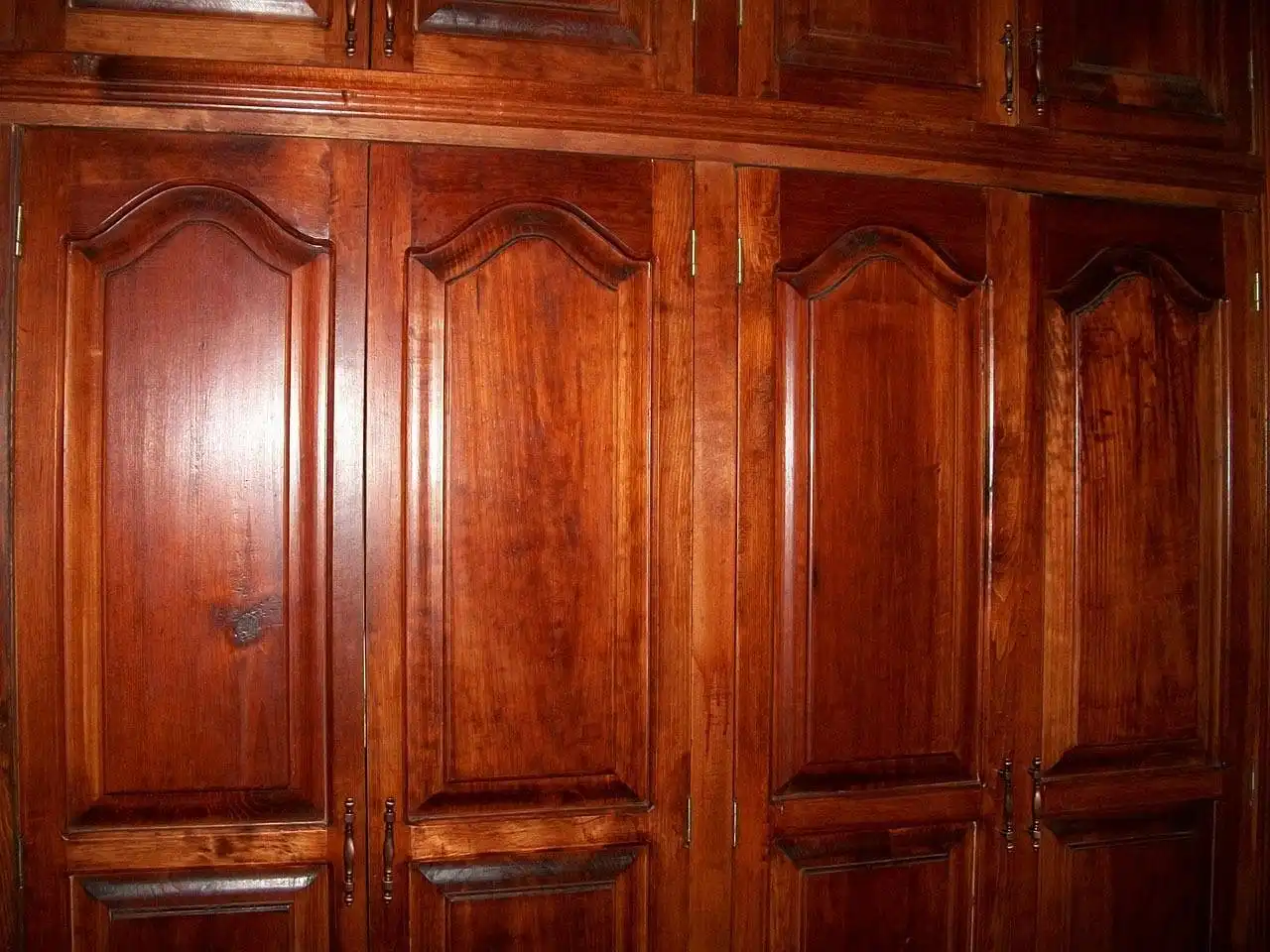
Best Woods for Closet Systems (2026): We Compared
For closet systems, 3/4-inch plywood is commonly used for cabinet boxes, 3/4-inch hardwood plywood or solid hardwood is often used for visible shelves and fronts, and moisture-resistant MDF or melamine is usually reserved for dry, low-load parts only. Cheap particleboard sags faster, swells with humidity, and can turn a simple closet into a repair job. For most closets, plywood is the most balanced material for boxes and shelves because it keeps weight, cost, and stiffness in check. This guide compares strength, weight, cost, sag risk, moisture behavior, and finish quality so you can choose the right material for each closet component.
Quick comparison
| Product | Badge | Best for | Price | ||
|---|---|---|---|---|---|
 |
Baltic Birch Plywood 24 x 24 x 3/4 Inch – 18 mm Craft Wood,Woodpeckers | Our pick | 24 x 24 x 3/4 Inch · B/BB Grade · Baltic Birch | $45.89
Price as of 23 Oct 2026
|
View |
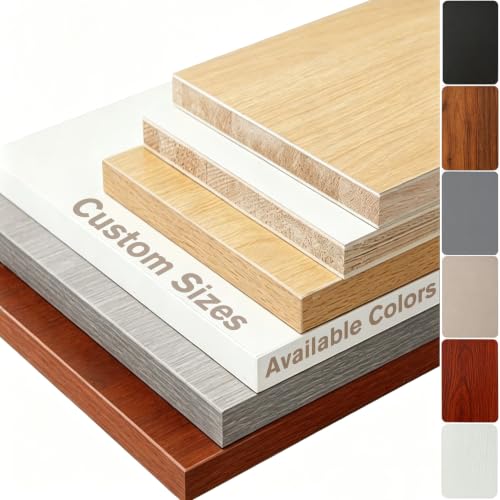 |
Custom Cabinet Shelves Cut to Size, Solid Wood, 3/4 inchGeneric | Upgrade pick | 3/4 inch Thick · 10 Colors · Solid Wood | $5.99
Price as of 23 Oct 2026
|
View |
 |
pamo Adjustable Closet Organizer Shelf Board White – 36 xpamo | Budget pick | 36 x 12 Inch · White · Melamine-Coated | $169.90
Price as of 23 Oct 2026
|
View |
 |
Barrington Hardwoods Red Oak Lumber Board – 3/4 in x 2 inBarrington Hardwoods | Also great | 3/4" x 2" x 48" · 4 Pcs · Red Oak | $34.91
Price as of 23 Oct 2026
|
View |
Plywood is the main default for closet systems because it gives you useful strength without turning the build into a heavy, costly job. The right pick still changes by part: shelves, side panels, exposed trim, and closet rods do not need the same material.
How we chose
The matrix below scores each material on seven points that matter in real closet builds: strength, weight, cost, sag risk, screw-holding, moisture tolerance, and finish quality. The scores are relative, not lab measurements.
| Material | Strength | Weight | Cost | Sag risk | Screw-holding | Moisture tolerance | Finish quality |
|---|---|---|---|---|---|---|---|
| Plywood | 4 | 4 | 3 | 3 | 4 | 4 | 3 |
| Baltic birch plywood | 5 | 4 | 2 | 5 | 5 | 4 | 3 |
| MDF | 3 | 2 | 4 | 2 | 3 | 1 | 5 |
| Particleboard with melamine | 2 | 3 | 5 | 2 | 2 | 2 | 4 |
| Pine | 2 | 5 | 4 | 2 | 3 | 2 | 3 |
| Oak | 4 | 2 | 2 | 4 | 5 | 3 | 4 |
| Maple | 5 | 2 | 2 | 4 | 5 | 3 | 4 |
| Birch | 4 | 3 | 3 | 3 | 4 | 3 | 4 |
| Walnut | 4 | 2 | 1 | 4 | 4 | 3 | 5 |
Component fit
Shelves: use plywood for most spans, Baltic birch for wider or heavier shelves, and solid hardwood only where you want a visible face and can accept the cost and weight. A 36-inch shelf span is often a point where support spacing, thickness, and load distribution matter more than wood species alone.
Side panels and verticals: plywood is the clean default for boxes and tall panels because its cross-grain veneer construction resists warping better than solid boards across the same width. If the closet is open and visible, edge banding or trim matters as much as the core material.
Closet rods: use hardwood in the 1 1/4-inch to 1 1/2-inch range when you want higher capacity. A typical wooden closet rod can hold between 40-100+ pounds, oak and maple rods can support up to 100+ pounds, and pine rods handle 40-60 pounds in typical use.
- Decide what the part must do: carry load, stay flat, look finished, or resist moisture.
- Choose the lightest material that still meets the load and appearance goal.
- For exposed sheet edges, add edge banding or solid trim before final finish.
- For shelves over 36 inches, add support spacing rather than relying on thicker material alone.
- Check indoor moisture before buying lumber. A 6-8% moisture target is a common indoor benchmark, but local climate and season still matter.
Plywood: best all-around choice for closet systems
Plywood is the most practical default for closet boxes, shelf panels, and vertical dividers because it uses cross-grain veneer construction to resist warping while keeping weight manageable. Standard plywood closet builds are sold as 4×8 sheets, and cabinet-grade sheets cost more than lower grades because they have cleaner faces and fewer voids.
The main tradeoff is appearance at the edges. Plywood needs edge banding or solid trim on exposed edges, and that adds labor and material cost to the installed price. Lower grades can also have more visible core gaps, which matters in open closets.
For most DIY closet systems, that is still a good trade. Plywood gives you a stable sheet good, decent screw-holding, and enough strength for ordinary shelf spans without the weight penalty of dense panels.
Cabinet-grade vs lower grades
Cabinet-grade plywood is the better choice when shelves or panels will be seen, touched, or painted. Lower grades can work inside hidden carcasses, but the face veneer, core consistency, and edge quality are not as clean. That affects both finish work and how much trimming you need after cutting.
Say your closet has 14-inch-deep shelves across a 36-inch opening and you want a clean painted look. Plywood lets you keep the shelf light enough for easier wall fastening while still holding screws well and taking edge banding cleanly.
Baltic birch plywood: best for stronger shelves
Baltic birch plywood is a premium all-hardwood plywood made with multiple thin plies. That construction gives it a strong strength-to-weight balance and good screw-holding, which is why it belongs on closet shelves that need extra stiffness without jumping to solid wood.
The Janka figure often cited for birch plywood is around 1,200 lbf, and that points to a harder, tougher material family than many budget sheet goods. It is also more expensive than standard plywood, so the value shows up when you need rigidity, not just a smooth face.
Use Baltic birch where the shelf is wide, the load is meaningful, or the front edge will remain visible. It is a smart upgrade for custom systems, but the higher price makes it hard to justify for every hidden panel.
MDF: best for painted, low-cost parts
MDF gives you a very smooth paintable surface and a predictable edge for paint-grade trim, which is why it works well for low-visibility closet parts. Its drawback is weight. MDF is heavy, and its sag risk rises on wider spans.
Moisture is the bigger problem. MDF is sensitive to humidity and can swell or break down faster than plywood if a closet sees damp air, a basement wall, or a seasonal moisture swing. The material can make sense for short, well-supported painted pieces, but it should not be the default for long shelves.
A common mistake is choosing MDF for a 36-inch closet shelf because the face looks perfect in the store. The shelf may look fine on day one and still be the first part to complain later if support spacing is too wide.
Particleboard with melamine: best for budget systems
Particleboard with melamine is the budget closet option when price and a pre-finished surface matter more than long-term toughness. The melamine face resists scratches and stains, and it skips the painting step, which lowers total labor on simple builds.
The weak point is the core and the edges. Edge durability is a concern, especially where hardware bites into the panel or where shelves get bumped during use. Fastener holding is weaker than plywood or solid hardwood, so you need careful drilling and proper support.
If the closet is dry, lightly loaded, and built as a basic system, melamine can be a sensible savings move. It is not the right pick for a heavy shelf, a damp closet, or a build that needs repeated disassembly.
Solid wood: best for visible, higher-end parts
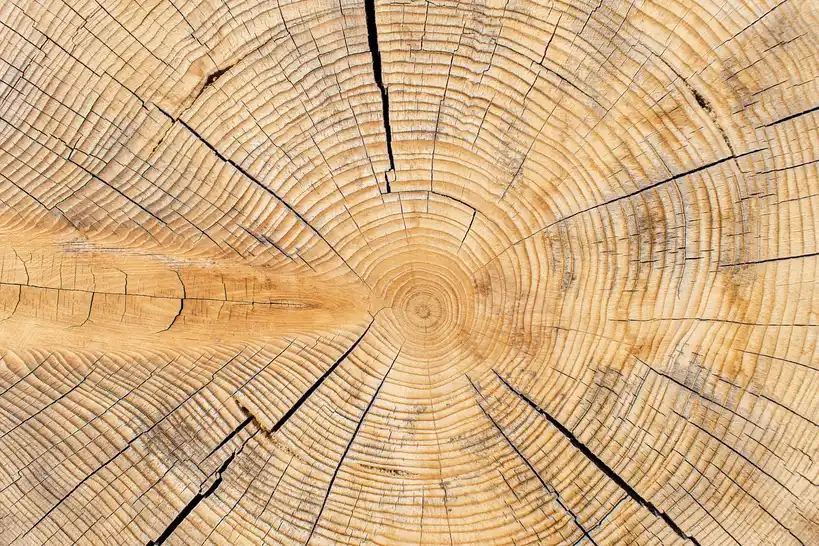
Solid hardwood gives you the best visible finish quality and strong screw-holding, but it costs more and tends to be heavier than softwoods and many sheet goods. Oak, maple, birch, and walnut are the main choices when the front edge or face will be seen every day.
White oak is listed at 1,360 lbf Janka hardness, hard maple at 1,450 lbf, walnut at 1,010 lbf, and pine at 870 lbf. Those figures help explain the feel difference: maple and oak resist dents better, while walnut offers a premium look with a softer hardness number than maple.
Solid wood also moves with moisture. That does not make it a bad choice. It means you should use it where the visual payoff and the screw-holding matter enough to justify the cost and the extra care in sizing.
Oak, maple, birch, and walnut
Oak is a strong, durable choice for exposed shelves, trim, and rod stock when you want a traditional look and high dent resistance. Maple is harder and often cleaner in appearance, which makes it a strong pick for modern visible parts. Birch lands in the middle on cost and performance. Walnut is the premium visual option, but it sits at the top of the cost ladder.
Pine and similar softwoods
Pine is the lightest and cheapest of the wood choices here, which makes it useful for light-duty storage and parts that need to stay easy to handle. The tradeoff is dent resistance. Pine rods and shelves can mark faster than hardwood, and pine is best reserved for lighter loads or painted systems where cost matters most.
Which one should you buy?
For most closets, buy plywood first. It gives you the best balance of strength, weight, and cost for boxes and shelves, and it is the easiest material to adapt to a full system. Choose solid hardwood only where the part is exposed and the visual finish matters.
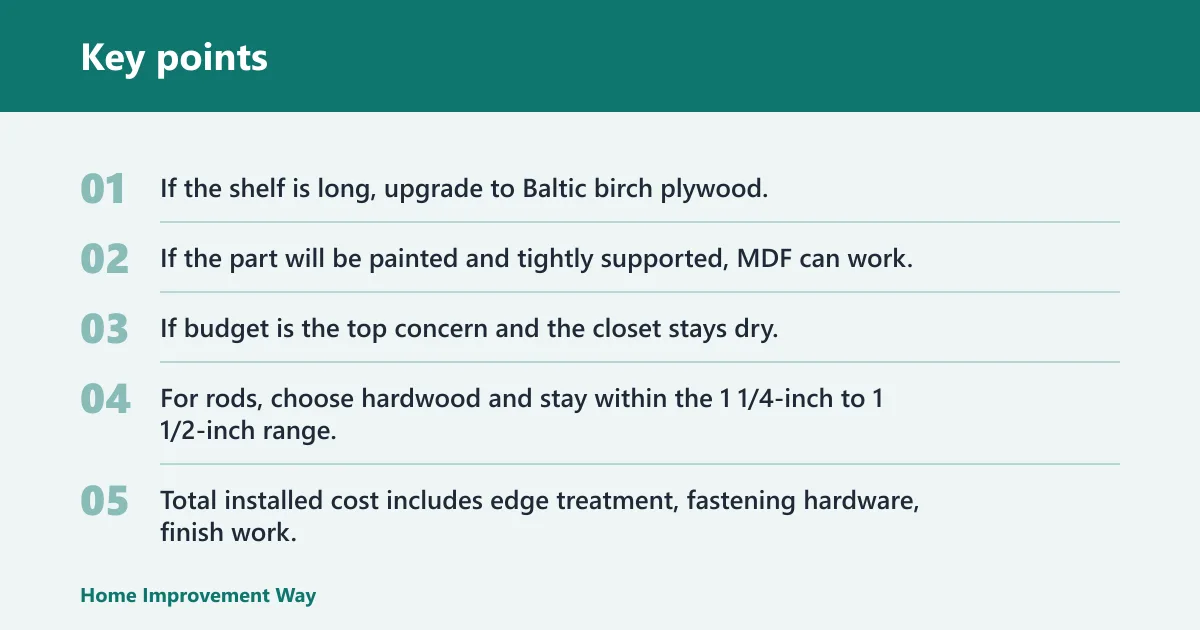
If the shelf is long, upgrade to Baltic birch plywood. If the part will be painted and tightly supported, MDF can work. If budget is the top concern and the closet stays dry, melamine-faced particleboard can fit a basic system. For rods, choose hardwood and stay within the 1 1/4-inch to 1 1/2-inch range.
Cost is not just sheet price. Total installed cost includes edge treatment, fastening hardware, finish work, and waste from cuts. That is one reason a cheaper board can end up costing more after the shelf is trimmed, banded, painted, and reinforced.
Picture a 48-inch-wide reach-in closet with two shelves and a hanging section. If the shelves are lightly loaded, plywood with edge banding gives the best mix of price and durability. If the same closet sits in a basement, the moisture risk pushes you away from MDF and toward plywood or a better-sealed hardwood solution.
Another common first-timer mistake is choosing the heaviest board because it feels stronger in the hand. A tall closet system mounted to a weaker wall can benefit more from a lighter, stable sheet good than from maximum hardness.
Frequently asked questions
What is the best wood for closet shelves?
Plywood is the main choice for closet shelves because it balances strength, weight, cost, and ease of installation. For wider or more heavily loaded shelves, Baltic birch plywood is the stronger upgrade. Use solid hardwood only when the shelf face is visible and the higher price is worth it.
Is plywood better than solid wood for closet systems?
Yes, for most closet systems. Plywood is better for boxes, long shelves, and vertical panels because it stays flatter across wide spans and costs less than comparable solid hardwood builds. Solid wood is better for visible parts, rods, and trim where finish quality and dent resistance matter more than sheet stability.
How thick should closet shelves be?
For many closet systems, 3/4-inch material is the practical starting point for shelves and cabinet parts. Once a shelf span reaches 36 inches, support spacing matters as much as thickness. Wider spans need either stronger material, shorter spacing, or an added center support to control sag.
What wood is cheapest for closet shelves?
Pine is the cheapest wood among the solid-wood choices, and melamine-faced particleboard is often the lowest-cost sheet option. Pine is light and easy to cut, but it dents more easily. Particleboard keeps the price down, yet edge durability and sag resistance are weaker than plywood.
What wood holds the most weight in a closet?
For rods, oak and maple can support up to 100+ pounds, while a typical wooden closet rod can hold between 40-100+ pounds. For shelves, Baltic birch plywood and dense hardwoods such as maple and oak are the strongest choices, but the real limit still depends on span and bracket spacing.
Should I use MDF for closet shelves?
MDF is a fair choice for painted, low-load shelves in a dry closet, but it is heavy and more vulnerable to sag and moisture than plywood. If the shelf span is long or the closet may see humidity swings, plywood is the safer choice. MDF works best where support spacing is tight.
What wood is best for humid closets?
Plywood is the safest general choice for humid closets because its cross-grain construction resists warping better than solid boards of the same width. Keep indoor moisture content near the 6-8% range where possible, and avoid MDF or particleboard in damp locations. Better edge sealing also helps.
How do I stop closet shelves from sagging?
Use a material that matches the span, then shorten the span with closer support spacing. A 36-inch opening deserves special attention. Choose 3/4-inch plywood or a stiffer option, add center support if needed, and keep heavy items closer to the vertical supports instead of loading the middle.
Sponsored / affiliate links. As an Amazon Associate I earn from qualifying purchases. I may earn additional commission from eligible campaigns.