Best Wood for Humid Climates: Stable Species to Choose
For humid rooms, start with stable species: white oak, teak, mahogany, and cypress are safer than movement-prone softwoods. In severe humidity swings, choose quarter-sawn stock and keep boards narrow. Pick poorly and you get cupping, gaps, swollen joints, and doors or panels that bind. This guide gives a humidity-first selection matrix by climate severity, project type, and how much movement you can tolerate.
Best wood for humid climates
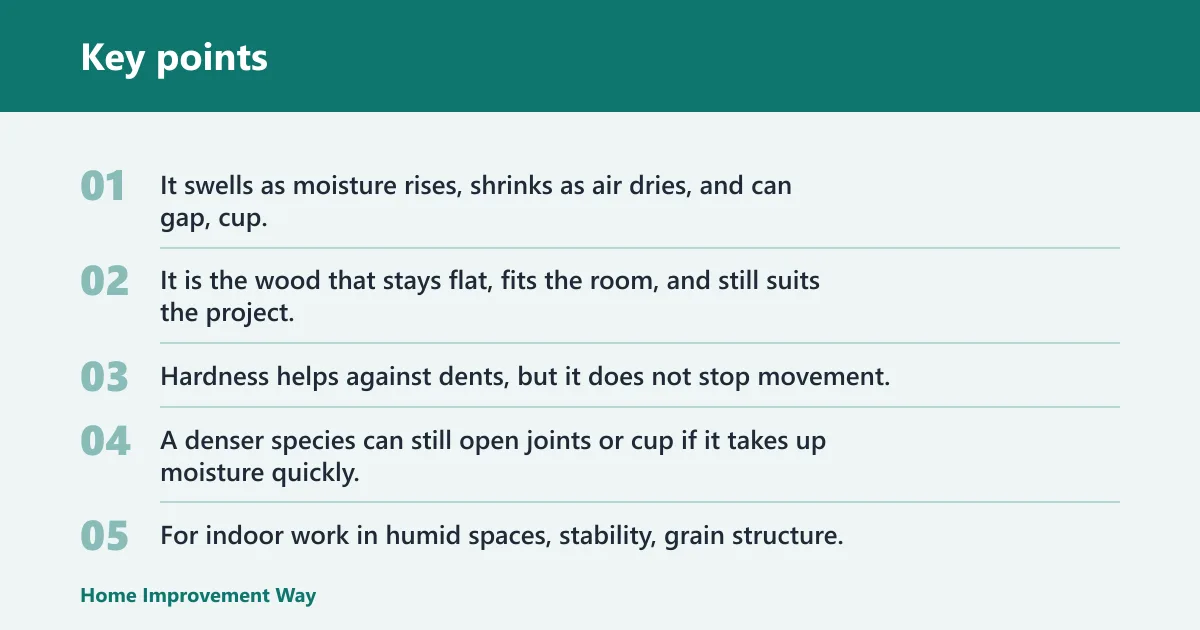


Humidity changes wood size. It swells as moisture rises, shrinks as air dries, and can gap, cup, or twist when the change is uneven. So the best choice is not the hardest wood. It is the wood that stays flat, fits the room, and still suits the project.
Why stability matters more than hardness alone
Hardness helps against dents, but it does not stop movement. A denser species can still open joints or cup if it takes up moisture quickly. For indoor work in humid spaces, stability, grain structure, and cut matter as much as dent resistance.
White oak is the clearest example. It has a closed grain structure, and quarter-sawn or rift-sawn boards are more dimensionally stable than flat-sawn boards. Red oak is common and cost-effective, but it is slightly less stable than white oak in humid climates.
When solid wood makes sense, and when it does not
Solid wood still works well when the room stays near a controlled indoor range and the piece is built with movement in mind. Think narrower boards, well-sized joinery, and a finish that slows moisture exchange. Finish helps, but it does not stop movement.
When climate control is uncertain, engineered hardwood is often the better specification. Its cross-ply construction resists dimensional movement, and it is a stronger choice than solid hardwood for ground-floor installations where moisture exposure is harder to control.
Indoor humidity control matters either way. A healthy indoor target is between 40 and 55 percent relative humidity, and exhaust fans or dehumidifiers help lower moisture exposure in bathrooms, laundry rooms, basements, and kitchens. Manufacturer guidance can vary, so follow the listing or manual for your exact product.
Humidity wood decision matrix
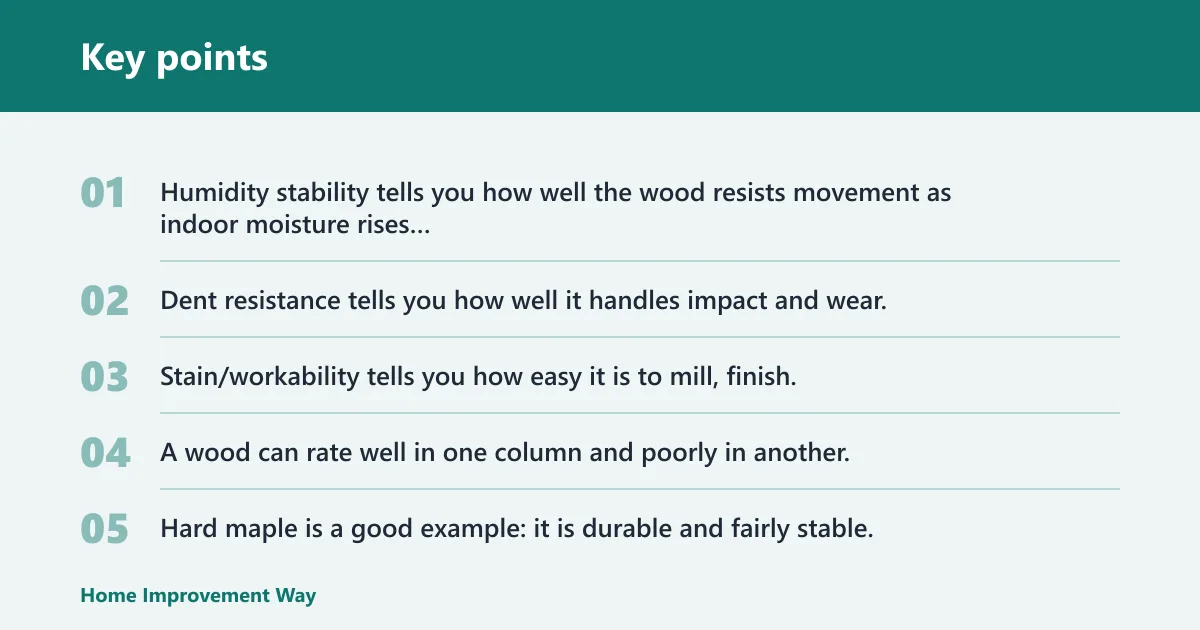
Use this matrix as a quick filter. Start with humidity stability, then check dent resistance, then decide whether the species will stain cleanly and fit the project. A good-looking wood that moves too much is a poor fit in a damp room.
| Wood | Humidity stability | Dent resistance | Stain/workability | Best use case |
|---|---|---|---|---|
| White oak | High | High | Good workability, stains well | Floors, bathroom vanities, built-ins, durable furniture |
| Red oak | Medium | High | Good workability, open grain shows more texture | Budget floors and furniture in moderately controlled rooms |
| Hard maple | Medium-high | High | Can stain unevenly | Tabletops, cabinets, painted pieces, high-wear parts |
| Hickory | Medium | Very high | Can be harder to machine cleanly; bold grain | Flooring and furniture where impact resistance matters more than calm movement |
| Walnut | Medium | Low-medium | Machines and finishes well | Cabinet fronts, accent furniture, low-wear pieces with a premium look |
| Teak | High | Medium | Oily wood; finish behavior varies | Bath-adjacent furniture, humid zones, specialty projects |
| Mahogany | High | Medium | Good working wood, finishes cleanly | Cabinetry and furniture in stable indoor spaces |
| Cypress | High | Low-medium | Light, easy to work | Decorative pieces and light-use projects in humid rooms |
How to read the three ratings
Humidity stability tells you how well the wood resists movement as indoor moisture rises and falls. Dent resistance tells you how well it handles impact and wear. Stain/workability tells you how easy it is to mill, finish, and color-match without blotching or fuzzing.
A wood can rate well in one column and poorly in another. Hard maple is a good example: it is durable and fairly stable, but it can be difficult to stain evenly. Walnut is attractive and workable, yet it is softer than oak, so it is not the best pick where dents are likely.
Best use case for each wood
Choose white oak when you want the best all-around balance for humid interiors. Choose red oak when budget matters and the room is only moderately variable. Choose hard maple for wear resistance in cabinets, tops, or painted work where color consistency is less of a concern.
Use hickory when impact resistance matters more than easy machining. Use walnut for appearance-first pieces that will not take hard abuse. Use engineered hardwood when the room conditions are not stable enough for solid wood to behave predictably.
Is white oak the best choice?
White oak is usually the safest all-around solid wood choice for humid interiors because it combines good dent resistance, a closed grain structure, and better moisture behavior than red oak. It is a strong pick for floors, built-ins, and furniture that must stay serviceable through seasonal swings. (Wood-database)
Why white oak holds up well in humidity
White oak has a Janka hardness of 1360. That makes it tough enough for daily use without being so hard that it becomes difficult to work. More important here, its closed grain structure helps it resist moisture uptake better than open-grain species in similar conditions.
That does not make it immune to movement. It still needs proper acclimation, correct fastening, and a finish system that slows moisture exchange. But among common domestic woods, it is one of the better choices when humidity is a concern.
Flat-sawn vs quarter-sawn vs rift-sawn
White oak is sold in flat-sawn, quarter-sawn, and rift-sawn cuts. Quarter-sawn and rift-sawn boards are more dimensionally stable than flat-sawn boards, so they are the smarter option when you want less seasonal movement. They also tend to show a straighter grain pattern.
That makes quarter-sawn white oak a strong option for tabletops, cabinet parts, and flooring in spaces that cycle between damp and dry. If you want the best balance of stability and appearance, this is the cut to ask for first.
Where white oak is a smart pick
Use white oak for bathroom vanities, kitchen cabinetry, shelving, and furniture in homes with normal seasonal swings. It also makes sense for flooring where you want a calmer grain than hickory and better humidity behavior than red oak.
Suppose a 36-inch vanity face frame sits in a room that runs damp after showers and then dries out fast with the exhaust fan. White oak is a safer choice than a more movement-prone wood because it gives you better odds of staying flat and aligned through those swings.
Is red oak good in humid rooms?
Red oak can work in humid rooms, but it is not the first pick when moisture swings are severe. It has an open grain, and it is slightly less stable than white oak in humid climates. Still, it is common, cost-effective, and widely available.
Open grain and movement behavior
Red oak has a Janka hardness of 1290. It is durable enough for many indoor uses, but the open grain means it can take on moisture more readily than white oak. That can lead to more visible movement in a room that stays damp or cycles often.
For furniture, that means joints and panels deserve more care. For flooring, it means you should pay attention to room conditions and installation guidance. Red oak can be a practical choice, but it is not the lowest-risk option when the air is unstable.
Cost and availability
Red oak is popular because it is easy to find and often priced below white oak. For a project where budget matters and the room has decent climate control, that tradeoff can make sense. It also machines well and takes stain predictably for many finishes.
Its strength is value, not top humidity performance. If your project is in a dry bedroom, hallway, or living room with steady HVAC, red oak may be a reasonable choice. In a bath-heavy or basement-adjacent space, white oak or engineered wood is usually the safer call.
Hard maple, hickory, and walnut
These three species cover different priorities. Hard maple offers toughness and a tight grain, hickory offers very high hardness with bold character, and walnut offers premium appearance with lower dent resistance. None is the universal answer for humid spaces.
Hard maple: stable enough, but stain carefully
Hard maple has a Janka hardness of 1450. It is fairly stable and has a fine, consistent grain, which helps it look clean on cabinets and tops. The tradeoff is finish behavior: it can be difficult to stain evenly, so blotching is a common concern.
That makes hard maple a better fit for painted parts, clear-finished modern pieces, and surfaces where a lighter natural look is acceptable. In humid weather, it is stable enough for many indoor uses, but it is not the first pick if you need easy staining.
Hickory: very hard, not the calmest mover
Hickory has a Janka hardness of 1820, making it one of the hardest common domestic flooring species. It also has dramatic grain variation, which gives it a strong look and helps hide wear. But hardness is not the same as low movement, and it should not be treated that way.
Hickory is a good choice when you want impact resistance and a bold appearance. It is available in solid and engineered formats. For humidity-driven projects, think of it as tough, not especially calm. If movement control is the main goal, white oak or engineered construction is the safer route.
Walnut has a Janka hardness of 1010. It is softer than oak, which means it dents more easily, but it brings a premium aesthetic that works well for cabinet fronts, tables, and other pieces that are handled with more care.
Walnut can perform in humid interiors when the room is reasonably controlled, but it is not the best choice for floors, entry pieces, or other high-impact spots. Choose it for appearance-first projects where the surface will not take heavy abuse.
Should you choose engineered wood?
Engineered wood is often the better choice when humidity control is uncertain or the installation is on a ground floor. Its cross-ply construction resists dimensional movement better than solid wood, so it handles changing indoor moisture with less distortion.
Why cross-ply construction helps
Solid wood moves mostly across the grain as moisture changes. Engineered wood layers grain directions against each other, which helps cancel out movement. That is why engineered hardwood is often the stronger specification for moisture-varying rooms.
This does not mean every engineered product is equal. Check the manufacturer’s listing for wear layer, core construction, and installation limits. The category gives you a better starting point, but the exact product still matters.
Where engineered wood beats solid hardwood
Choose engineered wood for basements, slab-on-grade spaces, first floors with limited climate control, and rooms near kitchens, baths, or exterior doors. It is also useful when you want the look of oak or walnut without taking the same movement risk as a solid board.
It can also help in broader indoor woodworking. Cabinet panels, wide shelves, and long door parts are less likely to telegraph seasonal change when the core construction is more stable. That matters in humid homes where doors and panels often suffer before floors do.
When climate control is uncertain
If you cannot keep indoor humidity near a steady range, do not assume a solid species alone will solve the problem. Exhaust fans and dehumidifiers reduce moisture exposure, but they do not replace good material choice. Use them with the wood, not instead of it.
A common first-timer mistake is installing a solid wood panel in a powder room with no working exhaust fan and expecting the finish to do the rest. The finish slows moisture exchange; it does not stop seasonal movement or remove joint stress.
How seasonal humidity affects wood movement
Seasonal swings make wood absorb moisture in humid months and release it in dry months. That change in moisture content drives gapping, cupping, and sometimes twist. The wider the swing, the more noticeable the movement can become.
Practical buying steps
- Check the manufacturer’s installation or finishing instructions before you buy.
- Measure the room’s indoor relative humidity and aim to keep it near 40 to 55 percent where practical.
- Choose the species and cut that fit the room’s moisture risk, not just the look.
- Inspect the boards or components for a moisture condition that matches the manufacturer’s allowed range.
- Use exhaust fans or a dehumidifier in rooms that routinely run damp.
- Acclimate the material per the manufacturer’s directions before installation or assembly.
What to avoid in humid rooms
Avoid treating decay resistance as if it were the same thing as dimensional stability. A wood can resist rot better and still move a lot with humidity change. Also avoid wide solid panels in uncontrolled rooms unless the design and instructions clearly allow for movement.
In humid climates, the worst choices are usually species or constructions that move easily and are installed with no room for seasonal change. If the project is a floor, follow the product manual. If the project is furniture or trim, plan for movement from the start.
Frequently asked questions
What is the best wood for humid climates?
White oak is the best all-around domestic choice for many humid interiors because it balances stability, dent resistance, and workability. Quarter-sawn or rift-sawn stock is even better when you want less movement. For unstable rooms, engineered hardwood is often the safer pick than solid wood.
Is white oak better than red oak in humid climates?
Yes. White oak is generally more moisture resistant than red oak, and red oak is slightly less stable in humid climates. Red oak is still useful when budget matters, but white oak gives you a better margin for movement control, especially in rooms that cycle through damp and dry periods.
Is hard maple stable in humid weather?
Hard maple is moderately stable and has a fine, consistent grain that makes it a good choice for many indoor projects. It is not the top low-movement species, but it works well when humidity is controlled. Its main drawback is that it can be difficult to stain evenly.
Is hickory a good choice for humid climates?
Hickory is a good choice when you want very high hardness and strong character, but it should not be chosen as a top low-movement species. It is better for wear resistance than for humidity control. If the room swings a lot, white oak or engineered wood is usually safer.
Should I choose engineered wood instead of solid wood in humid areas?
Often yes, especially for ground-floor installations or rooms where climate control is uncertain. Engineered hardwood uses cross-ply construction to resist dimensional movement better than solid wood. That makes it a stronger specification when moisture exposure is hard to control and seasonal swings are common.
What humidity level is best for wood indoors?
A healthy indoor target is between 40 and 55 percent relative humidity. That range helps reduce swelling, shrinking, gapping, and cupping. Some products have narrower manufacturer limits, so check the listing or manual for your exact wood flooring, panel, or furniture system.
Sponsored / affiliate links. As an Amazon Associate I earn from qualifying purchases. I may earn additional commission from eligible campaigns.