Best Wood for Floating Shelves: Strength Without Sagging
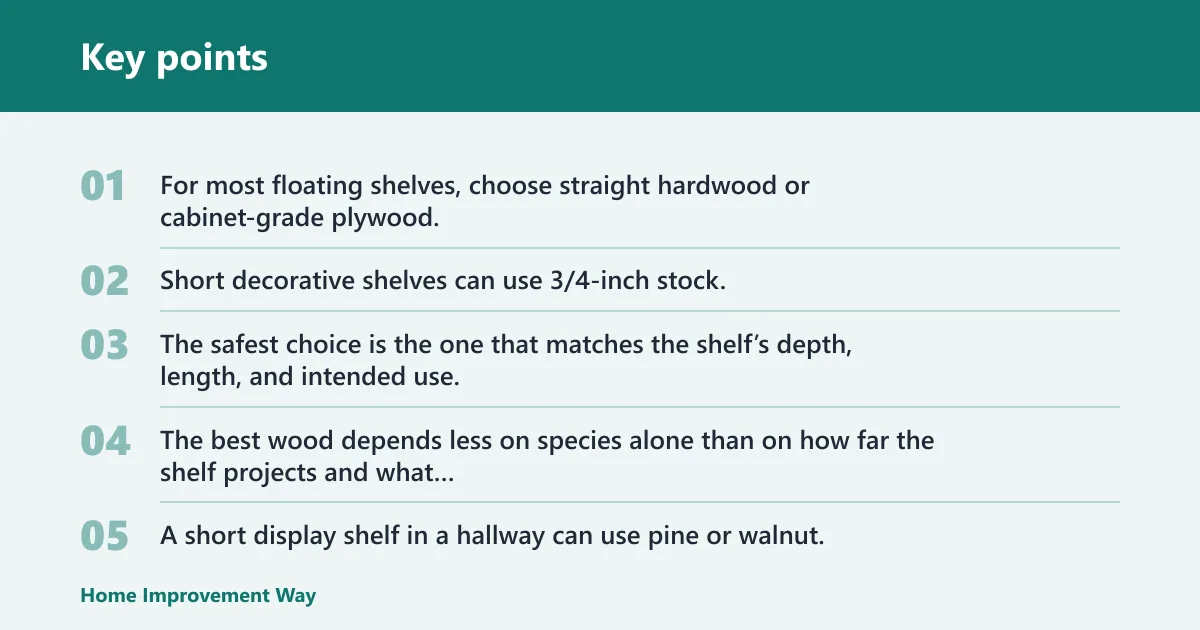
For most floating shelves, choose straight hardwood or cabinet-grade plywood, then size the shelf to the load and projection. Short decorative shelves can use 3/4-inch stock, but deeper spans and heavier loads usually need thicker hardwood, laminated construction, or a better support system. The safest choice is the one that matches the shelf’s depth, length, and intended use.
The best wood depends less on species alone than on how far the shelf projects and what it must carry. A short display shelf in a hallway can use pine or walnut. A kitchen shelf for dishes or a study shelf for books needs denser stock, a sound wall attachment, and lumber that stays steady with indoor humidity. See also hidden bracket installation, stud finding, and shelf load capacity.
Span and stiffness drive the wood choice, not grain

Set the decision rule by span, not opinion
Hidden suspension brackets give floating shelves their invisible look, but the wall attachment still has to carry the shelf’s weight and whatever you put on it. Manufacturer installation guidance for hidden shelf brackets consistently emphasizes fastening into studs or other structural framing for reliable support. The species matters, but the bracket layout and the shelf’s projection do the real work.
A small shelf with a short projection can tolerate more species choices. Once the shelf gets deeper or longer, stiffness matters more than color or grain pattern. That is where hard maple and white oak usually move ahead of softer woods.
Define when hardwood matters more than appearance
Hardwood matters most when the shelf has a longer span, carries books or dishes, or sits in a room with more moisture swings. Hard maple, white oak, and walnut are common hardwood picks because they bring strength, dent resistance, and better shape retention than soft pine. Softwoods can still work, but the design has to stay conservative.
For indoor furniture, kiln-dried stock near indoor equilibrium moisture is often appropriate; the NWFA recommends indoor wood products acclimate to the conditions where they will be used, and typical interior conditions often land around 6–8% moisture content. Excess moisture can cause wood to shrink, cup, or twist after assembly. That is why a straight board can still fail if it was chosen before it reached the room’s conditions. See also wood moisture control.
Shelf wood decision table
This load-class matrix uses projection depth, shelf length, and intended use to guide the build. If your use case falls between two rows, move to the heavier build, not the lighter one. When the shelf or load exceeds the bracket manufacturer’s rated depth or stud-capture guidance, redesign the shelf rather than stretching the hardware.
| Projection depth | Shelf length | Intended load type | Recommended species | Minimum practical thickness | Preferred construction | Redesign threshold |
|---|---|---|---|---|---|---|
| Up to 8 in. | Up to 36 in. | Decor, framed photos, small objects | Walnut, hard maple, or straight-grain pine | 3/4 in. solid wood or 3/4 in. plywood | Solid stock or plywood-faced shelf on a short hidden bracket fastened into studs | Redesign if the wall is drywall-only, the bracket cannot reach framing, or the load becomes concentrated rather than decorative. |
| 8 to 12 in. | 36 to 48 in. | Books, stacked dishes, small tool storage | Hard maple or white oak; walnut for similar span with lower load | 1 in. to 1 1/4 in. solid hardwood | Stiff hardwood or plywood-core build with bracket depth matched to shelf projection and capture into multiple studs | Redesign if the shelf extends beyond the bracket’s usable projection or if the length forces weak anchor spacing. |
| 12 to 16 in. | 48 to 72 in. | Heavier books, crockery, denser display loads | Hard maple or white oak | 1 1/4 in. to 1 1/2 in. solid hardwood, or laminated build | Laminated construction or plywood-core build with heavy-duty hidden brackets and verified stud capture | Redesign if the shelf needs wide spacing between studs, the load includes many heavy books, or the front edge sags under test fit. |
| Over 16 in. | Any span with dense loads | Heavy books, appliances, tools | White oak or hard maple, with engineered build | 1 1/2 in. or thicker, often with internal reinforcement | Box build, ledger-supported shelf, or cabinet-style system instead of a simple floating shelf | Do not use a standard floating shelf; redesign as a supported cabinet, ledger-mounted shelf, or enclosed casework. |
When the shelf needs a redesign instead of thicker lumber
Choose a redesign when the projection is large, the load sits far from the wall, or the wall itself cannot hold a reliable anchor pattern. Making the board thicker will not fix a weak drywall-only installation. It also will not solve a shelf that is too deep for the bracket length. Manufacturer load documents for hidden brackets typically limit both projection and stud engagement, so check those limits before cutting wood.
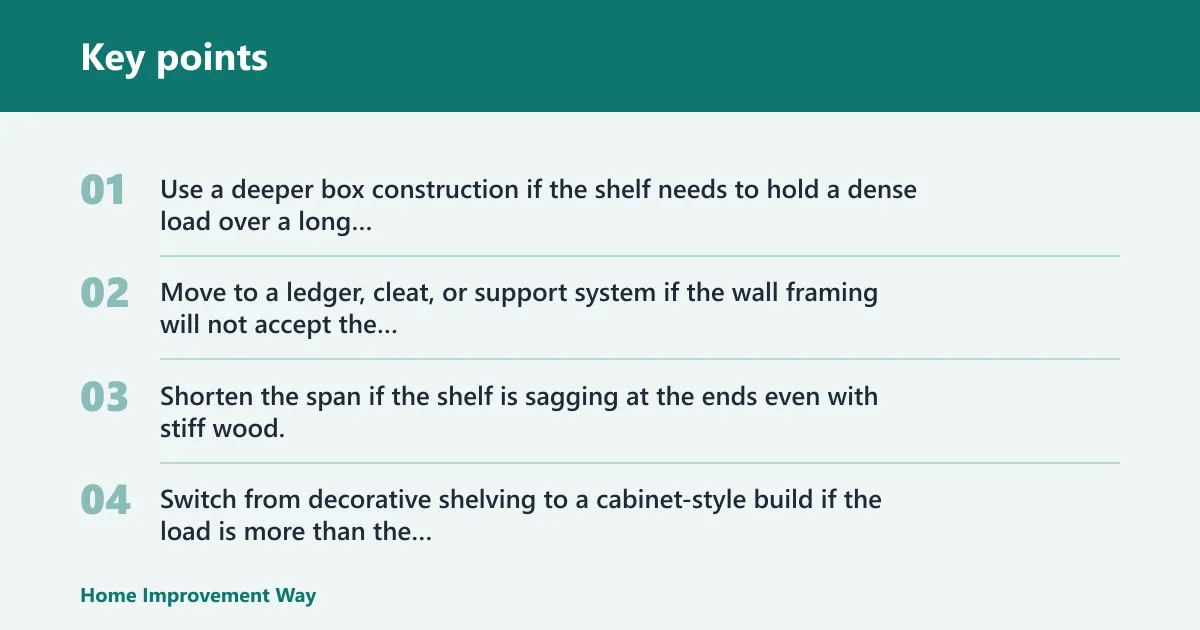
- Use a deeper box construction if the shelf needs to hold a dense load over a long projection.
- Move to a ledger, cleat, or support system if the wall framing will not accept the bracket layout.
- Shorten the span if the shelf is sagging at the ends even with stiff wood.
- Switch from decorative shelving to a cabinet-style build if the load is more than the wall hardware should carry.
Is hardwood better than pine?
Yes, for most load-bearing floating shelves, hardwood is the safer choice because it resists denting and sagging better than pine. Pine can work for lighter-duty shelves, but it gives up stiffness sooner, so it needs shorter spans, lighter loads, or a thicker build to perform well. For load-critical shelves, use a species with documented strength and a build that matches the load class.
Where hard maple fits best
Hard maple is a premier choice for floating shelves, with a Janka rating around 1450 lbf. The USDA Wood Handbook and wood-property references describe it as dense and strong, which helps when a shelf must resist denting and remain flat under weight. It is a strong fit for books, kitchenware, and heavier decor.
Where white oak fits best
White oak is rated around 1360 lbf and is strong, durable, and moisture resistant. Wood species references and the USDA Wood Handbook note that it performs well where toughness and dimensional stability matter. That makes it a smart pick for kitchens, mudrooms, and other spaces where humidity can move around.
Where walnut fits best
Walnut is rated around 1010 lbf and remains strong enough for most floating shelf applications. It is a good choice when you want a darker tone and more decorative grain without giving up dependable stability. For most rooms, walnut works well when the shelf span is sensible and the bracket support is sound.
Pine still has a place. Softwoods like pine can work for floating shelves, especially for lighter-duty shelves and shorter spans, but they are generally softer than hardwoods. That makes pine better for display loads than for heavy books or kitchen storage.
How thick should floating shelves be?
For common floating shelves, a practical range is 3/4 inch for short, light-duty shelves, 1 inch to 1 1/4 inches for most book or kitchen uses, and 1 1/2 inches or more for deeper spans or heavier loads. Thickness helps stiffness, but it only works when the wall anchor and bracket length are also sized correctly.
Practical thickness ranges for common spans
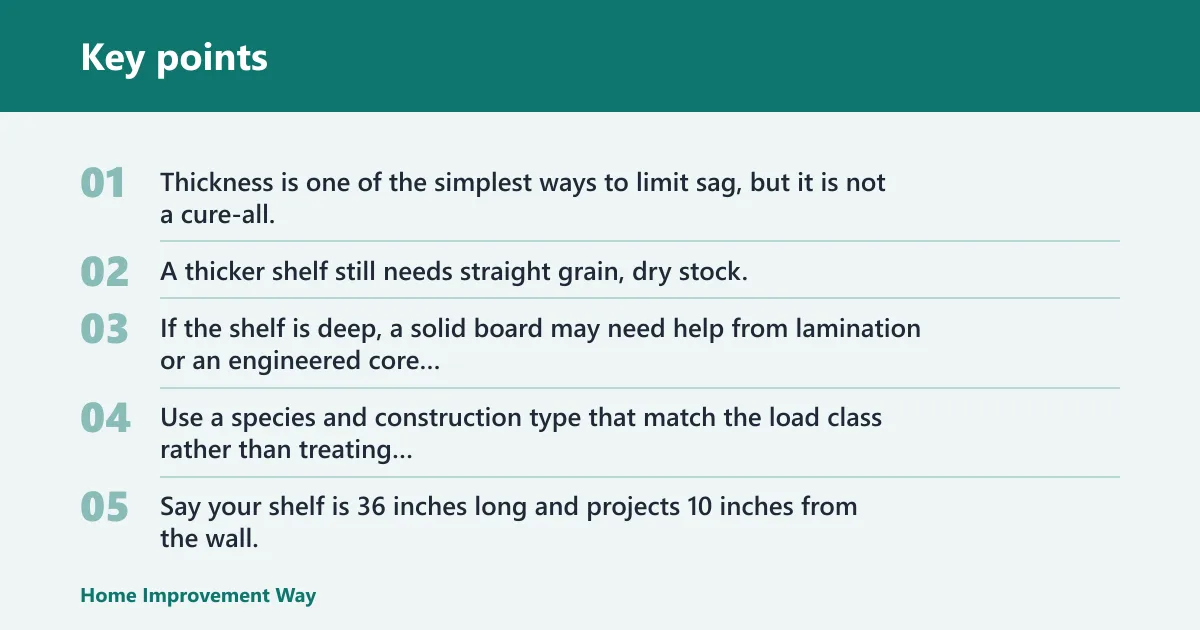
Thickness is one of the simplest ways to limit sag, but it is not a cure-all. A thicker shelf still needs straight grain, dry stock, and hidden suspension brackets that fit the job. If the shelf is deep, a solid board may need help from lamination or an engineered core to stay flat over time. Use a species and construction type that match the load class rather than treating thickness as the only variable.
Say your shelf is 36 inches long and projects 10 inches from the wall. A 1-inch hard maple shelf with a bracket anchored into studs is a much safer choice than a 3/4-inch pine board, even if both look fine on day one. The difference shows up after load is added and the shelf begins to work.
Hidden suspension brackets must match the shelf weight, length, and projection. If the bracket is too short for the shelf depth, the front edge can droop even when the board itself is stiff. If the bracket is too light for the load, the wall attachment becomes the weak point before the wood does. Manufacturer instructions usually specify both maximum projection and the required fastener engagement into framing.
The safest approach is to pair the board thickness with a bracket system sized for the final use. A short decorative shelf can use a lighter setup. A shelf for dishes or tools should use deeper hardware, more secure wall fastening, and a thicker board.
Why thicker wood does not fix a weak wall anchor
A thicker shelf cannot make up for bad fastening. If the hardware is not tied into studs, or if the wall material cannot support the load, the shelf can pull loose no matter how strong the species is. That is why wall structure comes before wood selection.
Picture a kitchen shelf loaded with plates and mugs. If the shelf is thick but the screws miss the studs, the board may stay straight while the anchors fail. The shelf then drops as a unit, which is a fastening problem, not a wood-species problem.
How do you keep floating shelves from warping?
Start with dry lumber, let it acclimate before milling, keep grain aligned with the shelf length, and finish both faces so moisture moves evenly. If the wood arrives too wet, it can shrink, cup, or twist later. Good hardware helps, but stable stock is what keeps the shelf flat. For interiors, follow wood-moisture-control guidance and match the material to room conditions.
Choose kiln-dried stock with the right moisture content
For indoor furniture, kiln-dried stock around 6–8% moisture content is often suitable. NWFA guidance for interior wood products emphasizes acclimation to the space where the material will live. That level helps reduce movement after installation. If the board is still carrying excess moisture, it can continue changing shape after the shelf is mounted.
Checking moisture before milling matters because excess moisture can cause wood to shrink, cup, or twist after assembly. That is especially important for floating shelves, where a small bend is easy to see along the front edge.
Let lumber acclimate before milling
Do not mill a shelf blank the same day it arrives if the shop and room differ a lot in temperature or humidity. Let the wood sit in the installation space or a similar indoor space first. That gives the board a better chance of moving before you cut joinery or set final dimensions.
Orient grain and joints for stability
Choose straight-grain stock and keep the grain running lengthwise along the shelf. Quartered or rift-oriented stock often behaves better than pieces with wild grain. Avoid crossing grain directions in ways that fight each other unless the build is engineered to handle that movement.
Solid wood can move with humidity. Plywood or veneered construction usually resists seasonal movement better because its layers counter each other, which is why cabinet-grade plywood is often used where flatness matters. Solid wood still wins for appearance and edge detail, but plywood can be the calmer choice for long, shallow shelves. See also hardwood vs plywood.
Finish and re-tighten hardware over time
Seal the shelf on all sides, including the back edge and underside. Uneven finishing lets one face absorb moisture faster than the other. After installation, check the hardware periodically and re-tighten it if the manufacturer allows it. Movement often starts small.
When should you not use a floating shelf?
Do not use a floating shelf when the wall cannot support the hardware or when the load is too demanding for a hidden-bracket design. The failure cases are predictable: drywall-only mounting, insufficient stud capture, oversized projection relative to rod depth, long spans with concentrated book loads, and wet or high-swing environments.
Drywall-only mounting
If the shelf can only be anchored to drywall, it should not be treated as a real load-bearing floating shelf. Drywall alone is not a substitute for framing, and thicker wood will not change that. Use a different support system or redesign the wall attachment.
Insufficient stud capture
If the bracket cannot reach enough framing for the shelf’s length and expected load, stop and redesign. A floating shelf that misses its structural support is a fastening failure waiting to happen. This is especially important for wider shelves, where the load is spread across multiple supports.
Oversized projection relative to rod depth
If the shelf projects farther than the hidden rods or bracket arms are designed to support, the front edge can sag or the shelf can lever off the wall. Oversize the support system only within manufacturer limits; beyond that, move to a box shelf, cleat, or cabinet-style build.
Long spans with concentrated book loads
Long shelves loaded with books at the center are a high-risk case. The shelf may look fine empty but deflect after loading because the stress is concentrated rather than evenly spread. For book-heavy runs, favor thicker hardwood, shorter spans, or a different support design.
Wet or high-swing environments
Bathrooms, laundry rooms, garages, and other high-swing spaces increase movement in both the wood and the wall assembly. Even stable species can change dimension when humidity swings are large. For those environments, choose a better-suited material system or avoid the floating shelf format altogether.
Shelf construction and sourcing
Construction choice matters as much as species. Solid hardwood gives a clean, furniture-like edge and a strong face for short to medium spans. Plywood or veneered builds often hold flatness better on longer shelves, especially when the goal is load support rather than a carved solid-wood look. Choose the material that best matches the load class and moisture conditions.
Solid wood versus plywood or veneered builds
Solid wood is the better choice when you want visible grain on the edge and a traditional shelf profile. Plywood can be the better choice when sag resistance matters over appearance, because stable layers reduce movement. Veneered panels split the difference: a stable core with a wood face.
What FSC certification adds for buyers
FSC certification signals responsible forest sourcing. For shelf lumber, that matters when you want a material choice that is easier to document from source to finished board. It does not change the shelf’s strength, but it can improve sourcing confidence when you are comparing otherwise similar boards.
Floating shelves use hidden suspension brackets for a clean look, but the hidden part does not mean the hardware is optional or universal. The bracket must match the shelf’s length, thickness, projection, and intended load. A mismatched bracket can leave the shelf stiff in the middle and weak at the ends. See also hidden bracket installation.
Suppose you want a 12-inch-deep shelf for cookbooks in a kitchen. White oak or hard maple, properly dried, with a bracket anchored into studs, is a more reliable path than pine with a short, light-duty bracket. The wood choice and the hardware choice should match the load.
Frequently asked questions
What is the best wood for floating shelves that won’t sag?
Hard maple is one of the strongest common choices, with a Janka rating around 1450 lbf, followed closely by white oak at around 1360 lbf. For most shelves that need to stay straight under books or dishes, choose a dense hardwood, a dry blank, and a bracket system sized for the shelf length.
Is hardwood better than pine for floating shelves?
Yes, when the shelf needs to carry meaningful weight or span farther from the wall. Pine can work for lighter-duty shelves, but hardwoods such as maple, oak, and walnut are better suited to loads that would bend softer stock. For a low-load display shelf, pine can still be a practical option.
How thick should wood be for floating shelves?
Use 3/4 inch for short decorative shelves, about 1 inch to 1 1/4 inches for most book or kitchen shelves, and 1 1/2 inches or more for deeper or heavier builds. Thickness helps, but it should be paired with solid wall anchoring and a bracket system that fits the shelf depth.
Can oak floating shelves hold heavy books?
Yes, white oak can be a strong choice for books when the shelf is built and mounted correctly. It is durable, moisture resistant, and stable when properly dried. For heavier book loads, use enough thickness, anchor into studs, and avoid an overly deep span that outruns the bracket.
Is maple or walnut better for floating shelves?
Maple is usually the better pick for maximum stiffness and resistance to warp or twist. Walnut is still strong enough for most floating shelf jobs and brings a darker, more decorative look. If the shelf will carry a heavier load, maple has the edge. If appearance matters more, walnut is often chosen.
Do I need kiln-dried wood for floating shelves?
Yes, indoor floating shelves should be made from dry stock. Kiln-dried hardwood around 6–8% moisture content is often suitable for indoor furniture, and dry lumber is less likely to shrink, cup, or twist after installation. Let the lumber acclimate before milling so it matches the room better.
Sources
USDA Forest Service, Wood Handbook: Wood as an Engineering Material, for species properties, strength, and moisture behavior.
Wood Database, for commonly cited Janka hardness values and species comparisons used in shelf material selection.
North American Wood Flooring Association guidance on acclimation and indoor moisture conditions, for typical interior moisture targets and moisture-control practices.
Hidden shelf bracket manufacturer installation and load instructions, for stud fastening, projection limits, fastener spacing, and allowable load guidance.
Sponsored / affiliate links. As an Amazon Associate I earn from qualifying purchases. I may earn additional commission from eligible campaigns.