Best Wood for Pergolas and Arbors: Structural Choices
For pergolas, start with decay-resistant, straight structural lumber: cedar, redwood, cypress, or pressure-treated pine for posts and beams. Use less expensive wood for nonstructural arbor trim. Skimping on the wrong part leads to sagging spans, faster rot, and higher replacement costs. This guide breaks down which wood belongs in each structural role, where strength matters most, and where you can save without weakening the build. Exact span limits, footing sizes, rafter spacing, and grade requirements depend on local code and the specific design, so this page is a starting point rather than a final sizing table.
Structural demands of pergolas versus arbors
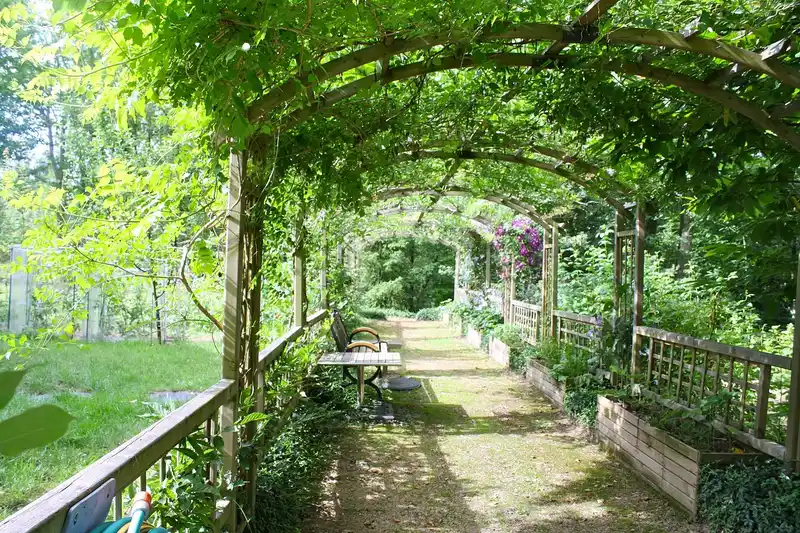

A pergola and an arbor do not ask the same things from wood. A pergola is a larger outdoor room with posts, beams, rafters, and a real load path. An arbor is a smaller decorative gateway, so lighter members can work if the piece is not carrying roof-like loads.
That difference matters more than species preference alone. A strong species in the wrong size can still sag. A naturally durable species in a thin, heavily loaded member can still crack, twist, or fail at the joint.
What a pergola needs from wood
A pergola needs lumber that can carry span, deflection, and wind uplift without moving too much. Posts, beams, rafters, and braces all matter. Concrete footings matter too, because the structure must stay planted while the frame carries overhead load and wind forces.
House of Hardwood lists pergola posts in 4×4, 6×6, 8×8, and larger dimensions, and beams in 4×10, 4×12, 6×10, 6×12, and oversized custom dimensions. That range is a clear signal: pergola wood choice starts with structure, not appearance.
What an arbor needs from wood
An arbor is smaller and lighter. Farrar Construction describes it as a small, decorative doorway, and their comparison table lists 4×4 posts for arbors. That is a very different job from a permanent outdoor room with broad beams and rafters.
For an arbor, visual stability and outdoor durability often matter more than long-span strength. Thin lattice, small posts, and light trim can be reasonable if the frame is not asked to do pergola work.
Why structural role comes first
Wood choice should follow the load, then the exposure, then the budget. A decorative member can use a different species from a beam. That saves money and avoids overspending on strength where strength is not the limiting factor.
It also prevents a common mistake: buying attractive cedar for every part, then discovering the structure still needs larger members or tighter spacing. Species does not replace sizing.
Which wood works best?
Douglas fir is the strongest all-around framing choice for many pergolas because it offers a high strength-to-cost ratio, but untreated Douglas fir is not naturally decay-resistant in the way cedar, redwood, or cypress are. Western red cedar is better for lighter decorative parts and small structures. Southern yellow pine can work when it is properly treated, kept dry enough for the service condition, and sized conservatively, but exposed heavy framing demands more attention to moisture content, grade, and design details.
For load-bearing pergola members, the best answer is often Douglas fir or Free of Heart Center Douglas fir. For smaller arbor parts, cedar often makes more sense. Pressure-treated lumber belongs in the conversation whenever the wood will stay exposed to weather.
Douglas fir for framing
Douglas fir is commonly recommended for pergola framing, especially for posts, beams, rafters, and braces. It is valued as a structural species rather than a decorative one.
The same source says Douglas Fir is denser than western red cedar. That density helps explain why it is favored for framing. It is not a magic fix, though. Exterior finishing and maintenance still matter outdoors.
House of Hardwood also describes Old Growth Douglas Fir as a dominant choice for pergola framing. That fits the structural role: it gives strong value where the members actually carry load.
Western red cedar for lighter parts
Western red cedar is naturally rot-resistant, lightweight, and stable. That makes it a good fit for smaller decorative outdoor structures and for noncritical parts of a pergola. It is often chosen for appearance, easy handling, and weather resistance.
But cedar is not the strongest framing choice. Lower load capacity in bending strength, compression, and shear, and says cedar structures may require posts positioned closer together or larger sizes. That is the key tradeoff.
In hot, wet, swinging climates, cedar can check more severely. The same source points to Texas conditions, with high summer heat and humidity swings increasing cracks. So cedar can be durable, but it is not immune to movement.
Southern yellow pine for budget builds
Southern yellow pine is common construction lumber and often cheaper than cedar or Douglas fir. It can be used outdoors, but the result depends heavily on treatment, moisture content, and whether the design keeps the wood out of persistently wet exposure. In larger members, warping and checking are common risks.
Use it carefully for pergola work. It is a budget option, not a default answer for exposed heavy framing. If you choose pine, treatment level and member size matter more than the label on the rack.
Where pressure-treated lumber fits
Pressure-treated lumber belongs in exposed outdoor conditions where decay risk is high and the species is otherwise not naturally durable enough. It is a common lower-cost option for pergola posts or ground-adjacent framing, especially where moisture is persistent.
That said, treatment does not remove movement, and it does not fix poor sizing. Posts in ground-contact or other high-moisture locations need the right treatment category for that exposure, while above-ground treated lumber is a different material choice. It can also affect appearance. For visible pergola parts, some homeowners prefer naturally durable species for the upper frame and reserve treated lumber for hidden or ground-contact areas.
FOHC lumber and grain movement
Free of Heart Center lumber reduces twisting and seasonal movement because it excludes the pith and center of the tree. For exterior structural work, that matters. The center of the log is where wood movement tends to create more distortion as moisture changes.
FOHC stock is not a cure-all, but it is a better starting point for posts, beams, and other exposed members that need to stay straighter over time. Grain orientation matters too. Straight, vertical grain is easier to keep stable than lumber cut around the center.
Why free of heart center stock moves less
FOHC lumber removes the most unstable core area from the board. That lowers the chance of twisting as the wood dries and then takes on outdoor moisture again. For pergola framing, that can mean straighter beams and fewer joint problems.
When a member twists, fasteners loosen and lines go out of square. On a pergola, that can show up as a bowed beam, a racked post, or a rafter that no longer sits flat.
Checking, twisting, and seasonal shift
Outdoor wood moves with weather. Dry heat opens checks. Rain and humidity change dimensions again. Larger members show these changes more clearly because they hold more internal stress.
A common first-timer mistake is using a cheaper, higher-moisture board for a visible pergola beam and expecting it to stay flat. Two seasons later, the beam can show checks at the ends and a slight twist that makes the whole roofline look off.
When clear grain matters most
Clear, straight grain matters most in posts, beams, and long rafters. It matters less in small trim pieces that are not spanning far. If the wood will carry load or define the structure line, grain quality should be part of the buying decision.
Pergola member sizing
Pergola sizing starts with load, not with species. A strong wood in too-small dimensions still sags. A decent wood in oversize dimensions may perform better than a fancier species that is undersized. For outdoor structures, the member size often drives the real-world result.
Post sizes and footing needs
For many pergolas, 6×6 posts are a common practical choice, and 8×8 posts are used when the span, height, or visual scale demands more stiffness. House of Hardwood lists 4×4, 6×6, 8×8, and larger dimensions for pergola posts. Smaller 4×4 posts are more typical of arbors than of larger pergolas.
Pergolas generally need concrete footings. That helps resist wind uplift and keeps posts from settling unevenly. A big outdoor room cannot rely on the same minimal support used by a lightweight decorative gateway.
Beam sizing and span limits
Beams need enough depth to resist sag over the span. House of Hardwood lists 4×10, 4×12, 6×10, 6×12, and oversized custom dimensions for beams. Those sizes exist because beam depth matters as much as species.
How much species affects span and sag depends on the member role. Douglas fir can give more capacity at a given size than cedar, while cedar may need closer post spacing or larger members. That is why species and spacing should be chosen together.
Rafter spacing and sag control
Rafters are smaller than beams, but they still carry the roof-like pattern of the pergola. House of Hardwood lists 2×6, 2×8, 2×10, and 2×12 for rafters. Wider spacing or longer runs call for more depth or closer spacing, depending on the design.
If rafters are too light, you get visible sag and a weaker line across the top. If they are too wet or too knotty, you can get uneven twist before installation is finished.
Braces, connectors, and uplift
Braces help resist sway and stiffen the frame. They matter when wind can rack the structure or when the top frame is tall enough to act like a sail. Connectors should be sized for the load path, not just for convenience.
For a pergola, uplift resistance is part of the design. For an arbor, that requirement is usually lighter, but the frame still needs enough anchoring to stay upright through weather and use.
What the decision matrix shows
This matrix separates structural importance from decorative use. It shows where Douglas fir usually gives the best value, where cedar makes sense, and where pressure-treated lumber is the practical lower-cost option. It also flags when member size should go up or a species should be avoided for the job.
| Part | Structural importance | Best-fit species | Minimum practical size | Outdoor durability tier | Common failure risk | Upsize or avoid if… |
|---|---|---|---|---|---|---|
| Posts | High | Douglas fir, FOHC Douglas fir, pressure-treated lumber | Pergola: 6×6; larger spans may need 8×8. Arbor: 4×4 | High if treated or naturally durable | Settlement, twist, base rot, uplift | Upsize when the pergola is tall, wide, or exposed to wind; avoid cedar 4x4s for large pergolas |
| Beams | High | Douglas fir, FOHC Douglas fir, pressure-treated lumber | Common ranges include 4×10, 4×12, 6×10, 6×12 | High if sealed and maintained | Sagging, checking, fastener loosening | Upsize if the span grows or if heavy shade slats are added; avoid cedar for long, lightly supported beams |
| Rafters | Medium to high | Douglas fir, cedar for lighter spans, pressure-treated lumber | Common ranges include 2×6, 2×8, 2×10, 2×12 | Medium to high | Deflection, twist, uneven line at the top | Upsize when spacing widens or the run length increases; avoid low-grade pine for exposed long rafters |
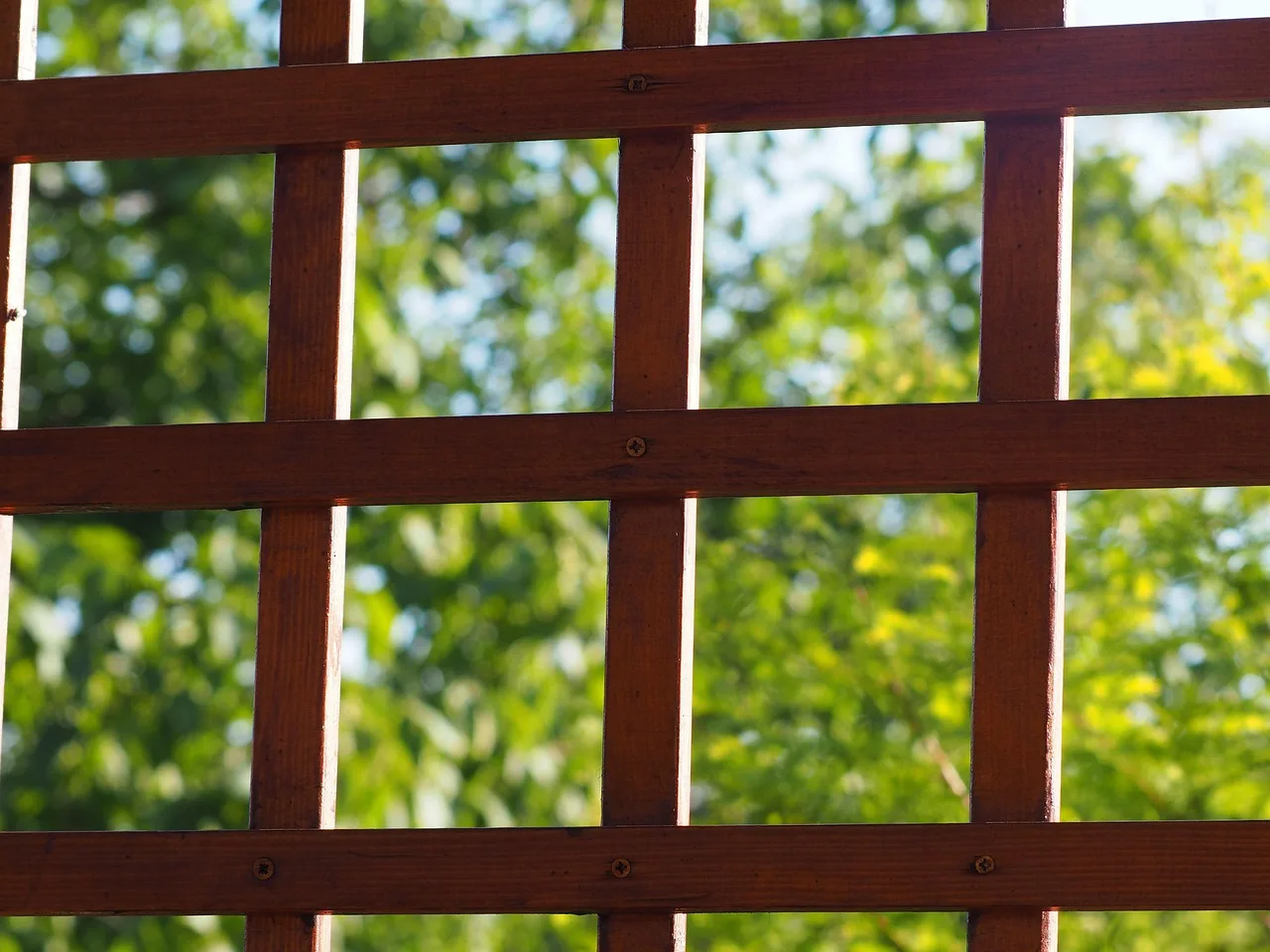
| Lattice | Low | Cedar, pressure-treated lumber, exterior-rated trim stock | Thin slats or small strips matched to layout | Medium | Warping, split ends, appearance loss | Use cedar for visible decorative work; avoid heavy species where the part only fills space |
| Trim | Low | Cedar, pine with treatment, exterior-rated trim stock | Small trim boards matched to detail work | Medium | Checking, paint failure, cupping | Use a more durable species when trim gets direct splash or direct sun; avoid overbuilding trim with structural lumber |
Can pine work outdoors?
Yes, pine can work outdoors if it is treated, detailed well, and used with caution. It is common and lower cost, but exposed heavy framing brings higher risk of warping, checking, and movement, especially in larger members. It is best treated as a budget option with limits.
For pergola structure, pine is acceptable when the wood is rated and protected for exposure, and when the design does not rely on slim members to do heavy work. For an arbor, it can be more workable because the loads are smaller.
Treatment level and exposure
Pressure treatment helps pine resist decay in outdoor service. It does not stop wood movement, and it does not make a weak span suddenly stiff enough for a larger pergola. The exposure level should guide how much protection you need.
Direct weather, wet soil, and trapped moisture call for more caution than a sheltered installation. If the part cannot dry, pine needs a stronger maintenance plan.
Where pine is acceptable
Pine is acceptable in smaller outdoor pieces, in hidden framing, and in projects where treatment is specified from the start. It can also work where budget matters more than a premium appearance, provided the builder uses the correct size and fastening details.
A small arbor with 4×4 treated posts and a light lattice top is a reasonable example. That is a reasonable place for pine. The same wood choice on a wide pergola with long beams and open exposure is a different story.
Common failure risks
The main risks are checking, twisting, and sagging. In larger exposed members, pine can move enough to affect alignment and joint tightness. That movement shows up first at the ends and at the fasteners.
If the piece is decorative, the risk is mostly appearance. If the piece is load-bearing, the same movement can reduce capacity and shorten service life.
When cedar is the better pick
Cedar is the better pick when the structure is smaller, the loads are lighter, and the owner values natural rot resistance and appearance. It is a strong fit for decorative arbors, light lattice, and trim where the wood is visible and not asked to carry a long span.
That does not make cedar weak in every case. It makes cedar better for the right job. In larger pergola framing, its lower load capacity can force closer post spacing or larger members.
Small decorative arbors
Arbors are usually the place where cedar shines. The structure is smaller than a pergola, often with 4×4 posts and light top pieces. Cedar’s lighter weight and natural decay resistance suit that use well.
For a garden gateway, a clean cedar frame can make sense without forcing the structure into oversized lumber. That is a good example of species following function.
Lower-load parts
Cedar works well in lattice, trim, and secondary pieces that do not carry the main load. It is also easier to handle in tighter decorative work where a lighter board matters more than raw capacity.
If you are deciding between cedar and Douglas fir for a noncritical cover board, cedar is often the better appearance-and-durability choice. If the same board is carrying weight, Douglas fir usually makes more sense.
Appearance versus strength
Do not confuse rot resistance with structural strength. Cedar can last well outdoors and still be the wrong pick for a long beam. Durability and load capacity are different questions.
That is why many good pergolas use cedar only where the part is not carrying the main load, while Douglas fir or treated lumber handles the frame.
Frequently asked questions
What is the best wood for pergolas and arbors?
For pergolas, Douglas fir is often the best structural value because it handles posts, beams, rafters, and braces well. For arbors, western red cedar is often the better fit because the structure is smaller, lighter, and more decorative. In humid or wet climates, naturally durable species or properly treated lumber need more attention to drainage, airflow, and maintenance than they do in dry climates. The best answer depends on load first, then exposure.
Is cedar or Douglas fir better for a pergola?
Douglas fir is usually better for a pergola frame because it has higher load capacity and is commonly recommended for structural members. Cedar is naturally rot-resistant and lighter, but it is less strong in bending, compression, and shear, so it often needs larger sizes or tighter spacing. If the project will stay exposed, connector choice and finish maintenance matter as much as species.
Do arbors need the same structural wood as pergolas?
No. Arbors are smaller decorative structures and often use 4×4 posts and lighter top pieces. Pergolas are bigger and need posts, beams, and rafters sized for span, wind uplift, and roof-like load. Using pergola-grade framing everywhere can waste money on an arbor.
What size lumber should I use for pergola posts and beams?
House of Hardwood lists pergola posts in 4×4, 6×6, 8×8, and larger dimensions, and beams in 4×10, 4×12, 6×10, 6×12, and oversized custom dimensions. For many pergolas, 6×6 posts are common, and 8×8 may be needed for larger spans or heavier designs. The exact size still depends on the span, spacing, and code for the project.
Can pine be used for an outdoor pergola?
Yes, but only with treatment, careful sizing, and realistic expectations. Southern yellow pine is common and lower cost, yet exposed heavy framing can show warping and checking. It is best for budget-conscious builds where the member sizes are generous, the treatment category matches the exposure, and maintenance is planned.
What wood lasts longest outdoors without rotting?
Naturally durable woods such as western red cedar last well outdoors, and pressure-treated lumber adds decay resistance where exposure is severe. For long service, species matters less than correct detailing, drainage, finish maintenance, and keeping the wood out of trapped moisture. No species ignores bad design.
Sponsored / affiliate links. As an Amazon Associate I earn from qualifying purchases. I may earn additional commission from eligible campaigns.