How to Adjust Cabinet Door Hinges (Fix a Sagging Door Fast)
A sagging or rubbing cabinet door is almost always a hinge-adjustment problem, not a broken hinge — concealed (European-style) hinges have three separate screws for height, side-to-side, and depth. Skipping the depth screw is the most common reason a “fixed” door still won’t close flush. This guide covers how to identify your hinge type, adjust each screw correctly, and fix a door that won’t latch.
Insert your Affiliate Disclosure reusable block here
Quick Answer
Concealed cabinet hinges adjust with three screws: turn the center screw to raise or lower the door, the side screw to shift it left or right, and the rear screw to change depth. Make quarter-turns only, testing after each one — over-turning any single screw is the most common mistake. Older butt hinges have no adjustment screws; use shims or a screw swap instead.
Why Do Cabinet Doors Need Adjusting?
Cabinet doors take daily abuse — opening, closing, and the occasional bump — so hinge screws gradually work loose and doors start to sag or hang crooked. Humidity swings also expand and contract the door and cabinet frame slightly, which is enough to throw a tight adjustment out of alignment within a season.
A door that rubs the frame, overlaps its neighbor unevenly, or won’t latch cleanly is telling you exactly which adjustment it needs. Diagnosing the specific symptom first — rather than guessing — is what makes the fix take minutes instead of an afternoon.
What Tools Will You Need?
Most cabinet hinge adjustments need only a screwdriver. Gather these before you start so you’re not hunting for tools mid-fix:
- Phillips screwdriver: fits nearly all concealed hinge adjustment screws.
- Small torpedo level: confirms the door edge is plumb after adjusting.
- Tape measure: checks that the reveal gap is even top to bottom.
- Shims: thin wood or plastic pieces for hinges with no adjustment screws.
- Replacement screws (longer/thicker): for stripped screw holes that won’t grip anymore.
Work with the cabinet door open and the space around it clear — you’ll be turning screws by feel in some positions, and a cluttered counter makes it easy to lose small parts.
What Types of Cabinet Hinges Do You Have?
A concealed hinge is a spring-loaded cabinet hinge that mounts entirely inside the cabinet frame and is invisible when the door is closed. It typically has three adjustment screws and is standard on most cabinets built since the 1990s. Older or budget cabinetry more often uses surface-mount or butt hinges instead, which adjust differently.
- Concealed (European) hinges: hidden inside the cabinet body; adjust up/down, left/right, and in/out via three screws. The most common type in modern kitchens.
- Soft-close hinges: a concealed hinge variant with a built-in hydraulic damper. Same three adjustment screws, plus a separate tension/force screw.
- Butt hinges: two flat plates, one on the door and one on the frame — the same style used on interior doors. No adjustment screws; fixed with tightening, shims, or a hinge swap.
- Surface-mount hinges: visible on the outside of the door, usually decorative. Limited adjustment — mostly just tightening.
Open the door and look at the hinge itself: if you see a round or rectangular cup recessed into the door with two or three screws on a metal plate, you have a concealed hinge. If you see two flat metal leaves joined by a pin, it’s a butt hinge.
Best Cabinet Hinge Replacement Pick
Ravinte Full Overlay Cabinet Hinges (2-Pack) – $7.39
If a single door is worn out or stripped rather than just misaligned, this 105° concealed hinge pair gives you the same three-screw height/side/depth adjustment this guide walks through, without buying a full box.
- Best for: replacing one worn or stripped hinge pair
- Why we picked it: same 3-way adjustment mechanism covered in this guide, full overlay fit
- Main drawback: sold as a single pair — not a fit for whole-kitchen replacements
Compare more cabinet hinge options
 Option 1 Chibery Soft-Close Hinges (2-Pack) – $8.99
|
 Option 2 Probrico Face-Frame Hinges (2-Pack) – $9.78
|
 Option 3 20-Pack Soft-Close Hinges – $24.69
|
As an Amazon Associate we earn from qualifying purchases.
How to Spot the Problem
Open the door — does it sag lower on one side? Close it — does it rub the frame or the neighboring door? Run a level along the top edge; if it’s not level, the height screw needs adjusting. Check the gap between the door and the frame all the way around: an uneven gap means the door needs a side-to-side or depth correction, not a height fix.
Also test the latch: does the door click shut fully, or stop short and bounce back? That symptom usually points to depth adjustment or a misaligned door latch rather than a hinge height problem. Identifying the exact symptom before touching a screw is what keeps the fix to one or two turns instead of several rounds of guessing.
How to Adjust Concealed Cabinet Hinges
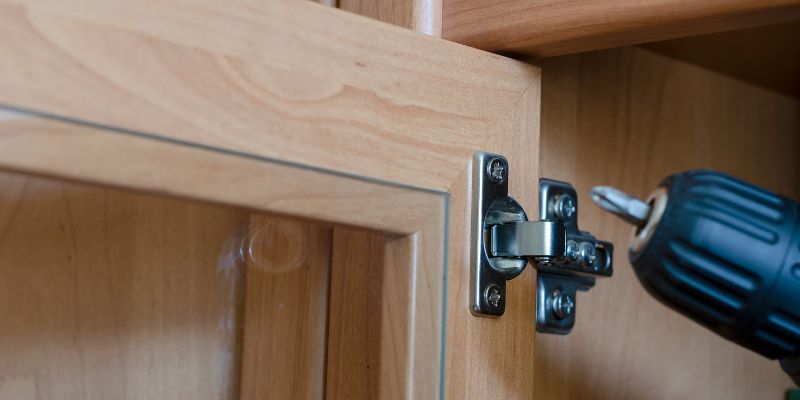
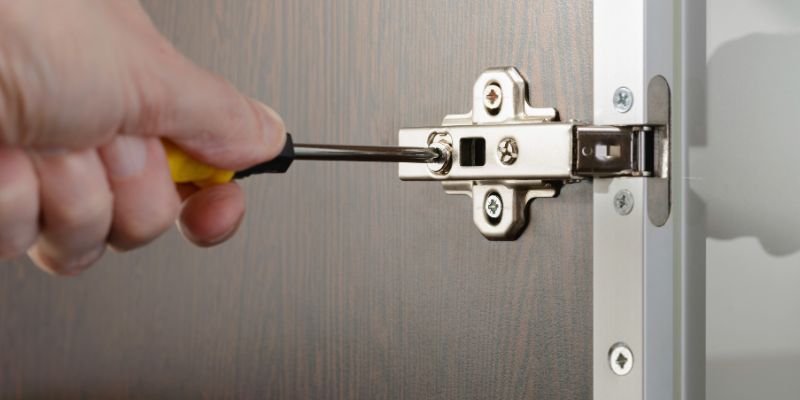
Concealed hinges have three adjustment screws, each controlling a different axis of movement:
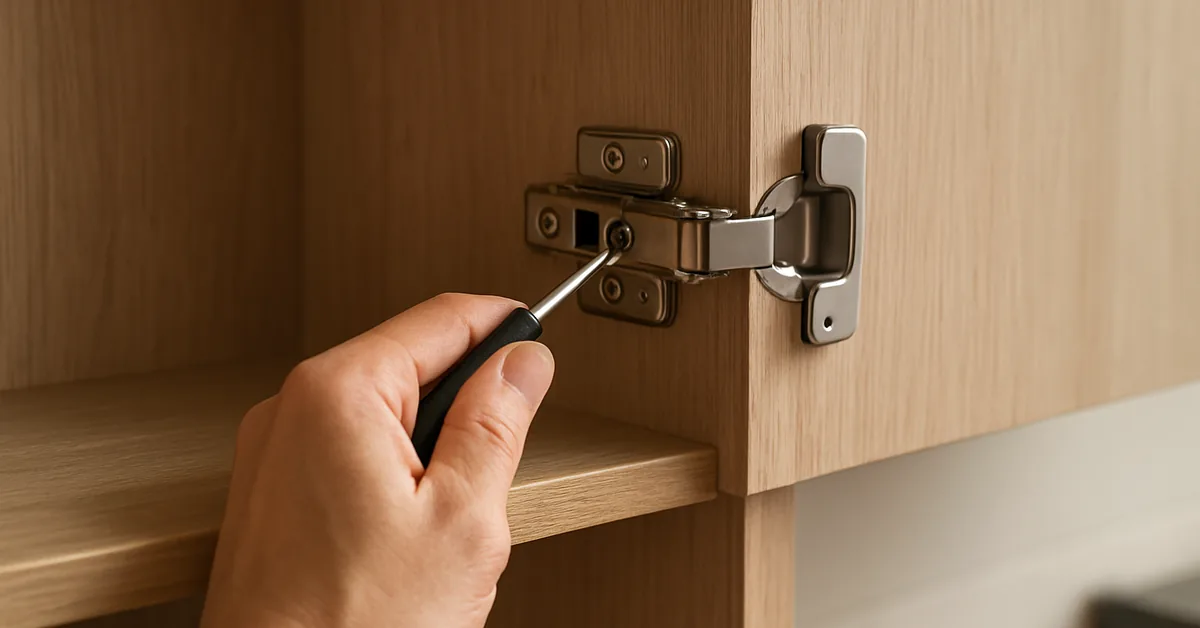
- Find the height screw: it’s the center screw on the mounting plate. Turn it clockwise to lift a sagging door, counterclockwise to lower one that sits too high.
- Adjust side-to-side: turn the screw on the hinge arm closest to the door to shift it left or right, fixing uneven overlap with the neighboring door.
- Adjust depth: turn the rear screw to move the door in or out — clockwise pulls it closer to the cabinet, counterclockwise pushes it out. This is the screw most people skip, and it’s usually why a door still won’t sit flush after height and side adjustments look fine.
- Test after every quarter-turn: close the door and recheck the gap before making another adjustment. Small movements compound quickly.
Most doors line up within 10 minutes once you know which screw controls which symptom.
How Much Gap Should There Be Between Cabinet Doors?
Aim for a consistent 1/16″ to 1/8″ reveal between adjacent cabinet doors and between the door and the frame. Measure from the same reference point on each door — top and bottom — rather than eyeballing it, since a gap that looks even can still be off by enough to cause rubbing lower down.
📊 Standard cabinet door reveal is 1/16″ to 1/8″ (roughly 2–3mm) on all sides — Source: General face-frame and frameless cabinetry fabrication practice (no single manufacturer standard; confirmed across multiple cabinet-maker technical guides).
How to Adjust Butt Hinges
Older cabinets and some budget lines use butt hinges — two flat plates with no adjustment screws. Start by tightening every screw on both the door-side and frame-side plates; a wobbling door is very often just loose screws, not a misaligned hinge.
If the door still sags after tightening, add a shim: loosen the frame-side screws, slip a thin piece of wood or plastic behind the hinge plate, then retighten. Close the door to check — if it still rubs or the gap is uneven, a second shim on the opposite hinge usually corrects it. If the hinge itself is worn or rusted rather than just loose, replace it — bring the old hinge to the store so the screw-hole spacing matches exactly.
Can You Adjust Soft-Close Hinges That Won’t Close All the Way?
Yes — a soft-close door that stops short or bounces back is almost always a misalignment issue, not a failed damper. Tighten every screw first, since a loose hinge won’t let the soft-close mechanism engage correctly. If it’s still not latching, use the depth screw to pull the door slightly closer to the cabinet — most soft-close hinges include a separate tension screw as well, which increases or decreases how much resistance the damper applies as the door swings shut.
If the door still won’t close after alignment and tension adjustments, the hydraulic damper itself has likely worn out — at that point, replacing the hinge is faster than continuing to chase the adjustment.
How to Fix a Door That Won’t Close Properly
If the latch doesn’t catch the strike plate, first check hinge alignment with a level — a door that’s off-plumb often misses the strike plate even when the latch itself works fine. Adjust the hinges as covered above, then retest.
If the latch still misses, loosen the strike plate screws and shift the plate slightly — up, down, or sideways — to line it up with the latch bolt, then retighten. If a gap remains, a shim behind the plate closes it. Test by closing the door normally; you should hear one clean click, not a scrape or a bounce.
What If Hinges Are Loose or Worn?
Loose screws are the single most common cause of a wobbling cabinet door. Tighten them first — if a screw spins without gripping, the hole is stripped. Switch to a longer or thicker screw rather than continuing to force the original one; a stripped hole rarely holds long-term.
If a screw hole has worn too large for any replacement screw to grip, see this guide on fixing oversized hinge screw holes before assuming the hinge or door needs replacing. For a hinge that’s simply old and rusted rather than stripped, unscrew it and match a new one to the existing holes.
How to Test Your Adjustments
Open the door and check it sits level with a torpedo level. Close it — there should be no rubbing and no gap wider than 1/8″ anywhere along the edge. Open and close the door a few times to confirm smooth motion and a solid, single-click latch. Five minutes of testing now saves a return trip to the same hinge next week.
How to Maintain Your Cabinet Hinges
A few minutes of upkeep a couple of times a year prevents most sagging-door calls before they start:
| Task | How Often | What to Do | Why It Helps |
|---|---|---|---|
| Tighten screws | Every 3–6 months | Screwdriver, turn clockwise | Stops sagging before it starts |
| Clean dust and grime | As needed | Wipe hinge with a dry rag | Prevents sticking |
| Check alignment | Every 6 months | Level against the door edge | Catches drift from humidity changes |
| Lubricate hinge pin/pivot | Once a year | Light dab of household oil, wipe excess | Keeps the pivot moving smoothly |
Common Mistakes to Avoid
- Turning one screw too far: make quarter-turns and test after each one — a full turn on a concealed hinge screw can overcorrect the door past where it started.
- Adjusting only one hinge: a two-hinge door usually needs a small correction on both hinges, not a large one on a single hinge.
- Skipping the depth screw: height and side adjustments alone won’t fix a door that won’t sit flush against the frame.
- Forcing a stripped screw: re-driving the same screw into a stripped hole won’t hold — move to a longer/thicker screw or a hinge-hole repair instead.
“Most concealed cabinet hinges allow roughly 2mm of adjustment per screw turn on each axis — small, incremental turns are how the hinge is designed to be adjusted, not a sign of a defective part.”
Frequently Asked Questions
Why do my cabinet doors sag or hang crooked?
Yes, this is normal wear — hinge screws loosen over time from daily use, and humidity swings shift the wood slightly. Tightening the screws or adjusting the height screw on a concealed hinge fixes most sagging without any parts replacement.
What tools do I need to adjust cabinet door hinges?
A Phillips screwdriver handles almost every concealed hinge adjustment. A small level and tape measure help you confirm the fix, and shims or replacement screws are only needed for older butt hinges or stripped screw holes.
How do I know what type of hinges I have?
Open the door and look. A round or rectangular cup recessed into the door with two or three screws on a metal plate is a concealed hinge. Two flat metal leaves joined by a pin, visible from outside the cabinet, is a butt hinge.
How much gap should there be between cabinet doors?
Aim for 1/16″ to 1/8″ on all sides — between adjacent doors and between the door and the cabinet frame. Measure at the top and bottom of each gap rather than just checking the middle, since an uneven gap often shows up more at one end.
Can soft-close cabinet hinges be adjusted the same way?
Yes. Soft-close hinges use the same height, side, and depth screws as standard concealed hinges, plus a separate tension screw that controls how much resistance the damper applies as the door closes.
Can I adjust old butt hinges the same way as concealed hinges?
No — butt hinges have no adjustment screws. Tighten the mounting screws first, add a shim behind the hinge plate if the door still sags, or replace the hinge entirely if it’s worn.
Once your cabinet doors sit level and close with a single clean click, the fix is done — recheck alignment every six months, since the same humidity swings that caused the original sag will gradually shift it again. For hinge issues on interior or entry doors rather than cabinets, see our guide on leveling a door with hinges, or browse more door hardware and lock repair guides.
Sponsored / affiliate links. As an Amazon Associate I earn from qualifying purchases. I may earn additional commission from eligible campaigns.
 Probrico Interior Black Door Hinges, 3.5 X 3.5 Inch Round Door Hinges with 1/4" Radius Corners, Black Hinges for Doors, 30 Pack
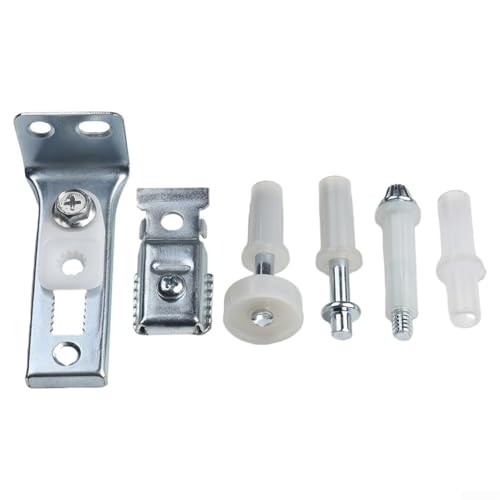 Bi-Fold Door Hardware Repair Kit, Fits 1" to 1-3/8" Thick Closet or Room Doors, Includes Top and Bottom Brackets, Pivots, Guide Wheel for Smooth Operation and Easy Installation