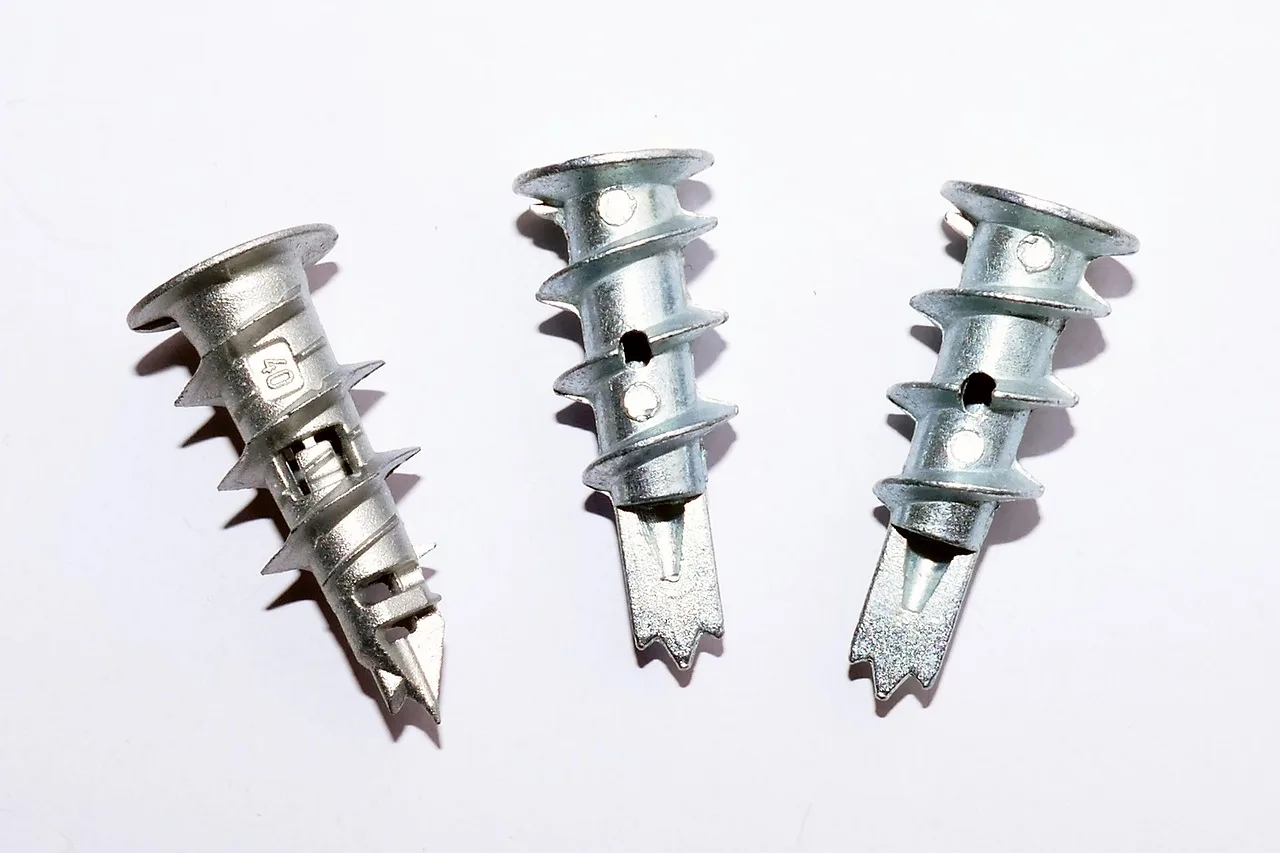
How to Install Hollow Wall Anchors in Drywall
Use a hollow-wall anchor only when the drywall is sound and the fastener will carry a light to moderate load; for loads heavier than about 20 pounds per anchor, a toggle or a stud is commonly recommended, but the exact maximum is product-specific and depends on the fixture, wall condition, and installation. A poor anchor choice can leave loose screws, damaged drywall, and dropped fixtures. This guide shows how to choose the right anchor, install it cleanly, and recover when the hole strips out or the anchor fails.
What you’ll need


- Stud finder
- Pencil
- Level
- Tape measure
- Drill or screwdriver, depending on anchor type
- Correct drywall anchor for the job
- Drywall screw that matches the anchor
- Safety glasses
- Vacuum or brush for dust
Drywall anchor basics
Drywall anchors add holding power to hollow drywall when there is no stud where you need one. The anchor spreads the load across more of the wall than a screw alone, but the wall still has limits. Weight rating, load direction, and drywall condition all matter, and manufacturer instructions should always control final size and load limits.
A single fastener driven into a stud can hold much more than a typical hollow-wall anchor, but the exact capacity depends on the stud, screw, and fixture. By contrast, threaded drywall anchors are commonly listed in product-specific ranges around 25 to 75 pounds, and plug-style drywall anchors are usually for lighter-duty jobs up to about 25 pounds. Those numbers are not a promise for every wall or fixture. For anchor selection and weight-rating basics, follow the anchor maker’s instructions and a neutral guide to drywall anchor selection such as anchor by weight.
What hollow drywall can and cannot hold
Hollow drywall can hold framed art, towel bars, small mirrors, and similar items when you match the anchor to the load and the wall condition. It is a poor match for heavy cabinets, televisions, or any fixture that creates high leverage or needs a stud-based mounting system. If the item pulls away from the wall or the anchor spins, the anchor is the wrong choice.
Which anchor should you use?
Start with the stud finder. If you can land the fastener in a stud, that is usually the better choice. If no stud is available, choose the anchor by weight and by how the load acts on the wall. Pulling straight out is easier on the anchor than a shelf or bracket that creates torque. For a step-by-step installation example for one style, see self-drilling anchors.
Say your framed print weighs about 8 pounds and hangs flat. A light-duty anchor is usually enough if the drywall is sound. Suppose a towel bar is used daily and sees repeated tugging. Pick a stronger anchor than you would for a picture frame, even if the weight is similar, because the load keeps moving.
Can you use drywall anchors in hollow doors? Sometimes, but not automatically. Hollow doors, plaster over lath, and other hollow substrates are not the same as drywall. Check the substrate first and follow the hardware maker’s instructions for that material. If the product is not approved for the surface, use different hardware.
When a stud is the better choice
Use a stud whenever the item is heavy, the load sticks far from the wall, or the anchor is likely to see repeated stress. A stud can take much more than a typical hollow-wall anchor, but the exact holding power still depends on the framing and screw choice. If you can shift the mounting point to a stud without changing the layout too much, do that first.
When to choose a toggle bolt
Choose a toggle bolt when the drywall is sound, the fixture is too heavy for a light anchor, and there is no stud where you need one. Toggle bolts spread the load behind the drywall and are a common choice for shelving, mirrors, and other moderate-to-heavier hollow-wall jobs. Use the manufacturer’s hole size and weight guidance, since capacity is product-specific.
When to choose a molly or hollow-wall anchor
Choose a molly or other hollow-wall anchor when you need more holding power than a plastic anchor can provide, but the fixture still does not justify a toggle bolt or a stud. These anchors expand behind the wall and work best in sound drywall. Use the maker’s listed bit size and screw size, because mismatch can cause spin-out or weak grip.
Drywall anchor selector table
| Anchor type | Hole prep | Drill-bit rule | Typical load range | Best use case | Wrong choice for | Common failure mode |
|---|---|---|---|---|---|---|
| Self-drilling drywall anchor | Usually no pre-drilling | No bit required unless it is hard to start; then use a pilot hole smaller than the anchor, per the manufacturer’s instructions | Light to medium duty; product-specific maximums are commonly listed around 25 to 75 pounds | Fast installs for pictures, towel rings, and other moderate loads | Shelves, TVs, cabinets, and fixtures with high leverage or repeated pull | Can strip the paper face or spin if forced in too hard |
| Plastic expansion drywall anchor | Needs a pilot hole | Use a hole that matches the anchor diameter; the anchor should fit snugly and the screw should match the anchor size | Up to about 25 pounds, but only as the product label allows | Lighter-duty hanging where the screw will expand the anchor | Cabinets, TVs, shelving, and any load that creates leverage or repeated stress | Oversized hole leads to pullout |
| Toggle bolt | Needs a larger hole for the toggle to pass through | Use the manufacturer-specified bit size and do not enlarge the hole beyond that | Product-specific maximums; often used for medium to heavier hollow-wall loads | When the fixture needs stronger hollow-wall support and no stud is available | Very thin drywall, cracked drywall, or holes too close to an edge | Toggle may not open correctly or the wall may crumble if the hole is wrong |
| Molly or hollow-wall anchor | Needs a pilot hole sized to the anchor | Use the specified bit size, not a guess, and match the screw to the anchor | Varies by model; product-specific maximums apply | Moderate-duty hollow-wall fastening where a more secure grip is needed | Heavy cabinets, large TVs, and fixtures that need stud mounting | Wrong bit size or poor seating causes wobble and pullout |
Quick troubleshooting checklist: if the anchor spins, the hole is likely oversized; if the face crumbles, the wall is too damaged or the screw was overtightened; if the fixture leans, the anchor may be too light-duty; and if the load is heavy or far from the wall, switch to a stud or a toggle-rated solution.
How do you install a drywall anchor?
Mark the wall, verify the spacing, and pick the right anchor before you drill. Most failures happen because the hole is wrong, the anchor is the wrong type, or the screw is driven too hard. Keep the anchor flush with the wall and stop as soon as it seats cleanly.
Self-drilling anchor installation
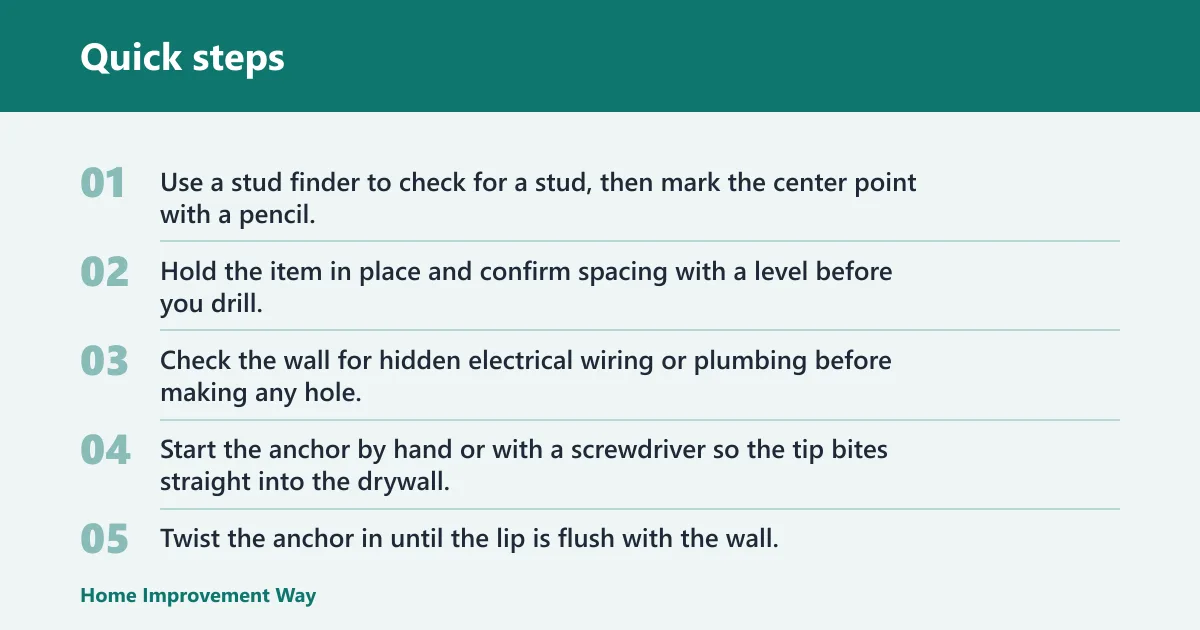
- Use a stud finder to check for a stud, then mark the center point with a pencil.
- Hold the item in place and confirm spacing with a level before you drill.
- Check the wall for hidden electrical wiring or plumbing before making any hole.
- Start the anchor by hand or with a screwdriver so the tip bites straight into the drywall.
- Twist the anchor in until the lip is flush with the wall; stop when the flange seats and do not keep turning after it bottoms out.
- Match the screw to the anchor size, then insert the drywall screw and tighten it only until the fixture is secure.
Plastic expansion anchor installation
- Use a stud finder to check for a stud, then mark the center point with a pencil.
- Hold the item in place and confirm spacing with a level before you drill.
- Check the wall for hidden electrical wiring or plumbing before making any hole.
- Drill the pilot hole to the manufacturer’s size so the anchor fits snugly.
- Tap the plastic anchor into the hole until it sits flush with the wall face.
- Insert the matching screw and tighten only until the anchor expands and the fixture is secure; stop before the screw strips or the anchor starts to spin.
A cordless drill can drive anchors carefully, but it can strip drywall if used too aggressively. A screwdriver gives more control, especially for self-drilling anchors that start by twisting. The screw should never be cranked down past the point where the anchor stops turning and the fixture sits flat.
Some anchor styles need a manufacturer-sized hole rather than a smaller one. That is why the label matters. A pilot hole should be slightly smaller than the anchor only for styles that call for that approach, while expansion anchors usually need a hole that is about the same size as the anchor diameter. Always match the screw size to the anchor so the threads engage as designed.
How do you know the anchor is seated correctly?
A seated anchor should sit flush, should not wobble, and should not spin when the screw is tightened by hand. Before hanging the full load, give the anchor a light test with the screw or fixture. If the face of the drywall crumbles or the anchor rotates, stop and reset the hole.
Picture a towel bar bracket that feels loose after installation. Back the screw out, inspect the hole, and make sure the anchor lip is flush. If the hole has opened up, move to a fresh spot or use a different anchor style that is designed for a larger grip area.
If that didn’t work, try this next
- If the anchor spins, remove it and move the hole at least a short distance away in sound drywall.
- If the hole is oversized, switch to a larger compatible anchor only if the manufacturer allows it; otherwise patch the hole and start over.
- If the anchor pulls out during testing, use a stronger anchor style or find a stud.
Common mistakes
Spinning anchor, oversized hole, crumbled paper, and pullout after tightening are the usual failures. They all point to the same problem: the anchor and the wall do not match well enough for the load.
- Spin-out: The hole was too large or the anchor was driven too hard. Start over in fresh drywall.
- Oversized hole: The pilot hole was too big for the anchor style. Use the correct bit size next time.
- Paper crumbling: The screw was overtightened or the drywall face was weak. Stop when the anchor is seated.
- Pullout: The load is too heavy, too far from the wall, or the anchor style is too light-duty. Move to a stud or a stronger hollow-wall anchor.
Prevention is simple here: match the anchor to the load, use the right hole size, and stop tightening as soon as the anchor and fixture are snug.
Frequently asked questions
How do you put drywall anchors in the wall?
For self-drilling styles, twist the anchor in until the lip is flush. For plastic expansion anchors, drill the proper hole first, tap the anchor in if needed, and then insert the screw. The anchor should fit snugly, not loosely. If it wobbles before the screw goes in, the hole is wrong.
Can you use drywall anchors in hollow doors?
Sometimes, but not by default. Hollow doors are a different substrate, and many anchors made for drywall are not the right choice there. Check the door material and the hardware maker’s instructions before drilling. If the load is important or the door skin is thin, use hardware made for hollow doors instead.
What size drill bit do I need for drywall anchors?
Use the anchor maker’s listed size whenever it is provided. Expansion anchors usually need a pilot hole that matches the anchor diameter, while some self-drilling anchors need no drill at all. If a self-drilling anchor is hard to start, use a smaller pilot hole rather than forcing it into the wall. Follow the product instructions rather than guessing.
How much weight can drywall anchors hold?
It depends on the anchor type, the drywall condition, and whether the load pulls straight out or acts like a lever. Product-specific maximums vary widely, with some threaded drywall anchors commonly listed around 25 to 75 pounds and plug anchors generally used for lighter loads up to about 25 pounds. Treat every rating as conditional, not universal.
What happens if a drywall anchor spins in the wall
The hole is usually too large, the wall face is damaged, or the anchor is the wrong style for the load. Back the screw out, remove the anchor, and move to a fresh spot in solid drywall. If the new hole would land too close to the old one, switch to a different anchor style or find a stud.
Sponsored / affiliate links. As an Amazon Associate I earn from qualifying purchases. I may earn additional commission from eligible campaigns.