Is Chopping Wood A Physical Or Chemical Change
Many people wonder Is Chopping Wood a Physical or Chemical Change?. It seems like a simple question, but it can sometimes be tricky to figure out. You might be a student learning about science or just curious about the world around you.
Don’t worry, this post will make it super clear! We’ll break it down step by step so you can easily tell the difference. Get ready to learn how to spot a physical change versus a chemical one!
Understanding Physical and Chemical Changes
In the world of science, we often talk about changes that happen to matter. These changes can be put into two main groups: physical changes and chemical changes. Knowing the difference helps us understand how things work.
This section will explore what makes a change physical and what makes it chemical. We will look at the core ideas behind each type of transformation.
What Is a Physical Change?
A physical change is when something changes its form or appearance, but its chemical makeup stays the same. Think about water. It can freeze into ice or boil into steam, but it’s still H2O.
No new substance is created. The molecules themselves are not altered. The particles are just arranged differently or have more or less energy.
Physical changes are often reversible. This means you can usually turn the substance back into its original state. For example, you can melt ice back into water.
You can also evaporate water and then condense it back into liquid form. This reversibility is a strong indicator of a physical change.
Examples of physical changes include:
- Melting ice: Solid water turns into liquid water.
- Boiling water: Liquid water turns into steam, a gas.
- Breaking glass: The glass is in smaller pieces, but it is still glass.
- Dissolving sugar in water: The sugar spreads out in the water but can be recovered by evaporating the water.
- Cutting paper: The paper is in smaller pieces, but it’s still paper.
Each of these involves a change in shape, size, or state, but the fundamental substance remains unchanged. The bonds between atoms within the molecules do not break or form new ones.
What Is a Chemical Change?
A chemical change, also known as a chemical reaction, happens when a substance is transformed into one or more new substances. This involves rearranging atoms and forming new chemical bonds. The original substance is no longer present in its original form.
A new substance with different properties is created.
Chemical changes are typically not easily reversible. Once a chemical change occurs, it’s hard to get the original materials back. For instance, when wood burns, it turns into ash, smoke, and gases.
You can’t easily turn that ash and smoke back into wood.
Signs that a chemical change has occurred include:
- A change in color: Like leaves changing color in the fall or iron rusting.
- The production of a gas: Seen as bubbles, like when baking soda reacts with vinegar.
- The formation of a precipitate: A solid that forms in a liquid solution.
- A change in temperature: The reaction might release heat (exothermic) or absorb heat (endothermic).
- The production of light or sound: Like fireworks or a combustion engine.
These signs indicate that new chemical bonds have been broken and new ones have been formed. The atoms have been rearranged to create entirely new molecules with different characteristics.
Is Chopping Wood a Physical Or Chemical Change?
Now that we know the basics of physical and chemical changes, we can tackle our main question: Is Chopping Wood a Physical Or Chemical Change? This is a great example to test your understanding. We will look closely at what happens when wood is chopped and apply our scientific definitions.
When we chop wood, we are essentially breaking down a larger piece of wood into smaller pieces. The wood is still wood, just in a different size. We are not creating any new substances.
The material’s chemical composition remains the same throughout the process.
Let’s consider the properties of wood before and after chopping. Before chopping, we have a large log. After chopping, we have smaller logs or kindling.
The color, smell, and chemical makeup of the wood itself have not changed. We haven’t introduced new elements or compounds.
The process of chopping involves applying force to break the wood apart. This force overcomes the intermolecular forces holding the wood fibers together, but it does not break the chemical bonds within the cellulose and lignin that make up the wood. This distinction is key to classifying the change correctly.
Therefore, chopping wood is a classic example of a physical change. It alters the size and shape of the wood but not its fundamental chemical identity. This concept is important for understanding many everyday phenomena.
The Mechanics of Chopping Wood
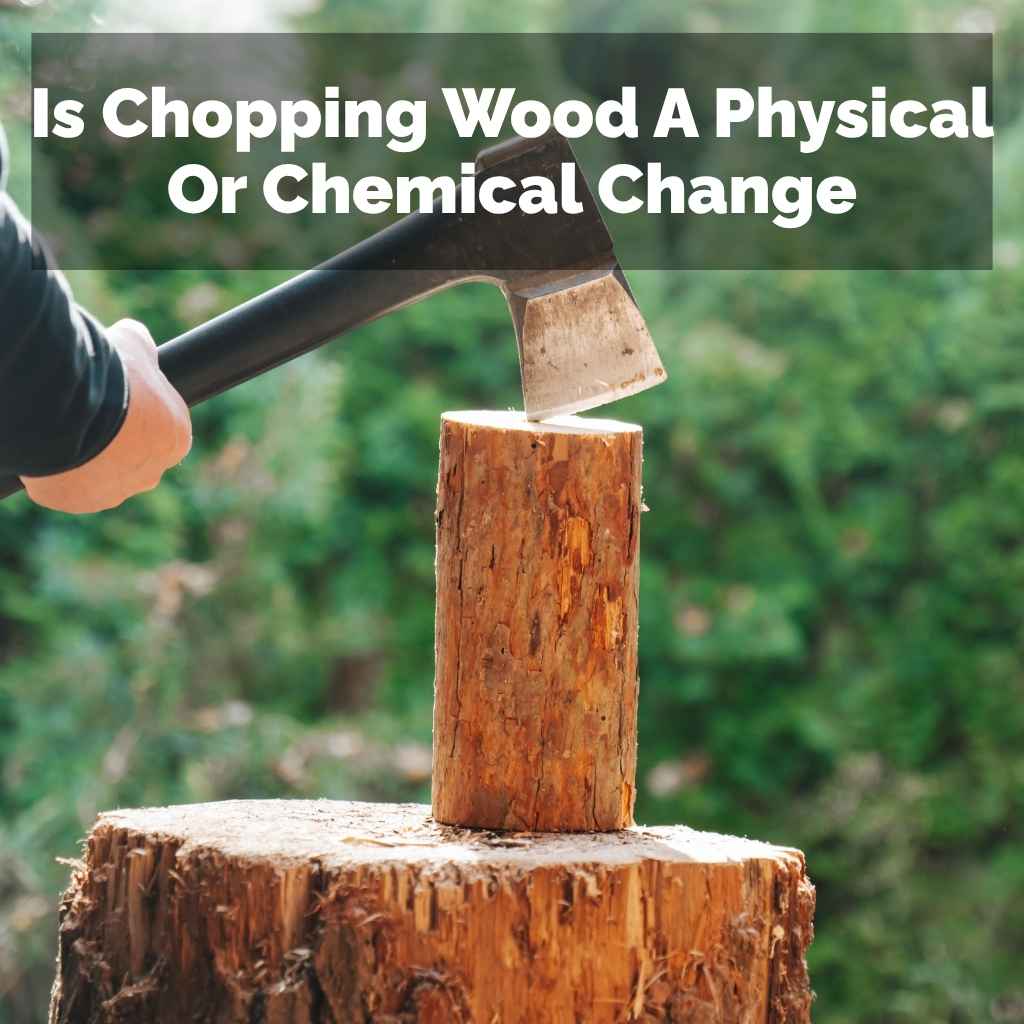
Chopping wood involves using an axe or a saw to divide a piece of wood. This action exerts mechanical energy on the wood fibers. The wood’s structure is broken at a macroscopic level, separating it into smaller sections.
The primary goal is division, not transformation into a new material.
Imagine the wood as a large bundle of tiny sticks tied together. When you chop it, you are cutting the ties that hold these bundles together and then cutting the bundles themselves. The tiny sticks (wood molecules) remain intact.
Their chemical bonds are not broken.
The tools used, like an axe, are designed to cut and split. They apply pressure and shear forces. These forces are strong enough to overcome the physical bonds between wood cells and between molecules in those cells.
However, they are not energetic enough to break the strong covalent bonds within the cellulose, hemicellulose, and lignin molecules.
The process is similar to cutting a piece of paper with scissors. The paper is now in smaller pieces, but it is still paper. The chemical composition of the paper has not changed.
It’s just a different arrangement of the same material.
The result of chopping is wood that is easier to handle, store, or burn. However, the material itself is fundamentally the same. It retains all its original chemical properties and potential for combustion.
Comparing Chopping to Other Wood Transformations
To further illustrate why chopping wood is a physical change, let’s compare it to what happens when wood undergoes a chemical change. Burning wood is a prime example of a chemical change.
When wood burns, it reacts with oxygen in the air. This reaction breaks down the complex organic molecules in wood, like cellulose and lignin, into simpler substances. These new substances include ash (minerals), carbon dioxide gas, water vapor, and various other gases and particles released as smoke.
This is a chemical change because the original wood is transformed into entirely new materials. The ash is a solid residue with a different composition than wood. Carbon dioxide is a gas that was not present in the original wood.
You cannot reverse the burning process to get the original log back.
Another chemical change related to wood is rotting or decomposition. When wood decomposes, it is broken down by microorganisms like fungi and bacteria. These organisms consume the wood’s organic matter and convert it into simpler compounds, often releasing gases like methane.
This also fundamentally alters the wood’s chemical makeup.
So, while chopping wood only changes its size and shape, burning or rotting wood involves creating completely new substances. This contrast clearly highlights the difference between physical and chemical transformations in the context of wood.
Evidence Supporting Chopping Wood As A Physical Change
We can look at several pieces of evidence to confirm that chopping wood is indeed a physical change. These indicators align perfectly with the definition of a physical transformation, where the substance’s identity remains constant.
One key piece of evidence is the lack of new substance formation. When wood is chopped, you get smaller pieces of wood. You don’t get ash, smoke, or any new chemical compounds.
The material you started with is the same material you end up with, just in a different form. This is a hallmark of a physical change.
Another strong piece of evidence is the reversibility of the process, at least in principle. While you can’t easily glue the chopped pieces back together perfectly, the wood itself hasn’t changed its chemical nature. If you were to somehow reassemble the pieces, the chemical composition of the entire log would remain the same.
Contrast this with burning, which is irreversible in practice.
The properties of the wood also remain largely the same. The wood still has its characteristic density (though now it might be slightly different per piece due to air pockets), its flammable nature (it will still burn), and its chemical composition. These fundamental properties are indicators that no chemical reaction has taken place.
Consider the energy involved. Chopping wood requires energy to break the physical bonds, but it doesn’t involve the significant energy release or absorption typical of chemical reactions, like combustion. The energy input is used to overcome intermolecular forces, not to break and form chemical bonds within molecules.
Finally, scientific analysis confirms this. Chemical tests on the chopped wood would yield the same results as tests on the original log. The elemental composition and molecular structure remain unchanged.
Observing Wood After Chopping
When you look at wood after it has been chopped, it’s still wood. You can see the grain, feel its texture, and smell its familiar scent. These sensory observations are important clues.
They tell us that the fundamental nature of the material hasn’t been altered.
The color of the wood remains the same, although new surfaces might appear lighter or darker depending on how the cut was made and the type of wood. The chemical compounds that give wood its color are still present. No new pigments have been formed.
The density of the chopped pieces might slightly differ from the original log due to the creation of new surfaces and potential air gaps. However, the intrinsic density of the wood material itself has not changed. This is a physical property, not a chemical one.
The flammability of the wood is also a key indicator. Chopped wood will still burn, producing ash, smoke, and gases, just like an unchopped log. This ability to burn is a chemical property of wood, and since that property is retained, it suggests no chemical change has occurred during chopping.
Furthermore, if you were to analyze a sample of chopped wood at a molecular level, you would find the same arrangement of carbon, hydrogen, and oxygen atoms bonded together in cellulose, lignin, and other organic compounds as you would in an unchopped log. The bonds within these molecules remain intact.
These consistent observations reinforce the idea that chopping wood is a change in form, not a change in substance. The wood has been divided, but it has not been chemically transformed.
The Role of Energy In Chopping
Energy plays a role in all changes, but the type and amount of energy involved can tell us a lot about whether a change is physical or chemical. Chopping wood requires energy to happen.
The energy needed for chopping is primarily mechanical energy. This energy is used to overcome the physical forces that hold the wood fibers together. Think of it like pushing a large number of tiny threads apart.
You need force to break those connections, but the threads themselves remain intact.
These physical forces are often called intermolecular forces. They are weaker than the chemical bonds that hold atoms together within molecules. When you chop wood, you are essentially breaking these weaker intermolecular forces, which causes the wood to split or break apart.
In contrast, chemical changes, like burning, involve breaking and forming much stronger chemical bonds. These reactions often release a significant amount of energy (like heat and light in a fire) or require a large input of energy to start. The energy changes in chemical reactions are typically much greater than those in physical changes.
For chopping wood, the energy input is directly related to the work done in splitting the material. It’s an applied force that causes the wood to fracture. There isn’t a spontaneous release or absorption of energy that would indicate a chemical transformation is occurring.
This difference in energy requirements and outcomes is a crucial factor in distinguishing between physical and chemical changes. Chopping wood’s energy profile is characteristic of a physical process.
The Process of Chopping Wood Explained
To fully grasp why chopping wood is a physical change, let’s break down the actual process. It’s a simple mechanical action that has a clear outcome in terms of the material involved.
The process begins with a solid piece of wood, often a log or a thicker branch. This wood is composed of long, fibrous cells made primarily of cellulose and lignin. These materials give wood its strength and structure.
When you chop wood, you use a tool like an axe or a maul. This tool is swung with force. The sharp edge of the tool strikes the wood.
The impact creates immense pressure on a small area of the wood.
This pressure causes the wood fibers to split apart. The fibers themselves, which are made of molecules, are not broken down. Instead, the connections between these fibers and between the cells are severed.
The wood essentially separates along its natural grain.
The result is two or more smaller pieces of wood. These pieces are still chemically identical to the original piece. They have the same atoms bonded in the same way.
The wood has been divided, but not changed in its fundamental composition.
Imagine cutting a piece of string. You use scissors to sever the fibers. The fibers are now in shorter lengths, but each fiber is still made of the same material.
Chopping wood is a similar concept but on a much larger and more complex scale.
The process does not involve any new elements being added or any atoms being rearranged to form new molecules. It is purely a mechanical separation of existing material.
What Happens To Wood Molecules When Chopped
When wood is chopped, the molecules that make up the wood remain intact. Wood is composed mainly of cellulose, hemicellulose, and lignin. These are complex organic molecules made up of carbon, hydrogen, and oxygen atoms.
Cellulose, for example, is a long chain of glucose units linked together. These glucose units are held together by strong covalent bonds. When you chop wood, the axe blade passes between these cellulose fibers and between the cells that contain them.
The covalent bonds that hold the atoms together within the cellulose molecules are not broken. The bonds that hold the glucose units together in the long chains are also not broken. The same is true for lignin and hemicellulose.
Instead, the energy from the chopping action breaks weaker physical bonds, such as hydrogen bonds and van der Waals forces, that exist between these molecules and between the wood cells. These forces are what hold the structure of the wood together.
Think of it like a brick wall. Chopping wood is like using a trowel to separate the bricks. The bricks themselves (the molecules) are not broken.
The mortar between them (the physical forces) is what gets broken, allowing the wall to be divided.
So, at the molecular level, the wood is unchanged. The atoms and their bonds within the molecules are exactly the same before and after chopping. This is the core reason why chopping is a physical change.
Real-World Examples Of Physical Change
We see physical changes happening all around us every day. Understanding these examples can help solidify the concept. Here are a few common occurrences that demonstrate physical changes:
- Making a Salad: When you chop vegetables like lettuce, tomatoes, and cucumbers for a salad, you are performing a physical change. The vegetables are cut into smaller pieces, but they remain lettuce, tomatoes, and cucumbers. Their chemical composition has not altered.
- Shredding Paper: Like chopping wood, shredding paper breaks it into smaller strips. The paper is still paper; it has just been divided into smaller segments. This is a physical change.
- Freezing Water: Water (H2O) in liquid form turns into ice (solid H2O) when cooled. The molecules are still H2O, just arranged in a more ordered, solid structure. This is a physical change, and melting the ice reverses it.
- Dissolving Salt in Water: When salt dissolves in water, the salt crystals break down into individual ions dispersed throughout the water. However, the salt and water remain chemically separate. Evaporating the water will leave the salt behind, indicating a physical change.
- Bending Metal: If you bend a metal wire, you are changing its shape. The metal itself is still the same metal, with the same chemical properties. This is a physical change.
These examples share a common theme: the substance’s identity remains the same, even though its form or appearance might change. Chopping wood fits perfectly into this category.
Distinguishing Physical From Chemical Changes In Other Scenarios
Learning to distinguish between physical and chemical changes is a valuable skill. It helps us understand the world better, from cooking in the kitchen to scientific experiments. Let’s look at some other scenarios to practice this skill.
Consider baking a cake. When you mix flour, eggs, sugar, and other ingredients, and then bake them, a chemical change occurs. The heat causes chemical reactions that transform the batter into a cake.
New substances with different textures, tastes, and smells are formed. You cannot simply unbake a cake to get the original ingredients back.
On the other hand, if you were to cut the baked cake into slices, that would be a physical change. The cake is still cake, just in smaller portions. The chemical makeup has not changed by slicing.
Another example is rusting iron. When iron is exposed to oxygen and moisture, it reacts to form iron oxide, commonly known as rust. Rust is a reddish-brown powdery substance with different properties than iron.
This is a chemical change. You can’t easily convert rust back into shiny iron.
Contrast this with polishing a piece of iron. Polishing removes dirt and surface imperfections, making the iron look shinier. However, the iron itself remains unchanged chemically.
This is a physical change.
The key is always to ask: Is a new substance being formed? If the answer is yes, it’s a chemical change. If the substance’s identity is preserved, even with a change in shape, size, or state, it’s a physical change.
The Role Of Sawdust In Chopping
When wood is chopped or sawn, sawdust is produced. Sawdust is essentially very fine particles of wood. It’s the physical result of the wood being broken down into smaller pieces by the cutting tool.
Sawdust is still wood. It is made of the same chemical compounds as the larger pieces of wood from which it came. The process of creating sawdust involves the mechanical breaking of wood fibers, not a chemical reaction that creates new substances.
The production of sawdust is therefore evidence of a physical change. It’s a byproduct of the physical division of the wood. If sawdust were a new chemical substance, like ash from burning, then we would classify the process differently.
The fact that sawdust can be collected and, in theory, compressed back into larger pieces of wood (though practically difficult) further supports its nature as a physical manifestation of the original material.
Sawdust is just wood in a much smaller, powdered form. Its presence confirms that the original wood material has been physically divided, not chemically altered.
How To Identify New Substances
Identifying whether a new substance has been formed is the most reliable way to tell if a chemical change has occurred. Several observable signs can help you determine this:
- Color Change: A sudden or significant change in color often indicates a new substance has formed. For example, when copper turns green from oxidation or iron rusts.
- Gas Production: If you see bubbles forming and releasing a gas that wasn’t there before, it’s usually a sign of a chemical reaction. Think of baking soda and vinegar fizzing.
- Formation of a Precipitate: When two liquids are mixed and a solid material forms and settles out, that solid is a precipitate, and its formation is a chemical change.
- Energy Change: If a reaction produces heat or light, or if it absorbs heat making the surroundings cold, it often signifies a chemical change.
- Odor Change: A new or distinct smell being produced can indicate that new chemical compounds have been created.
In the case of chopping wood, none of these indicators are present. The wood’s color, state, and odor remain consistent with it being wood. There’s no gas produced, no precipitate formed, and no significant heat or light released.
This lack of evidence for new substance formation strongly points to a physical change.
Conclusion On Is Chopping Wood A Physical Or Chemical Change?
So, to definitively answer: Is Chopping Wood a Physical Or Chemical Change? It is a physical change. The wood is simply divided into smaller pieces.
Its chemical makeup remains the same. This is a key concept in understanding science.
Frequently Asked Questions
Question: Does chopping wood change its chemical formula
Answer: No, chopping wood does not change its chemical formula. The wood is still made of the same molecules, like cellulose and lignin, with the same atoms bonded in the same ways.
Question: What are the signs of a chemical change
Answer: Signs of a chemical change include a change in color, production of gas, formation of a precipitate, a change in temperature, or the production of light or sound.
Question: Is breaking glass a physical or chemical change
Answer: Breaking glass is a physical change because the glass is still glass, just in smaller pieces. Its chemical composition does not change.
Question: Can chopping wood be reversed
Answer: While practically difficult to perfectly reassemble, the chemical nature of the wood is not altered by chopping, so in principle, the material remains the same and could be reformed.
Question: Why is it important to know the difference between physical and chemical changes
Answer: Knowing the difference helps us understand how substances behave, predict outcomes of processes, and make informed decisions in science, cooking, and everyday life.
Summary
Chopping wood is a physical change. The wood’s size and shape are altered, but its chemical identity remains the same. No new substances are formed during this process.
This simple act provides a clear example of physical transformation in action.
Sponsored / affiliate links. As an Amazon Associate I earn from qualifying purchases. I may earn additional commission from eligible campaigns.