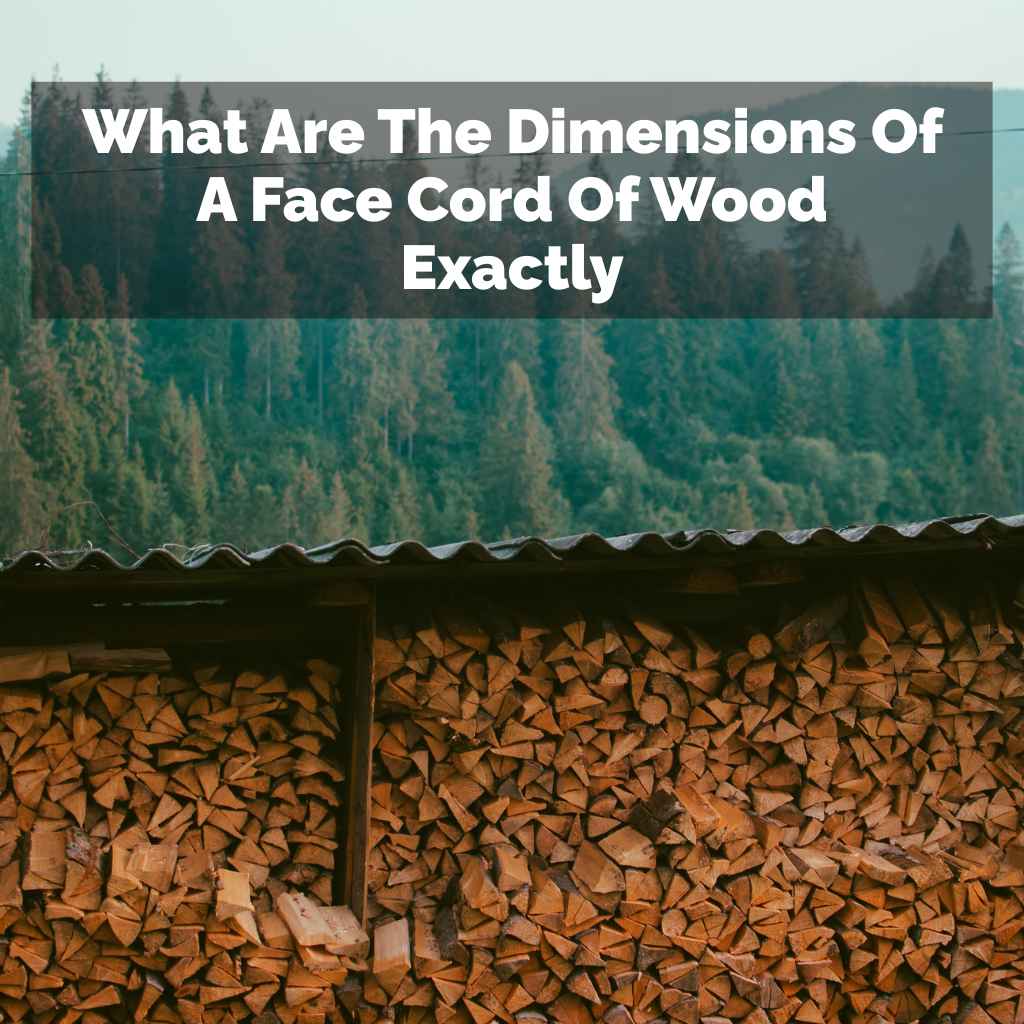
What Are The Dimensions Of A Face Cord Of Wood Exactly?
A face cord of wood is a stack that is 4 feet high and 8 feet long, but only 16 inches deep. This means it is a third of a full cord. It contains roughly 128 cubic feet of wood, but the actual wood volume is much less due to air space.
Understanding Firewood Measurements
Firewood is often sold in cords. A full cord is a standard measurement. It’s a big pile of wood. Imagine a stack that is 4 feet high. It’s also 8 feet long. And it’s 4 feet deep. This standard full cord, when you stack the wood really tight, has about 128 cubic feet of space. However, wood isn’t perfectly stacked. There are gaps. So, the actual wood in a full cord is closer to 80 to 90 cubic feet. The rest is air.
This is where the term “face cord” comes in. It’s a term that can sometimes cause confusion. People often think it means the same as a full cord. But it doesn’t. A face cord is a smaller measure. It’s based on the length of the wood pieces. Most firewood is cut into logs that are 16 inches long. Or sometimes 24 inches long. A face cord uses this length. It’s often used by firewood sellers. They want to offer a smaller, more manageable amount.
Why the Different Terms?
The difference in terms is mostly about how wood is cut and sold. When wood is processed for fireplaces or wood stoves, it’s usually cut into shorter lengths. These lengths are easier to handle and fit into burning devices. A full cord is a more traditional measurement. It reflects a larger, more rustic way of storing and selling wood. Think of a big outdoor woodpile.
A face cord makes sense when you’re selling wood that’s already been cut to a specific length. For example, if you sell wood that’s 16 inches long, a face cord will have the same height and length as a full cord (4 feet by 8 feet). But its depth will only be 16 inches. This matches the length of the wood. This makes it a convenient way to measure and price smaller quantities. But it also means you get less wood than in a full cord.
The Numbers: Face Cord vs. Full Cord
Let’s get down to the numbers. A full cord is defined as 128 cubic feet of stacked wood. This means it’s 4 feet high, 8 feet long, and 4 feet deep. This is a very specific volume.
Now, a face cord. It keeps the same height and length. So it’s 4 feet high and 8 feet long. But its depth is different. It’s usually the length of a single log. For most firewood sold today, this is 16 inches. That’s about 1.33 feet. So, a face cord is basically 4 feet high, 8 feet long, and 1.33 feet deep.
If you do the math, this makes a face cord about one-third the volume of a full cord. Think of it this way: A full cord is like three face cords stacked side-by-side in terms of depth. So, if you order a face cord, you’re getting a stack of wood that is 4 feet by 8 feet by 16 inches. This is a significant difference from the 4 feet by 4 feet depth of a full cord.
My Own Face Cord Fumble
I remember one particularly cold autumn. I thought I was being smart. I saw a local seller offering “face cords” for a really good price. I figured, hey, it’s wood, right? How different could it be? I pictured a substantial pile. I ordered two face cords, thinking I was getting a great deal and would be set for the winter.
When the truck arrived, my heart sank a little. The pile looked… small. Much smaller than I had imagined. I walked around it, trying to convince myself it was just the angle. But no. It was a neat stack, 4 feet high and 8 feet long, but it was shallow. The logs were all 16 inches, so the depth was just that. I felt a pang of annoyance. Then, a bit of worry. Would this really be enough? I had expected a mountain of wood. Instead, I got a respectable stack, but definitely not the “full cord” amount I had secretly hoped for, despite ordering “face cords.” That’s when I really learned to pay attention to the specific terms and their real meanings. It saved me a lot of future shivering and frantic last-minute wood runs.
What Does a Face Cord Look Like?
Let’s paint a picture of a face cord. Imagine you’re looking at a woodpile from the side. It’s a solid wall of wood. This wall is 4 feet tall. It stretches 8 feet across. Now, look at it from the end. This is where the depth comes in. The stack is only about 16 inches deep. This means the logs are laid end-to-end along that 8-foot length.
Think of it like a loaf of bread. A full cord is like a whole loaf, cut into many slices. A face cord is like just a few of those slices, laid out side-by-side. The total volume is less. The amount of actual wood is less. It’s crucial to visualize this. It helps you understand what you are buying.
Visualizing the Difference
To make it even clearer, let’s use another comparison. Imagine three identical shallow boxes. Each box is 4 feet tall, 8 feet long, and 16 inches deep. If you put these three boxes next to each other, along their 8-foot sides, you would create a larger, deeper box. This larger box would be 4 feet tall, 8 feet long, and about 48 inches (or 4 feet) deep. That bigger box represents a full cord. So, one face cord is one of those smaller boxes.
This visual helps drive home the point. When you see a stack of wood that’s 4 feet high and 8 feet long, you need to know its depth. That depth is what tells you if it’s a face cord or a full cord (or something else). Always ask about the depth or the actual cubic feet of wood if you’re unsure.
Common Wood Lengths
The depth of a face cord is usually determined by the length of the firewood pieces. In the U.S., firewood is most commonly cut into lengths of 16 inches. Sometimes you’ll see 18 inches, 20 inches, or 24 inches. These are common sizes that fit well into most residential wood stoves and fireplaces.
So, if the wood you’re buying is cut into 16-inch logs, a face cord will be 16 inches deep. If the logs are 20 inches long, the face cord will be 20 inches deep. This is why the term “face cord” is directly tied to the log length. It’s a measure of one “face” or one layer of logs.
Factors Affecting Actual Wood Volume
It’s important to remember that even when you measure a cord or a face cord, the actual amount of wood can vary. This is because of how the wood is stacked.
- Air Space: Wood is not perfectly uniform. Logs have different shapes. They don’t fit together like puzzle pieces. This creates air gaps between them. The tighter the wood is stacked, the less air space there will be. This means more actual wood volume.
- Log Shape: Some logs are round. Others might be split. Split logs can sometimes fit together more snugly. This can reduce the amount of air.
- Seasoning: Wood shrinks as it dries. So, a cord of green wood will be slightly larger than a cord of seasoned wood. However, the measurement is usually done when the wood is stacked, not based on its dry volume.
When you buy a face cord, you are buying a measured volume of stacked wood. The actual solid wood content will always be less than the total cubic feet of the stack. This is true for both face cords and full cords. It’s just part of buying firewood.
Face Cord Breakdown: Quick Scan
Dimensions: 4 feet high x 8 feet long x 16 inches (approx. 1.33 feet) deep.
Volume: Roughly 42.7 cubic feet of stacked wood.
Actual Wood Volume: Significantly less than 42.7 cubic feet, due to air gaps.
Relation to Full Cord: Approximately 1/3 of a full cord.
Comparing Face Cords to Other Firewood Measures
People also talk about “rick” or “stere” of wood. These terms can add to the confusion.
- Rick: This is a very informal term. It’s often used interchangeably with “face cord.” In some regions, a rick might mean a stack that’s 4 feet high, 8 feet long, and the width of a truck bed (which could be 2 feet or more). It’s best to clarify what a “rick” means where you are buying.
- Stere: This is a metric unit. It’s common in Canada and parts of Europe. A stere is one cubic meter of stacked wood. One cubic meter is about 35.3 cubic feet. A full cord (128 cubic feet) is roughly 3.6 cubic meters. So, a stere is much smaller than a full cord.
The Importance of Clarification
Because these terms can be fuzzy, it’s always best to ask the seller for specifics. Don’t just rely on the name. Ask:
- “How deep is the stack?”
- “What are the dimensions in feet?”
- “Is this a full cord, or a face cord?”
- “Can you tell me the length of the logs?”
A reputable seller will be happy to explain. They will clearly state the dimensions. They want you to be a satisfied customer. This avoids misunderstandings and ensures you get the amount of wood you need.
Myth vs. Reality: Face Cords
Myth: A face cord is the same as a full cord, just cut shorter.
Reality: A face cord is a smaller measure. It’s 4 feet high and 8 feet long, but only about 16 inches deep. A full cord is 4 feet deep.
Myth: A face cord is a universally understood measurement.
Reality: While “face cord” has a standard definition (4x8x16 inches), terms like “rick” are less precise and can vary by region.
Myth: More face cords mean more wood volume, dollar for dollar.
Reality: You get less wood per face cord than per full cord. Always compare based on total cubic feet or actual wood volume if possible.
Real-World Scenarios for Face Cords
So, when might a face cord be the right amount of wood for you?
Scenario Spotlight: The Weekend Cabin
Situation: You own a small cabin. You only use it on weekends during the fall and winter.
Wood Need: You need enough wood for a few cozy fires each weekend, but not enough to justify a massive pile that might sit and get damp over the summer.
Why Face Cord Fits: A face cord or two might be perfect. It provides a manageable amount of wood. It takes up less space than a full cord.
You can store it easily near your cabin or on a small porch. This avoids waste and overstocking.
The Small Homeowner
If you live in a smaller home. Or perhaps you have a very efficient wood stove. You might not burn as much wood as someone with a larger house. A full cord might be more than you can use in a season. It could also be more than you have space to store. In this case, buying wood in face cord increments makes sense. You can buy what you need for a few weeks at a time.
The Occasional Fireplace User
Maybe you’re not relying on wood for primary heat. You just like to light a fire in the fi
Storage Space Limitations
Let’s be honest, space is often a big factor. Many people don’t have vast backyards. They might have a small patio. Or a narrow side yard. A full cord of wood takes up a significant footprint. It’s 4 feet deep. A face cord, being only 16 inches deep, is much more compact. It can fit into tighter spaces. This makes it a practical choice for urban or suburban dwellers.
When a Face Cord Isn’t Enough
On the flip side, when is a face cord definitely not enough?
Primary Heat Source
If you depend on your wood stove or fireplace for the main source of heat for your home. Especially if you live in a colder climate. A face cord will likely not last very long. People who use wood as their primary heat source often burn through multiple full cords of wood over an entire winter. Ordering just one or two face cords would leave them cold.
Large Homes or Poor Insulation
A large house requires more heat. A home that is poorly insulated will lose heat faster. This means the heating system, including a wood stove, has to work harder and longer. This burns more wood. In these situations, you need a substantial supply. A face cord would be depleted very quickly.
Long, Cold Winters
In areas with very long and harsh winters, wood consumption goes up significantly. You need wood not just for the coldest months, but also for the shoulder seasons. This extended need means a larger volume of wood is required. A face cord would be a temporary solution at best.
When to Buy More: A Quick Checklist
You need more than a face cord if:
- Wood is your primary heat source.
- You live in a large home.
- Your home is not well-insulated.
- Your winters are consistently long and cold.
- You want to avoid running out of wood mid-season.
What This Means for Your Firewood Purchase
So, what’s the takeaway? Knowing the dimensions of a face cord is crucial. It helps you make informed decisions when buying firewood.
- Understand the Deal: When you see a price for a “face cord,” know exactly what you’re getting. It’s a stack of 4×8 feet with a depth of about 16 inches.
- Calculate Your Needs: Think about how much wood you used last year. Consider your heating habits. This will help you estimate if a face cord is enough, or if you need multiple face cords or full cords.
- Compare Prices Wisely: Don’t just compare prices per “cord” if one is a full cord and the other is a face cord. You need to compare price per cubic foot of stacked wood or, even better, price per actual solid wood volume if the seller can provide that.
Calculating Value
To truly compare value, you can do a simple calculation. Let’s assume a face cord is 4 feet high, 8 feet long, and 1.33 feet deep. That’s about 42.7 cubic feet of stacked wood. A full cord is 128 cubic feet of stacked wood.
If a face cord costs $100, then for $300, you could buy three face cords. This would give you 3 x 42.7 = 128.1 cubic feet of stacked wood. This is roughly the volume of a full cord. So, if a full cord is being sold for $250, buying three face cords for $300 is a worse deal. However, if a full cord is $350, then buying three face cords might be a slightly better deal, assuming the wood quality is the same. Always factor in the total volume you’re getting for your money.
Simple Checks Before You Buy
Before the wood truck pulls away, take a moment.
- Visually Inspect the Stack: Does it look like 4 feet by 8 feet? Does the depth look like about 16 inches? Trust your eyes.
- Ask About Log Length: Confirm the logs are the length you need for your stove or fireplace.
- Check for Quality: Is the wood reasonably dry? Does it look like it was seasoned properly? Avoid wood that looks moldy or overly green.
These quick checks can save you from disappointment. They ensure you’re getting good value and usable firewood.
Face Cord vs. Full Cord: Key Differences
Feature | Face Cord | Full Cord
Height | 4 feet | 4 feet
Length | 8 feet | 8 feet
Depth | ~16 inches (log length) | 4 feet
Volume (Stacked) | ~43 cubic feet | 128 cubic feet
Fraction of Full Cord | ~1/3 | 1 (or 3/3)
Typical Use Case | Smaller needs, limited space, supplemental heat | Primary heat source, larger homes, colder climates
Frequently Asked Questions About Face Cords
What are the exact dimensions of a face cord of wood?
A face cord of wood is typically measured as 4 feet high, 8 feet long, and approximately 16 inches deep. This depth usually corresponds to the length of the firewood logs.
How does a face cord compare to a full cord of wood?
A full cord of wood is a stack that is 4 feet high, 8 feet long, and 4 feet deep, totaling 128 cubic feet of stacked wood. A face cord is roughly one-third of a full cord because it is only about 16 inches deep.
Why is firewood sold in face cords?
Firewood is often sold in face cords because it’s a convenient measure for sellers and buyers when the wood is cut to a standard length (like 16 inches). It offers a smaller, more affordable quantity for those who don’t need a full cord.
Is a face cord enough wood for a winter?
For most people using wood as a primary heat source in a cold climate, a face cord is not enough wood for an entire winter. It’s more suited for supplemental heat or occasional use.
What does ‘rick’ mean when buying firewood?
The term ‘rick’ is informal and often used interchangeably with ‘face cord.’ However, its exact dimensions can vary by region. It’s always best to clarify the specific dimensions (height, length, and depth) with the seller.
How much actual wood is in a face cord, considering air space?
The stacked volume of a face cord is about 42.7 cubic feet. However, the actual solid wood content is significantly less due to the natural air gaps between logs when stacked. This percentage varies based on how tightly the wood is stacked.
Conclusion
Understanding the dimensions of a face cord is more than just knowing numbers. It’s about ensuring you get the right amount of firewood for your needs. A face cord is a stack that’s 4 feet high and 8 feet long, with a depth typically equal to the log length, often around 16 inches. This makes it about one-third of a full cord. While it’s a useful measure for smaller quantities, limited storage, or supplemental heating, it’s crucial to be clear on these dimensions. Always ask your firewood supplier for the exact measurements to avoid surprises and stay warm all season long.
Sponsored / affiliate links. As an Amazon Associate I earn from qualifying purchases. I may earn additional commission from eligible campaigns.