What Influences the Angle of Solar Radiation on Your Home?
The angle of solar radiation hitting your home changes constantly throughout the day and across the year, directly affecting your energy costs, comfort, and even the lifespan of your roof. Understanding what influences this angle helps you make smarter decisions about window placement, solar panel installation, and passive heating strategies. This post breaks down the key factors that determine sun angles and how they impact your specific property.
Simply put, the angle of solar radiation at your home is primarily driven by your latitude, the Earth’s axial tilt, the current season, and the time of day. These factors combine to create the sun path you see in your local sky, which determines how much direct sunlight hits your roof, windows, and walls at any given moment.
Key Takeaways
- The angle of solar radiation shifts significantly with latitude, seasons, and daily time — understanding this is essential for optimizing home energy use.
- The Earth’s 23.5-degree axial tilt creates seasonal variations in sun angle, which directly impacts passive solar heating and cooling needs.
- Building orientation and roof pitch can be planned to capture or block solar radiation based on your local sun path data.
- Solar panel efficiency drops by 10-25% when panels are not tilted to match the optimal solar radiation angle for your location.
- Free tools from NREL and NOAA let you calculate the exact sun angles for your home address throughout the year.
What Is the Angle of Solar Radiation and Why Does It Matter?
The angle of solar radiation refers to the angle at which sunlight strikes a surface — typically measured from the horizontal plane. When the sun is high overhead, the radiation angle is steep, and the energy is concentrated over a small area. When the sun is low on the horizon, the angle is shallow, spreading the same energy over a larger surface area.
This matters for your home because a steeper angle delivers more energy per square foot. If your windows or solar panels face the sun at the wrong angle, you lose efficiency. According to the National Renewable Energy Laboratory (NREL), adjusting your solar panel tilt to match your latitude can improve annual energy production by up to 15% compared to a flat-mounted system.
There are three main types of solar radiation angles that affect your home:
- Solar altitude angle — the height of the sun above the horizon (0° at sunrise/sunset, 90° directly overhead)
- Solar azimuth angle — the compass direction of the sun (north, east, south, west)
- Angle of incidence — the angle between the incoming sunlight and a surface’s perpendicular line (important for windows and panels)
These angles are not fixed. They change every minute of the day and every day of the year. Understanding them is the foundation of passive solar design and photovoltaic system optimization.
Tip: The angle of incidence is the most practical angle to track for home energy use. When this angle is 0°, sunlight hits the surface directly — this is your ideal scenario for solar panels and south-facing windows.
How Does Latitude Affect the Angle of Solar Radiation?
Your home’s latitude is the single most important factor determining the angle of solar radiation you receive. Latitude measures how far north or south you are from the equator. Homes near the equator (0° latitude) see the sun pass almost directly overhead year-round.
Homes near the poles (60°+ latitude) see the sun at much lower angles, even in summer.
For every degree of latitude you move away from the equator, the sun’s maximum altitude decreases by roughly one degree. This means a home in Miami (25.8° N) experiences a much higher sun angle than a home in Seattle (47.6° N). The practical effect is that northern homes receive less intense solar radiation per square foot, even on clear days.
Here is how latitude changes the optimal tilt for solar panels:
| Latitude Range | Example City | Optimal Panel Tilt | Winter Sun Altitude (Noon) |
|---|---|---|---|
| 0° – 15° | Quito, Ecuador | 10° – 15° | 65° – 80° |
| 25° – 35° | Phoenix, AZ | 30° – 35° | 35° – 40° |
| 40° – 50° | Chicago, IL | 40° – 50° | 20° – 30° |
| 55° – 65° | Edinburgh, Scotland | 55° – 65° | 5° – 15° |
As the table shows, homes at higher latitudes need steeper panel tilts and see much lower winter sun. This directly impacts how much solar radiation your roof and windows receive during the coldest months.
Important: Your latitude determines the maximum possible sun angle at solar noon on the summer solstice. This value equals 90° minus your latitude plus 23.5°. For a home at 40° N, the max summer sun angle is 90° – 40° + 23.5° = 73.5°.
What Role Do Seasons Play in Solar Radiation Angles?
The Earth’s 23.5-degree axial tilt creates the seasons, and this tilt directly controls the angle of solar radiation your home receives throughout the year. During summer in the Northern Hemisphere, the North Pole tilts toward the sun, making the sun appear higher in the sky. During winter, the tilt points away, dropping the sun lower on the horizon.
This seasonal shift changes your daily solar radiation by as much as 40-60% depending on your latitude. A home at 45° N receives roughly three times more solar energy on a clear June day than on a clear December day, purely because of the changing sun angle.
The seasonal effect follows a predictable pattern:
- Summer solstice (June 21) — Sun reaches its highest altitude of the year. Solar radiation is most intense and concentrated.
- Winter solstice (December 21) — Sun reaches its lowest altitude. Solar radiation is weakest and spread over a larger area.
- Equinoxes (March 20 and September 22) — The sun is directly above the equator. Day and night are equal. Solar angles are halfway between summer and winter extremes.
For home design, this means you need to plan for both extremes. Overhangs that block summer sun from windows should be sized based on the summer solstice angle. Collecting winter heat requires understanding the winter solstice angle so that low sunlight can reach south-facing glass.
A study by the U.S. Department of Energy found that properly designed passive solar homes can reduce heating costs by 25-50% by simply matching window placement and overhang depth to local seasonal sun angles. That is a dramatic savings from understanding just one factor.
Here is how the seasonal sun altitude changes at a mid-latitude home (40° N):
| Season | Solar Noon Altitude | Sunrise/Sunset Shift | Energy Impact on South Wall |
|---|---|---|---|
| Summer | 73.5° | NE / NW | Low — sun is nearly overhead |
| Equinox | 50.0° | East / West | Moderate — good balance |
| Winter | 26.5° | SE / SW | High — low sun penetrates deeply |
Notice how winter sun at 26.5° altitude can shine deep into south-facing rooms, while summer sun at 73.5° barely enters windows with even a modest overhang. This is the core principle of passive solar design.
How Does Time of Day Change the Sun’s Angle?
Within a single day, the angle of solar radiation changes continuously from sunrise to sunset. At sunrise and sunset, the sun is at 0° altitude — its rays travel through the maximum amount of atmosphere and deliver the least energy. At solar noon (when the sun crosses the meridian), the altitude reaches its daily maximum.
The rate of change is fastest in the hours around sunrise and sunset and slowest around solar noon. For a mid-latitude home, the sun angle changes by about 15° per hour in the middle of the day but more slowly near the horizon due to atmospheric refraction.
This daily cycle has three practical implications for your home:
- East and west windows receive intense morning and afternoon sun at low angles, which can cause overheating and glare. This is especially problematic in summer when the sun rises early and sets late.
- South-facing windows (in the Northern Hemisphere) receive consistent sun throughout the day at a relatively steady angle, making them ideal for passive solar heating and solar panels.
- North-facing windows receive little to no direct solar radiation in the Northern Hemisphere, which means they lose heat but gain very little solar benefit.
The azimuth angle also shifts dramatically during the day. At sunrise, the sun is in the east. By noon, it is due south (in the Northern Hemisphere).
By sunset, it is in the west. This means a fixed solar panel or window can only capture direct radiation for a limited window of time each day unless you use tracking systems.
According to data from NASA’s Surface Meteorology and Solar Energy database, a fixed south-facing solar panel at 40° N receives about 4.5 peak sun hours per day on average. A dual-axis tracking system that follows the sun’s daily angle can boost that to over 7 peak sun hours — a 55% increase in energy capture.
Warning: Low-angle morning and afternoon sun through west-facing windows can increase cooling loads by 20-30% in summer. If you have large west-facing windows without shading, expect your air conditioner to work much harder.
What Is Solar Declination and How Does It Impact Your Home?
Solar declination is the angular distance of the sun north or south of the celestial equator. It changes daily because the Earth is tilted on its axis as it orbits the sun. Solar declination ranges from +23.5° on the summer solstice to -23.5° on the winter solstice, passing through 0° at the equinoxes.
This value is critical for calculating the exact angle of solar radiation for any location on any day of the year. The formula to find the solar altitude angle at solar noon is:
Solar Altitude = 90° – Latitude + Solar Declination
For example, a home in Denver (39.7° N) on June 21 (declination +23.5°) has a noon sun angle of 90° – 39.7° + 23.5° = 73.8°. On December 21 (declination -23.5°), the same home has a noon sun angle of 90° – 39.7° + (-23.5°) = 26.8°.
That is a swing of 47° between summer and winter. This directly determines how deep sunlight penetrates into your home through windows:
- Winter (low sun): Sunlight enters windows at a shallow angle and can reach deep into rooms — sometimes 15-20 feet inside. This provides free heat.
- Summer (high sun): Sunlight enters at a steep angle. With a properly sized overhang, the beam hits the window sill or floor near the window and does not penetrate far, reducing heat gain.
The practical takeaway is that you can use overhangs, awnings, and blinds that are designed around your local solar declination extremes. The American Society of Heating, Refrigerating and Air-Conditioning Engineers (ASHRAE) recommends sizing overhangs so that the full window is shaded at solar noon on June 21 but fully exposed at solar noon on December 21.
Solar declination also affects the length of your day. Higher declination values (summer) mean longer days and more total solar radiation hours. Lower values (winter) mean shorter days.
This compounds the effect of the lower angle — fewer hours AND less intense radiation.
How Does Building Orientation Interact with Solar Radiation?
Your home’s orientation relative to true south (not magnetic south) is the most controllable factor affecting how solar radiation hits your building. A house with its longest side facing south maximizes winter solar gain and minimizes summer overheating. A house with its longest side facing east or west captures more low-angle morning or afternoon sun, which often causes glare and cooling issues.
The ideal orientation for passive solar homes in the Northern Hemisphere is to have the main living spaces and largest windows face within 15° of true south. This alignment ensures that during winter, when the sun is low, the south-facing windows capture maximum heat. During summer, when the sun is high, the same windows receive minimal direct radiation because the overhangs block it.
Here are the effects of each primary orientation on solar radiation exposure:
- South orientation (ideal): Maximum winter solar gain, minimal summer gain with proper overhangs. Best for solar panels.
- East orientation: Strong morning sun in summer and winter. Causes overheating in summer mornings. Low winter solar gain.
- West orientation: Strong afternoon sun in summer and winter. Worst for summer overheating. High cooling load.
- North orientation: Very little direct solar radiation year-round in the Northern Hemisphere. Consistent but cool light.
A study by the Florida Solar Energy Center found that homes with poor orientation (long axis east-west instead of north-south) can have cooling loads that are 25-35% higher than optimally oriented homes in the same climate. This is because east and west walls receive much more intense low-angle sun, especially in summer.
If you are designing a new home or renovating, consider rotating the floor plan to align the main glass area within 15° of true south. If you are stuck with an existing orientation, you can still manage solar radiation through landscaping (deciduous trees on the west side), exterior shades, and reflective window films.
Tip: Use a compass and adjust for magnetic declination (the difference between magnetic north and true north in your area). In much of the U.S., magnetic north is 10-15° east of true north, so a compass reading of 180° (south) may actually point 165-170° true. Check NOAA’s magnetic declination calculator for your exact location.
The Impact of Roof Pitch and Window Placement on Solar Gain
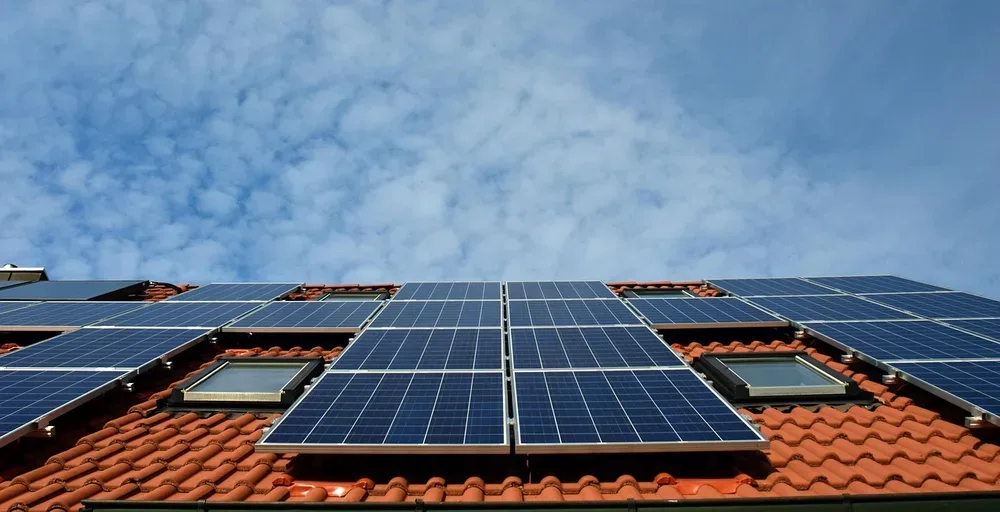
Your roof pitch — the slope angle of your roof — directly determines how much solar radiation your solar panels or roof-mounted collectors receive. If your roof pitch matches the optimal tilt angle for your latitude and season, you capture more energy per square foot. If it does not, you lose efficiency.
For solar panels, the ideal tilt angle equals your latitude for year-round production. For winter-only optimization, add 10-15° to your latitude. For summer-only optimization, subtract 10-15°.
Most existing homes have roof pitches between 15° and 45°. A 4/12 pitch (18.4°) is common in warmer climates, while an 8/12 pitch (33.7°) is common in snowy areas. These often do not match the optimal angle perfectly.
Window placement is equally important. Even with perfect orientation, the vertical placement of windows on a wall changes how solar radiation interacts with your interior:
- High windows (near ceiling): In winter, low-angle sun penetrates deep into the room from high windows. In summer, high windows are harder to shade effectively.
- Low windows (near floor): In winter, low windows allow sun to hit the floor directly, warming thermal mass. In summer, low windows are easier to shade with overhangs.
- Clerestory windows (high on wall or roof): Excellent for bringing daylight deep into a home without overheating. They capture high-angle summer sun less directly than vertical windows.
The National Fenestration Rating Council (NFRC) provides solar heat gain coefficient (SHGC) ratings for windows. A window with a high SHGC (0.6 or above) allows more solar radiation through and is ideal for cold climates with good orientation. A low SHGC (0.3 or below) blocks solar gain and is better for hot climates or east/west exposures.
Here is a quick guide for matching window SHGC to your situation:
| Climate Type | Recommended SHGC | Best Window Orientation |
|---|---|---|
| Cold (heating dominated) | 0.55 – 0.70 | South |
| Mixed (heating + cooling) | 0.40 – 0.55 | South, limited east/west |
| Hot (cooling dominated) | 0.25 – 0.40 | North, shaded south |
Matching window SHGC to your climate and orientation is one of the most cost-effective ways to manage solar radiation without changing the building structure.
Warning: Do not install high-SHGC windows on the west side of your home in a hot climate. The low-angle afternoon sun will pour through those windows and can raise indoor temperatures by 10-15°F on summer afternoons, drastically increasing your cooling costs.
Practical Ways to Use Sun Angle Data for Home Energy Savings
Now that you understand what influences the angle of solar radiation, here is how to apply that knowledge to your home. These strategies work for both new construction and existing homes.
Use free online tools to calculate your local sun angles. The NOAA Solar Calculator and the NREL PVWatts Calculator both provide precise sun angle data for any address. Enter your location and get the solar altitude and azimuth for any date and time. This takes the guesswork out of designing overhangs, positioning panels, and placing windows.
Size your overhangs for seasonal angles. A properly sized overhang blocks summer sun but allows winter sun. The general rule is that the overhang depth should be roughly half the window height for a south-facing window at 40° N latitude. For more precision, use the formula: Overhang depth = window height × tan(90° – summer noon altitude).
- Find your summer solstice noon sun altitude (from NOAA or the formula above).
- Measure your window height from sill to header.
- Calculate: overhang depth = window height × tan(90° – summer altitude).
- Position the overhang so it aligns with the top of the window.
Tilt your solar panels to match seasonal needs. If you have adjustable mounts, set panels to your latitude minus 10° in summer and latitude plus 10° in winter. If you have a fixed mount, set it to your latitude for best year-round production. Data from NREL shows that fixed panels tilted to latitude produce about 95% of the energy of a dual-axis tracking system on an annual basis.
Plant deciduous trees on the west and east sides. Trees lose their leaves in winter, allowing low-angle sun to reach your home for passive heating. In summer, their full canopy blocks the intense east and west sun. A well-placed tree on the west side can reduce cooling costs by 15-25% according to the U.S.
Department of Agriculture.
Use reflective and absorptive materials strategically. Light-colored roofing reflects solar radiation and keeps attics cooler. Dark-colored surfaces on south-facing walls or patios absorb winter sun and radiate heat. The Lawrence Berkeley National Laboratory found that cool roofs can reduce peak cooling demand by 10-15% in hot climates.
These strategies are not expensive. Many of them — like adjusting panel tilt, adding temporary shades, or planting trees — cost very little and pay back in energy savings within 1-3 years.
Tip: For a quick DIY check, observe the shadow cast by your south-facing overhang at noon on June 21 and December 21. In June, the shadow should cover the entire window. In December, the shadow should barely touch the sill. If this is not the case, adjust your overhang depth or add exterior shades seasonally.
Frequently Asked Questions
What is the optimal angle of solar radiation for my solar panels?
The optimal angle for solar panels equals your latitude for year-round production. For maximum winter production, add 10-15° to your latitude. For maximum summer production, subtract 10-15°.
Use the NREL PVWatts Calculator to get the exact recommended tilt for your specific address.
How much does the angle of solar radiation change between summer and winter?
At a mid-latitude location like 40° N, the noon sun altitude changes from about 73.5° in summer to about 26.5° in winter — a difference of 47°. This dramatic shift means the same window receives vastly different amounts of solar radiation depending on the season.
Does the angle of solar radiation affect indoor temperature?
Yes, directly. Low-angle winter sun can penetrate deep into rooms, raising indoor temperatures by 5-10°F without any heating system. High-angle summer sun tends to hit the roof and upper walls, which can increase attic temperatures by 30-50°F if not properly insulated and ventilated.
What time of day is the angle of solar radiation highest?
The highest solar altitude occurs at solar noon — which is usually between 12:00 PM and 1:30 PM depending on your location and daylight saving time. Solar noon is the midpoint between sunrise and sunset, not necessarily 12:00 PM on your clock.
Can I change the angle of solar radiation hitting my home?
You cannot change the sun’s position, but you can control how it interacts with your home. Use overhangs, awnings, window films, reflective roofing, landscaping, and adjustable solar panel mounts to capture or block solar radiation based on your needs. You can also rotate window placement and roof pitch during construction or major renovation.
Final Thoughts
The angle of solar radiation at your home is determined by your latitude, the Earth’s axial tilt, the season, and the time of day — factors you cannot change but can work with. By understanding these variables and applying simple design strategies like proper overhang sizing, window orientation, and solar panel tilting, you can significantly reduce your energy costs and improve home comfort. Start by looking up your local sun angles online and then make one or two changes this season.
Sponsored / affiliate links. As an Amazon Associate I earn from qualifying purchases. I may earn additional commission from eligible campaigns.