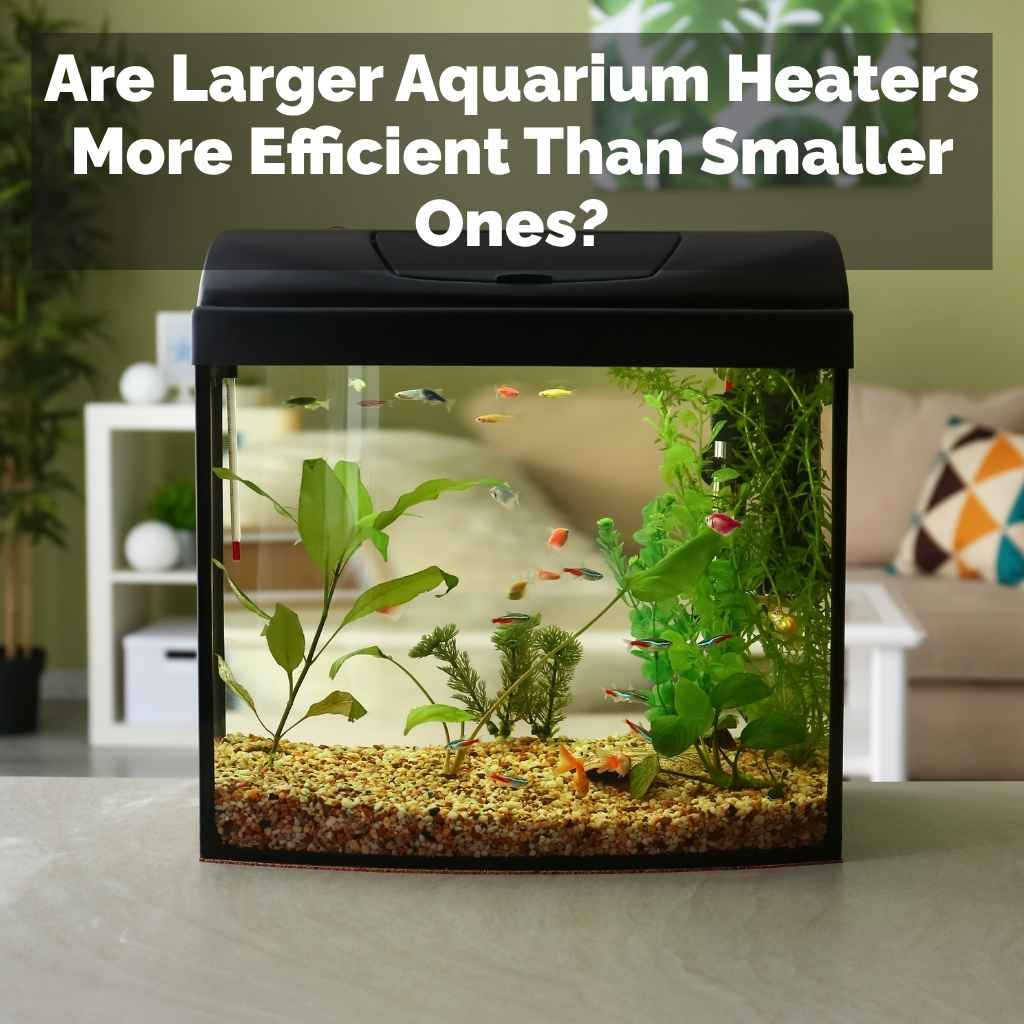
Are Larger Aquarium Heaters More Efficient Than Smaller Ones?
The efficiency of an aquarium heater isn’t just about its wattage. It’s a balance between wattage, tank size, room temperature, and heater placement. Larger heaters aren’t inherently more efficient; the right size heater for your specific tank conditions offers the best performance and energy saving.
Understanding Aquarium Heater Wattage

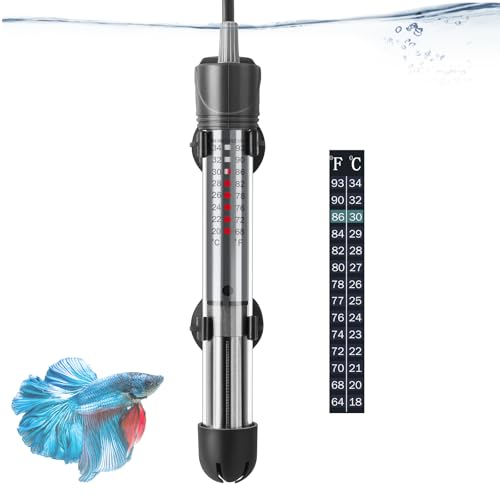

When you look at aquarium heaters, the first thing you’ll notice is the wattage. This number tells you how much power the heater uses. A 100-watt heater uses more electricity than a 50-watt heater.
But what does that wattage actually do? It tells us how quickly the heater can add heat to your water.
Think of it like a light bulb. A 100-watt bulb is brighter than a 60-watt bulb. It puts out more light energy.
An aquarium heater puts out heat energy. So, a higher wattage means it can heat your water faster or maintain a higher temperature.
The general rule of thumb you’ll see is about 3 to 5 watts per gallon of water. This is a good starting point. For a 20-gallon tank, you might look at a 60 to 100-watt heater.
For a 55-gallon tank, maybe a 150 to 200-watt heater.
But this is just a guide. It’s not a hard rule. Many things can change how much wattage you actually need.
Room temperature is a big one. A heater in a warm room has an easier job than one in a cold basement. Water changes also play a part.
If you do large water changes with cold water, your heater has to work harder to bring the temperature back up.
What “Efficient” Really Means for Heaters
When we talk about “efficient” in the context of aquarium heaters, we’re usually talking about two main things: energy efficiency and heating efficiency. These aren’t quite the same.
Energy Efficiency means how well the heater converts electrical energy into heat. Most modern aquarium heaters are pretty good at this. They’re essentially resistors that get hot when electricity flows through them.
Very little energy is lost to anything else, like light or sound. So, most heaters you buy today are quite energy efficient in that sense.
Heating Efficiency is more about how well the heater does its job in your specific aquarium. It’s about maintaining the correct temperature without wasting energy. A heater that’s too small will run constantly, trying to keep up.
This uses more electricity over time. A heater that’s too big might cycle on and off too much, or even overheat the tank slightly before shutting off. This can also be inefficient and bad for fish.
So, the most “efficient” heater is the one that keeps your water at the stable temperature your fish need, using the least amount of electricity possible for that job. It’s about having the right size heater.
The Role of Wattage vs. Tank Size
Let’s go back to that 3-5 watts per gallon idea. It’s a starting point because it links wattage to the volume of water. A larger volume of water needs more heat to raise its temperature.
More water holds more heat, too. So, it takes more energy to change the temperature of a big tank than a small one.
If you have a 10-gallon tank and a 50-watt heater, that’s 5 watts per gallon. If you have a 50-gallon tank and a 250-watt heater, that’s also 5 watts per gallon. In both cases, the heater has the same “power density” relative to the water it’s heating.
Now, what if you put a 150-watt heater in a 10-gallon tank? That’s 15 watts per gallon! This heater would be very powerful.
It could heat the water extremely quickly. It might even be hard to control the temperature. It would likely overheat the tank and shut off, then the temperature would drop quickly, and it would turn back on.
This constant cycling uses energy and isn’t good for fish.
Conversely, if you put a 50-watt heater in a 50-gallon tank (1 watt per gallon), it would struggle. It would likely run all the time and still not be able to keep the water at the desired temperature, especially if the room is cool. This constant running uses a lot of electricity, and you still wouldn’t have a stable temperature.
This is very inefficient.
So, the relationship between wattage and tank size is key. A larger tank needs a higher wattage heater just to have a similar heating rate per gallon as a smaller tank with a smaller heater. It’s not that the big heater is more efficient in itself, but that its wattage is appropriate for the larger volume.
Factors Beyond Wattage Affecting Efficiency
Wattage is important, but it’s not the whole story when it comes to how efficiently your aquarium heater works. Several other things play a big role. Understanding these will help you get the best performance and save energy.
Room Temperature: This is huge. If your aquarium is in a consistently warm room (say, 70-75°F), your heater won’t have to work as hard. It won’t need to run as often or for as long.
If your aquarium is in a cold basement (say, 50-60°F), the heater has to fight against the cold constantly. It will run much more often.
A heater rated for a “normal” room might struggle in a cold room. You might need a higher wattage heater than the standard guideline suggests for that tank size if your room is chilly. Conversely, if your room is very hot, you might get away with a slightly lower wattage heater.
Tank Location and Insulation: Where is your tank placed? If it’s near a drafty window or an air conditioning vent, it will lose heat faster. If it’s near a heat source (like a radiator or direct sunlight), it might heat up too much.
Having a good lid on your aquarium also helps trap heat. Water evaporates and takes heat with it, so a lid reduces this loss.
Water Flow: Good water circulation around the heater is important. It helps spread the heat evenly through the tank. If the water is stagnant around the heater, the water right there might get very hot, and the rest of the tank might stay cooler.
This can cause the heater to cycle oddly and not maintain a consistent temperature throughout.
Heater Type and Quality: Not all heaters are made the same. Submersible heaters are the most common. Some are made of glass, and some are made of plastic.
Glass ones can break if dropped or exposed to air when on. Plastic ones are generally more durable. Higher quality brands often have more reliable thermostats, which means they are better at turning on and off at the right temperature, leading to more stable conditions and less wasted energy.
Thermostat Accuracy: This is probably one of the most overlooked aspects. The thermostat is what tells the heater when to turn on and off. If the thermostat isn’t very accurate, the temperature in your tank can swing quite a bit.
This is stressful for fish. A more accurate thermostat means the temperature stays closer to the set point, which is better for the inhabitants and more energy efficient because the heater only runs when truly needed.
Submersible vs. Hang-on-Back Heaters: Most common heaters are submersible. There are also some hang-on-back filters that have integrated heaters, or some setups might use in-line heaters.
Submersible heaters are generally considered very efficient because they are placed directly in the water they are heating. In-line heaters are also efficient. Hang-on-back heaters might be slightly less direct but still effective.
Heater Placement Matters
Where you put your heater impacts its job.
- Good spot: Near the filter output. This helps move the warm water around the tank quickly.
- Bad spot: In a corner with no water flow. Heat can get trapped, and the rest of the tank stays cold.
- Avoid: Direct sunlight. This can cause overheating.
- Keep clear: Make sure there’s space around the heater. Don’t bury it in gravel or have plants blocking it.
Comparing Heater Wattage for Different Tank Sizes
Let’s look at some examples to make this clearer. Imagine you have a 20-gallon tank. The general rule suggests a 60-100 watt heater.
If you choose a 75-watt heater for your 20-gallon tank, and the room is around 70°F, it will likely do a great job. It will heat the water to your set temperature and cycle on and off as needed. This is efficient.
What if you chose a 150-watt heater for that same 20-gallon tank? It has much more power. It will heat the water up very fast.
The thermostat might kick in, shutting it off quickly. Then the water cools, and it kicks back on. This frequent on/off cycling is not ideal for fish.
It also means the heater is sitting idle for periods. While it heats quickly when on, the overall energy use might not be lower than a properly sized heater, and the temperature stability is worse.
Now, consider a 55-gallon tank. The guideline suggests 150-200 watts. If you use a 150-watt heater and your room is cool, say 65°F, it might run almost constantly.
It might still struggle to keep the tank at 78°F. In this case, a 200-watt heater might be more appropriate. It will reach the target temperature faster and cycle on and off, rather than running non-stop.
This is more efficient and provides better temperature control.
So, a larger wattage heater is not inherently more efficient. It’s more efficient if the larger wattage is needed to overcome the challenges of a larger water volume or a colder environment.
Quick Wattage Guide (Room Temp ~70°F)
General starting points. Adjust for room temp and tank needs.
| Tank Size (Gallons) | Recommended Wattage |
| 5-10 | 25-50W |
| 10-20 | 50-100W |
| 20-30 | 100-150W |
| 30-55 | 150-200W |
| 55-75 | 200-300W |
| 75-125 | 300-400W |
Can a Larger Heater Be Less Efficient?
Yes, absolutely. A larger heater can be less efficient if it’s oversized for the tank and the conditions. Let’s paint a picture.
Imagine you have a small 10-gallon tank. Your room temperature is a comfortable 72°F. You decide to buy a 150-watt heater because you think “bigger is better” or “I might upgrade later.” You set the thermostat to 78°F.
The heater turns on. Because it’s so powerful for that small volume of water, it can heat it up to 78°F in just a few minutes. The thermostat senses this and shuts the heater off.
The water is now 78°F.
But the room is only 72°F. The water will start to cool down. As soon as it drops to, say, 77°F, the thermostat tells the heater to turn back on.
It heats up to 78°F again in a few minutes and shuts off. This cycle might happen many times a day.
When the heater is on, it’s using 150 watts of power. When it’s off, it’s using zero watts. Compare this to a properly sized 50-watt heater for that 10-gallon tank.
It might take 10-15 minutes to heat the water from 75°F to 78°F. It will then stay off for a longer period before needing to turn on again. When it is on, it uses only 50 watts.
While the 150-watt heater is off for longer stretches, the amount of time it spends actively heating at a higher wattage can still lead to more overall energy consumption than the 50-watt heater running for longer periods but at a lower wattage. Plus, the constant temperature fluctuations are stressful for your fish and invertebrates.
In this scenario, the oversized 150-watt heater is less energy-efficient and provides worse temperature stability compared to the correctly sized 50-watt heater.
Contrast: Oversized vs. Right-Sized Heater
Understanding the difference in performance.
Oversized Heater (e.g., 150W in 10 Gal)
Pros: Heats water very quickly. Can handle extreme temperature drops briefly.
Cons: Frequent cycling (on/off). Poor temperature stability. Can overheat tank easily.
Higher peak energy draw. Potentially stressful for fish.
Right-Sized Heater (e.g., 50W in 10 Gal)
Pros: Stable temperature control. Less stress on fish. Runs longer, gentler cycles.
More energy efficient overall for steady temps. Safer.
Cons: Slower to heat up initially. Might struggle in extreme cold without room adjustments.
My Own Heater Mishap: A Fishy Tale
I remember setting up my first “dream” 40-gallon breeder tank. I was so excited. I’d done my research, or so I thought.
I bought a beautiful, sleek 200-watt submersible heater. It looked great, felt solid, and promised stable temperatures. My room is usually around 70°F, and the tank was for tropical fish that needed about 78°F.
I set it up, plugged it in, and set the dial. Within an hour, the tank temperature was at 78°F. Success!
Or so I believed. Over the next few days, I noticed my fish seemed a little… sluggish. Not sick, just not as active as I’d expect.
Then, one morning, I woke up to find my thermometer reading 82°F! The heater was still on, even though the dial was set to 78°F.
Panic set in. I unplugged it immediately. The temperature slowly started to drop.
I spent the day watching it, trying to figure out what went wrong. Was the heater broken? Was the thermostat faulty?
It turns out, the problem wasn’t a broken heater; it was an oversized heater. The 200-watt heater was so powerful for that 40-gallon volume that its thermostat could never accurately find the sweet spot. It would heat too fast, overshoot the target, and then the water would cool too much before it could accurately kick back on.
The temperature swings were probably stressing the fish.
I ended up swapping it out for a 150-watt heater. Immediately, the temperature became much more stable. The cycles were longer and gentler.
My fish perked up within a day. It was a powerful lesson: bigger isn’t always better, and for aquarium heaters, the right size is crucial for both efficiency and the well-being of your aquatic pets.
What About Dual Heater Setups?
For larger aquariums, especially those over 75 or 100 gallons, some people opt for two smaller heaters instead of one very large one. This is often a smart move and can contribute to better efficiency and reliability.
Let’s say you have a 100-gallon tank. You might need around 300-400 watts. Instead of one 400-watt heater, you could use two 200-watt heaters.
Here’s why this can be more efficient and beneficial:
- Redundancy: If one heater fails (and heaters do fail), the other can often keep the water at a survivable temperature until you can replace the broken one. This protects your fish from a sudden temperature drop.
- More Stable Heating: Two heaters, each running at a lower power setting and for longer cycles, can provide more consistent heating across the entire tank. They spread the heat more evenly.
- Less Stress on Equipment: Each heater is working less intensely than a single, massively overpowered heater trying to do the entire job. This can potentially extend their lifespan.
- Easier Temperature Management: With two heaters, you might be able to fine-tune the temperature more easily. You can set them to slightly different temperatures if needed, or simply ensure they don’t both kick on at the exact same moment, which could cause a brief surge.
While two heaters might seem like more initial cost, the benefits in stability, redundancy, and potentially overall energy use can make them a more efficient long-term solution for larger tanks.
When Two is Better Than One
Using multiple heaters for large tanks.
Scenario: Large Aquarium (e.g., 100+ Gallons)
Option A: Single High-Wattage Heater
- Potential Issues: High single point of failure, potentially less even heat distribution, harder to find exact temperature sweet spot.
Option B: Two Mid-Range Wattage Heaters
- Benefits: Redundancy (if one breaks, the other helps). More stable, even heating. Less strain on individual units. Better control.
- Considerations: Ensure good flow around both heaters. Set them to the same target temperature.
Real-World Context: The Cold Garage Tank
Let’s talk about a scenario where a larger heater, or even supplemental heating, might be necessary and more efficient in its own way. My friend, Sarah, lives in a home with an attached garage that gets quite cold in the winter. She decided to set up a 55-gallon tank in that garage for a few hardy fish species that tolerate cooler temperatures, like some types of goldfish or certain Killifish.
The garage temperature can dip into the 40s Fahrenheit. Sarah initially put a 200-watt heater in the tank, aiming for about 68°F. This heater ran constantly.
It never really shut off. While it was running, it was drawing 200 watts. It kept the temperature stable, but at a cost.
It was essentially running 24/7.
She asked me if she should get a bigger heater, maybe a 300-watt. I explained that even a 300-watt heater would likely run almost non-stop in those conditions. The real issue was the extreme temperature difference between the inside of the tank and the outside air.
Instead, we looked at ways to improve the tank’s insulation and airflow. We made sure the lid was tight. We also considered adding a second, smaller heater (say, a 100-watt) to work alongside the 200-watt one.
The idea was that together, they might be able to maintain the temperature more comfortably. The 200-watt might handle the bulk of the heating, and the 100-watt would kick in for longer periods to maintain it, or vice-versa, depending on how they were set.
The takeaway here is that in extreme environments, the “standard” wattage calculations might not be enough. You might need a higher wattage, or a combination of heaters, to maintain a stable temperature. In this cold garage scenario, a “larger” heating solution (whether a single higher wattage or multiple units) is more efficient than a system that constantly struggles and fails to reach its target temperature.
What This Means for You: Choosing Wisely
So, are larger aquarium heaters more efficient? The answer, as we’ve seen, is a nuanced “it depends.” They aren’t inherently more efficient in their design. Their efficiency comes from being the right size for the job.
When it’s normal to consider a larger wattage:
- Larger Tank Volumes: As tank size increases, the wattage needs to increase proportionally just to keep up with heating demands.
- Colder Ambient Room Temperatures: If your aquarium is in a basement, garage, or drafty room, you’ll need more wattage than the standard guide suggests.
- Tropical Fish Requiring Higher Temps: Fish that need warmer water (e.g., 80-82°F) will require a heater to work harder than those needing cooler temps (e.g., 70-75°F), especially if the room temp is lower.
When a larger heater might be less efficient:
- Oversized for Tank Size: Putting a heater with way too much wattage into a small tank leads to constant cycling, poor temperature stability, and potentially higher energy use than a properly sized unit.
- Uninsulated Tank or Poor Location: If your tank loses heat rapidly due to drafts or an open lid, even a larger heater might struggle or cycle too much.
Simple checks you can do:
- Monitor your thermometer: Don’t just trust the heater’s dial. Use a reliable thermometer (or two!) to track the actual water temperature throughout the day and night.
- Observe heater cycling: Does the heater turn on for a very short burst and then shut off? Does it stay on for hours and hours without reaching temperature? These are signs it might be the wrong size.
- Consider room temperature: Be realistic about the temperature of the room your tank is in. This is a huge factor.
Quick Checks for Your Heater
Is your heater working right?
1. Temperature Check:
- Normal: Thermometer stays within 1-2 degrees of your set point.
- Concerning: Thermometer swings wildly (more than 3-4 degrees) or is consistently off from the set point.
2. Cycling Behavior:
- Normal: Heater turns on for a reasonable period (e.g., 10-30 minutes depending on size/tank) then stays off for a while.
- Concerning: Heater is on for just a minute or two, then off for a long time. Or, it stays on constantly without reaching the target temperature.
Quick Tips for Optimal Heater Efficiency
Choosing the right wattage is your first step. But here are a few more tips to help your heater run efficiently and keep your fish happy:
- Use a reliable thermometer: Digital or glass thermometers are more accurate than the built-in dials on many heaters. Place it away from the heater.
- Ensure good water flow: Position your heater where water from your filter or powerhead can circulate around it. This distributes heat evenly.
- Use a lid: A lid significantly reduces heat loss through evaporation.
- Consider dual heaters for large tanks: For tanks over 75 gallons, two smaller heaters are often better than one large one.
- Account for room temperature: If your room is consistently cold, buy a slightly higher wattage heater than the basic guidelines suggest.
- Replace old heaters: Heater thermostats can become less accurate over time. If your heater is several years old, consider replacing it to ensure consistent temperature and efficiency.
- Check heater seals: Ensure your submersible heater is fully submerged according to its instructions. Running it dry can damage it.
Frequently Asked Questions About Aquarium Heater Efficiency
Are submersible aquarium heaters more efficient than in-line heaters?
Both submersible and in-line aquarium heaters can be very efficient. Submersible heaters are placed directly in the tank, heating the water where it matters most. In-line heaters are placed in the filter’s outflow tubing, heating the water as it returns to the tank.
For most home aquariums, the difference in efficiency is negligible. The most important factor is choosing the correct wattage for your tank size and environmental conditions.
Does a heater that runs all the time mean it’s less efficient?
Yes, if a heater has to run all the time to maintain temperature, it generally means it’s either too small for the tank or the environment is too cold for its wattage. While it’s actively heating when on, constant operation can use more energy over time than a properly sized heater that cycles on and off. It also suggests the temperature is not being maintained optimally.
Can I use a heater designed for a larger tank in a smaller tank?
You can, but it’s generally not recommended for efficiency or stability. A heater with too much wattage for a small tank will heat the water very quickly and then shut off. This leads to frequent on/off cycles, poor temperature consistency, and can stress your fish.
It’s more energy-efficient and better for the aquarium inhabitants to use a heater with the appropriate wattage.
How does ambient room temperature affect aquarium heater efficiency?
Ambient room temperature has a significant impact. If the room is warm, the heater has less work to do and will run less often, thus using less energy. If the room is cold, the heater must work harder and run more frequently to maintain the desired water temperature.
In colder rooms, you might need a higher wattage heater than typically recommended for your tank size.
Is it better to have one large aquarium heater or two smaller ones?
For larger aquariums (generally over 75 gallons), using two smaller heaters is often better. This provides redundancy if one heater fails, leads to more even heat distribution, and can offer more stable temperature control than a single, very high-wattage heater. For smaller tanks, one appropriately sized heater is usually sufficient and perfectly efficient.
How often should an aquarium heater cycle on and off?
There’s no single exact answer, as it depends on many factors like heater size, tank size, room temp, and set point. However, you generally want to see a heater cycle on for a reasonable duration (not just seconds) and then stay off for a significant period. If it’s cycling very rapidly (on for a minute, off for five), it’s likely too powerful.
If it’s on constantly, it’s likely too weak or the environment is too cold.
Conclusion: Size for Success
When it comes to aquarium heaters, efficiency isn’t about the size of the heater itself, but its suitability for your specific aquarium. A larger wattage heater isn’t automatically more efficient. In fact, an oversized heater can be less efficient and detrimental to your fish’s health.
The real key is matching the heater’s wattage to your tank’s volume, the ambient temperature, and the needs of your aquatic life.
By understanding these factors, you can choose a heater that provides stable temperatures, runs efficiently, and keeps your underwater world a happy, healthy place. Focus on the right size, not just the biggest size, for the best results.
Sponsored / affiliate links. As an Amazon Associate I earn from qualifying purchases. I may earn additional commission from eligible campaigns.