How Much Electricity Does Pipe Heat Tape Use?
Frozen pipes can burst and cause costly water damage fast. This guide shows how to estimate heat tape cost by length, wattage, runtime, and thermostat control.
This guide is part of our Frozen Pipes: How to Prevent, Thaw and Fix Them series.
How heat tape wattage becomes your electricity bill
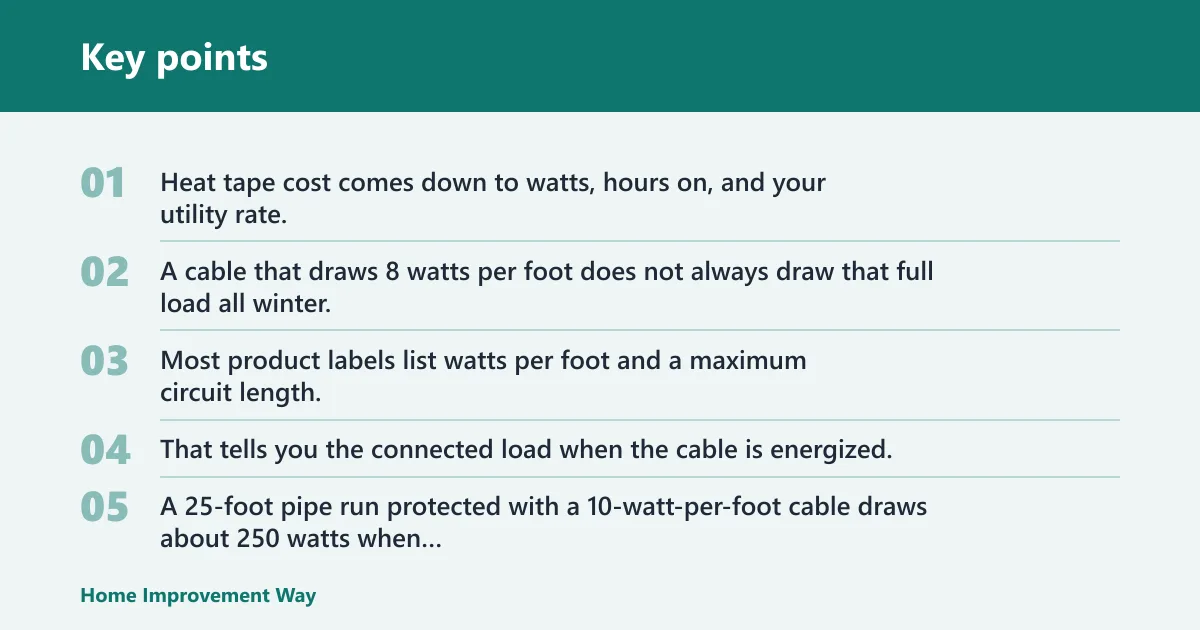


Heat tape cost comes down to watts, hours on, and your utility rate. A cable that draws 8 watts per foot does not always draw that full load all winter, because thermostat control, self-regulating behavior, insulation, and outdoor temperature all change runtime.
What wattage labels mean
Most product labels list watts per foot and a maximum circuit length. That tells you the connected load when the cable is energized. A 25-foot pipe run protected with a 10-watt-per-foot cable draws about 250 watts when fully on; a 50-foot run at the same rating draws about 500 watts.
How watts become kilowatt-hours
The bill uses kilowatt-hours, or kWh, not watts. The basic calculation is: watts × hours ÷ 1,000 = kWh. If a 200-watt heat tape runs 24 hours, that is 4.8 kWh for the day. Over 30 days, that works out to about 144 kWh if it truly runs nonstop.
Why runtime changes the bill
Runtime matters because the cable usually does not run at full power every hour of winter. A thermostat may switch it on only near a freeze point, and self-regulating cable reduces output as pipe temperature rises. That is why two homes with the same pipe length can see very different bills.
How much electricity does pipe heat tape use?
Use the cable’s watt rating, the heated length, and the duty cycle. If the tape runs constantly, multiply total watts by hours of use. If it cycles, multiply by the fraction of time it is actually on. Then use your utility rate to convert kWh into dollars.
A quick formula you can use
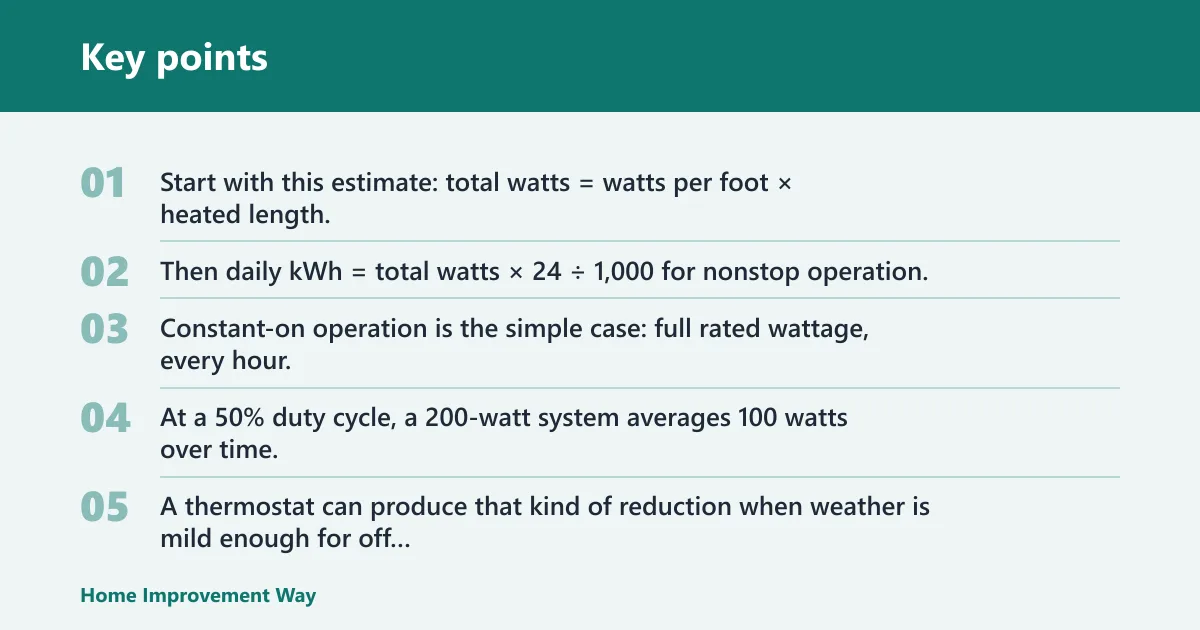
Start with this estimate: total watts = watts per foot × heated length. Then daily kWh = total watts × 24 ÷ 1,000 for nonstop operation, or multiply that result by the duty cycle if the controller cycles the cable. Monthly cost = monthly kWh × your rate.
Constant-on versus cycling operation
Constant-on operation is the simple case: full rated wattage, every hour. Cycling changes the answer fast. At a 50% duty cycle, a 200-watt system averages 100 watts over time, so monthly use is roughly cut in half. A thermostat can produce that kind of reduction when weather is mild enough for off periods.
Where electricity rate changes the result
Your power company rate changes the answer, so the same cable can cost different amounts to run in different places. A 100 kWh month costs $15 at $0.15 per kWh, $20 at $0.20, and $25 at $0.25. That spread matters more as the cable gets longer or runs longer hours.
What wattage does pipe heat tape use?
Heat tape wattage depends on the product and the run. Manufacturer ratings are listed in watts per foot, and the cable type, climate, and whether the cable is self-regulating or constant-wattage all affect the result. Check the label or manual before you size the circuit.
Watts per foot on the label
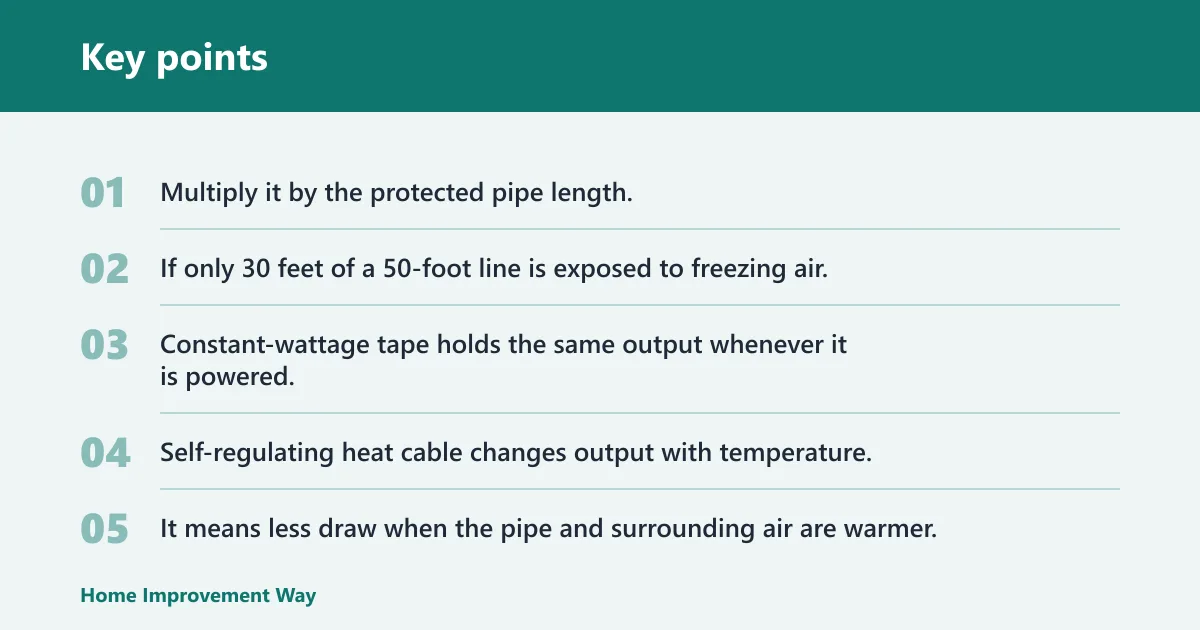
The watts-per-foot figure is the key number. Multiply it by the protected pipe length, not the total pipe run if you are only heating the exposed section. If only 30 feet of a 50-foot line is exposed to freezing air, the heated load should be based on that 30-foot section unless the maker says otherwise.
Self-regulating versus constant-wattage cable
Constant-wattage tape holds the same output whenever it is powered. Self-regulating heat cable changes output with temperature, so it can reduce energy use during milder weather. That does not mean zero draw. It means less draw when the pipe and surrounding air are warmer.
Total circuit length and protected pipe length
Do not confuse total circuit length with heated pipe length. Some installations route cable over elbows, valves, or longer exposed sections, and spiral wrap uses more cable than a straight run. More cable length means more watts, unless the manufacturer specifies a different spacing or pattern.
How does pipe length change the cost?
Pipe length is one of the biggest drivers of cost. More feet protected means more total watts, more kWh, and a higher monthly bill. A short exposed section may cost very little to maintain, while a long exterior run can add up if it stays energized for much of the winter.
10-foot pipe example
Suppose a 10-foot exposed pipe uses 8 watts per foot. That is 80 watts when on. If it runs nonstop for 30 days, the use is about 57.6 kWh. At $0.16 per kWh, that is about $9.22 for the month.
25-foot pipe example
Suppose a 12-foot copper line in an unheated crawl space uses 7 watts per foot. That is 84 watts when on. If it runs nonstop for 30 days, the use is about 60.48 kWh. At $0.16 per kWh, that is about $9.68 for the month.
50-foot pipe example
Suppose a 40-foot outdoor water line wrapped with heat tape uses 6 watts per foot. That is 240 watts when on. If it runs nonstop for 30 days, the use is about 172.8 kWh. At $0.16 per kWh, that is about $27.65 for the month.
Start with the exposed section only. Then choose the right control method, avoid oversizing, and insulate the pipe correctly. These steps usually save more than trying to guess a lower wattage number without changing the installation.
- Measure the exposed pipe, not the full indoor-outdoor run.
- Pick a cable rated for the pipe type and climate.
- Use a thermostat or temperature controller when the product allows it.
- Install insulation that is compatible with the cable.
- Choose straight run before spiral wrap unless the manufacturer requires spiral spacing for the pipe size or exposure.
- Use plug-in or hardwired power only as the product is listed, and keep GFCI protection in place where required.
Say your crawlspace has a 25-foot exposed pipe and you only need freeze protection during cold snaps. A self-regulating cable with a thermostat will usually cost less to run than the same cable plugged in continuously, because the controller can keep it off during milder periods.
A common first-timer mistake is wrapping more cable than the pipe needs. Spiral wrap can be useful on especially vulnerable spots, but it increases total cable length and wattage. If a straight run protects the pipe, that is usually the lower-energy option.
Thermostats and controllers
A thermostat or temperature controller can lower runtime by switching the cable on only near a set temperature. That helps most when the pipe is insulated and the outdoor temperature hovers above freezing part of the time. Without a controller, the cable may stay on longer than needed.
On/off temperature thresholds
Controllers have an on temperature and an off temperature, or a single switch point depending on the design. The lower the temperature outside, the more often the cable stays on. Once the air warms, the cable should cycle off instead of running all day.
Duty cycle and cycling behavior
Duty cycle is the share of time the cable is energized. A 50% duty cycle means half the time on and half off on average. That does not happen in a neat pattern every hour, but it is a useful planning number for estimating bill impact.
When controls can cut runtime
A controller helps most when the weather is near the freeze point, the pipe is insulated, and the heated section is limited to exposed areas. If the cable is oversized or the pipe loses heat fast, the controller may still cycle, but the savings will be smaller than expected.
Insulation and heat loss
Pipe insulation lowers heat loss, which reduces how often heat tape needs to run. It does not directly lower the cable’s rated wattage, but it can shorten runtime and reduce cycling. That is why insulation is one of the simplest ways to cut operating cost.
Pipe insulation thickness
Thicker insulation generally reduces heat loss better than thin foam. The exact benefit depends on pipe size, ambient temperature, wind exposure, and whether the insulation stays dry. A wet or damaged wrap can lose much of its value.
Compatibility with heat tape
Not every insulation product is a fit for every heat cable. Check the manufacturer’s instructions before covering the cable. Some systems require specific insulation types or spacing so the cable does not overheat, especially around valves and fittings.
Why insulation can lower runtime
Insulation keeps more heat in the pipe, so the thermostat may cycle less often. That matters most on windy exterior runs and in colder regions. If the pipe loses less heat to the air, the system needs fewer energized hours to stay above freezing.
Heat tape cost calculator
Use this table as a planning tool. It compares common pipe lengths, estimates watts, and shows monthly cost at three electricity rates. The constant-on column assumes 24 hours a day. The 50% duty-cycle column assumes the cable is energized half the time on average.
| Pipe scenario | Estimated watts | Daily kWh, constant-on | Monthly kWh, constant-on | Monthly cost at $0.15 | Monthly cost at $0.20 | Monthly cost at $0.25 | Monthly cost at 50% duty cycle |
|---|---|---|---|---|---|---|---|
| 10 ft at 8 W/ft | 80 | 1.92 | 57.6 | $8.64 | $11.52 | $14.40 | $7.20 to $14.40, depending on rate |
| 25 ft at 8 W/ft | 200 | 4.80 | 144 | $21.60 | $28.80 | $36.00 | $10.80 to $18.00, depending on rate |
| 50 ft at 8 W/ft | 400 | 9.60 | 288 | $43.20 | $57.60 | $72.00 | $21.60 to $36.00, depending on rate |
Frequently asked questions
How much energy does heat tape use?
Energy use depends on total watts and runtime. A 200-watt cable running 24 hours uses 4.8 kWh per day. If a thermostat cuts runtime in half, daily use falls to about 2.4 kWh. The longer the cable stays on, the higher the bill.
How much power does heat tape use?
Power use is the cable’s wattage while energized. That number comes from watts per foot times the heated length. A 25-foot run at 8 watts per foot draws about 200 watts when on. Self-regulating cable can draw less than that in warmer conditions.
How many watts does heat tape use?
It depends on the product and length. Many systems are rated in watts per foot, so the total can be modest on a short pipe and much higher on a long run. Check the label or manual for the exact figure before estimating cost.
How much electricity does pipe heat tape use per day?
Daily use is watts × 24 ÷ 1,000 for constant operation. A 400-watt system uses 9.6 kWh per day if it never cycles off. If a thermostat or self-regulating cable cuts runtime, the daily number drops in direct proportion to the duty cycle.
How much does heat tape cost to run all winter?
Take the monthly kWh estimate and multiply by the number of cold months, then adjust for your rate. A 200-watt cable that runs nonstop for four months uses about 576 kWh. At $0.20 per kWh, that is about $115.20 for the season.
Does heat tape use a lot of electricity?
It can, if it is long, oversized, or left on all winter without a controller. A short, well-insulated run with a thermostat may use far less than a major appliance. Compared with the average U.S. household use of about 899 kWh per month in 2022, a small heat-tape load is often modest. (EIA)
How do I calculate heat tape electricity use?
Multiply watts per foot by heated length, then multiply by hours on and divide by 1,000 to get kWh. Add your local electricity rate to convert kWh into dollars. For seasonal cost, multiply by the number of months you expect the cable to run.
Sponsored / affiliate links. As an Amazon Associate I earn from qualifying purchases. I may earn additional commission from eligible campaigns.
 GRABOTE 2 Rolls 20mm X 33m 108ft Heat Tape,Adhesive Heat Resistant/Transfer Tape, Heat Vinyl Thermal Sublimation Press Tape,No Residue,for Electronics,Soldering,Circuit Board
 GRABOTE 2 Rolls 20mm X 33m 108ft Heat Tape,Adhesive Heat Resistant/Transfer Tape, Heat Vinyl Thermal Sublimation Press Tape,No Residue,Heat Resistance 482℉(250℃),Comes Off Clean,Easy Peal