How to Tell If Your Outdoor Spigot Is Frozen
A frozen outdoor spigot may give little or no flow, a frost-free faucet may dribble for about 10 to 30 seconds after shutoff, and a hidden split can show water inside the wall or basement. Miss the symptom, and you waste time while a burst pipe sends water behind siding or drywall. This guide gives the fastest checks to separate frozen, normal drain-down, and a split behind the wall.
Quick diagnosis
What you’ll need
- Bucket or towel for runoff
- Flashlight for the basement, rim joist, or interior wall check
- Access to the interior shut-off valve if your home has one
- Basic gloves for removing hoses and fittings
How do you know if your outside faucet is frozen?
Start with the symptom, then check where the water problem shows up. No water at the spout usually points to ice or a closed supply. Water that appears only indoors while the faucet runs points to a split in the wall cavity, which needs a faster response than a simple exterior thaw.
Outdoor spigot symptom table
| Symptom | Likely meaning | Next step |
|---|---|---|
| No water at all | Frozen line, closed interior shut-off valve, or blocked frost-free drainage | Remove attachments and check the interior shut-off valve first |
| Weak trickle | Partial freeze or a restriction in the line | Remove the hose, then retest the spigot |
| Water only after opening the hose | Water trapped in a hose, splitter, timer, or quick-connect fitting | Disconnect every attachment and run the faucet again |
| Dripping from the spout after shutoff | Normal drain-down on a frost-free faucet, or a worn washer on a plain spigot | Watch whether it stops after draining; replace the washer if it keeps dripping |
| Moisture in the basement | Possible split behind the wall | Look at the rim joist and the interior wall while the faucet runs |
| Water appearing only while the faucet runs | Hidden burst in the wall cavity or near the supply line | Close the house supply shutoff now |
| Frost-free faucet with attached hose: yes or no | No means it can drain; yes means the hose may trap water and freeze the line | Remove the hose before calling it safe |
| Shut off house supply now | Pressurized water is escaping inside the wall | Close the house supply shutoff and call for repair |
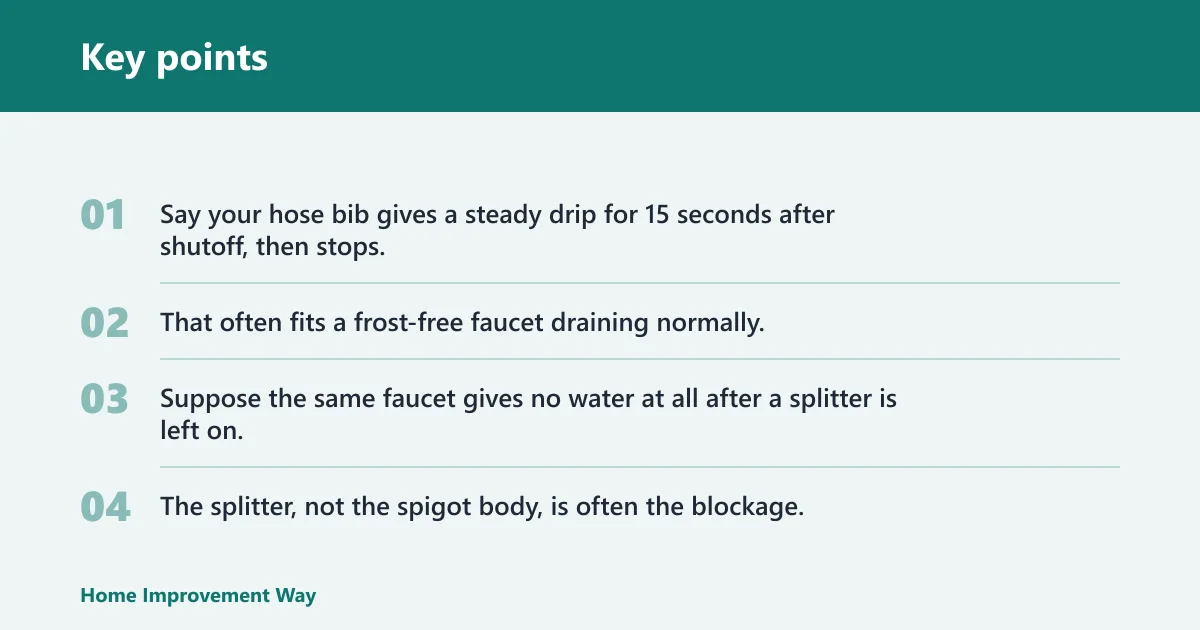
Say your hose bib gives a steady drip for 15 seconds after shutoff, then stops. That often fits a frost-free faucet draining normally, especially if the hose is removed and the body slopes downward. Suppose the same faucet gives no water at all after a splitter is left on. The splitter, not the spigot body, is often the blockage.
Step 1: Remove attachments
Take off every hose, splitter, timer, and quick-connect fitting before you decide the spigot is frozen. A hose left attached can stop a frost-free faucet from draining, and a shut-off nozzle, splitter, or irrigation timer can do the same. If the faucet is plain rather than frost-free, trapped water in those parts can still freeze the outlet.
- Turn the outdoor faucet off.
- Disconnect the hose, splitter, timer, and quick-connect fitting.
- Open the faucet fully and watch for flow and drain-down.
- If water starts moving after removal, the attachment was the problem.
Why attachments matter
A frost-free outdoor faucet, also called a sillcock or wall hydrant, is not insulated or heated. Its valve sits inside the heated wall, and the stem is about 8 to 12 inches long. That design only works if the line can empty downward after shutoff.
Step 2: Test the faucet type
Check whether the fixture is plain or frost-free. A frost-free faucet closes inside the heated wall, so the section outside should empty when it is properly installed. A plain outdoor hose bib or spigot can freeze if water is trapped inside, and it may have an interior shut-off valve that you need to close before winter.
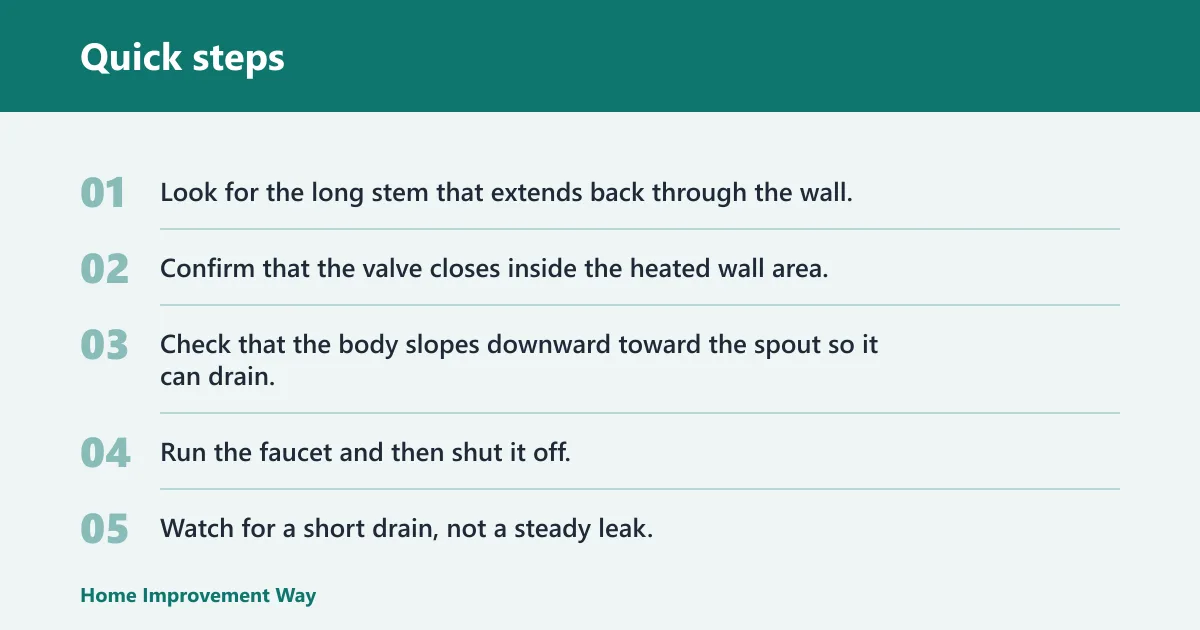
- Look for the long stem that extends back through the wall.
- Confirm that the valve closes inside the heated wall area.
- Check that the body slopes downward toward the spout so it can drain.
- Run the faucet and then shut it off.
- Watch for a short drain, not a steady leak.
Yes or no check for frost-free faucets
If the faucet is frost-free and a hose, timer, or splitter is attached, answer no: it is not draining the way it should. If the faucet is frost-free and nothing is attached, answer yes only if the line drains and the spout stops after a brief drip. A correctly installed frost-proof valve will always drain unless something was left attached.
How do you tell if your spigot already burst inside the wall?
Watch the basement, rim joist, and the interior wall while the faucet runs. Water that appears indoors only when the outdoor faucet is open is a strong warning sign of a split behind the wall. A damp or stained rim joist is another clue, and the damage may show up later even if the outside faucet looks normal.
- Open the faucet and keep it running for a moment.
- Use a flashlight to check the basement wall below the spigot.
- Inspect the rim joist for dampness or staining.
- Look for moisture on the interior wall near the faucet location.
- Close the house supply shutoff if water appears inside.
Why the inside check matters
Many bursts happen in the wall cavity, where you may not see damage from outside. The pipe can split, then leak only under pressure. That is why water in the basement while the spigot runs should be treated as a plumbing problem, not just a frozen fixture.
Why does water stop coming out of my outdoor spigot in winter?
Water usually stops because ice blocks the outlet, the interior shut-off valve is closed, or the faucet cannot drain properly. Cold weather timing matters too. Lake County guidance says hoses should come off by the first week of October, O’Hare’s 1991-2020 normal first freeze date is October 19, and Rockford’s is October 13. O’Hare has recorded a first freeze as early as September 22.
A common first-timer mistake is waiting for a hard freeze before checking the line. By then, a frost-free faucet that still has a hose attached may already be holding trapped water near the valve.
Can a frost-free spigot still freeze?
Yes. A frost-free faucet is not insulated or heated, so it still depends on proper drainage. If a hose is left on, or a nozzle, splitter, or timer stays attached, the outside section can hold water and freeze. A frost-free unit can also freeze if it is installed level or pitched the wrong way.
- Remove every attached hose and fitting.
- Open the faucet and confirm that it drains downward.
- If it still holds water, check the interior shut-off valve if your home has one.
- If the faucet still will not empty, stop using it until it is repaired.
When should you shut off the house supply?
Shut off the house supply if water is running inside the wall, or if the basement shows active moisture while the faucet is open. That stops pressurized water from feeding the split and limits further damage. If the leak is indoors, waiting for the outdoor faucet to thaw is the wrong move.
If that didn’t work, try this next
- Find the interior shut-off valve on the supply line serving the outdoor faucet.
- Turn it clockwise to close it fully.
- Open the outdoor faucet again to relieve pressure and drain what remains.
- Keep watching the basement and wall area for any new moisture.
- Schedule repair if water returns when the valve is reopened.
When a plumber is the right call
Call a plumber if water appears in the wall cavity, the rim joist stains keep growing, or the faucet still will not drain after all attachments are removed. Repair cost is usually lower when the problem is caught at the fixture or supply line, before drywall, insulation, or framing are soaked.
Common mistakes
- Leaving a hose attached through winter
- Assuming no outside leak means no damage inside the wall
- Ignoring water that shows up only while the faucet runs
- Forgetting the interior shut-off valve before the first hard freeze
Remove hoses and fittings before the first cold snap, and confirm the faucet drains after shutoff. If the fixture is frost-free, that check matters every season, because the valve only protects the wall side when the outlet can empty.
Frequently asked questions
How do I know if my outdoor spigot is freeze proof?
Look for a long stem that reaches into the heated wall, with the valve closing inside the house side of the wall. A frost-free faucet is not insulated or heated, so it still needs clear drainage. If attachments are left on, it can behave like a plain spigot and freeze.
How do I tell if my spigot already burst inside the wall?
Open the faucet and look inside the house, not just outside. A damp rim joist, moisture on the interior wall, or water in the basement only while the faucet runs can signal a split. Close the house supply shutoff if you see any of those signs.
Does a hose left on a frost-free faucet make it freeze?
Yes. A hose left attached can stop a frost-free faucet from draining, and the same is true for a splitter or irrigation timer. Remove all attachments before cold weather. If the faucet still holds water after that, treat it as a drainage or installation problem.
Sponsored / affiliate links. As an Amazon Associate I earn from qualifying purchases. I may earn additional commission from eligible campaigns.