How to Choose Between Salt-based and Salt-free Water Treatment
Choose salt-based softening if your water test shows hardness above about 7 grains per gallon and you want softer-feeling water. Choose salt-free scale control if your main goal is to limit deposits and avoid added sodium. Pick the wrong system and you can still get scale, soap scum, or maintenance you did not want. This guide compares both options by water test results, household symptoms, and installation limits. The hardness threshold and scale-risk framing follow common utility and extension guidance on hard water and scaling, including EPA consumer information and state extension materials.
Salt-based vs salt-free at a glance
The trade-off is straightforward. A salt-based softener removes calcium and magnesium, so the water feels softer and soap lathers better. A salt-free conditioner does not remove hardness minerals; it changes how they behave so scale is less likely to stick. One changes the water’s hardness result. The other mainly changes scale behavior. Ion-exchange softening is the standard NSF/ANSI 44 softener mechanism; salt-free TAC systems are scale-prevention devices, not hardness-removal devices.
That difference matters because the goal is not always the same. If you want fewer spots, less scale, and no sodium addition, a salt-free system may fit. If you want the classic soft-water feel, better lather, and full relief from hard-water complaints, salt-based softening is the more direct match.
| Criterion | Salt-based water softener | Salt-free water conditioner |
|---|---|---|
| What it changes | Removes calcium and magnesium by ion exchange | Does not remove hardness minerals; reduces scale formation |
| Soap feel and lather | Improves both | Usually does not create the same soft-water feel |
| Salt and wastewater | Needs salt, regeneration, and a drain line | Typically needs no salt, backwashing, or drain |
| Sodium | Adds sodium proportional to hardness removed | Adds no sodium from treatment |
| Best fit | Full hard-water symptom relief | Scale control, low-sodium limits, or drain limits |
What problem are you trying to solve?
Start with the outcome, not the label. If the complaint is scale on fixtures, cloudy water spots, or limited installation space, salt-free conditioning can be enough. If the complaint is stiff laundry, dry-feeling skin after bathing, soap scum, or poor lather, salt-based softening is usually the better fit. EPA consumer guidance and extension publications consistently separate hard-water symptoms from scale-only concerns for this reason.
Choose by symptom: scale, soap feel, sodium, or install limits
Scale control and soft-water feel are different goals. A conditioner can help reduce deposits while leaving hardness minerals in the water. A softener removes those minerals, so the water acts softer in sinks, showers, and laundry. If your biggest concern is sodium or brine discharge, that points away from salt-based equipment. The sodium tradeoff is a real ion-exchange effect: sodium is exchanged into the treated water as calcium and magnesium are removed, and NSF/WQA consumer materials describe that tradeoff plainly.
Suppose a condo owner has 12 grains per gallon of hardness and no floor drain near the mechanical closet. Salt-free conditioning may be the practical option because drainage is limited. Now change only one thing: the home has the same hardness, but a full laundry room with drain access and a strong desire for softer-feeling shower water. Salt-based softening becomes the stronger match.
When scale control alone is enough
Scale control alone is often enough when the main issue is mineral buildup, not soap performance. That is especially true when the water test shows hardness near the threshold where scale becomes noticeable, about 7 grains per gallon, and the household does not expect soft-water feel to change. Salt-free systems are built for that use case, although they typically leave hardness readings unchanged because the minerals remain in the water.
This is also the better lane when you want to avoid salt and wastewater. Salt-free conditioning produces no wastewater and needs no salt or electricity in many whole-house systems. It can be a sensible fit for limited-drain installs, some septic concerns, and households that want lower maintenance. Septic suitability still depends on local rules, system design, and wastewater handling requirements; EPA and state/local health guidance generally treat that as a site-specific question rather than a universal yes/no.
When you need full softening instead
Choose a softener when hard-water symptoms are affecting daily use, not just fixture buildup. If soap scum remains, shampoo feels stubborn to rinse, or laundry comes out dull, the hardness minerals are still doing their work in the water. Salt-free conditioning does not remove those minerals, so those complaints can remain. That is why utility and extension references treat softening as the solution for performance complaints and scale control as a separate objective.
A common first-timer mistake is expecting a conditioner to change the feel of water in the shower the same way a softener does. That usually does not happen. If softer-feeling water is the goal, ion exchange is the direct route.
Water hardness and test results
Measure the water before choosing anything. Hardness is usually shown in grains per gallon or mg/L, and around 7 grains per gallon is a meaningful scale threshold. Higher hardness raises scale risk, so the number helps separate light scale-control needs from full softening needs. Many utility hard-water guides use similar breakpoints to explain when scaling and soap inefficiency become noticeable.
How to read grains per gallon or mg/L
Test strips can give a quick reading, and lab tests are better when the water also has iron, chlorine, or chloramine concerns. A salt-free conditioner leaves hardness concentration unchanged on a test strip, so the number may look the same after treatment even if scale behavior improves. That can confuse people who expect the strip to drop.
If the test comes back high, the next question is not just “hard or soft.” It is “what outcome do you want?” A high hardness reading plus soft-water complaints points toward salt-based treatment. A high hardness reading plus a low-sodium or no-drain constraint can point toward salt-free conditioning.
What else on the test can change the choice
Chlorine or chloramine changes the decision. City water may need both scale control and taste or odor reduction, and softening alone does not solve that job. Carbon filtration is often part of the answer when disinfectant taste or smell is part of the complaint. EPA and major utilities note that chloramine and chlorine taste/odor are typically handled by activated carbon, not by softening alone.
Iron and sediment also matter. They can foul media, reduce system life, or make a simple softener or conditioner the wrong first step. If those show up on the test, the treatment train may need prefiltration before you decide between salt-based and salt-free water treatment.
Salt-based softener or salt-free conditioner?

Salt-based softeners and salt-free conditioners solve different problems, even though they are often sold as alternatives. Ion exchange removes calcium and magnesium. TAC and similar salt-free media do not remove them; they change mineral behavior so scale is less likely to stick to pipes and fixtures. WQA and NSF-aligned consumer guidance draw that same distinction: softening lowers hardness, while salt-free devices are scale-control systems.
How ion exchange compares with TAC
Template-assisted crystallization, or TAC, is the process used by many salt-free conditioners. TAC media uses microscopic nucleation sites to start crystallization, keeping minerals in suspension as micro-crystals instead of leaving them to plate onto surfaces. In many whole-house systems, that means no wastewater and no electricity. Performance, however, depends on feed-water chemistry, hardness level, flow conditions, and the manufacturer’s specified operating range; TAC is not a universal fix for every water quality problem.
That also explains the limit. If the minerals are still in the water, the water still tests hard. TAC can reduce scale, but it does not deliver the same soft-water feel that ion exchange provides.
What salt-free treatment can and cannot do
Salt-free treatment can be a good fit for scale control, sodium avoidance, and installations with no drain line. It may also help in some setups where odors or chlorine are part of the broader treatment plan, depending on the full system design. Manufacturer claims and third-party guidance vary, but the consistent point is that salt-free scale-control media is not a chlorine or chloramine remover by itself; those contaminants generally need a carbon or specialty treatment stage.
It will not remove hardness minerals. It will not reliably fix soap scum, poor lather, or the soft-water feel complaint. If the job is to change how the water performs in the shower and laundry, salt-free is usually the weaker answer.
When mixed water problems call for two systems
City water often needs more than one treatment step. A household may want scale control, but also need chlorine or chloramine reduction for taste and odor. In that case, a carbon filter paired with either a softener or conditioner can be the more complete solution. EPA and utility sources commonly recommend carbon for chlorine taste/odor reduction; chloramine may require catalytic carbon or a media specifically rated for chloramine reduction.
Picture a suburban home with 9 grains per gallon of hardness and a strong chlorine smell at the tap. A salt-based softener would help with hardness, but not with chlorine on its own. Adding carbon filtration addresses the second problem directly.
Water treatment decision matrix
This table ties the choice to real household conditions. The same water test can lead to different answers depending on complaint, sodium limits, drainage, and whether the goal is full softening or scale control only.
| Water test result | Main complaint | Best-fit system type | Why it fits | What it will not solve |
|---|---|---|---|---|
| 4 grains per gallon, no iron | Light fixture spotting | Salt-free conditioner | Scale control is the main need, and hardness is modest | Soap feel may stay unchanged |
| 8 grains per gallon, no drain near install | Scale on faucets and shower walls | Salt-free conditioner | Useful where drainage is limited and scale control matters most | It will not remove hardness minerals or fully change lather |
| 10 grains per gallon, laundry and shower complaints | Soap scum and rough-feeling rinsing | Salt-based softener | Ion exchange removes calcium and magnesium, improving lather | It does not treat chlorine or chloramine by itself |
| 12 grains per gallon, low-sodium household | Wants scale reduction without added sodium | Salt-free conditioner | No sodium is added from treatment | Soft-water feel will not match a softener |
| 14 grains per gallon, septic system | Brine discharge concern | Salt-free conditioner | No brine discharge and no regeneration wastewater | Hard-water feel and lather issues can remain |
| 16 grains per gallon, strong soap scum | Bathroom buildup and poor lather | Salt-based softener | Full hard-water symptom relief is the goal | Does not remove chlorine or chloramine alone |
| 9 grains per gallon, chlorine taste and scale | Taste, odor, and deposits | Softener plus carbon filtration | One system handles hardness; the other handles chlorine | Softening alone will not fix taste or odor |
| 7 grains per gallon, condo with second-floor install | Limited space and no clear drain route | Salt-free conditioner | Fits restricted installs and avoids a drain line requirement | It will not remove hardness minerals or create a softer feel |
Red flags by system
Some water and house conditions make one option a poor fit. Use these red flags to avoid buying the wrong equipment for the problem you actually have.
| Red flags that rule out salt-free alone | Red flags that make salt-based the safer pick |
|---|---|
| You need softer-feeling water, not just less scale | You want stronger soap lather and less soap scum |
| Your test shows hard-water symptoms are already severe | Your hardness level is high enough that scale is a recurring problem |
| You expect the test strip to drop after treatment | You can handle salt use, regeneration, and a drain line |
| Chlorine, chloramine, or iron also need treatment | You want the full hard-water fix and can add separate carbon filtration if needed |
Salt-free is also the weaker choice when a household expects laundry or shower comfort to change in a big way. If the water still feels hard after treatment, the system may be doing its scale-control job while still failing the day-to-day comfort test.
Salt-based is the safer pick when you want the broadest relief from hard-water symptoms and can support the installation. Salt-free conditioning does not remove calcium and magnesium, while softeners add sodium proportional to hardness removed. That sodium tradeoff matters for some households, and EPA and utility guidance generally treats it as a preference-and-health consideration rather than a universal problem.
Installation and maintenance checks
Installation constraints often decide the choice before performance does. Softeners usually need a drain line for regeneration, while salt-free systems are useful where drainage is limited. Condos, tight mechanical closets, and second-floor installs often point toward salt-free treatment for that reason alone.
Drain access, regeneration, and wastewater
A salt-based softener needs a place to send regeneration wastewater. If there is no drain, the install can become complicated or impossible without extra plumbing work. Salt-free conditioning avoids that issue because it typically needs no salt, backwashing, or drain. Local plumbing and wastewater rules can still apply, so drain access is only one part of the install check.
That difference matters for maintenance too. Salt-free systems are usually easier to live with day to day, but easier maintenance does not mean better fit. A low-maintenance system that leaves your main complaint unchanged is still the wrong choice.
Septic systems and low-sodium limits
Septic systems raise the stakes for brine discharge. Salt-free systems avoid brine discharge, which can make them the cleaner fit where septic impact is a concern. Low-sodium households should also pay attention here, since salt-based softeners add sodium to treated water. Septic suitability depends on local health codes, septic design, and how the system handles wastewater; it is not automatically prohibited everywhere, but many jurisdictions caution against unmanaged brine discharge.
That does not automatically rule out softening. It means the choice should be made with the household limit in mind, not by assuming all hard-water treatment works the same way.
Flow rate and whole-house demand
Flow rate matters because whole-house treatment should keep up when showers, laundry, and appliances run at the same time. Manufacturer sizing should match the home’s demand, or pressure and performance can suffer. Whole-house systems that are undersized can leave you with uneven treatment at peak use.
For that reason, the right system is not only about chemistry. It is also about how much water the home uses, where the unit can go, and whether a drain, electricity, or a carbon stage is practical in that space.
Choose salt-based if… / Choose salt-free if…
Choose salt-based softening if your test shows meaningful hardness and you want the water to feel soft, rinse cleanly, and produce better lather. It is the better pick when soap scum, dry-feeling skin, or laundry complaints are the main issue and you can support salt, regeneration, and a drain line.
Choose salt-free conditioning if your main goal is scale control, sodium avoidance, or a simpler install with no drain. It is the better fit when you do not need the soft-water feel, when drainage is limited, or when a septic setup makes brine discharge a concern. TAC and similar systems may work best when feed water stays within the manufacturer’s specified hardness, flow, and pretreatment conditions.
Our picks by need
This section is best read as a neutral comparison framework, not a shopping shortlist. The most useful filter is still the water test: if the water needs full hardness removal, look to a salt-based softener; if the water mainly needs scale control and the install is constrained, look to salt-free conditioning; if both hardness and chlorine taste/odor are present, a paired system is often the cleaner answer.
Full softening: Aquasana SimplySoft 40K grain Whole House water softener

Based on the manufacturer’s specs and published product details, this Aquasana softener fits households that want the classic soft-water result from ion exchange. It uses salt-based treatment, has metered regeneration, and is built for full hard-water symptom relief rather than scale control alone.
The drawback is the one that comes with the category: it needs salt, regeneration, and a drain line. It also adds sodium proportional to hardness removed, so it is not the first choice for low-sodium households or installs with limited drainage.
Softener plus carbon: AFW filters Built Fleck 5600SXT 48,000 grain water softener with upflow carbon filter
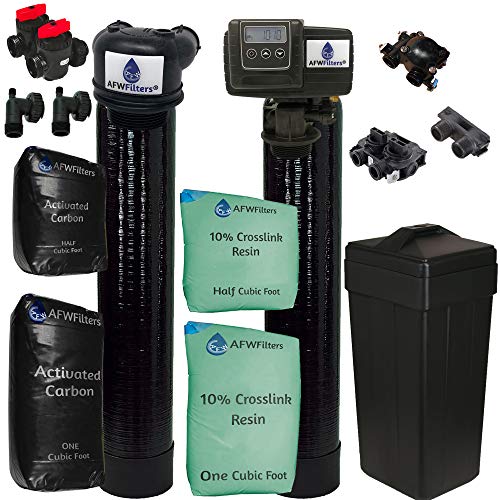
This setup makes sense when hardness is only part of the problem. Based on the published details, it combines whole-house softening with carbon filtration, so it is aimed at homes that need hardness reduction and a better answer for chlorine-related taste or odor.
The tradeoff is size and complexity. A combined system needs more space, and more parts mean more to set up and service. It is a stronger fit for a home with multiple water complaints than for a simple scale-control job.
Scale control only: Tier1 900,000 gallon salt-Free whole house TAC scale Prevention system

This Tier1 system fits the scale-control lane. It uses TAC, needs no salt or electricity, and is positioned as a low-maintenance whole-house conditioner for households that want to reduce mineral buildup without moving to true softening.
The drawback is the same one all salt-free systems share: it does not remove hardness minerals. If soap scum, spotting, or soft-water feel are the priority, this is not the complete answer.
Mistakes to avoid
Do not choose based on the word “softener” alone. Some salt-free products are sold as softener alternatives, but they do not remove hardness minerals. That difference changes the outcome at the tap, which is why NSF, WQA, and utility sources separate softening from scale prevention.
Do not ignore chlorine or chloramine if the water tastes or smells off. Hardness treatment does not automatically solve disinfectant taste issues, so carbon filtration may still be needed.
Do not skip the drain check. A salt-based unit without a drain plan becomes an installation problem, not a water solution.
Do not assume septic systems ban all treatment. They do push the decision toward systems that avoid brine discharge, which is why salt-free often gets the nod there. Still, local septic and plumbing rules control the final answer.
Frequently asked questions
What is the difference between salt-based and salt-free water treatment?
Salt-based treatment removes calcium and magnesium through ion exchange, so the water feels softer and soaps lather better. Salt-free treatment does not remove hardness minerals. It changes how those minerals behave so scale is less likely to stick to pipes and fixtures. That is the core distinction used by NSF/WQA consumer explanations and most utility guides.
Which water treatment is better if I want softer-feeling water?
Salt-based softening is the better choice if soft-water feel matters. That is the result of removing hardness minerals from the water. Salt-free conditioning can reduce scale, but it usually will not give you the same shower feel or soap performance.
When is salt-free water treatment enough for scale control?
Salt-free treatment is often enough when scale is the main issue and you do not need softer-feeling water. It can fit homes near the 7 grains per gallon threshold, especially where drainage is limited, sodium avoidance matters, or the household wants a lower-maintenance setup. TAC performance is still most reliable when water chemistry and flow match the manufacturer’s stated range.
Does salt-free water treatment remove hardness minerals?
No. Salt-free systems do not remove hardness minerals. A test strip will still show the hardness in the water because the minerals remain present; the system only changes how they behave so they are less likely to form hard scale deposits.
Can a salt-based softener help with chlorine or just hardness?
A salt-based softener mainly handles hardness. It does not remove chlorine or chloramine by itself, so taste and odor complaints often need carbon filtration too. If city water has both hard water and disinfectant taste, a combined treatment approach is often the better plan, and EPA or utility sources generally point to carbon for chlorine or chloramine reduction.
Is salt-free water treatment better for low-sodium diets or septic systems?
Yes, often. Salt-free treatment adds no sodium from the system and avoids brine discharge, which can make it a better fit for low-sodium households and some septic setups. That said, it will not give the same soft-water feel as a salt-based softener, and septic suitability still depends on local rules.
What should I check in my water test before choosing a system?
Check hardness in grains per gallon or mg/L first. Then look for chlorine, chloramine, iron, and sediment. Hardness tells you whether scale risk is significant. The other items tell you whether you also need carbon filtration, prefiltration, or a different treatment plan. If chloramine is present, confirm the carbon stage is rated for it.
How do flow rate, hardness level, and installation constraints affect the choice?
Flow rate affects whether the system can keep up with the home’s demand. Hardness level tells you how serious the scale risk is. Installation constraints, especially drain access, can rule out a softener even when it would otherwise be the better performance choice. Whole-house equipment should be sized to peak demand, not average use.
Sources
- https://www.epa.gov/privatewells/private-drinking-water-wells-treatment-systems
- https://www.epa.gov/ground-water-and-drinking-water/consumer-factsheet-about-arsenic-drinking-water
- https://www.nsf.org/consumer-resources/water-quality/water-softeners
- https://www.wqa.org/learn-about-water/common-contaminants/hardness
- https://extension.psu.edu/hard-water-and-water-softeners
- https://extension.umn.edu/water-quality-and-soil-testing/hard-water
- https://www.cdc.gov/healthywater/drinking/private/wells/treatment.html
Sponsored / affiliate links. As an Amazon Associate I earn from qualifying purchases. I may earn additional commission from eligible campaigns.