What Size Water Softener Do I Need for My Home?
For most homes, choose a softener with enough usable grain capacity to cover about 7 to 10 days of water use at the home’s hardness level, then check that the flow rate can handle the peak fixtures running at once. Too little capacity causes hard-water breakthrough, more frequent regeneration, and weak performance at busy times. This guide shows how to size by hardness, household gallons, and peak demand.
What size water softener do I need?
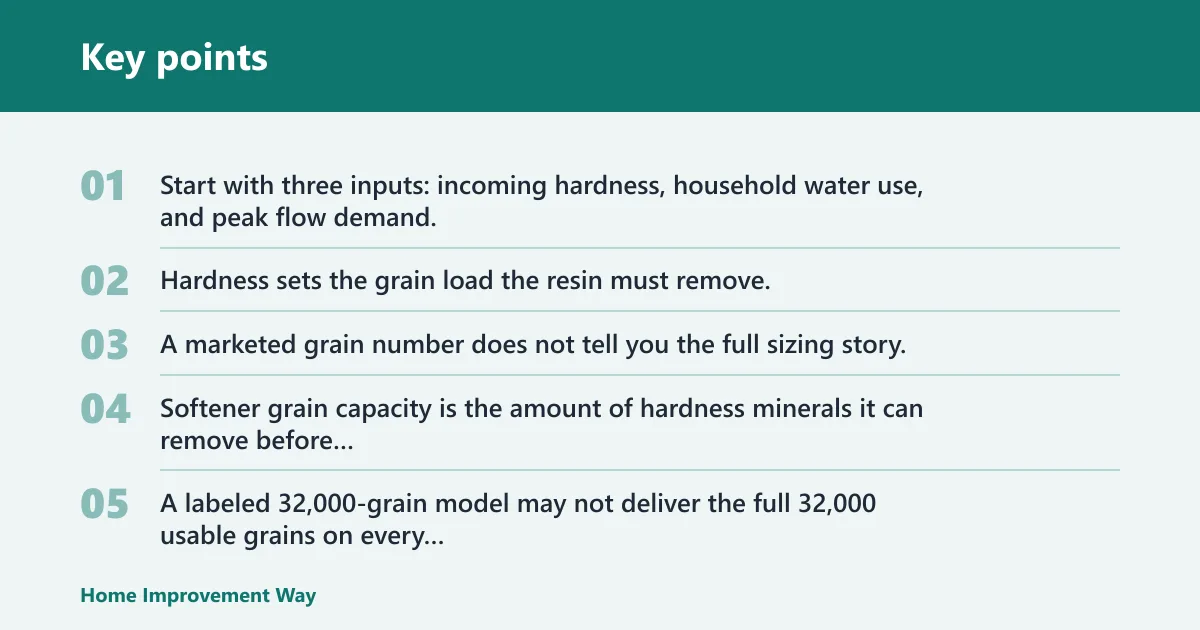


Start with three inputs: incoming hardness, household water use, and peak flow demand. Hardness sets the grain load the resin must remove, daily gallons show how fast that load builds, and flow rate tells you whether the softener can keep up when several fixtures run at once.
Why grain number alone is not enough
A marketed grain number does not tell you the full sizing story. Softener grain capacity is the amount of hardness minerals it can remove before regeneration, but usable capacity depends on the salt setting and how efficiently the unit regenerates. A labeled 32,000-grain model may not deliver the full 32,000 usable grains on every setting.
That is why a good size choice balances capacity and flow. A unit that looks large enough on paper can still miss the mark if it regenerates too often, or if its service flow rate cannot handle two showers and a laundry load at the same time.
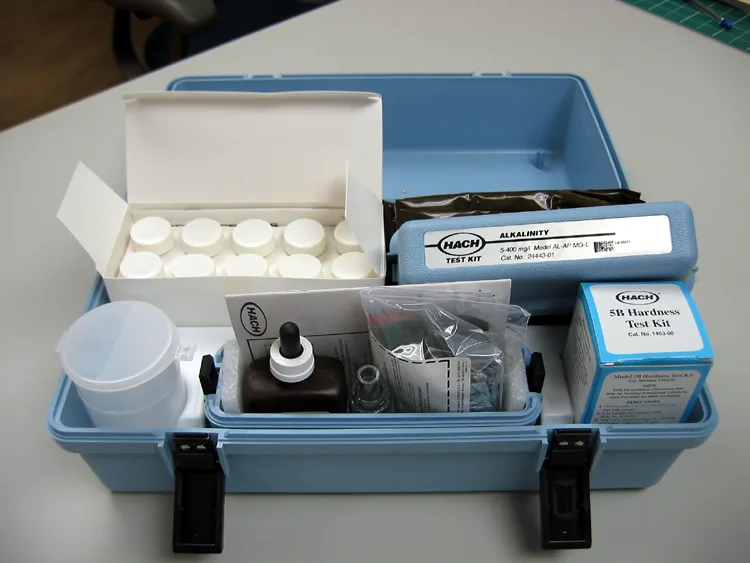
How do you measure hardness?
Use the incoming untreated water hardness, not softened water from a bypassed or mixed source. Hardness is measured in grains per gallon, parts per million, or milligrams per liter. If your result is in ppm or mg/L, divide by 17.1 to convert to gpg.
Use the right number for sizing
For sizing, enter the raw hardness entering the softener. If part of the house is on a bypass line, or if the sample came from already treated water, the result will be too low and the softener may be undersized.
If the report shows 171 mg/L, divide by 17.1 to get 10 gpg. If it shows 10 gpg already, you can use that number directly. The QWL calculator uses hardness in grains per gallon.
How much water does your home use?
If you do not have a water bill or meter reading, use 75 gallons per person per day as a planning value. A better estimate comes from actual household usage, because bills and meters capture real demand more accurately than a simple headcount. Leave out irrigation and bypassed fixtures.
Estimate daily gallons
Water use often rises with long showers, frequent laundry, large tubs, or a household that has guests. A home with two bathrooms and a soaking tub may need more attention to peak demand even if the average daily gallons look ordinary.
For a four-person home, 75 gallons per person per day gives 300 gallons per day. That same value appears in common planning examples from water-softener calculators and is a reasonable fallback when no meter data is available.
Water softener sizing worksheet
Use this worksheet to turn household size, hardness, iron, and daily gallons into a usable grain-capacity range. It is a planning tool, not a substitute for a water test or a final check of the softener’s service flow rate.
| Input | How to use it | Resulting sizing guidance | When another factor decides the size |
|---|---|---|---|
| Household size | Multiply people by daily gallons | Start with 50 to 75 gallons per person per day; use 75 when no better data is available | Peak flow matters more in multi-bath homes |
| Hardness | Use incoming gpg | Grain load = people × daily gallons × gpg | High hardness pushes capacity upward fast |
| Iron | Add a safety margin if iron is present | Use a larger usable-capacity range or separate iron pretreatment | Dedicated iron filtration becomes the better choice when iron is persistent or high |
| Daily gallons | Use bill or meter data if available | Choose capacity for several days of normal demand, not one day only | Irregular use or guests may justify a larger reserve |
| Flow rate | Check simultaneous fixtures | Make sure the softener can meet peak GPM without pressure loss | Flow rate becomes the deciding factor in homes with multiple showers or large tubs |
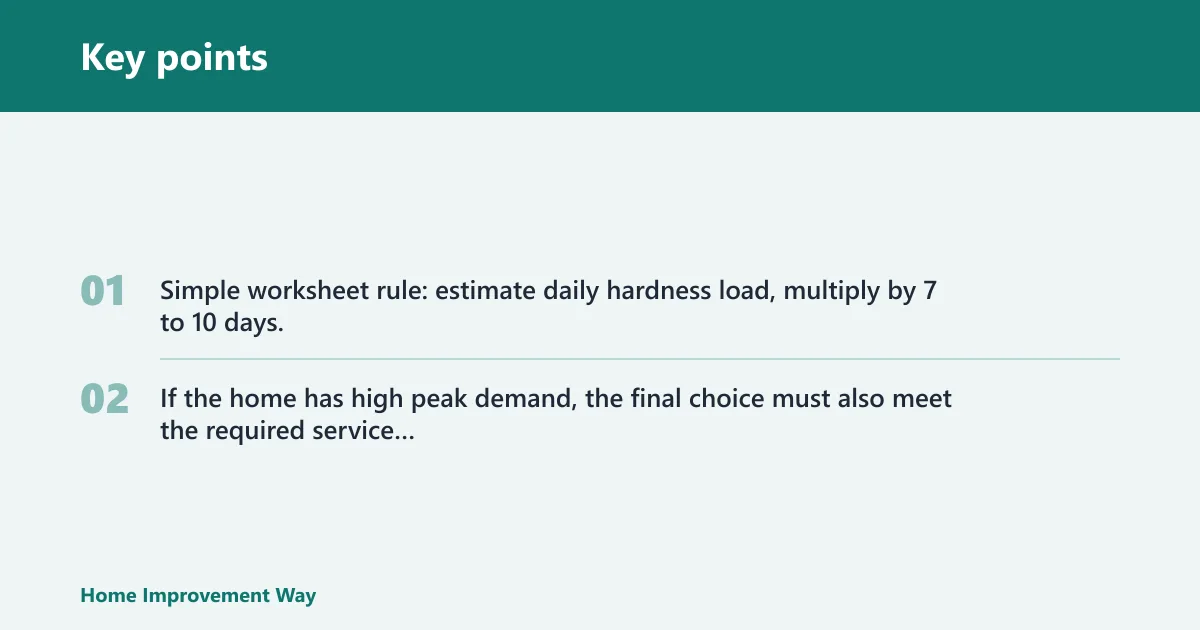
Simple worksheet rule: estimate daily hardness load, multiply by 7 to 10 days, then compare that number with the softener’s usable grain capacity at its intended salt dose. If the home has high peak demand, the final choice must also meet the required service flow rate.
How do grain capacity and regeneration work?
Regeneration happens when the resin bed is saturated with hardness ions and needs brine to restore capacity. Demand-initiated regeneration is often preferred over timer-based control because it regenerates when the bed is actually nearing exhaustion, not on a fixed schedule that can waste salt and water.
Usable capacity versus advertised capacity
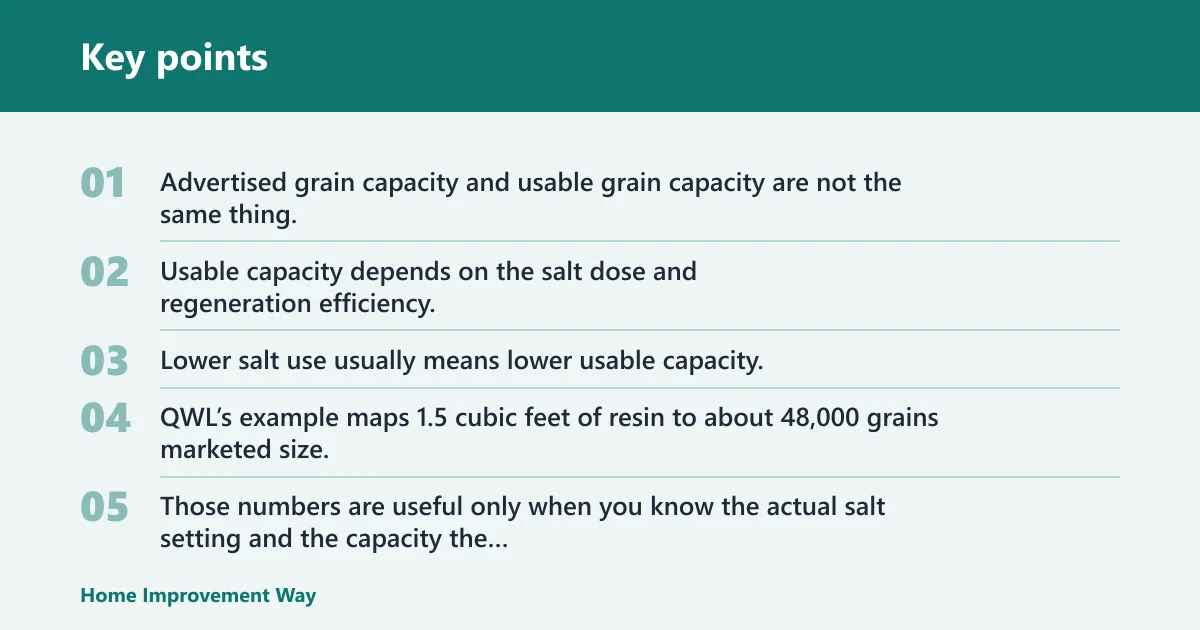
Advertised grain capacity and usable grain capacity are not the same thing. Usable capacity depends on the salt dose and regeneration efficiency. Lower salt use usually means lower usable capacity, so a marketing label can look larger than the performance the unit may deliver in real use.
QWL’s example maps 1.5 cubic feet of resin to about 48,000 grains marketed size, while another common home example is 32,000 grains. Those numbers are useful only when you know the actual salt setting and the capacity the unit can deliver at that setting.
How salt dose changes efficiency
Lower salt settings often improve efficiency in the sense of using less salt per cycle, but they also reduce usable capacity. That tradeoff matters because a softener sized too tightly may regenerate too often, while one set too low for the house may leave too little reserve between cycles.
A correctly sized system should regenerate after several days of normal demand, not every day and not after the resin has been pushed far past its useful reserve. Frequent regeneration increases salt and water use, and it can shorten resin life over time.
When does flow rate matter more than grain capacity?
Flow rate becomes the deciding factor when several fixtures can run at once and the softener cannot pass enough water without a pressure drop. In a multi-bathroom home, service flow rate matters just as much as grain capacity because the system can have enough capacity on paper but still feel weak at peak use.
Watch for peak demand problems
Signs of a flow mismatch include pressure loss during showers, weak fill rates at a tub, or a noticeable drop when the washer and two fixtures run together. If that happens, increase service flow capability even if the grain number already looks large enough.
QWL’s typical continuous service flow rate for a four-person home is roughly 10 GPM or more. WaterSoftenerSizer lists 48K grains and 13 GPM for a large-household hard-water recommendation. Those examples show that capacity and flow are separate decisions, not one number.
Say your home has two showers, a dishwasher, and a laundry load that often overlap. A 32,000-grain softener may have enough capacity for the day’s hardness load, but if the service flow rate is too low, the showers can still feel starved while the resin is doing its job.
How does iron change softener size?
Iron in well water should be counted during sizing because it can foul the resin bed and reduce usable capacity. If you ignore iron, the softener may lose performance early, regenerate more often, and wear out faster than expected.
When to add pretreatment
Use pretreatment or a dedicated iron filter when iron is persistent enough to load the resin quickly or when staining and orange buildup appear along with hardness. The exact cutoff depends on water chemistry, but the key point is simple: iron is not a minor footnote in sizing.
With iron present, a larger softener is not always the answer. If iron is enough to foul the bed, pretreatment protects the resin better than simply buying more capacity. That can preserve both performance and resin life.
Signs the resin bed may foul early
Watch for reduced softening between regenerations, a rise in hardness breakthrough, and shorter intervals before the unit needs cleaning or regeneration. Iron can also create staining that shows the softener is carrying more than hardness alone.
A common first-timer mistake is sizing only for hardness and ignoring a well with iron. The result can be a system that seems large enough at install time but begins to underperform as the resin bed loads up.
How often should a correctly sized softener regenerate?
A correctly sized softener should usually regenerate after several days of normal household use, not after every short burst of demand. Demand-initiated control is the better target because it tracks actual hardness removal and helps avoid unnecessary salt and water use.
Regeneration timing and wear
If a softener regenerates too often, salt use rises and the resin gets more cycling than it needs. If it regenerates too rarely, hardness can break through before the next cycle and untreated water reaches fixtures.
For most homes, the goal is a schedule that matches real usage patterns. Irregular occupancy, guests, hot tubs, and heavy laundry weeks can all change the demand enough to justify a wider capacity range or a larger reserve.
Examples that show the math
Suppose a family of four has water at 10 gpg and uses about 75 gallons per person per day. That is 300 gallons per day and 3,000 grains of hardness load per day, before any iron adjustment. A capacity target for 7 to 10 days would start around 21,000 to 30,000 usable grains, then move upward if the home has high peak flow or iron.
Picture a larger home with three bathrooms, frequent laundry, and 8 gpg hardness. The daily hardness load may not look extreme, but the flow requirement can still push the choice toward a higher-flow unit even if the grain math points to a smaller resin bed.
- Measure incoming hardness in gpg, or convert ppm or mg/L by dividing by 17.1.
- Estimate daily water use with a bill or meter, or use 75 gallons per person per day.
- Multiply daily gallons by hardness to get daily grain load.
- Choose a usable grain capacity that covers 7 to 10 days of that load.
- Check whether simultaneous fixtures require a higher service flow rate.
- Add iron pretreatment if well water contains enough iron to foul the resin.
Frequently asked questions
What size water softener do I need for my home?
Choose a softener based on usable grain capacity first, then verify service flow rate. For most homes, that means enough capacity to cover 7 to 10 days of hardness load at your measured gpg, with a flow rating that can handle showers or laundry running together without pressure loss.
How do I know what size water softener I need for my home?
Start with a hardness test on incoming untreated water, estimate daily gallons, and check peak fixture demand. If you know the household’s actual water use from a meter or bill, use that instead of a rough estimate. Then compare the resulting grain load with usable capacity, not just the marketed grain number.
What size water softener do I need for my house?
Your house size matters because it often predicts both water use and peak flow, but it is not the only input. A smaller house with very hard water may need more grain capacity than a larger house with moderate hardness. Multi-bath layouts can also require a higher service flow rate.
How many grains should my water softener be?
There is no single correct grain number. The right size depends on incoming hardness, daily water use, and how many days of reserve you want between regenerations. A common home example is 32,000 grains, while larger homes or hard-water homes may need more usable capacity and more flow.
Do I size a softener by people, hardness, or flow rate?
Size it by all three. People and hardness determine the daily grain load, while flow rate determines whether the softener can keep up when fixtures run at the same time. If the grain math and the flow rating disagree, the lower-performing part decides the final size.
What size softener do I need for well water with iron?
Well water with iron needs extra attention because iron can foul the resin bed and shorten resin life. Add pretreatment or a dedicated iron filter when iron is enough to load the softener quickly, or when staining and early performance loss appear. A larger softener alone may not solve the problem.
Sponsored / affiliate links. As an Amazon Associate I earn from qualifying purchases. I may earn additional commission from eligible campaigns.
 Water Air Purifiers for Home, Air Washer Aroma Diffuser, Air Filter Washer Humidifier, Essential Oils Aroma Fresher With LED Night light for Office, Bedroom,Small Air Cleaner For Smoke and Pets
 Water Air Purifiers for Home, Air Washer Aroma Diffuser, Air Filter Washer Humidifier, Essential Oils Aroma Fresher With LED Night light for Office, Bedroom,Small Air Cleaner For Smoke and Pets