What Temperature Do Pipes Freeze at?
Updated by: Home Improvement Way Editorial Team
Reviewed by: Licensed plumber and water-damage consultant
Date updated: 2026-10-30
Pipes can start freezing at 32°F, and the risk becomes much more serious around 20°F and below, especially when pipes sit in exterior walls, unheated spaces, or thinly insulated cavities. That baseline comes from the freezing point of water itself, but the real danger depends on exposure time, insulation, air leaks, and where the plumbing runs. The Red Cross and state extension services also advise keeping homes heated to at least about 55°F during freezing weather to reduce the chance of frozen pipes and burst lines.
What temperature do pipes freeze at?
32°F is the freezing point of water, so it is the right starting point for homeowners. It is not a guaranteed pipe-freeze point, though. Pipes can still avoid freezing at 32°F if the cold is brief and the plumbing is protected, while exposed lines can freeze after longer cold exposure below that mark.
Why 32°F is the baseline, not the whole answer
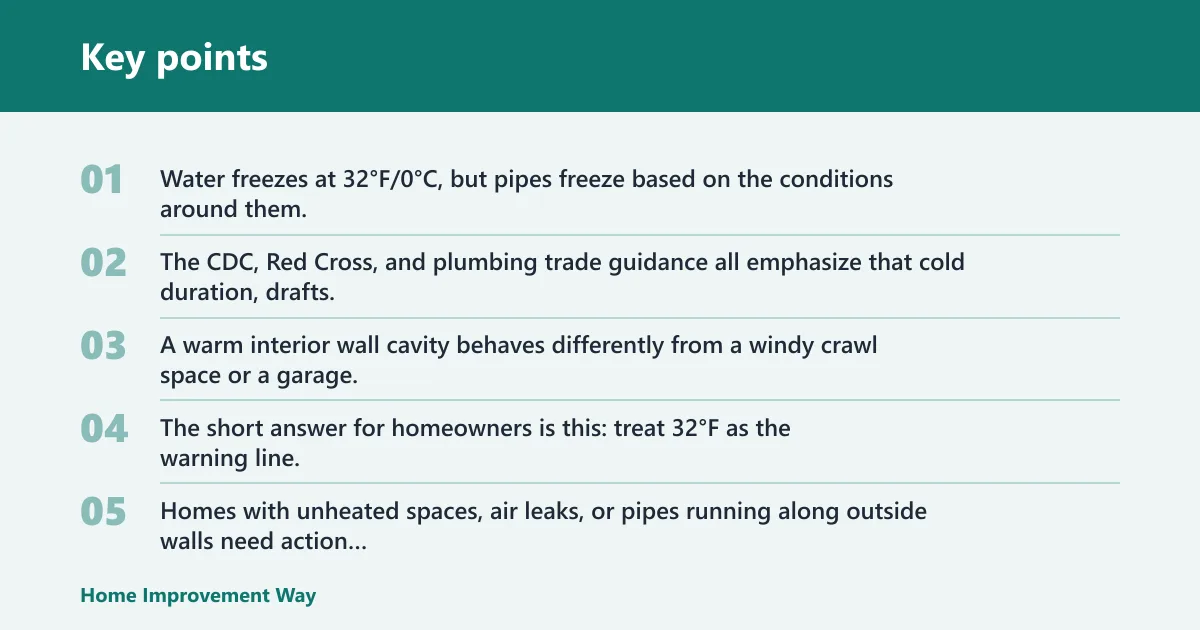
Water freezes at 32°F/0°C, but pipes freeze based on the conditions around them, not the thermometer alone. The CDC, Red Cross, and plumbing trade guidance all emphasize that cold duration, drafts, and exposed pipe routes matter as much as the air temperature. A warm interior wall cavity behaves differently from a windy crawl space or a garage.
The short answer for homeowners is this: treat 32°F as the warning line, and treat around 20°F as a practical danger zone. Homes with unheated spaces, air leaks, or pipes running along outside walls need action before the temperature gets that low, especially if the forecast stays cold for hours.
In houses, apartments, and basements, the same outdoor temperature can produce very different results. A heated apartment stack may stay safe while a garage line or attic run freezes first. The deciding factors are temperature, duration, insulation, and where the pipe sits.
Pipe freeze risk by temperature
Use the temperature bands below as a homeowner rule of thumb, not a promise. The Red Cross and extension guidance consistently frame 55°F as a practical indoor protection target, while plumbers focus on the pipe route, drafts, and exposure. The colder it gets, the faster the risk climbs.
| Temperature band | Exposure level | Estimated risk | Exact homeowner action |
|---|---|---|---|
| 32°F to 25°F | Short cold snap; protected pipes usually hold, but exposed lines are vulnerable | Moderate | Keep the thermostat at about 55°F or higher, open cabinet doors, and drip faucets near exterior walls. |
| 24°F to 20°F | Longer cold stretch; uninsulated or poorly routed pipes can freeze | High | Add insulation or heat tape to vulnerable lines, keep heat on, and check pipe routes in basements, attics, and garages. |
| Below 20°F | Severe cold; exposed and unprotected pipes are at serious risk | Very high | Drip faucets, protect the most exposed pipes first, use sensors or freeze detectors, and keep indoor heat steady overnight. |
That table reflects the practical risk ladder many homeowners need. At 32°F, you have a warning. Near 22°F, action matters. Below 20°F, the chance of freezing rises quickly, especially if the cold lasts long enough for the pipe wall to lose heat faster than the water can recover.
Why two homes at the same temperature freeze differently
Two homes can sit in the same forecast and still have different freeze risk. The difference comes from exposure time, insulation, airflow, and the path the pipe takes through the structure. A sheltered line with heat nearby behaves differently from a line in a drafty wall or an unheated space.
Exposure time and cold duration
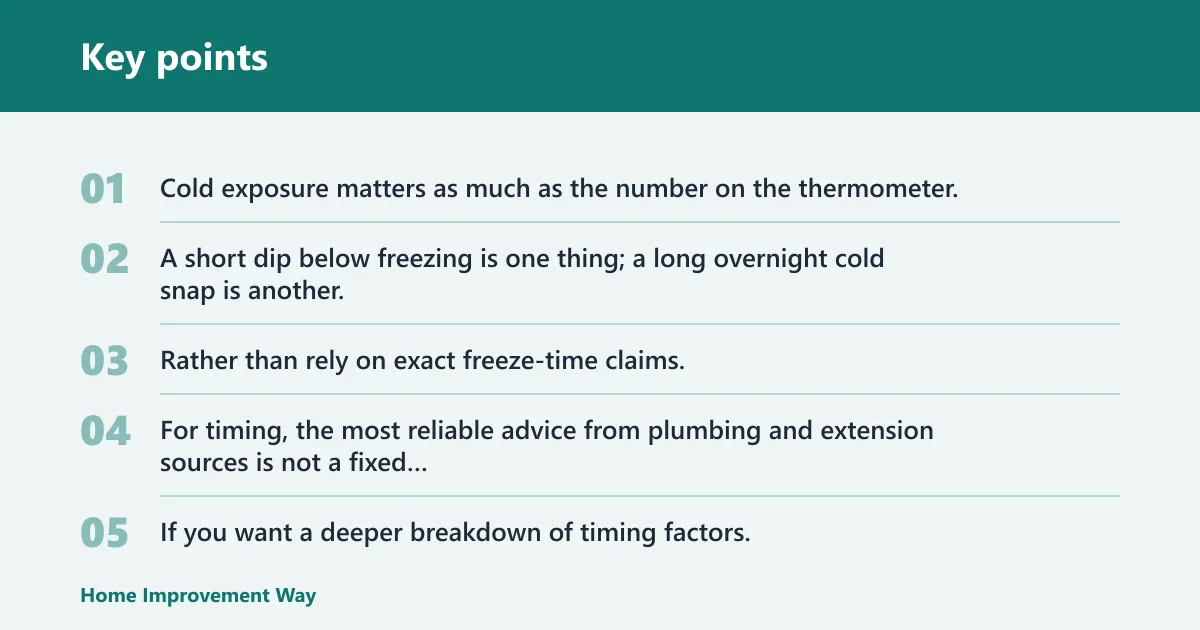
Cold exposure matters as much as the number on the thermometer. A short dip below freezing is one thing; a long overnight cold snap is another. Rather than rely on exact freeze-time claims, use the safer rule: if the weather stays near or below freezing for hours, exposed plumbing needs protection, especially when the forecast stays cold after sunset.
For timing, the most reliable advice from plumbing and extension sources is not a fixed number of hours, but a risk pattern: the longer the cold lasts, the more likely a vulnerable run is to freeze. If you want a deeper breakdown of timing factors, see how long exposed pipes take to freeze.
Say your laundry room has a supply line in an exterior wall and the temperature holds near 18°F until morning. That line is in a much worse spot than a kitchen line inside a heated cabinet, even though both are in the same house.
Insulation level and air leaks
Insulated pipes resist freezing longer than uninsulated pipes, but insulation is not a guarantee. Heat loss still happens when cold air moves around the pipe, especially through cracks, gaps, or poorly sealed wall cavities. Air leaks can turn a mild cold snap into a freezing problem for one branch of plumbing.
Unprotected pipes freeze faster because they give up heat to the surrounding air faster. That is why pipe insulation, heat tape, and sealing drafts work best together rather than as separate fixes. The CDC and Red Cross both emphasize reducing drafts and keeping warm air moving near plumbing during freezes.
Pipe route through the home
Pipe location often matters more than the label on the pipe itself. Basements, attics, garages, crawl spaces, exterior walls, and other unheated spaces are the most vulnerable routes. A pipe with a long run through a cold garage ceiling can freeze before a different pipe in the same home shows any trouble.
Picture a basement with a utility sink line running along an outside wall. If the wall stays cold and the room is not heated, the pipe can freeze even while the rest of the house feels fine. That is why the route matters, not only the room temperature in the center of the home.
Material differences: PEX, PVC, copper, and galvanized steel
Pipe material matters, but it does not override temperature and exposure. PEX is flexible, so it can tolerate expansion better than some rigid pipe materials. Copper, PVC, and galvanized steel are all vulnerable to freezing if the water inside turns to ice and pressure builds. No common pipe material is safe once conditions are cold enough for long enough.
The practical point is simple: material changes how a pipe may react, but location, insulation, and duration decide whether freezing starts. A protected PEX line in a warm crawl space is lower risk than a copper line in a windy attic.
What temperature do pipes freeze indoors?
Indoor freezing risk depends on where the pipe sits and how warm the surrounding air stays. An occupied home with the thermostat at about 55°F or higher during a cold snap is the common protection target used by the Red Cross and many extension services. Lower settings can be risky if the plumbing is in outside walls, garages, basements, or other cooler areas.
Occupied homes and the 55°F target
For an occupied home, about 55°F or a bit higher is a practical indoor target during freezing weather. That setting helps keep the building shell and the plumbing warmer, which lowers the chance that a pipe wall will lose heat too quickly. If the home has weak insulation or exposed plumbing, a higher setting may still be needed.
The Red Cross recommends keeping the thermostat at least 55°F when temperatures drop below freezing. State extension offices give the same general advice because it reduces the chance that pipes in exterior walls, basements, and cabinets will fall below freezing.
Vacant homes and higher-risk setups
Vacant homes need extra caution because doors are not being opened, sinks are not being used, and small issues go unnoticed longer. If you are away, keep the heat on, and do not let the home drift into a low-temperature range just to save energy. The savings can disappear fast if a pipe bursts.
A common first-timer mistake is lowering the thermostat too far before a cold night because the house “feels closed up.” Closed up is not the same as protected. Plumbing in outer walls, garages, and crawl spaces still needs heat to stay above freezing.
Apartments, basements, and unheated rooms
Apartments can be safer than detached homes when heat from neighboring units helps, but corner units and top-floor lines near cold exterior walls can still freeze. Basements often carry exposed supply and drain lines, so a cold basement can become a problem even when the main floor is warm. Unheated rooms are the biggest indoor risk zones.
If your apartment has a sink on an exterior wall, keep cabinet doors open during a freeze and let the warm room air reach the plumbing. If your basement has exposed pipes, treat it like a cold utility space rather than an extension of the heated living area.
Signs a pipe is already frozen
The clearest signs are weak or stopped water flow, frost or ice on exposed piping, odd bulging, and unusual odors or sounds near the line. A frozen pipe does not always burst right away, so a sudden drop in water pressure during a freeze should be treated as an urgent warning, not a minor inconvenience.
Common warning signs
- No water or only a trickle from one faucet
- A faucet that starts slowly and then stops
- Visible frost on exposed pipes
- Bulging or warped pipe sections
- Cracks, damp drywall, or water stains after thawing begins
- Unusual smells from sinks or drains connected to a frozen line
What to check first
Start with the faucet farthest from the main water entry if you suspect a freeze. Compare water flow in different fixtures to narrow down the affected branch. If you hear water running where it should not be, or if a pipe looks split, shut off the water and call a plumber right away.
What to do tonight if freezing weather is coming
Start with the thermostat, then protect the most exposed pipes. Keep indoor heat on and aim for about 55°F or higher in occupied homes. Open cabinet doors near sinks on exterior walls so warm air can reach the pipes, and use a slow drip on vulnerable faucets when temperatures are expected to stay low for hours.
These steps are most useful before the freeze starts. Once water has already frozen in a pipe, the goal shifts from prevention to careful thawing and checking for leaks. A burst can happen after the ice starts moving or thawing, when pressure inside the line changes.
Prevention checklist
- Set the thermostat to about 55°F or higher and leave the heat on overnight.
- Open cabinet doors under sinks that sit on exterior walls.
- Let vulnerable faucets drip slightly during a long cold spell.
- Insulate exposed lines in basements, garages, crawl spaces, and attics.
- Add heat tape where the pipe is repeatedly exposed to cold.
- Seal air leaks near plumbing penetrations, sill plates, and utility openings.
Use the right protection in the right place
Monitoring tools help when the cold reaches the lower end of the risk range. Temperature sensors and freeze detectors can warn you that a utility space is dropping too far. Smart leak detectors add another layer, because a frozen pipe can crack or burst before you notice water on the floor.
Frozen water expands, and that expansion can crack or burst pipe walls under pressure. That is the failure mechanism behind the damage, not the cold itself. The pipe may not fail until after thawing starts, which is why a small frozen section can still become a major leak later.
How plumbers find the highest-risk runs
Plumbers usually start by tracing the plumbing path, not just the room that feels cold. The highest-risk runs are often in exterior walls, garages, basements, crawl spaces, and attic transitions. They look for drafts, missing insulation, long horizontal runs, and places where supply lines cross from heated into unheated space.
What the inspection usually focuses
In practice, the most vulnerable pipe is often the one with the longest exposure to cold air and the least access to heat from the house. That means a line behind a kitchen sink on an outside wall, a laundry branch in the garage, or a basement run near a rim joist can be more dangerous than a shorter line elsewhere. Plumbers also check for recurring freeze history, because repeat problem spots usually point to an insulation or air-sealing issue.
Frequently asked questions
What temperature do pipes freeze at indoors?
Indoors, pipes freeze when the surrounding air stays cold enough for long enough, especially in exterior walls, basements, garages, and unheated rooms. About 55°F or higher is the practical protection target for an occupied home. Lower indoor settings raise the chance of frozen pipes in cold weather.
What temp can pipes freeze at in a house?
In a house, pipes can freeze below 32°F if the cold lasts long enough and the pipe is exposed. A practical danger zone starts around 20°F. Uninsulated sections, drafty wall cavities, and pipes in unheated areas are the first to freeze when temperatures fall.
At what temperature do pipes freeze without heat?
Without heat, pipes are much more exposed to freezing once temperatures drop below 32°F. The risk gets serious near 20°F, and shorter exposure can be enough for unprotected lines. If heat is off in a vacant home, keep the risk high in mind even before the coldest part of the night.
What temperature do pipes freeze in Celsius?
Water freezes at 0°C, which is the Celsius baseline. A practical danger zone for pipes starts around -7°C, and risk rises further below about -9°C. Those numbers still depend on exposure, insulation, and how long the cold lasts inside or outside the home.
What temperature do pipes freeze in a basement?
Basements can freeze pipes when the space is cold, drafty, or poorly insulated, even if the main house feels warm. Pipes along exterior walls are most at risk. If the basement drops near the danger zone for several hours, exposed lines there may freeze first.
Do pipes freeze at 32 degrees or lower?
Yes, pipes are at risk of freezing when temperatures drop below 32°F. That does not mean every pipe freezes immediately at 32°F. Exposure time, insulation, and pipe location decide how fast the risk becomes real, and some protected pipes may stay safe for longer.
What temperature do pipes freeze in an apartment?
Apartment pipes can freeze in cold weather when the unit loses heat, especially near exterior walls, windows, or unheated utility areas. Shared walls may help, but they do not protect every line. Keep the apartment warm, open cabinet doors over plumbing, and watch corner units closely during long cold snaps.
Sources
American Red Cross freeze-weather guidance; CDC winter home safety guidance; state extension service recommendations on frozen-pipe prevention; insurer guidance on keeping thermostats at about 55°F and sealing drafts; plumbing trade recommendations on vulnerable pipe locations and freeze prevention.
Sponsored / affiliate links. As an Amazon Associate I earn from qualifying purchases. I may earn additional commission from eligible campaigns.