Which Pipes Freeze First: Copper, PEX or PVC?
Water starts to freeze at 32°F / 0°C, but which pipe freezes first in a real home depends more on exposure, airflow, insulation, and water stagnation than on material alone. In exposed runs, copper usually loses heat faster because it conducts heat well, PEX usually tolerates freezing best because it can expand, and PVC is highly location- and fitting-dependent. A frozen line can split, flood walls, and lead to costly repairs. This guide compares freeze timing and burst risk by location so the ranking stays practical, not theoretical.
| Factor | Which Pipes Freeze First: Copper, PEX | PVC | Winner |
|---|---|---|---|
| Freeze timing in exposed runs | Copper usually loses heat faster in exposed runs because it conducts heat well; PEX usually tolerates freezing best because it can expand. | PVC is highly location- and fitting-dependent in freeze-prone areas. | Which Pipes Freeze First: Copper, PEX |
| Burst risk when ice forms | PEX has lower burst risk than rigid pipe because it can expand, though fittings can still fail; copper is rigid and more likely to split. | PVC has high burst risk at glued joints and rigid transitions. | Which Pipes Freeze First: Copper, PEX |
| Maintenance and repair effort | Copper repairs can take more labor because soldering is required; PEX is more forgiving and flexible, with fewer immediate rupture issues. | PVC failure points are often glued fittings and short trapped sections, which are weak in freeze-prone supply use. | Which Pipes Freeze First: Copper, PEX |
| Cost impact of freeze damage | Frozen lines can lead to costly repairs; copper is less forgiving and can leak later when thaw begins, while PEX is less likely to rupture immediately. | PVC can fail at glued joints and rigid transitions, which can also create costly repairs. | Which Pipes Freeze First: Copper, PEX |
| Best-fit use in vulnerable spaces | PEX is described as the strongest of the three for a vulnerable wall cavity, usually the best in a protected crawlspace, and often the safest for exposed garage supply lines. | PVC is generally avoided for freeze-prone supply piping in exterior walls and is better reserved for drainage or other non-pressurized tasks in cold-risk settings. | Which Pipes Freeze First: Copper, PEX |
| Underground and burial performance | PEX is often preferred for buried water service where code and local conditions allow, with lower burst risk than rigid pipe though transitions remain vulnerable. | PVC can be used for some buried applications, but burial depth and application limits matter more than the material label alone; shallow or poorly supported runs have high burst risk. | Which Pipes Freeze First: Copper, PEX |
| Conditioned indoor performance | Copper, PEX, and PVC can all be low-risk in heated space if protected from cold spots; PEX is a strong option when routed cleanly and protected from hidden cold spots. | PVC is appropriate only where it is allowed and the application calls for it. | Tie |
Placement and exposure matter more than pipe material
Which pipe freezes first often depends more on placement than on material. Copper can conduct heat away faster, so exposed copper often loses warmth sooner than PEX in a drafty wall, crawlspace, or garage. But a buried line or a short run inside conditioned space may stay safe longer no matter what the pipe is made of. The practical question is not just which freezes first, but which is most likely to burst when ice forms.
Freeze timing versus burst risk
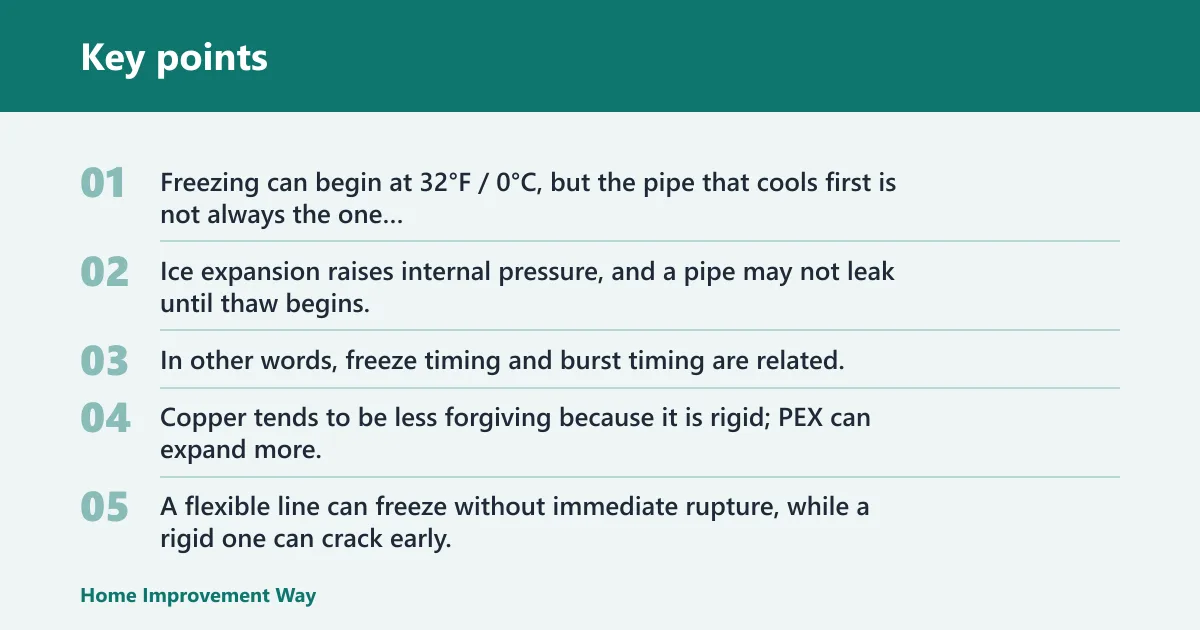
Freezing can begin at 32°F / 0°C, but the pipe that cools first is not always the one that fails first. Ice expansion raises internal pressure, and a pipe may not leak until thaw begins. In other words, freeze timing and burst timing are related, but they are not the same thing. Copper tends to be less forgiving because it is rigid; PEX can expand more; PVC depends heavily on the joint design, exposure, and whether the application is appropriate for the pipe at all.
A flexible line can freeze without immediate rupture, while a rigid one can crack early. A short dead-end branch, a line with several elbows, or a section with trapped water can fail before a longer straight run of the same material.
Direct comparison by room and exposure
In a drafty exterior wall or vented crawlspace, copper often reaches trouble sooner because it sheds heat quickly and has little give once ice starts forming. In the same setting, PEX usually tolerates the first stage of freezing longer. PVC is more variable: if it is being used in a non-pressurized or drain role, the risk profile is different than a pressurized supply line, and the fittings often become the weak point.
That is why layout matters so much. A line near a cold outer sheathing layer, a pipe with wind washing through gaps, or a section with a lot of trapped water can behave worse than the same pipe installed deeper in insulation and farther from cold air.
Why frost depth and burial depth matter underground
For buried piping, frost depth is a better guide than pipe material alone. If a line sits above local frost depth, it can still freeze in a cold snap even if the pipe itself is flexible. Building and plumbing guidance generally point to burying water service lines below the frost line or below the locally required frost depth, because soil temperature changes more slowly than the air above it. Material helps, but depth does the heavy lifting.
Underground freezing also depends on soil type, moisture, and how much the line is isolated from surface cold. A shallow run under a driveway edge or near a foundation can still be vulnerable, especially where the pipe enters the building.
How copper behaves in cold
Copper is rigid metal tubing with high thermal conductivity, so it sheds heat quickly when the surrounding air is cold. That does not mean copper always freezes first, but it does mean copper loses heat faster than plastic pipe when the rest of the conditions are similar. It is a common potable water supply material, and it is often chosen where durability or UV exposure matters, but that same rigidity makes it less forgiving when water turns to ice.
Where copper fails first
Freeze damage often starts at exposed bends, fittings, and sections in exterior walls. A long straight copper line may hold up longer than a short branch with several joints, yet once ice builds pressure, the pipe is more likely to split than stretch.
That is why copper can look fine during the freeze and then leak later when the thaw begins. Copper installation also requires soldering, so any repair or replacement inside a tight cavity can take more labor than a flexible alternative.
Why PEX usually freezes later
PEX is cross-linked polyethylene tubing, and its flexibility is the reason it usually performs better in freezing conditions. It can expand slightly as ice forms, which lowers burst risk compared with rigid pipe in the same exposure. That said, PEX still needs the right application, and its performance depends on how the line is routed, supported, and protected from cold air.
Flexibility under ice expansion
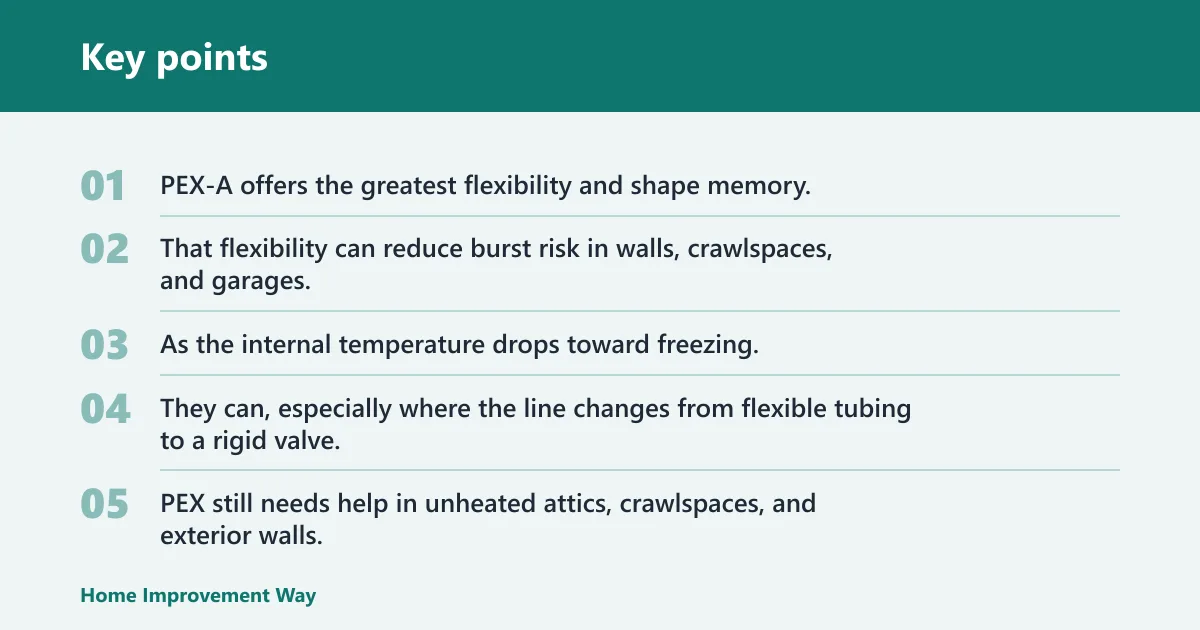
PEX-A offers the greatest flexibility and shape memory, while PEX-B is the most common residential choice. That flexibility can reduce burst risk in walls, crawlspaces, and garages, and PEX installation can eliminate leak-prone connections within walls when the route is planned well.
That does not mean PEX is freeze-proof. As the internal temperature drops toward freezing, the material may tolerate expansion better than copper, but the system can still fail at fittings or rigid transitions. Do PEX pipes burst when they freeze? They can, especially where the line changes from flexible tubing to a rigid valve, manifold, or stub-out.
Where PEX still needs protection
PEX still needs help in unheated attics, crawlspaces, and exterior walls. Foam wrap, sleeves, air sealing, and heat cable can reduce risk on vulnerable sections, but those measures only work when they are approved for the location and installed correctly. Heat cable and heat trace products should be used only when listed for the application and installed per the manufacturer’s instructions, because improper use can create fire or shock hazards.
PEX is often a strong choice in cold climates because it tolerates freezing better than rigid materials, but that is a tolerance advantage, not immunity. If a line has long dead ends, multiple tees, or a transition to rigid pipe, the weak point can still fail first.
Do PVC pipes freeze?
Yes, PVC pipes can freeze. They are not freeze-proof, and cold conditions can cause cracking or joint failure, especially in exposed, pressurized, or poorly supported runs. PVC is also commonly used for drains or other non-pressurized applications, so it should not be treated as a direct substitute for potable supply tubing in cold-risk locations. For pressure-rated plumbing use, the product rating and code-approved application matter more than a general assumption that all PVC behaves the same way.
Freeze risk in drains and non-pressurized runs
PVC may feel less brittle than copper, but that does not make it safe in freezing weather. When water inside a PVC line freezes, the pipe body or a glued joint can fail, and the risk rises when the run is exposed to wind or sits near an exterior wall.
Because PVC is often used outside potable supply service, many homeowners only encounter it in drain, vent, or other non-pressurized work. In those uses, freezing can still create cracks, separations, or leaks once the ice thaws.
Why fittings can fail before the pipe body
Fitting count matters. Every elbow, coupling, tee, or transition adds a place where pressure can concentrate, so a short run with several joints can fail sooner than a longer straight run of the same pipe.
That is one reason a supposedly better material can still lose in a bad layout. Trapped water volume, dead-end branches, and rigid connections can turn a small cold spot into the first failure point.
What changes freeze timing?
Temperature is only the starting point. Air movement, insulation, pipe orientation, and how much of the line sits outside conditioned space all change when a pipe actually freezes.
32°F and colder air exposure
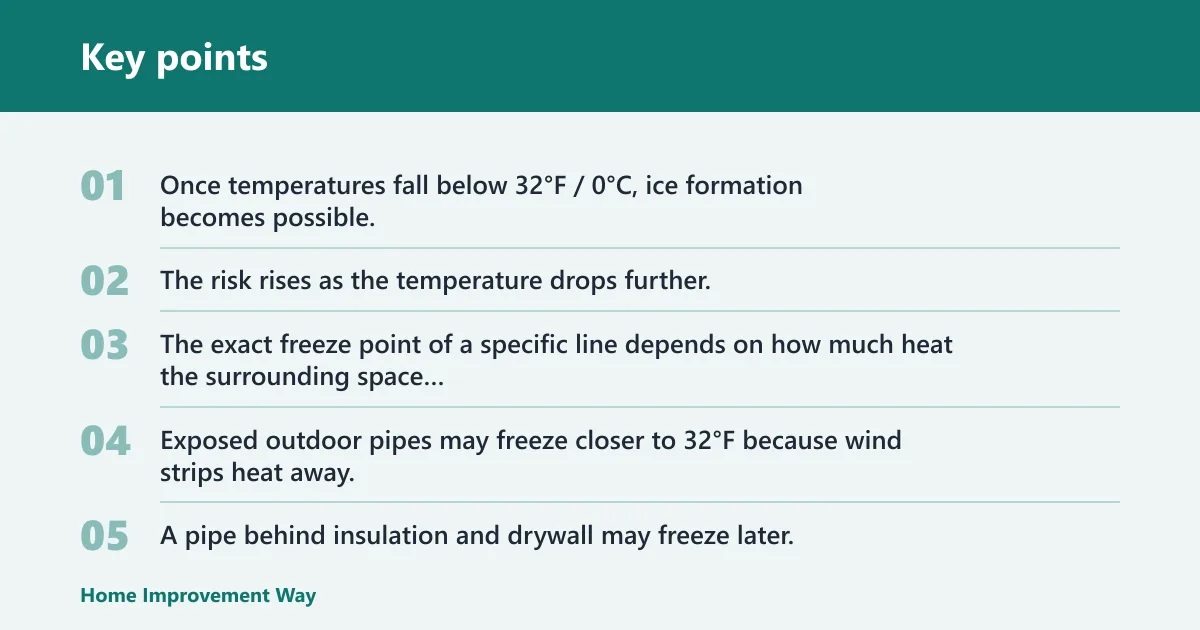
Once temperatures fall below 32°F / 0°C, ice formation becomes possible. The risk rises as the temperature drops further, and longer cold snaps make failures more likely in unprotected runs. The exact freeze point of a specific line depends on how much heat the surrounding space can provide and how quickly that heat is carried away.
Exposed outdoor pipes may freeze closer to 32°F because wind strips heat away. A pipe behind insulation and drywall may freeze later, but only if the wall cavity gets enough heat from the home to stay above freezing.
Insulation, wind, and pipe orientation
Pipe insulation, usually foam wrap or sleeve, reduces heat loss on exposed runs in crawlspaces, exterior walls, and garages. It helps, but it does not fix a line that sits in a wind tunnel or one that passes through an unheated space with constant cold air.
Orientation matters too. A pipe mounted near the outer face of a wall, or one that runs near vents and gaps, loses heat faster than a line tucked deeper inside the conditioned side of the assembly.
Trapped water volume and dead ends
Short dead-end sections can freeze first because there is less moving water to buffer the cold. A capped branch, a low point, or a loop that traps water often reaches trouble before a long, well-sloped run does.
That is why two homes with the same pipe material can behave differently. Placement and layout often matter as much as the pipe itself.
Choose which pipes freeze first: Copper, PEX if…
Choose a flexible supply line when the route passes through a crawlspace, garage, exterior wall, or other area that can drop near freezing. It is also the better pick when burst tolerance matters more than rigidity, or when you want a material that is easier to route with fewer leak-prone joints inside the wall.
- You need a residential potable water line in a cold-risk location.
- You want better tolerance to ice expansion than rigid metal provides.
- You are replacing a line that has failed at fittings or transitions.
- You want a material commonly used for cold-climate installations.
Freeze-prevention checklist
These steps reduce freeze risk no matter which pipe material is in the wall:
- Insulate exposed pipe with properly sized foam sleeve or wrap.
- Seal air leaks around penetrations, rim joists, and wall openings.
- Use heat cable or heat tape only where approved and installed to the product instructions.
- In severe cold, keep a slow drip on vulnerable lines if local guidance and the plumbing system allow it.
- If a pipe freezes, shut off the water and thaw it safely with gentle heat; never use an open flame.
Choose PVC if…
Choose PVC if the application fits its limits, such as drains or other non-pressurized runs where the pipe is not expected to carry hot potable water. It is also the better fit when code, drainage design, or a non-supply use makes PVC the right material, not because it is freeze-proof, but because the job calls for PVC.
- The run is non-pressurized or drain-related.
- The pipe is not serving as the main freeze-risk water supply line.
- You can protect joints and the body from cold exposure.
- The installation does not require the flexibility that PEX offers.
What is the best pipe for freezing conditions?
For freeze-prone residential water lines, PEX is usually the best choice because it tolerates ice expansion better than copper and is less likely to burst. For a specific home, the best answer is often the pipe in the best location, meaning the line that stays warm, insulated, and away from wind exposure.
Copper still works well in protected, durable installations where rigidity is useful. PVC belongs in the right non-pressurized or drain application, not as a blanket answer for cold-weather supply lines.
Frequently asked questions
Which pipes freeze first: copper, PEX or PVC?
In exposed runs, copper often loses heat faster than PEX, while PVC is highly dependent on whether the use is pressure-rated, how many fittings are present, and how exposed the line is. PEX usually tolerates the first stage of freezing better, but location still beats material in many homes.
Will PVC pipe freeze underground?
Yes, buried PVC can freeze if the soil temperature drops enough, the line is shallow, or frost depth reaches the pipe. Underground placement lowers risk, but it does not remove it. Long cold snaps and poor burial depth can still cause trouble.
Which pipes are most likely to freeze?
Exposed pipes in exterior walls, garages, crawlspaces, and unheated basements are usually the most likely to freeze. A short run with trapped water, several fittings, or wind exposure can fail before a longer protected run, even if both are the same material.
What temperature do PVC pipes freeze at?
Water in a pipe can start forming ice around 32°F / 0°C, but the exact freezing point for a given run can vary with exposure, wind, insulation, and how much heat the surrounding space provides. PVC is not freeze-proof, so colder air increases risk quickly.
Do PEX pipes burst when they freeze?
PEX is less likely to burst than copper because it is flexible, but it is not immune. Ice can still damage fittings, transitions, or unsupported sections. A frozen PEX line may survive the freeze and reveal a leak later when the ice thaws.
Sponsored / affiliate links. As an Amazon Associate I earn from qualifying purchases. I may earn additional commission from eligible campaigns.