Does Pipe Insulation Really Prevent Freezing?
Installer-reviewed guidance: Pipe insulation can slow heat loss, but it rarely keeps water from freezing in unheated or drafty spaces. It is enough only in mild exposure or when paired with heat, air sealing, and water-flow management. Frozen pipes can burst and cause costly water damage, especially in basements, crawl spaces, garages, exterior walls, under sinks, and vacant homes. This guide explains when insulation helps, when it fails, and what to do instead.
How pipe insulation delays freezing
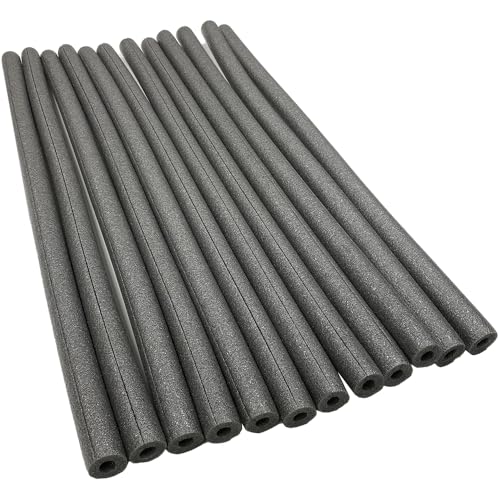


Sometimes, but not on its own in cold, exposed areas. Foam pipe insulation is a closed-cell foam sleeve that reduces heat loss, so water inside a pipe cools more slowly. That can delay freezing, but it does not make the pipe freeze-proof when temperatures stay below freezing for long periods. Manufacturer data and guidance from standards-based insulation sizing methods make the key point: freeze resistance depends on ambient temperature, exposure duration, pipe diameter, and insulation thickness, not just the material itself.
What insulation does to heat loss
Pipe insulation works by slowing heat transfer from the water and pipe to the surrounding air. That helps on accessible hot and cold pipes, especially where the air is only mildly cool or where the pipe sees short cold spells. It works less well when the space stays cold for hours. In practice, a sleeve that matches the pipe and is installed continuously performs far better than a loose sleeve with gaps at seams, elbows, or penetrations.
Common foam sleeve thicknesses are often available in sizes such as 9, 13, 19, and 25 mm. Those sizes fit many household pipe diameters, but fit matters. A sleeve that is too loose leaves gaps. A sleeve that is too thin leaves too little resistance to heat loss. BS 5422:2023 uses pipe outside diameter, thermal conductivity, and exposure conditions to select thickness, which is why the same insulation thickness is not appropriate in every location.
Why slowing freeze-up is not the same as preventing it
Slowing a freeze gives you more time. It does not guarantee safety. Heat trace product guidance gives a concrete example: a 25 mm bore pipe at 5°C with 25 mm insulation can freeze within one hour at -10°C ambient. That is the difference between slowing freeze-up and preventing it. In other words, insulation can extend the time to failure, but it cannot be relied on as the only protection once the surrounding air stays well below freezing.
Thermal conductivity helps explain why. It is measured in W/mK, and lower values insulate better. But material alone does not decide performance. Temperature, thickness, exposure duration, and fit all matter. A sleeve with decent conductivity still loses the battle if the air around the pipe stays very cold. (Wikipedia)
Where insulation helps most
Insulation helps most on short, accessible runs in spaces that are only moderately cool, such as a heated basement with a drafty corner or an interior utility area that dips below room temperature. It is also useful as a companion layer under heat trace cable, because it slows the heat that the cable adds from escaping into the room. Manufacturer installation guidance for heat trace systems commonly calls for insulation over the cable to keep the added heat where it is needed.
Why pipes freeze first
Pipes freeze first where cold air reaches them easily and heat cannot replace what is lost. Unheated spaces, drafts, thin coverage, and poor airflow all speed freezing. Pipes near exterior walls, in garages, or above vents face more risk than pipes in stable indoor air. The risk rises further when cold exposure lasts long enough for the pipe wall and water to cool through the insulation layer.
Unheated spaces and cold surfaces
Basements, crawl spaces, garages, and exterior walls are the usual trouble spots. Ready & Able lists basements, crawl spaces, and garages as at-risk locations. Those spaces often sit near outdoor temperatures, so pipe insulation has to do more work than it would inside conditioned rooms.
Cold masonry, cold sheathing, and cold framing can pull heat away from the pipe. If the pipe is in a wall cavity with little warm air nearby, insulation alone may only slow the freeze. It does not create heat. That is why air sealing and heat trace become more important as the space gets colder and the exposure lasts longer.
Air movement, drafts, and gaps
Wind and air leakage matter because moving air strips away warm air around the pipe. Gaps in insulation coverage matter too. A pipe wrapped in one section but bare at a fitting or elbow can still freeze at the weak point first.
A common first-timer mistake is insulating a visible straight run and leaving the first elbow, valve, or tee exposed. That small gap can be enough for freezing to start there, then travel into the rest of the line. In installer practice, failures often show up first at elbows, shutoff valves, and where a line turns into an exterior wall, because those spots combine thin coverage with the greatest air leakage.
Which pipes freeze first?
Small-diameter, exposed, and poorly shielded pipes usually freeze first. Lines in exterior walls, unheated crawl spaces, and garages are high on the list. Under-sink pipes can also freeze when cabinet air is cold and there is no warm room air circulating around them. Long stagnant runs are also vulnerable. If water is not moving and the pipe sits near freezing air, heat leaves the water faster than it can be replaced.
Pipe insulation decision table
This table gives a practical answer to the question most homeowners actually need: what is enough in this space? Match the location to the fix that fits the risk, not just to the pipe itself. The key thresholds are temperature band, exposure duration, pipe location, and insulation thickness; if any one of those shifts toward severe exposure, move beyond insulation-only protection.
| Scenario | Risk level | Recommended fix |
|---|---|---|
| Heated basement | Lower, if the room stays warm | Insulation only |
| Unheated crawl space | High, especially with drafts | Insulation plus air sealing |
| Exterior wall cavity | High, because warm air is limited | Insulation plus heat tape |
| Garage pipe | High in sustained cold | Insulation plus heat tape |
| Exposed under-sink pipe | Moderate to high if cabinet air is cold | Insulation plus air sealing |
| Vacation home | Very high when left vacant | Drain-down/shutoff |
Decision framework:
| Temperature band | Exposure duration | Pipe location | Insulation thickness outcome | Why | Confidence | Escalate when… |
|---|---|---|---|---|---|---|
| Just above freezing to mild frost | Short cold spells | Heated basement, interior utility run | 9–13 mm may be adequate on accessible straight runs | Warm surrounding air and brief exposure limit heat loss | Medium | Air leaks, elbows, valves, or multi-hour subfreezing exposure appear |
| Below freezing for several hours | Moderate | Drafty crawl space, under-sink cabinet | 13–19 mm plus full-fit coverage | Thicker sleeves slow heat loss, but drafts can still strip heat away | Medium | Cold air washes across the pipe or cabinet temperature stays near outdoor air |
| Sustained hard freeze | Long duration | Exterior wall, garage, exposed line | 19–25 mm alone is usually not enough | Long exposure overwhelms passive insulation even when fit is good | High | Switch to heat trace, air sealing, or both |
| Seasonal vacancy or no heat | Days to weeks | Vacation home, seasonal outbuilding, exterior faucet | Insulation is secondary | No heat source means freeze protection must come from water removal or shutdown | High | Drain-down and shutoff become the primary protection |
When insulation is enough
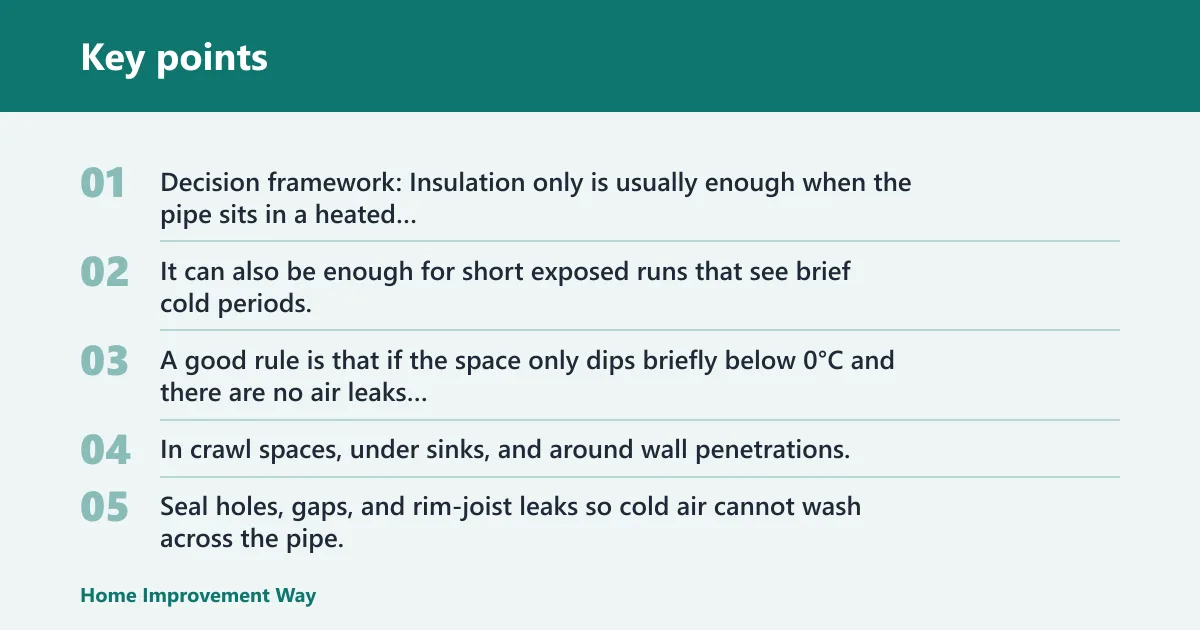
Insulation only is usually enough when the pipe sits in a heated basement or another space that stays above freezing most of the time. It can also be enough for short exposed runs that see brief cold periods, as long as the sleeve fits the pipe diameter well and covers the full run. A good rule is that if the space only dips briefly below 0°C and there are no air leaks at fittings, insulation can be a reasonable first line of defense.
When insulation needs air sealing
In crawl spaces, under sinks, and around wall penetrations, air sealing often matters as much as insulation. Seal holes, gaps, and rim-joist leaks so cold air cannot wash across the pipe. If the cabinet or cavity still pulls in outdoor air, insulation will keep losing the same battle. Escalate from insulation-only to air sealing when you can feel drafts, see open penetrations, or find the pipe within reach of outdoor air paths.
When insulation needs heat tape
Use heat trace cable when the space stays cold enough that passive insulation is not enough. Heat trace is active freeze protection. It comes in self-regulating or constant wattage types and is often paired with a thermostat. That combination adds heat when needed instead of only slowing heat loss. Industry guidance commonly places heat trace on exterior-wall runs, garages, and other pipes that see sustained cold or repeated freeze events.
When drain-down and shutoff are the answer
Vacation homes and outdoor faucets need a different plan. Shut off the water supply, drain the line, and leave the faucet open as needed to clear trapped water. For outdoor taps, insulation alone is not enough. Faucet covers or frost-proof fixtures can add protection, but shutoff and draining come first. Escalate immediately to drain-down if the line will be unattended through a freeze, if the home is seasonal, or if prior freeze events have already damaged the line.
Do you still need heat tape?
Yes, if the pipe is in a space where insulation alone cannot keep the water above freezing. Heat tape is not the same as insulation. Insulation slows heat loss. Heat trace adds heat. If the ambient temperature stays low long enough, passive insulation may fail even when it is installed correctly. In severe exposure, the question is not whether insulation helps; it is whether the pipe has any active protection at all.
Self-regulating versus constant wattage cable
Self-regulating cable changes output as conditions change, while constant wattage cable delivers a fixed output. Both are used for freeze protection. The better choice depends on the pipe, the exposure, and the installation details, including whether the cable must wrap bends or run along a straight section. Manufacturer guidance typically favors self-regulating cable where varying exposure or overlapping geometry makes fixed-output cable harder to manage.
Why a thermostat lowers running time
An ambient sensing thermostat can switch heat trace on only when temperatures fall below a set point, with an example around 4°C. That matters because it limits operating time. Heat Trace recommends an ON/OFF air sensing thermostat for this purpose, which helps the system run only when freeze risk is present. In practical terms, the thermostat setpoint should be low enough to avoid unnecessary runtime but high enough to activate before the pipe itself gets dangerously cold.
Where heat trace belongs
Heat trace belongs on vulnerable sections that cannot stay warm enough on their own: garage lines, exterior wall runs, long exposed supply lines, and pipes in unheated spaces. It should be installed to the manufacturer’s instructions, then covered with compatible insulation so the heat goes into the pipe instead of the room. If the pipe is also in a drafty cavity, heat trace should be paired with air sealing rather than used as a substitute for it.
How thick should pipe insulation be?
Thickness should match both the pipe diameter and the exposure. Bigger pipes need different thicknesses, and a sleeve that does not fit tightly enough leaves gaps. The right answer is not “as much as possible.” It is the thickness that matches the pipe, the space, and the temperature risk. BS 5422:2023 bases thickness on pipe outside diameter, thermal conductivity, and the insulation system’s intended performance, which is why sizing logic changes with the pipe and location.
Matching thickness to pipe diameter
Pipe diameter matters because the sleeve must cover the pipe evenly without leaving voids. Standard sizing is important. A line that is too large for the insulation can expose seams and reduce coverage, while a sleeve that is too tight may not close properly around elbows or fittings. For that reason, sizing should be checked at the actual pipe OD, not guessed from the nominal pipe size alone.
As a practical example, a 1/2-inch pipe and a 3/4-inch pipe may not use the same sleeve size. The larger pipe has more surface area, so the insulation choice and fit matter more.
What thermal conductivity means
Thermal conductivity is expressed in W/mK. Lower numbers insulate better because they pass less heat. That value is useful for comparing materials, but it does not tell the whole story. You still need enough thickness and a good fit for the pipe and the space.
Some listed values help illustrate the range. Climaflex insulation is listed at 0.036 W/mK at 0°C, and Armaflex Evo is listed at 0.033 W/mK at 0°C. Rubaflex self-seal is listed in 9, 13, 19, 25, 32, and 40 mm thicknesses. Those numbers help you compare products, not replace the need for proper sizing.
Using BS 5422:2023 as a sizing reference
BS 5422:2023 sets insulation thickness by pipe outside diameter and thermal conductivity. That matters because freeze protection is not one-size-fits-all. A pipe with a larger outside diameter or a material with different conductivity may need a different sleeve thickness to reach the same level of protection. In that standard-based approach, the answer changes when the pipe runs through a colder space, when the exposure lasts longer, or when the pipe is mounted on an exterior wall with limited ambient heat.
- Measure the pipe outside diameter.
- Check the space: heated, drafty, or unheated.
- Choose the insulation thickness that fits the pipe and the exposure.
- Seal gaps at joints, fittings, and wall penetrations.
- Add heat trace if the space stays below freezing.
- Drain and shut off seasonal or outdoor lines.
Frequently asked questions
Does insulating pipes help prevent freezing?
Yes, but only partly. Insulation helps prevent freezing by slowing heat loss, which buys time before the water temperature drops to freezing. It works best in mild exposure or when paired with air sealing, heat trace, indoor heat, or controlled water shutdown. It is not a stand-alone cure in sustained cold.
Does foam pipe insulation prevent freezing?
Foam pipe insulation can reduce the chance of freezing, but it does not guarantee protection. It is a closed-cell foam sleeve meant to slow heat loss on accessible hot and cold pipes. In unheated basements, garages, or exterior walls, it often needs help from heat, air sealing, or drain-down.
How much does pipe insulation slow freezing, really?
It can slow freezing enough to matter in short cold spells, but the effect is limited in prolonged subfreezing air. Heat trace product guidance showing a 25 mm bore pipe at 5°C with 25 mm insulation freezing within one hour at -10°C ambient illustrates how quickly protection can fail when the environment is severe. The takeaway is not that insulation does nothing; it is that freeze time depends heavily on the coldest temperature and how long the pipe stays in it.
Will foam pipe insulation stop pipes from bursting?
No, not by itself. Foam insulation may delay freezing, but it does not stop a pipe from freezing and bursting if the surrounding space stays cold long enough. The goal is to keep water moving, keep warm air around vulnerable runs, or add active heat where passive insulation is not enough.
Do I still need heat tape if pipes are insulated?
Often, yes. Heat tape or heat trace is useful when insulation alone cannot keep a pipe above freezing. It is active protection, unlike foam insulation. Pair it with a thermostat that turns the cable on only when outdoor air drops, which helps control operating cost and avoids unnecessary runtime.
Is pipe insulation enough in an unheated basement or crawl space?
Usually not by itself. Ready & Able identifies basements, crawl spaces, and garages as at risk, and notes that insulation slows heat loss but does not make pipes freeze-proof. In those spaces, add air sealing, consider heat trace, or use shutoff and drain-down if the line is seasonal or vacant.
Related guides: heat trace, crawl-space air sealing, outdoor faucet winterization, and pipe burst prevention.
Sources: BS 5422:2023; Heat Trace manufacturer installation and thermostat guidance; manufacturer datasheets for Climaflex, Armaflex Evo, and Rubaflex; Ready & Able freeze-risk guidance for basements, crawl spaces, and garages.
Sponsored / affiliate links. As an Amazon Associate I earn from qualifying purchases. I may earn additional commission from eligible campaigns.