Do Outdoor Faucet Covers Really Work?
Outdoor faucet covers can help with exposed frost-free bibs and short cold snaps, but they do not protect a live, water-filled line from freezing. If the pipe still holds water, winterization matters too. A missed freeze can split piping or damage the valve, leading to leaks and expensive repairs. Here’s how to tell when a cover is enough and when you need to shut off, drain, or insulate more than the spigot.
This guide is part of our Frozen Pipes: How to Prevent, Thaw and Fix Them series.
The limits of insulation on a live water line


Yes, but only in the narrow way they are designed to work. A faucet cover adds insulation around the faucet body and blocks wind, which slows heat loss. It does not add heat, and it does not stop water in the wall or supply pipe from freezing if that pipe still holds water.
The line between “works” and “does not work” matters. A cover can help a drained faucet survive a short cold snap, but it cannot protect a live line that still contains standing water. Extension guidance from Texas A&M AgriLife notes that outdoor faucets should be disconnected and drained before freezes, because leftover water is the real problem, not the cover alone. Texas A&M AgriLife Extension: Winterizing Outdoor Faucets
The answer also depends on severity. Covers are useful as added protection in brief freezes, but they are not a stand-alone fix for deep or extended cold. Municipal winterization guides, including Omaha Public Power District’s freeze-prevention guidance, stress that faucet covers work best as a supplement after the hose is removed and the line is drained. Omaha Public Power District: Help Winterize Your Home
What a cover can do
A typical faucet cover is a rigid foam dome or an insulated pouch. Its job is to trap a pocket of still air around the faucet body. That dead air space slows heat loss and cuts wind-driven cooling at the wall, especially when the cover fits tightly against the siding.
What a cover cannot do
A cover cannot drain the line for you. It cannot make up for a hose left attached, a failed interior shutoff, or a faucet that is already waterlogged. If the plumbing behind the wall is full of water, the cover is only one layer of defense, not the primary freeze protection.
Why the answer depends on freeze severity
A short overnight dip is a different problem from a multi-day hard freeze. The longer the cold lasts, the more likely the pipe behind the wall gets cold enough to freeze. Covers are especially useful on the north side of the house, but they are still an added layer, not a substitute for drainage. Homes with greater wind exposure lose heat faster, which is why utility guidance often flags exposed walls and shaded sides as higher-risk locations. Madison Gas and Electric: Frozen Pipes
How outdoor faucet covers work
Faucet covers work by slowing heat loss, not by creating heat. They trap a pocket of still air around the spigot and shield the faucet from wind. That simple setup can make a real difference when the cold is brief and the plumbing has already been drained.
Insulating air pocket
The air pocket is the main feature. The cover only works if it sits flat against the siding. Gaps let cold air move behind the cover, and moving air strips away the insulation effect. That is why a snug fit matters more than a bulky cover with a poor seal.
Foam, fabric, and reflective layers
Rigid foam domes are the most common type. Insulated fabric pouches fit odd-shaped faucets and frost-free bibs better. Weather-resistant fabric versions often use a reflective outer layer, which helps shed wind and surface moisture while the insulation slows heat loss.
Why tight wall contact matters
The seal at the wall matters as much as the insulation itself. A snug fit against the wall keeps cold air out. Cracked foam, loose straps, or a damaged closure can cut effectiveness fast, especially on a windy wall or near an unheated crawl space. The American Red Cross also recommends insulating outdoor faucets and sealing any gaps around vulnerable plumbing entry points. American Red Cross: Winter storm safety
Which cover type should you choose?
Choose the cover that fits the faucet shape and the exposure, not just the cheapest one. A rigid foam dome is common and simple. An insulated pouch is better for irregular shapes and frost-free bibs. Either way, the cover should sit tight against the siding and close securely.
Rigid foam dome covers
Rigid foam domes are the standard choice for a typical hose bib. They are common, inexpensive, reusable for several seasons if stored dry, and easy to place over a standard wall-mounted spigot.
Insulated pouch covers
Insulated pouches work better when the faucet is awkwardly shaped or projects farther from the wall. They also tend to fit frost-free bibs better than a hard dome. That matters when the handle, stem, or backflow parts leave less room for a rigid shell.
Fit, closure, and reuse
Look for foam, heavy-duty rubber, weather-resistant fabric, and a closure that seals well. A strap, cord, or hook-and-loop closure should hold the cover snugly without leaving gaps. Dry storage matters too. Wet insulation loses performance and can break down sooner.
Is a faucet cover enough?
Sometimes yes, sometimes no. The decision turns on freeze severity, whether the hose is removed, whether the faucet is frost-free, whether an interior shutoff exists, and how exposed the wall is. Use the table below as a simple rule: cover only for short, mild freezes; add drainage when the line can be emptied; call a plumber when the system cannot be isolated or the freeze risk is severe.
| Climate severity | Hose attached | Frost-free faucet | Interior shutoff available | Exposure type | Recommended action |
|---|---|---|---|---|---|
| Mild overnight freeze | No | Any type | No | Average exposure | Cover only |
| 2-day freeze | No | Standard or frost-free | Yes | Moderate exposure | Cover plus drain |
| Deep freeze below 15°F | No | Any type | Yes | Exposed wall | Cover plus drain |
| North-facing wall | No | Any type | Yes | Wind-exposed north side | Cover plus drain |
| Frost-free bib with hose attached | Yes | Yes | Yes or no | Any | Call a plumber |
| Older standard hose bib with no shutoff | No | No | No | Unheated crawl space wall | Call a plumber |
Say your hose bib sits on a north-facing brick wall and the forecast calls for 18°F overnight. If the line can be shut off and drained from inside, a cover adds useful protection. If that same wall is expected to stay below 15°F for two nights, the cover alone is not enough. Municipal utilities commonly warn that exposed, shaded, and wind-facing walls freeze sooner than protected locations. Austin Water: Winterizing Your Home
A common first-timer mistake is to wrap the faucet and leave a hose coiled on the end. That hose can trap water and defeat drain-back on a frost-free bib. The cover may still fit, but the plumbing behind it is no longer in the safe setup that the cover assumes.
How do I install one correctly?
Install the cover only after the hose is removed and the faucet area is dry. The goal is a tight seal against the wall, no gaps for cold air, and a closure that stays shut in wind. A cover on a wet or loose setup loses much of its value, and the easiest failure point is usually a poor seal at the perimeter.
- Disconnect the garden hose before installing a cover.
- Drain the hose and store it indoors.
- Check the gasket or edge of the cover for cracks, compression loss, or missing pieces.
- Set the cover so it sits flat against the siding or wall.
- Fasten the strap, cord, or hook-and-loop closure snugly.
- Look for any gaps around the perimeter, especially at the top and bottom.
- Remove the cover after the freeze risk passes and let it dry before storage.
Check the seal before the cold hits
The seal should press evenly against the wall. If the faucet is mounted on rough siding, a rigid foam dome may need better alignment than a pouch style. Any visible gap becomes a path for cold air, which weakens the insulation effect fast in windy conditions.
Look for wet or damaged insulation
Wet insulation is a warning sign. Cracked foam, torn fabric, or a broken closure should be replaced, not patched in place for a hard freeze. A damaged cover can still block some wind, but its protection is reduced enough that you should not count on it.
When is a cover not enough?
A cover is not enough when the line still holds water, when the freeze lasts longer than the cover can realistically buffer, or when the faucet setup has known weak points. If you cannot shut off and drain the exterior line, the risk is in the pipe, not just at the spigot.
No interior shutoff available
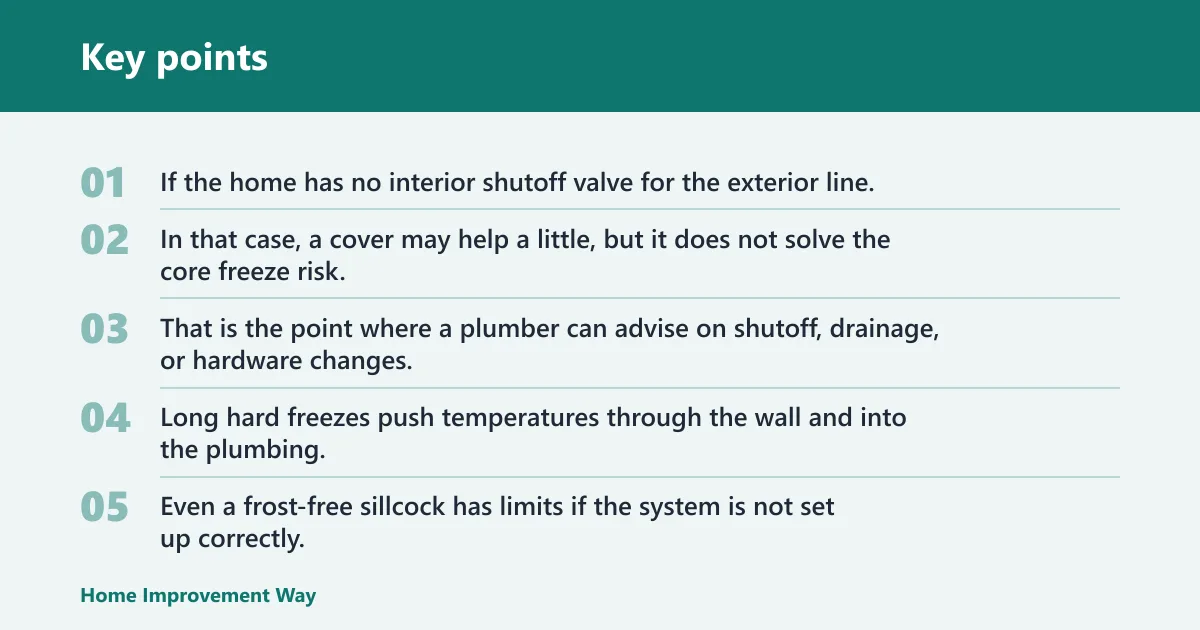
If the home has no interior shutoff valve for the exterior line, you cannot fully isolate and drain the pipe from inside. In that case, a cover may help a little, but it does not solve the core freeze risk. That is the point where a plumber can advise on shutoff, drainage, or hardware changes.
Extended hard freeze
Long hard freezes push temperatures through the wall and into the plumbing. Even a frost-free sillcock has limits if the system is not set up correctly. A cover can help during the cold snap, but it should not be treated as the only defense when the forecast stays severe for days. Frost-free design helps, but only when the line can drain as intended. frost-free bibs
Frost-free faucet with attachments left
Frost-free sillcocks are designed to drain back when shut off properly, but they are still vulnerable if a hose or splitter remains attached. That attachment can trap water in the wrong place. A cover can be useful for a frost-free bib during cold snaps, but only after the hose is removed.
Unheated crawl space or exposed wall
Homes with an unheated crawl space or a wall that gets hard wind exposure need more caution. Cold can reach the pipe faster in those locations. North-facing walls are especially worth covering, but if the supply line runs through a cold void, the pipe system may need more than insulation at the spigot.
Frost-free faucets and older homes
Frost-free faucets reduce risk, but they do not erase it. Older standard hose bibs are more vulnerable because the shutoff point and the water-holding section are often more exposed. The right move depends on whether the faucet can drain back, and whether anything is still attached at the outlet.
Why frost-free models still need care
A frost-free sillcock is designed to drain back when shut off properly. If a hose or splitter stays attached, that drain-back can be defeated. A cover is still useful in a cold snap, but it is the backup layer, not the main freeze protection.
What changes in older standard bibs
Older standard hose bibs often leave more water near the wall penetration. That makes them more vulnerable at the wall than a frost-free model. If the home also lacks an interior shutoff valve for the exterior line, the safest path is usually to have the plumbing evaluated before a hard freeze hits.
When to call a plumber
Call a plumber if the exterior line has no shutoff, if the faucet has already frozen, or if the pipe disappears into an exposed wall or crawl space and you cannot drain it. A cover is not a fix for a pipe that is already at risk inside the wall, and post-freeze leaks often show up later as a split valve or dripping stem. freeze damage
Picture a rental with an older hose bib on a garage wall. The tenant can see frost on the outside cover, but the real problem is the line running through the unheated wall cavity. In that case, the cover is only part of the answer, and the plumbing setup needs a closer look.
Frequently asked questions
Do outdoor faucet covers really work?
Yes, for the right conditions. They work by trapping still air and blocking wind around the faucet body. They are most useful for short or moderate cold snaps, especially when the hose is removed and the faucet sits tight against the wall.
Do outdoor faucet covers work in deep freezes?
Not well enough to count on by themselves. Their effectiveness drops in severe cold, and they should be treated as a supplement rather than the main defense. For a deep freeze, you need shutoff and drainage if the plumbing allows it.
Do outdoor faucet covers work on frost-free faucets?
Yes, as an added layer. Frost-free bibs are designed to drain back when shut off properly, but a cover can still help during a cold snap. Just keep a hose or splitter off the end, or the drain-back advantage can be lost.
Do outdoor faucet covers work with a hose attached?
No. A cover does not work with a hose attached, because the hose can trap water and defeat the drain-back path. Disconnecting the garden hose before installing a cover is required, and the hose should be drained and stored indoors.
What is the best outdoor faucet cover?
The best cover is the one that fits the faucet shape and seals tightly against the wall. Rigid foam domes are the most common type, while insulated fabric pouches fit odd-shaped faucets and frost-free bibs better. A secure closure and dry insulation matter as much as the material.
Can a faucet cover stop a pipe from bursting?
It can reduce the chance of freeze damage, but it cannot guarantee that a pipe will not burst. If the line still holds water, the risk remains in the pipe behind the wall. That is why a cover is an extra layer, not a substitute for shutoff and drainage.
Sponsored / affiliate links. As an Amazon Associate I earn from qualifying purchases. I may earn additional commission from eligible campaigns.