Is It Safe to Leave Heat Tape Plugged in All Winter?
Heat tape can stay plugged in all winter only if it is a listed self-regulating heating cable or heat tape rated for continuous use, installed exactly as its label directs, and protected by a GFCI where the product instructions or local code require it; otherwise, unplug it when freezing risk ends. A bad setup can overheat, trip breakers, damage pipe insulation, or start a fire. This guide explains when to leave heat tape energized, when to shut it off, and the warning signs that mean stop using it.
This guide is part of our Frozen Pipes: How to Prevent, Thaw and Fix Them series.
What heat tape can stay on?

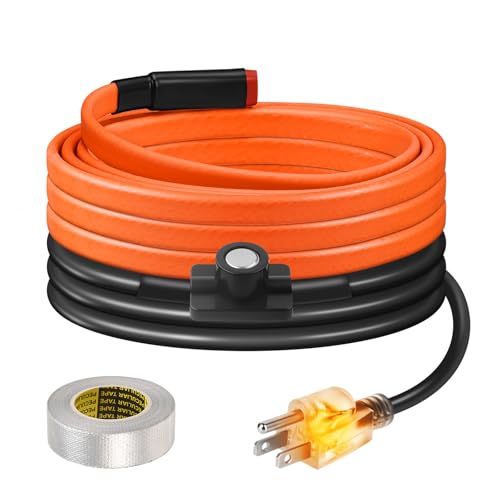

The safest candidates for winter-long operation are listed self-regulating cables and some thermostatically controlled products approved for the specific pipe and location. Constant-wattage cable has tighter limits, and any damaged, unknown, or unlisted product should be treated as unsafe until you verify it.
Self-regulating cable
Self-regulating heat tape is commonly described as adjusting heat output based on surrounding temperature, and it is often considered suitable for seasonal continuous connection when the label allows it. It still needs the right pipe rating, a proper outlet, and clean physical condition.
Thermostatically controlled cable
Thermostatically controlled heat tape turns on or off based on temperature. It can be suitable for leaving plugged in through the cold season, but sensor placement matters. If the sensor is warm, shaded, buried, or mounted where it cannot read pipe or air temperature correctly, the system may cycle at the wrong time.
Constant-wattage cable
Constant-wattage heat tape keeps heating whenever it receives power. That means it has stricter installation limits than self-regulating cable, and it may be metal-pipe only depending on the label. It must not overlap or touch itself unless the manufacturer specifically allows that arrangement.
Say your pipe run is a short section of metal supply line in a crawl space, and the product label says the cable is approved for that pipe type with continuous use. In that case, winter use can be reasonable if the jacket is intact, the plug is sound, and the circuit is GFCI-protected.
Heat tape safety checklist
Use this before you decide to leave heat tape energized. The goal is not only “does it heat?” but “is it the right cable, on the right pipe, with the right protection?” A product can still fail that check even if it is self-regulating or thermostatic.
| Cable type | Label requirement | Outlet protection | Visible condition | Pipe material compatibility | Action |
|---|---|---|---|---|---|
| Self-regulating | Listed for continuous seasonal use and approved for the pipe | GFCI recommended | No cracks, frays, exposed conductors, charring, or plug damage | Must match metal or plastic pipe rating on label | Leave plugged in |
| Thermostatically controlled | Listed for the location and sensor installed per instructions | GFCI recommended | Sensor intact and cable not crushed or kinked | Must match the pipe type named by the maker | Monitor |
| Constant-wattage | Approved for the pipe type and continuous use, if allowed | GFCI recommended | No overlap, no self-contact, no visible wear | Often metal-pipe only depending on label | Monitor |
| Unknown or unlisted | No verifiable label or approval | Do not rely on outlet protection alone | Age, condition, or history not clear | Compatibility cannot be verified | Unplug |
| Cracked, charring, exposed conductor, damaged plug, or unknown cable | Label absent, unreadable, or uncertain | Not a reason to keep using it | Failed inspection | Do not assume any pipe fit | Stop using immediately |
A GFCI outlet is recommended for heat tape installations when the product instructions or local code call for it, especially for exposed or outdoor runs. It helps protect against electrical shock. It does not make a damaged cable safe, and it does not fix a bad fit on the wrong pipe.
One common mistake is trusting the cable because it “still works.” Suppose a homeowner sees the pipe stay warm, but the plug body is cracked and the jacket has a blackened spot near a clamp. That cable should come out of service, even if the room is still below freezing.
What to check before you leave it
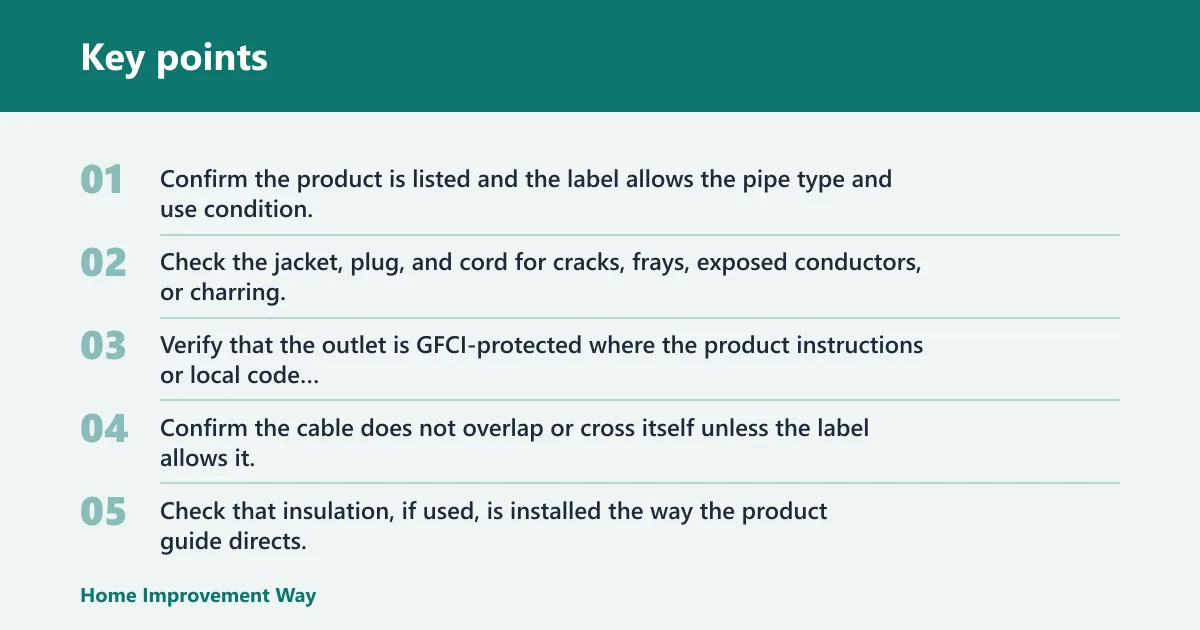
- Confirm the product is listed and the label allows the pipe type and use condition.
- Check the jacket, plug, and cord for cracks, frays, exposed conductors, or charring.
- Verify that the outlet is GFCI-protected where the product instructions or local code require it for exposed or outdoor installations.
- Confirm the cable does not overlap or cross itself unless the label allows it.
- Check that insulation, if used, is installed the way the product guide directs.
- If any part is uncertain, unplug it and replace the cable rather than guessing.
When should you unplug heat tape?
Unplug heat tape when freezing weather has passed, when the cable fails inspection, or when the installation no longer matches the label. Warm spells above freezing are a good time to shut it off, especially if the pipe no longer needs freeze protection and the product is not meant for year-round use.
Warm weather
If temperatures stay above freezing, the cable usually does not need to keep running. That is different from saying it is safe all year. Some products can remain plugged in through winter, but the decision should still track the weather, the label, and the pipe’s risk of freezing.
Damage or wear
Cracked cable, exposed conductor, charring, and a damaged plug are stop-use conditions. Older cable deserves a closer look, especially if it has lived through multiple freeze-thaw seasons or has been moved around during repairs.
Wrong fit for the pipe or location
Heat tape used on the wrong pipe material, in the wrong location, or without the required outlet protection should be unplugged. Heat tape is typically used on exposed pipe areas such as crawl spaces, basements, and exterior walls. If the run is buried behind wallboard or hidden where you cannot inspect it, that is a problem.
Does pipe type change the answer?
Yes. Pipe material changes cable choice, installation method, and the margin for error. Metal pipe and plastic pipe do not always accept the same product. A cable that works on one may be wrong for the other, even if the outer package looks similar.
Plastic pipe: PEX, PVC, and CPVC
Plastic-pipe heat trace guides recommend a self-regulating cable rated for plastic pipe. They also recommend aluminum foil tape under the cable on plastic pipe installs, because it helps spread heat around the pipe surface. The same guides recommend a ground-fault protected outlet.
Heat tape on PEX and PVC should not overlap unless the manufacturer allows it. That warning matters because plastic can be more sensitive to concentrated heat. If the product sheet does not clearly approve the setup, do not treat it as safe by default.
Metal pipe and constant-wattage limits
Some constant-wattage products are metal-pipe only. That is why the label matters more than the box copy. A metal pipe can still be the wrong match if the cable is not approved for that pipe diameter, that location, or that run length.
Why foil tape and insulation matter
Aluminum foil tape under the cable on plastic pipe helps distribute heat. Pipe insulation goes over the cable and slows heat loss, so the system works less to hold temperature. That improves performance and efficiency, but it does not fix a damaged cable or a mismatched product.
Why manufacturer instructions matter
Manufacturer instructions decide more than convenience. They define whether a cable is allowed on that pipe, whether it can be overlapped, whether it can remain energized through freezing weather, and whether it needs a specific sensor location. A product that is fine in one setup may be wrong in another.
UL listing and product labels
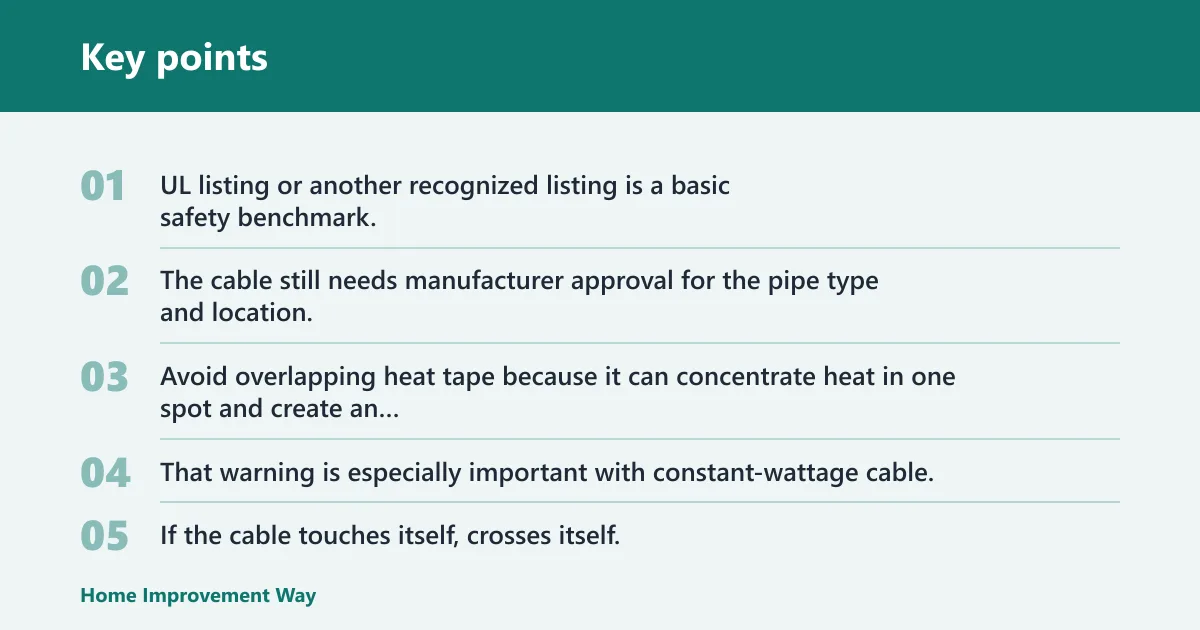
UL listing or another recognized listing is a basic safety benchmark, but it is not the whole answer. The cable still needs manufacturer approval for the pipe type and location.
Do not cross or overlap unless the label allows it
Avoid overlapping heat tape because it can concentrate heat in one spot and create an overheating and fire hazard. That warning is especially important with constant-wattage cable. If the cable touches itself, crosses itself, or is tightly wrapped where heat cannot escape, the installation can overheat fast.
Unknown or unlisted cable is a no-go
Do not assume an unknown or unlisted cable is safe because it looks intact. If you cannot verify the rating, pipe fit, or listing, unplug it. The safe choice is replacement with a product that matches the pipe and the environment.
Heat tape and insulation
Insulation works with heat tape, not instead of it. It slows heat loss so the cable does not have to work as hard, and it can help the pipe hold warmth longer during cold spells. That can lower runtime on a properly installed system.
Insulation should be installed over the cable, following the product instructions. It should not crush the cable or trap damage against the pipe. If the cable is already frayed, charring, or improperly routed, insulation will not make it acceptable.
Think of insulation as a support layer. It helps a good setup do its job. It does not rescue a bad one.
Frequently asked questions
Can you leave heat tape plugged in all winter?
Yes, some heat tape can stay plugged in during freezing weather, but only if the product is listed for that use, installed to its label, and protected by a GFCI where required by the product instructions or local code. Self-regulating cable is usually the safest option for seasonal continuous connection.
Should heat tape stay plugged in all the time?
No, not as a blanket rule. Some products can stay energized through winter, but “all the time” is broader than “all winter.” If temperatures stay above freezing, or if the cable is damaged, unknown, or mismatched to the pipe, unplug it.
When should heat tape be turned off?
Turn it off when the freezing risk has passed, when the cable is worn or damaged, or when the installation no longer matches the label. A warm spell above freezing is the usual shutdown point for seasonal use, unless the manufacturer says otherwise.
How do I know if my heat tape is safe to keep on?
Check the label, the listing, the pipe type, the outlet protection, and the visible condition. If the cable is self-regulating or thermostatic, approved for the pipe, and free of cracks, frays, exposed conductors, or plug damage, it may be safe to keep on for the season.
Does self-regulating heat tape need to stay plugged in all winter?
No. It can stay plugged in through freezing weather when the product is approved for that use, but it does not need to run all year. Self-regulating cable changes output with temperature, so it is often a good seasonal choice, not a year-round default.
How often should heat tape be inspected?
Inspect it before winter starts and again during the season, especially after storms, repairs, or any movement of the pipe. A quick visual check is worth doing whenever you can see the run.
Can heat tape run all year or only during freezing weather?
Some products can remain plugged in for the cold season, but that is not the same as being approved for year-round use. Unless the label specifically allows all-year operation, treat heat tape as a freeze-season device and unplug it when temperatures stay above freezing.
Sponsored / affiliate links. As an Amazon Associate I earn from qualifying purchases. I may earn additional commission from eligible campaigns.
 GRABOTE 2 Rolls 20mm X 33m 108ft Heat Tape,Adhesive Heat Resistant/Transfer Tape, Heat Vinyl Thermal Sublimation Press Tape,No Residue,for Electronics,Soldering,Circuit Board
 GRABOTE 2 Rolls 20mm X 33m 108ft Heat Tape,Adhesive Heat Resistant/Transfer Tape, Heat Vinyl Thermal Sublimation Press Tape,No Residue,Heat Resistance 482℉(250℃),Comes Off Clean,Easy Peal