Self-Regulating vs Constant Wattage Heat Cable for Pipes
Choose self-regulating heat cable for most homeowner pipe freeze protection because it changes output along the run; use constant wattage only for short, uniform layouts where the cable can stay evenly installed and controlled. Wrong cable choice or sloppy installation can freeze pipes, trip breakers, or create overheating risks. This guide compares both types by pipe layout, safety, pipe material, insulation status, ambient exposure, and control method so you can choose the safer, simpler option.
| Decision factor | Self-Regulating | Constant Wattage Heat Cable for Pipes | Winner |
|---|---|---|---|
| Output behavior | Adjusts wattage per linear foot as pipe temperature changes | Stays at a fixed wattage per linear foot | Self-Regulating |
| Overlap tolerance | May tolerate limited crossing only if the exact instructions allow it for that specific model | Cannot be overlapped | Self-Regulating |
| Thermostat or controller need | May need or strongly benefit from a thermostat or controller, depending on the kit | Typically used with a thermostat or control | Tie |
| Installation complexity | Better for bends, fittings, and mixed exposure | Best for short, straight, easy-to-secure runs | Self-Regulating |
| Safety sensitivity | More forgiving of temperature changes and some layout mistakes, within the manufacturer’s instructions | Higher sensitivity to overlap, dry-pipe exposure, and poor placement | Self-Regulating |
| Pipe material fit | Commonly used on metal and some plastic pipe systems when the kit is listed for that material | Works on fewer layouts unless the instructions explicitly support the pipe type | Self-Regulating |
| Insulation and ambient exposure | Handles uneven exposure better when insulation is incomplete or the run spans colder and warmer zones | Depends more heavily on consistent insulation and steady ambient conditions | Self-Regulating |
| Continuous energized run vs thermostat-controlled run | Works best with control when the pipe does not need full-time heat | More dependent on a thermostat or controller to limit runtime | Self-Regulating |
| Upfront and operating cost | Usually higher upfront, often lower waste from runtime control | Costs less upfront, but mistakes and runtime can erase that advantage | Constant Wattage Heat Cable for Pipes |
What each cable type does on a pipe
Self-regulating
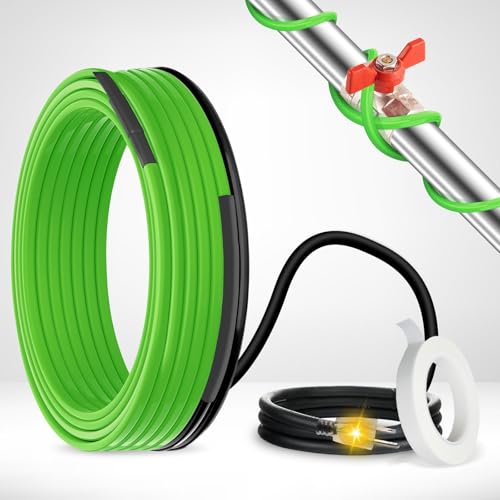
Self-regulating pipe heat cable changes its heat output with pipe temperature. When the pipe is colder, output rises; when the pipe warms up, output drops. For pipe freeze protection heat tracing, that behavior helps because the cable can respond to changing exposure along the same run. The exact behavior still depends on the product’s listing and installation instructions from the manufacturer.
Constant wattage
Constant wattage heat cable delivers the same wattage per linear foot the whole time it is energized. That keeps the output simple, but it also means the cable does not reduce heat in warmer spots. For water pipes, that fixed output needs tighter installation and control. It is not a general-purpose substitute for every pipe trace kit.
Roof and gutter de-icing is a related product category, but it is not the same job. Pipe freeze protection cable must be approved for water-filled pipes and installed to the manufacturer’s instructions for that use, not for a roof edge or downspout.
Why pipe layout changes the better choice
Pipe layout changes the risk profile. A straight basement line has fewer contact points and fewer chances for overlap; a crawlspace run with brackets, elbows, and friction points is much easier to misroute. The more complex the path, the more self-regulating cable tends to fit the job.
Say your roughly 18-foot copper line runs straight from a water heater to a laundry sink along an open basement wall. That is a simple layout, but if the cable must be tightly taped in a straight path and controlled by a thermostat, constant wattage can still be a reasonable option. Add a couple of bends and a support strap, and the balance shifts toward self-regulating.
Side-by-side comparison
Heat output and temperature response
Self-regulating cable is the more adaptable option because it responds to pipe temperature along the run. That matters when one section of pipe is near an exterior wall and another sits in a milder interior zone. Constant wattage does not change output on its own, so its performance depends more on layout and control. Manufacturer install sheets for pipe tracing generally treat the product listing, pipe material, and control method as part of the system, not as optional extras.
Overlap risk and installation tolerance
Overlap is the clearest safety divider. Whether self-regulating cable can cross itself is product-specific and instruction-dependent; some models permit limited crossing in specified conditions, while others do not. Constant wattage cable should not be overlapped. That makes installation mistakes more serious and raises the importance of reading the exact install manual before energizing the run.
A common first-timer mistake is wrapping a constant wattage cable around a pipe and then crossing the cable at a valve or tee. That creates a hot spot. On a dry or empty pipe, the risk is greater because pipe heat trace products are generally intended for contact with the pipe and for the specific operating conditions described by the manufacturer. Do not assume any heat tape is safe on a dry pipe unless the product instructions explicitly cover that condition.
Thermostat or controller needs
Both cable types often work better with a thermostat or controller. A thermostat-controlled kit may energize below the high 30s Fahrenheit, which helps reduce runtime when the pipe is not near a freeze risk. Some kits include built-in control; others require a separate thermostat. Energy-control documentation matters here because the control strategy affects how long the cable remains energized, how often it cycles, and whether the system is being used continuously or only when ambient conditions justify it.
Upfront cost and winter operating cost
Radiant Solutions says constant wattage cable costs less upfront. That can matter on a short, simple run where the cable will be installed once and left alone. But if the layout is more difficult, the lower buy-in can be offset by a higher chance of replacement, rework, or control mistakes.
Self-regulating cable often costs more to buy, but it can reduce wasted output when temperatures rise and can forgive some layout variation. Over a winter, the real cost is not only energy. It also includes the cost of poor installation, and that is where the more forgiving cable often makes sense.
Which heat cable is safer for pipes?
For most water pipes, self-regulating is the safer pick because it is more tolerant of temperature changes and has a lower overlap risk when installed correctly. Safety still depends on the exact product listing, the pipe material, the routing, the insulation condition, and whether the installation follows the manufacturer’s pipe freeze protection instructions. Roof and gutter ratings do not count for this decision.
Safety certification to verify
Look for a product listing from a recognized safety agency that is specific to pipe freeze protection heat tracing. UL Solutions, CSA Group, or comparable certification bodies may be relevant, but the listing must match the intended pipe application and the exact cable/system configuration. A certification for one use does not automatically transfer to another use.
Failure modes that matter most
The biggest failure modes are overlap, dry-pipe exposure, debris contact, and thermostat omission. Constant wattage is more sensitive to all four. Self-regulating still needs correct installation, but its temperature-responsive output gives it a wider margin when conditions vary along the run. Even so, that margin is not a substitute for correct spacing, proper mounting, and the approved end-to-end kit components.
Why roof and gutter ratings do not count
A cable sold for roof and gutter de-icing may be listed for outdoor use, but that does not make it right for water pipes. Pipe freeze protection heat tracing has different contact conditions, different routing constraints, and different instructions. If the label does not specifically cover pipes, treat it as the wrong product for this job.
Heat cable decision matrix
Use this matrix to match pipe scenario, overlap risk, thermostat need, pipe material, insulation status, ambient exposure, and energizing method before you buy. The right answer depends on the layout, not just the brand name or wattage printed on the box.
| Pipe scenario | Pipe material | Insulation status | Ambient exposure | Overlap risk | Need for thermostat | Continuous or controlled run | Recommended cable type | Red flags |
|---|---|---|---|---|---|---|---|---|
| Exposed basement line | Copper or listed compatible pipe material | Partial or adequate insulation | Moderate indoor cold near exterior walls | Low if the run is straight | Recommended; often built into a kit | Usually controlled by thermostat | Self-Regulating | Crossing the cable at fittings; using roof/gutter cable |
| Crawlspace run | Metal pipe or approved plastic pipe per the instructions | Often inconsistent or missing in spots | High, especially in unconditioned space | Moderate to high | Recommended | Should be thermostat-controlled rather than continuously energized | Self-Regulating | Loose contact with debris; hard-to-see overlaps; unsupported spans |
| Outdoor spigot | Metal fixture or listed assembly as directed by the manufacturer | Usually limited or exposed | High wind and freeze exposure | Moderate | Recommended or required by the kit | Controlled run preferred | Self-Regulating | Plugging into a non-GFCI outlet; using dry-pipe installation assumptions |
| Short straight section | Compatible pipe material per label | Good insulation and stable conditions | Low to moderate | Low | Can be included in a controlled kit | Can be thermostat-controlled or lightly managed | Constant Wattage Heat Cable for Pipes | Any bend, wrap, or overlap; no control strategy |
| Long run with bends or fittings | Mixed pipe and fitting transitions | Varies by section | Mixed exposure along the route | High | Recommended | Should not be left continuously energized without a plan | Self-Regulating | Trying to force a fixed-output cable through elbows or valves |
| Pipe with insulation already installed | Any approved pipe material | Already insulated, but gaps may exist | Depends on where the insulation is missing | Depends on layout | Recommended | Thermostat-controlled is usually preferred | Self-Regulating | Treating insulation as a substitute for cable; ignoring clearance and access |
Pipe insulation affects performance and energy use, but it does not replace heat cable. It helps the cable hold heat and reduces runtime, yet the pipe still needs approved freeze protection if the exposure is severe enough.
GFCI-protected power is recommended for plug-in installations, especially outdoors or in damp locations. That does not fix a bad cable choice, but it is part of a safer setup. For hardwired systems, follow the applicable electrical code requirements and the manufacturer’s installation instructions.
When should I use constant wattage heat cable on pipes?
Use constant wattage heat cable only when the run is short, straight, and easy to install without overlaps or messy routing. It also fits better when the product comes as a thermostat-controlled kit and the installation instructions are simple and direct. That is the narrow case where the lower upfront price makes sense.
Short, straight runs with simple routing
Constant wattage is most defensible on a short section that stays visible and accessible, such as a straight basement segment with no tight turns. The cable can be kept evenly placed, and the installer can verify that it never crosses itself. Installer guidance and manufacturer manuals generally emphasize exact spacing and secure attachment because fixed-output cable has less forgiveness if the route changes after energizing.
Situations where careful no-overlap installation is realistic
If you can route the cable without bends, crossings, or debris contact, constant wattage becomes more practical. That is less about the cable being better and more about the layout being easy. The no-overlap rule is the key constraint, and it is one reason installers usually check the entire route before powering the system.
Cases where the thermostat requirement is already built
If the kit includes control and the setpoint is suited to pipe freeze protection, constant wattage can be acceptable on a simple run. A thermostat-controlled kit that energizes below the high 30s Fahrenheit is a common way to limit runtime. Without that control, constant wattage is a poorer fit.
Does self-regulating heat trace need a thermostat?
Often, yes, or at least it benefits from one. Self-regulating cable may still work without a separate thermostat in some kits, but a controller is commonly recommended to reduce energy use and limit unnecessary runtime. If the kit includes built-in control, follow that design rather than adding a second control layer blindly.
When a thermostat or controller is recommended
A thermostat is especially useful when the pipe is exposed only part of the day or when the climate swings above and below freezing. It reduces the time the cable stays energized. That matters on a pipe that does not need heat once ambient conditions rise.
How setpoints near freezing reduce runtime
A setpoint near freezing keeps the cable from running through mild weather. Energy-control documentation for pipe tracing commonly centers on turning the system on only when the ambient temperature approaches the freeze-risk range. That range is practical because pipe freeze risk rises as temperatures approach freezing, not when it is comfortably above it.
What changes if the kit includes built-in control
If the kit includes its own control, you should follow that system rather than assuming more control is better. The main question becomes whether the control is listed for the pipe application and whether the cable length, pipe material, and insulation plan match the instructions. Wattage selection still depends on the product and the layout.
Expert installation checks before energizing a cable
Installers typically inspect the full route before energizing a pipe heat cable, not just the box label. The first check is overlap risk: look at every bend, valve, tee, clamp, and transition where the cable could cross itself or be pinched. The second check is the environment: crawlspaces, entry points, and unconditioned sections are where kits most often fail because debris, moisture, or poor visibility makes it easy to miss a problem. The third check is pipe condition, including whether the line is dry, partially drained, or fully water-filled, because product instructions may not allow the same setup in each case. Before power-up, installers also confirm the correct pipe material listing, proper attachment method, GFCI protection where required, thermostat placement, and whether insulation will be installed or restored after the cable is secured.
Choose Self-Regulating if… / Choose Constant Wattage Heat Cable for Pipes if…
Choose self-regulating if the pipe run has bends, fittings, crawlspace access, mixed exposure, or any chance of a crossing at installation time. Choose it if you want the more forgiving option for a homeowner project and you are pairing it with pipe insulation and a GFCI-protected outlet. For most freeze-protection jobs, that is the cleaner choice.
Choose constant wattage heat cable for pipes only if the run is short, straight, fully visible, and easy to keep free of overlap. Choose it if the kit already includes suitable control and the installation instructions match a simple pipe layout. Avoid it on dry pipes, on complex routes, or anywhere the cable might touch itself.
If the installation is borderline, pick the cable type that gives you the bigger safety margin. That is usually self-regulating.
Frequently asked questions
What is the difference between self-regulating and constant wattage heat cable?
Self-regulating cable changes output as pipe temperature changes, so it can run hotter where the pipe is colder and back off where the pipe warms. Constant wattage cable stays fixed at one output level. For pipe freeze protection, that difference affects safety, installation tolerance, and how much control you need.
Which heat cable is safer for water pipes?
Self-regulating is usually the safer choice for water pipes because it is more forgiving of changing temperatures and less sensitive to some installation variables. Safety still depends on a pipe-specific certification, proper routing, and following the product instructions. A roof and gutter rating does not make it safe for pipes.
Can self-regulating heat cable overlap itself?
Sometimes, but only if the exact product instructions allow it. The allowance is product-specific, not universal. Read the label and the install sheet before you assume any overlap is acceptable.
What wattage heat cable is best for frozen pipe protection?
There is no single best wattage for every pipe. The right choice depends on pipe material, insulation, exposure, cable length, and the manufacturer’s instructions for the exact application. For that reason, the safer buying rule is to match the listed pipe-freeze-protection kit to the job, not to chase a wattage number alone.
Can you use the same heat cable for roofs and water pipes?
No, not by default. Roof and gutter cable is a different application, and a product listed for that use is not automatically approved for pipe freeze protection. For water pipes, look for a listing and installation guide that specifically cover pipes, not just outdoor de-icing.
Sources
- Raychem pipe freeze protection installation documentation
- Frost King pipe heating cable installation instructions
- EasyHeat pipe heating cable installation manual
- UL Solutions product listing and installation requirements for heat-trace systems
- CSA Group certification guidance for electric heating and heat-tracing products
- National Electrical Code guidance on GFCI protection, outdoor receptacles, and wet-location use
- Manufacturer energy-control documentation for thermostats and heat-trace controllers
Sponsored / affiliate links. As an Amazon Associate I earn from qualifying purchases. I may earn additional commission from eligible campaigns.