Wax Ring vs Waxless Toilet Seal: Which Should You Use?
Use a Wax Ring when the flange is solid, the toilet sits level, and you want the lowest-cost seal for a standard replacement. Use a Waxless Toilet Seal when you need to shift the bowl, pull it more than once, or avoid scraping old wax from the flange. A bad pick can cause leaks, sewer gas, rocking, and a failed reset. This guide compares wax and waxless seals by install condition, fit, durability, cleanup, and when each one makes sense.
| Decision factor | Wax Ring | Waxless Toilet Seal | Winner |
|---|---|---|---|
| Up-front cost | Usually the cheaper parts option, often around or under $20 for the seal and replacement parts | Costs more than wax | Wax Ring |
| Install forgiveness | Single-use compression seal; once the toilet is lifted, it must be replaced | Repositionable during install and more forgiving if the toilet is lifted again | Waxless Toilet Seal |
| Cleanup and rework | Can leave sticky residue that must be scraped off | Cleaner to reset and easier when repeated access is likely | Waxless Toilet Seal |
| Best fit for stable installs | Proven choice when the flange is at or near floor level and the toilet is stable | Can work, but is usually more than you need for a standard reset | Wax Ring |
| Access-sensitive jobs | Works, but cleanup and rework are less forgiving | Better when a finished ceiling below makes leak risk and cleanup more sensitive | Waxless Toilet Seal |
| Long-term fit after movement | Lasts decades if undisturbed, but movement can break the seal | More forgiving during installation, but still depends on a stable toilet base and flange | Tie |
What each seal does at the toilet base
Both seals do the same job: they make a watertight and gas-tight barrier between the toilet horn and the drain flange. The difference is how they handle the install. Wax compresses into place and stays there; waxless uses rubber or foam with adhesive, so you can move it during setup.
A wax ring has decades of use in toilet installs. If the toilet rocks, the seal can fail no matter which material you pick.
Wax ring and waxless at a glance
A wax ring is the standard low-cost choice for a normal replacement. It is single-use after the toilet is lifted, and you should replace it any time the toilet comes off. Waxless seals cost more, but they are easier to reset when the bowl needs to come back off.
Suppose a homeowner is replacing a toilet in a hall bath with a flange that sits flush with the finished floor. The floor is solid, the bowl does not rock, and the job is a straightforward reset. That is a wax-ring job.
Wax ring vs waxless seal
The trade-off is plain: wax costs less and works well in stable installs, while waxless fits jobs that may need a second try or a cleaner redo. The right pick depends less on brand claims and more on flange height, floor stability, and access below the bathroom.
Cost and parts
Wax rings are usually the budget option. A replacement can cost under $20 for parts, and adding flange repair can still keep the project under $50. Waxless seals cost more, but the higher price buys repositioning and cleaner rework.
Install forgiveness and repositioning
Wax is unforgiving. Once compressed, it is done, and lifting the toilet means starting over with a new ring. Waxless seals are more forgiving during placement and fit better when the toilet may need to be nudged, lifted, or reset again.
Cleanup, repeat access, and maintenance
Wax can leave residue that takes time to scrape away with a putty knife. Waxless seals are cleaner for repeat access, which matters when the toilet must be pulled again or when a finished ceiling below raises the stakes of a leak. That is where waxless earns its keep.
Best-fit situations
Wax wins for standard, stable replacements. Waxless wins when the install is awkward, access-sensitive, or likely to be reopened. Neither seal fixes a cracked flange or a soft subfloor by itself.
When should you choose a wax ring?
Choose a wax ring when the flange is solid, the toilet sits level, and you want the simplest seal for a standard replacement. It is the default for stable installs because it is cheap, common, and reliable when the flange and bowl do not move. If the toilet is lifted, replace it.
Stable flange and level toilet
A standard wax ring may work when the flange is at or near floor level. If the flange is more than 1/4-inch low, an extra-thick wax ring is usually the better wax option. That still leaves a single-use seal, so do not count on a second try.
Low-cost standard replacement
If the toilet came off cleanly, the flange is intact, and the floor is not soft, wax is usually the cleaner answer for the wallet. It can last 20 to 30 years if undisturbed. Movement changes that equation fast.
When is a waxless toilet seal better?
Choose a waxless toilet seal when you expect repeat access, need repositioning during install, or want a cleaner reset around a job that is hard to revisit. It is especially useful on raised floors and in rooms where a leak below would be expensive or messy to chase. It is not the fix for a bad flange.
Repeated toilet removals
If a toilet may come back off for floor work, drain checks, or a correction after a test fit, waxless makes more sense. Wax is single-use after the toilet is lifted. Waxless is more forgiving if the bowl has to be raised again before the bolts are final-tightened.
Cleaner rework after a reset
Waxless seals use rubber rather than wax, and they use adhesive to attach to the toilet base. That makes cleanup easier when the toilet must be reset more than once. It also helps when the install is happening over a finished ceiling below and you want less mess at the base.
Finished ceiling below or access-sensitive jobs
When a bathroom sits over a finished ceiling, a poor seal can create ceiling stains below before the leak is obvious upstairs. In that situation, many homeowners prefer the more forgiving rework path of a waxless seal. The key is still a sound flange and a toilet that sits flat.
Wax ring decision by flange condition
Flange height should drive the seal choice before anything else. A flange can sit above, flush with, or below the finished floor, and each position changes the right fix.
Flange above or flush with the floor
When the flange is at or near floor level, a standard wax ring is usually the first choice. This is the simplest case because the seal can compress properly without extra build-up. If the toilet pulls down evenly, that is the cleanest path.
Flange below finished floor
If the floor flange is more than 1/4-inch low, use an extra thick wax ring. That is the best wax option for a recessed flange. If the flange is too far below the floor, a flange extender or repair ring is often a better fix than trying to stack wax.
Cracked, loose, or damaged flange
A cracked or loose flange can cause repeat leaks and should not be ignored. In many cases, a flange extender or repair ring is the better repair because it restores the seal height and support for the closet bolts. If the flange is loose, a new seal alone is a temporary answer.
A common first-timer mistake is blaming the ring when the flange is actually loose. The toilet may stop leaking for a while after a reset, then start again because the mounting point is still moving. That points to flange repair, not just seal replacement.
Installation scenarios and fallback fixes
This decision table maps the most common install conditions to the right seal and the next fix if the first choice is not enough. Use it as a buying guide before you pull the toilet. Fix the flange problem first when the toilet base is not stable.
| Scenario | Recommended seal type | Risk level | Fallback fix |
|---|---|---|---|
| Standard flange | Wax Ring | Low | Replace closet bolts and inspect the flange for cracks before setting the bowl |
| Recessed flange | Wax Ring | Moderate | Use an extra thick wax ring; if the flange is too low, add a flange extender or repair ring |
| Cracked flange | Waxless Toilet Seal | High | Install a flange extender or repair ring before relying on any seal |
| Rocking toilet | Waxless Toilet Seal | High | Shim and correct the floor or subfloor, then reseat with fresh hardware |
| Repeat removals | Waxless Toilet Seal | Moderate | Keep extra bolts and a spare seal on hand for the second reset |
| Basement or finished ceiling below | Waxless Toilet Seal | Moderate | Use a cleaner reset, then verify there is no seepage after flush tests |
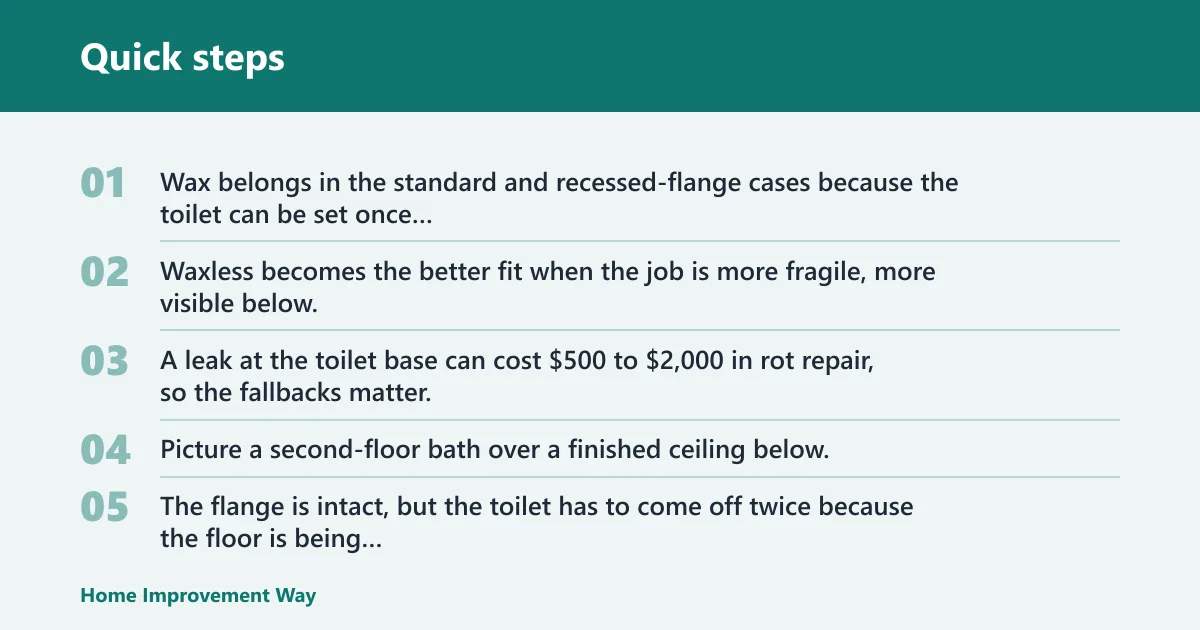
Wax belongs in the standard and recessed-flange cases because the toilet can be set once and left alone. Waxless becomes the better fit when the job is more fragile, more visible below, or more likely to be opened again. A leak at the toilet base can cost $500 to $2,000 in rot repair, so the fallbacks matter.
Picture a second-floor bath over a finished ceiling below. The flange is intact, but the toilet has to come off twice because the floor is being replaced around it. A waxless seal reduces cleanup and gives more room for a reset without throwing away a compressed wax ring after the first lift.
What should you inspect before buying the seal?
Check the leak symptoms, the fastening hardware, and the tools before you choose a seal. The wrong part is often less of a problem than missing a loose flange, rusted bolts, or a soft subfloor. Start with the evidence at the toilet base.
Leak symptoms at the base
Look for water pooling after flush, sewer-gas odor, soft or spongy flooring, a rocking toilet, or ceiling stains below an upstairs bathroom. Those signs point to seal failure or a flange problem. They also tell you whether cleanup below could become part of the repair.
Closet bolts and fastening hardware
Closet bolts hold the toilet to the floor, and they are commonly replaced during reseat jobs. Rusted or stripped bolts complicate installation and can keep the toilet from clamping evenly on the new seal. Many wax-ring kits include bolts, which is useful on a standard reset.
Tools and cleanup supplies
Keep a putty knife, wrench or pliers, towel or rag, bucket, and degreaser or household cleaner nearby. Those basics handle old wax removal and the final clean surface before the new seal goes in. A clean flange top and toilet horn give the best chance of a dry reset.
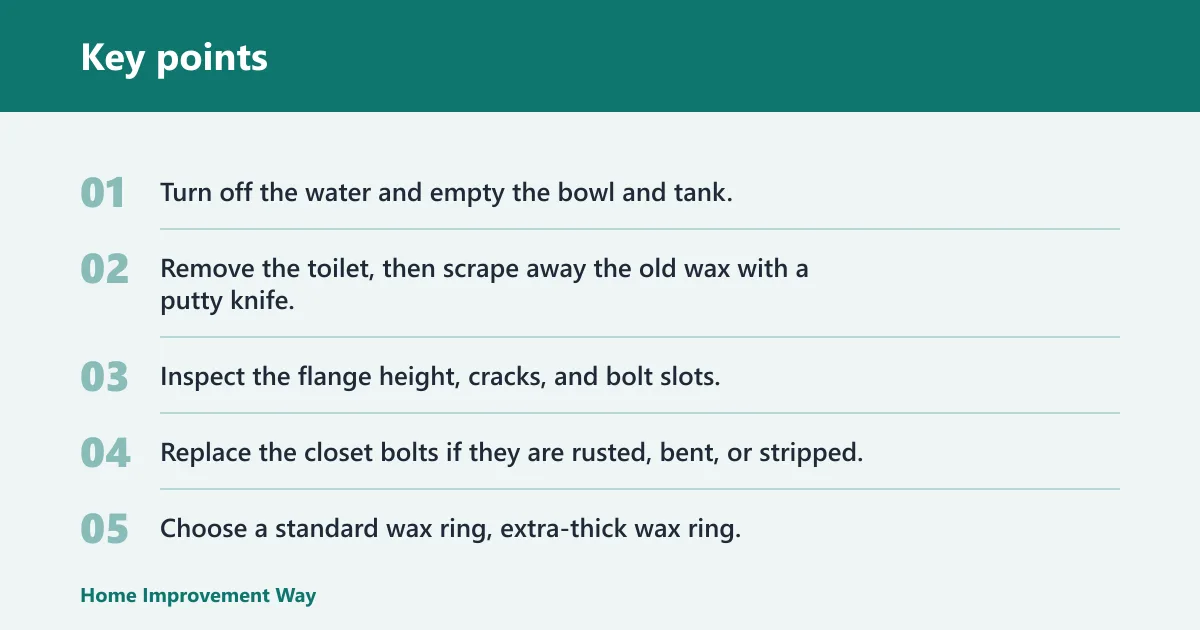
- Turn off the water and empty the bowl and tank.
- Remove the toilet, then scrape away the old wax with a putty knife.
- Inspect the flange height, cracks, and bolt slots.
- Replace the closet bolts if they are rusted, bent, or stripped.
- Choose a standard wax ring, extra-thick wax ring, or waxless seal based on the flange and access conditions.
- Set the toilet evenly and tighten the bolts without forcing the bowl to rock.
Choose wax Ring if… choose Waxless toilet seal if…
Choose Wax Ring if the flange is solid, at or near floor level, and the toilet is not likely to be lifted again. It is also the better pick when you want the lowest-cost path for a normal replacement, including the extra-thick version for a recessed flange that is more than 1/4-inch low.
Choose Waxless Toilet Seal if the toilet may need repositioning, if you expect repeated removal, or if cleanup and access below the bathroom matter more than the lower price. It is also the better choice when you want a cleaner reset around a difficult install, but only after the flange and floor are stable enough to support it.


Frequently asked questions
Should I use a wax ring or a waxless toilet seal?
Use a wax ring for a stable, standard replacement with a sound flange and a toilet that sits level. Use a waxless toilet seal when you need repositioning, repeat removal, or a cleaner reset. If the toilet rocks or the flange is damaged, fix that first. The seal cannot make up for movement.
When is a waxless toilet seal better than wax?
A waxless toilet seal is better when the toilet may need to come back off, when cleanup matters, or when a finished ceiling below makes leak control more sensitive. It is also helpful during a tricky reset because it can be repositioned. It does not replace flange repair or floor correction.
Can I reuse a wax ring if I lift the toilet?
No. A wax ring is single-use after the toilet is lifted, and the toilet should be reset with a new ring. Once compressed, it will not seal the same way again. If the bowl has to be repositioned, start over with fresh wax or switch to a waxless seal for that job.
What size wax ring do I need for a recessed flange?
If the floor flange is more than 1/4-inch low, use an extra thick wax ring. That is the usual wax answer for a recessed flange. If the flange sits too far below the floor or is damaged, a flange extender or repair ring is often the better fix than relying on a thicker ring alone.
How do I know if my toilet leak is from the wax ring?
Look for water pooling after flush, sewer-gas odor, soft or spongy flooring, or a rocking toilet. Ceiling stains below an upstairs bathroom can also point to a bad seal. If the toilet moves, the wax ring may be failing from lack of support, not just age.
Should I replace the closet bolts when changing the seal?
Yes, in most reseat jobs. Closet bolts hold the toilet to the floor, and rusted or stripped bolts can stop the bowl from tightening evenly. Fresh bolts help the toilet clamp the new seal without twisting. That matters for both wax and waxless installs.
Sponsored / affiliate links. As an Amazon Associate I earn from qualifying purchases. I may earn additional commission from eligible campaigns.