Comfort Height vs Standard Height Toilets: Which Fits?
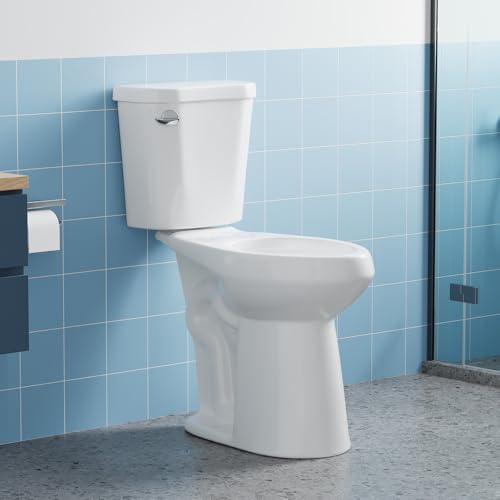
Comfort height toilets, usually 17 to 19 inches from floor to seat, are easier for many adults to sit on and stand from. Standard toilets around that height can often fit shorter users and kids better. Choose the wrong height and you can end up with awkward foot support, harder transfers, or a toilet that crowds a small bathroom. This guide compares comfort height vs standard height toilets by fit, mobility, children, and layout constraints.
This guide is part of our Toilet repair guide series.
Comfort height vs standard height toilets: the core trade-off
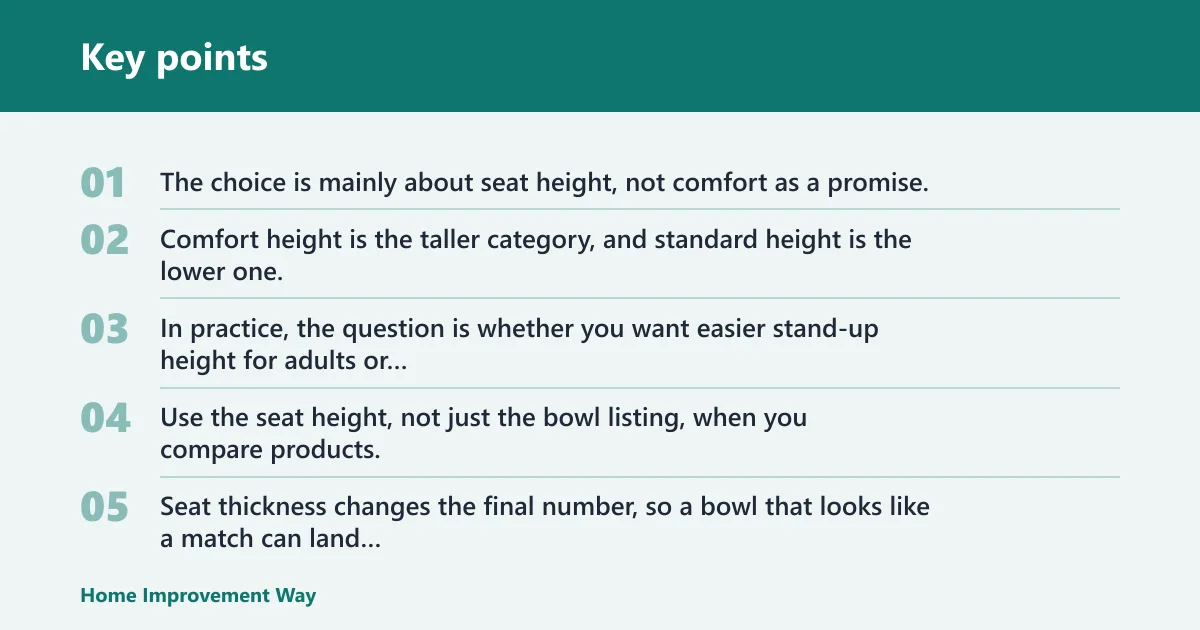


The choice is mainly about seat height, not comfort as a promise. Comfort height is the taller category, and standard height is the lower one. In practice, the question is whether you want easier stand-up height for adults or better foot contact for shorter users and children.
| Decision factor | Comfort Height | Standard Height Toilets | Winner |
|---|---|---|---|
| Installed seat height | 17 to 19 inches | 15 to 16 inches | Depends on the user |
| Ease of sitting down and standing up | Usually easier for many adults | Usually harder for taller or mobility-limited users | Comfort Height |
| Fit for shorter users and kids | May leave feet dangling | Usually better foot support | Standard Height Toilets |
| Room fit in a compact bathroom | Can feel taller or more crowded | Usually less awkward in tight layouts | Standard Height Toilets |
| Transfer ease from walkers or wheelchairs | Often closer to transfer height | Usually lower than a typical transfer target | Comfort Height |
Installed height matters more than bowl-only specs
Use the seat height, not just the bowl listing, when you compare products. Seat thickness changes the final number, so a bowl that looks like a match can land higher or lower once the seat is installed.
Who usually benefits from each height at a glance
Comfort height toilets are a good fit for tall people, disabled users, elderly users, and seniors. Standard height toilets are usually better for short people and kids. That split helps, but it does not settle the choice by itself.
📊 Chair height and comfort height refer to toilets with a minimum height of 17 inches. Source: Chair Height vs Comfort Height vs Standard Height Toilets.
How tall is each toilet height once the seat is installed?
Comfort height with seat is listed at 17 to 19 inches, while standard height with seat is listed at 15 to 16 inches. Those are the numbers that matter for fit, because they reflect the surface you actually sit on. If you measure only the bowl, you can miss the real installed height.
Measure from floor to top of seat, not just the bowl
To compare toilets correctly, measure from the finished floor to the top of the seat. That gives you the usable height, which affects foot contact, knee bend, and stand-up effort. A thicker seat can shift the final number enough to matter.
Why seat thickness can change the buying decision
Two toilets with similar bowl specs can end up different after installation. A taller seat can push a borderline setup into the range that feels too high for a shorter user. That is why a product page should be checked for the installed seat height, not only the bowl category.
What to check on product pages before you order
Look for the seat-height range, the manufacturer’s height term, and whether the number includes the seat. Kohler uses comfort height for chair-height toilets. American Standard uses right height, and Toto calls the same height class universal height.
Which toilet height fits which users best?
Fit depends on the person, not just the bathroom. A height that makes standing easier for one user can make foot support worse for another. That is why the same toilet can be a strong choice in one home and a poor one in another.
Short adults and stable foot contact
Short adults often do better on standard height because their feet are more likely to rest flat on the floor. A comfort height toilet may leave feet dangling for shorter users, which can feel unstable and awkward. If the user cannot plant both feet well, the taller option is usually the wrong pick.
Tall adults and easier stand-up height
Tall adults often prefer comfort height because the higher seat reduces the distance from sitting to standing. The lower bend at the knees and hips can feel easier during repeated use. Standard height may feel too low, especially if the user is long-legged.
Older adults and knee or hip limitations
For older adults, the main issue is often sit-to-stand effort. Comfort height usually helps because it reduces how far the body has to rise. That said, if the user is short, the gain in standing ease can be offset by poor foot support.
Children and family use
Standard height is usually better for children because it is easier to reach and sit on without feeling perched. In a mixed family bathroom, a comfort height toilet can work, but younger children may need a step stool or more supervision. If children use the bathroom alone, the lower height is often simpler.
Users who transfer from walkers or wheelchairs
For transfers, height alignment matters. Comfort height often sits closer to a transfer-friendly range than a standard toilet, which can reduce the effort needed to move onto the seat. Even then, you still need enough clear floor space around the toilet for the transfer path and device position.
Say your household has a 6-foot adult, a 5-foot-1 parent, and a 7-year-old child. The taller adult may like comfort height, but the shorter adult may feel their feet float, and the child may need help every time. In that kind of mixed home, height choice should follow the primary daily user, not the tallest person.
Does comfort height cause problems in a small bathroom?
Yes, it can. A taller toilet may fit the rough-in and still feel cramped if the bathroom is tight, the door swings close, or a vanity crowds the bowl. In a small layout, comfort height can make the room feel more packed even when it is technically code-compliant.
Clearance in front of the bowl and around the door swing
Check the open space in front of the toilet and whether the door clears the seat when it opens. A taller bowl can feel more intrusive in a narrow path, especially if the room already has limited walking space. The toilet may be usable on paper but annoying in daily use.
Vanity, cabinet, and seat-to-fixture spacing issues
Look at side clearance to the vanity or cabinet. A taller toilet seat can make the room feel tighter when the fixture sits close to a sink base or storage cabinet. If the bathroom is already compact, the lower standard height often feels less cramped.
When a taller bowl feels awkward in a compact layout
A common first-timer mistake is choosing comfort height because it sounds easier, then discovering the seat feels too high for the room scale. The toilet can dominate a small bath visually and functionally. When the layout is tight, the fit of the room matters as much as the fit of the body.
Compare comfort height and standard height in a simple household fit matrix
This matrix uses a simple 1 to 5 fit score, with the higher number indicating a better fit for that user group. It is not a durability rating. It is a practical starting point for households that need to balance adults, children, and mobility needs.
| User group | Comfort Height | Standard Height Toilets | Winner |
|---|---|---|---|
| Short adult | 2/5 | 5/5 | Standard Height Toilets |
| Tall adult | 5/5 | 3/5 | Comfort Height |
| Senior or mobility-limited user | 5/5 | 2/5 | Comfort Height |
| Child | 2/5 | 5/5 | Standard Height Toilets |
| Mixed household | 4/5 | 4/5 | Tie |
Short adult scorecard
Standard height wins because it gives shorter users better floor contact. Comfort height can work for some short adults, but the risk is poor foot support and a sitting position that feels too tall. If the feet do not land flat, the higher seat is usually a miss.
Tall adult scorecard
Comfort height usually wins because it reduces knee bend and makes standing back up easier. Standard height can still work, but the lower seat often feels like extra effort for taller legs and hips. For taller users, the higher seat is often the more practical option.
Senior or mobility-limited user scorecard
Comfort height usually wins here because less rise is required during sit-to-stand movement. That matters for knee pain, hip limits, and general transfer effort. Standard height can still be fine for some users, but it is less forgiving when strength or joint motion is limited.
Child usability scorecard
Standard height wins for children because the lower seat is easier to reach and use without strain. Comfort height can be fine in a family bath if children are older, but smaller kids often need more help. If the toilet is for independent child use, the lower height is the safer bet.
Mixed-household scorecard
Mixed households are the hardest call. If adults with mobility limits are the main users, comfort height is usually the better compromise. If the bathroom is shared heavily by children and shorter adults, standard height can be the more workable middle ground.
Choose Comfort Height if… / choose Standard Height Toilets if…
Choose comfort height if the main users are tall adults, older adults, or anyone who needs less effort getting up and down. Choose standard height if the main users are shorter adults or children, or if the bathroom is tight and you want a less imposing fixture. If your household splits between both, measure first and decide based on the person who uses that bathroom most often.
When comfort height is the better pick
Pick comfort height if the user wants easier transfers, has knee or hip limits, or prefers a higher sitting position. It is also a good candidate when the bathroom has enough front clearance and side space. In those cases, the taller seat usually improves function without much downside.
When standard height is the better pick
Pick standard height if shorter users or kids are the primary users. It also makes sense when floor contact matters more than stand-up ease. In a compact bath, the lower profile can feel more natural and less crowded.
When neither height is ideal
If the home has both small children and a mobility-limited adult, neither height may be perfect. Re-measure the bathroom and compare actual seat height, not brand labels alone. In some cases, a different bathroom can get the comfort-height toilet while the family bath stays standard height.
What does ADA toilet height mean, and is it the same as comfort height?
ADA-compliant toilet height overlaps with chair height in many cases, but the terms are not identical. ADA is a compliance reference, while comfort height is a product category name. They often point to the same general height class, but you still need to verify the installed seat height and the full bathroom layout.
Where ADA-compliant height overlaps with chair height
Chair height toilets are approximately 17 to 19 inches tall from the floor to the top of the seat, and that range commonly overlaps with ADA-oriented products. That is why shoppers often see the terms used together. Even so, overlap does not guarantee every seat or every installation will suit every user.
Why ADA language is not a full buying shortcut
ADA wording does not tell you whether the toilet is right for a short user, a child, or a cramped bathroom. It is one reference point, not a complete fit test. You still need to check the actual seat height, the room clearance, and who will use the bathroom most.
How brand names like right height and universal height fit in
Brand names can make the same height class look different. American Standard uses right height, Kohler uses comfort height, and Toto uses universal height. Those are naming differences for the chair-height category, not separate height standards.
Measurement checklist before you buy
Measure the toilet height the way it will be used: floor to top of seat. Then verify the room around it. A toilet can be the right height and still be the wrong choice if the layout is too tight or the users do not fit the height well.
- Measure from the finished floor to the top of the seat.
- Check whether the listed height includes the seat or only the bowl.
- Compare the number with the user group: short adult, tall adult, senior, child, or mobility-limited user.
- Check front clearance, door swing, and side space near the vanity or cabinet.
- Confirm the rough-in so the bowl will physically fit the space.
- Make sure the toilet will not block walking paths or transfer space.
What to confirm for rough-in and installation
Rough-in tells you whether the toilet will fit the plumbing layout, but it does not solve height-fit problems. A toilet can match the rough-in and still be too tall for shorter users or too low for a mobility-limited user. Always pair rough-in checks with seat-height checks.
Frequently asked questions
What is the difference between comfort height and standard height toilets?
Comfort height toilets are usually 17 to 19 inches from the floor to the top of the seat, while standard height toilets are usually 15 to 16 inches. The taller option is easier for many adults to sit on and stand from. The lower option usually fits shorter users and kids better.
Is comfort height the same as chair height?
Yes, chair height is a common synonym for comfort height. The category usually starts at a minimum height of 17 inches, and many brands use different names for the same general size. Kohler says comfort height, while other makers may use chair height or related labels.
Is a comfort height toilet better for older adults?
Often, yes. The higher seat reduces how far the person has to move during sitting and standing, which can help with knee or hip limits. But the fit still depends on the user’s height, because a very short older adult may lose stable foot contact on a taller seat.
Are standard height toilets better for kids or shorter people?
Yes, standard height toilets are generally better for kids and shorter users. The 15 to 16 inch seat range usually gives better foot support and feels less high off the floor. That makes sitting more stable and often easier to manage without a step stool.
How tall is a comfort height toilet with the seat installed?
Comfort height with seat is listed at 17 to 19 inches. That is the measurement that matters for real-world use, since the seat thickness affects the finished height. Always check whether the product listing refers to the bowl only or the installed seat height.
What does ADA-compliant toilet height mean?
ADA-compliant toilet height refers to a height range used in accessibility planning, and it often overlaps with chair-height toilets. It is not a complete buying shortcut, because the bathroom still has to fit the user and the space. Seat height, floor clearance, and transfer space still need separate checks.
Sponsored / affiliate links. As an Amazon Associate I earn from qualifying purchases. I may earn additional commission from eligible campaigns.