Toilet Bowl Shapes Explained: Round vs Elongated
Elongated toilet bowls add about 2 inches to the front and usually fit adults better. Round bowls save space and are usually the safer pick in tight bathrooms. Choose wrong and you can end up with a bowl that crowds a doorway, feels cramped, or costs more than needed. This guide compares fit, comfort, rough-in limits, cost, and which bowl shape makes sense for each bathroom.
This guide is part of our Toilet repair guide series.
Toilet bowl shapes explained: round vs elongated
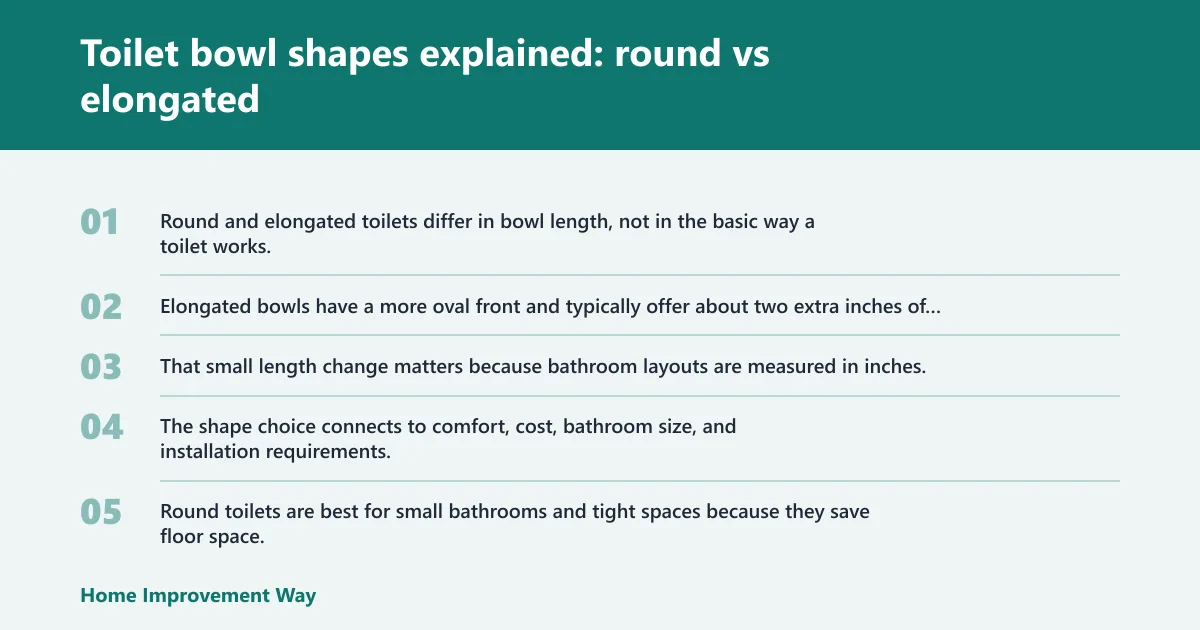
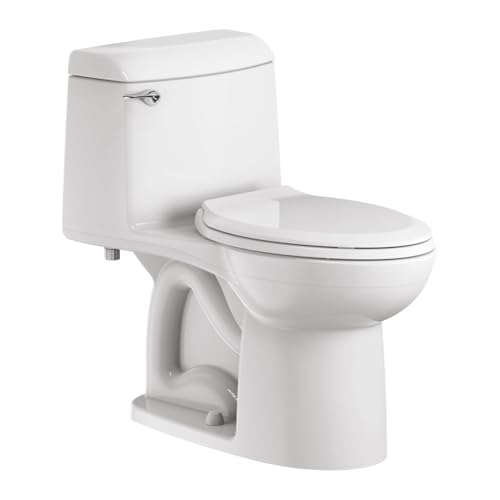

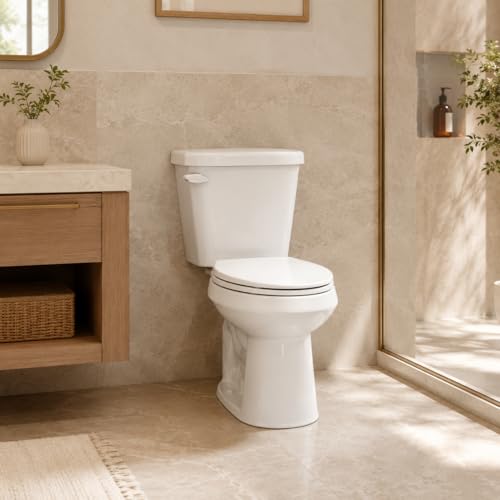
Round and elongated toilets differ in bowl length, not in the basic way a toilet works. Elongated bowls have a more oval front and typically offer about two extra inches of bowl space, while round bowls are shorter and protrude about two inches less on average.
That small length change matters because bathroom layouts are measured in inches. The shape choice connects to comfort, cost, bathroom size, and installation requirements, so the right pick depends on how much front clearance you have and who will use the bathroom.
| Decision factor | Toilet Bowl Shapes Explained: Round | Elongated | Winner |
|---|---|---|---|
| Front clearance | Protrudes about two inches less on average; better for tight spaces | Needs more room in front because of the longer bowl | Round |
| Comfort for many adults | Can feel less comfortable for some users | Usually provides more sitting space and improved comfort | Elongated |
| Budget | Generally more affordable | Often costs about $50 more | Round |
| Cleaning access | Shorter bowl can leave a little more access around the front | Longer bowl can make front wipe-downs slightly harder in tight layouts | Round |
| Seat compatibility | Needs a round seat | Needs an elongated seat | Tie |
Front clearance is where shape becomes a layout issue
Round toilets are best for small bathrooms and tight spaces because they save floor space. Elongated toilets can still fit in many bathrooms, but the extra front length can crowd a door swing, vanity edge, or shower entrance if the room is already cramped.
A common first-timer mistake is checking rough-in and forgetting front clearance. Those are different measurements, and both matter.
Comfort usually favors the elongated bowl
Elongated toilets usually provide more sitting space and improved comfort, especially for many adults. Round bowls can feel fine for children, guest baths, or rooms used briefly, but some users notice the shorter bowl right away.
That does not mean every household needs elongated. If the bathroom is tight, comfort may matter less than simply being able to close the door without brushing the toilet.
Cost tilts toward round bowls
Round toilets are generally more affordable. Elongated toilets often cost about $50 more, and that gap can matter when you are already paying for a replacement, supply line, wax ring, shutoff valve work, or labor.
Installation cost also matters. If the room needs additional plumbing work or a different seat, the total bill can climb faster than the bowl price suggests.
📊 Most toilet rough-ins are 12 inches. Source: Elongated vs Round Toilets (Comparisons, Pros & Cons, & Ratings….
How much space does each shape need?
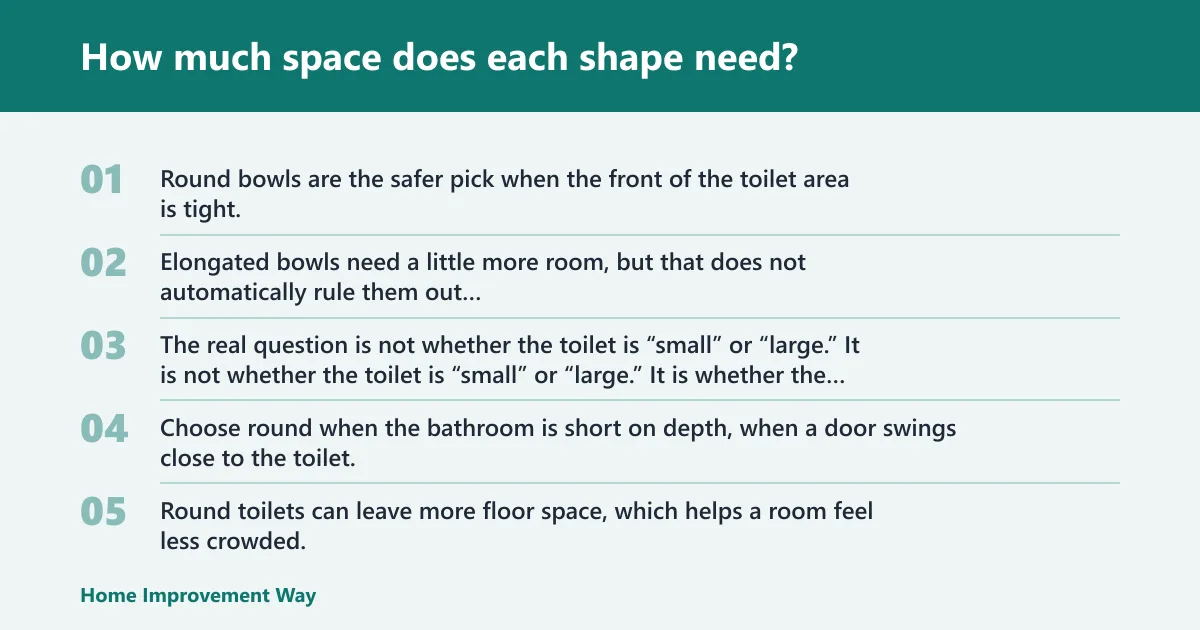
Round bowls are the safer pick when the front of the toilet area is tight, because they protrude about two inches less on average. Elongated bowls need a little more room, but that does not automatically rule them out in a compact bathroom if the layout still leaves comfortable clearance.
The real question is not whether the toilet is “small” or “large.” It is whether the room still has enough open space after you account for the bowl, the door, and nearby fixtures.
When a round bowl fits better in small bathrooms
Choose round when the bathroom is short on depth, when a door swings close to the toilet, or when the fixture sits near a tub, linen cabinet, or vanity edge. Round toilets can leave more floor space, which helps a room feel less crowded.
If you are replacing an older compact toilet, round often preserves the original traffic pattern with the least disruption.
When an elongated bowl still works in tighter layouts
Elongated toilets can work in smaller bathrooms if the room is laid out well and the front clearance is still acceptable. The key is to measure before buying, not after delivery.
Suppose a hall bath is used by adults every day and has only one toilet. A slightly longer bowl may be worth the tradeoff if the door still clears and the room does not feel pinched.

Which toilet bowl shape is more comfortable?
Elongated toilet bowls are usually more comfortable for adults because they offer more sitting space and a longer front profile. Round bowls can feel a bit shorter under the user, which is why they are often chosen more for fit than for comfort.
Comfort matters most in a primary bath or any bathroom used frequently by adults. In a powder room or child’s bath, the smaller footprint of a round bowl may be the better tradeoff.
Kids, mixed households, and guest baths
For households with small children, mixed users, or mostly short visits, round can be a practical choice. It is easier to fit, usually less expensive, and often good enough where the toilet is used quickly rather than for long sits.
If the bathroom serves older adults, larger adults, or anyone who spends more time in that room, elongated usually earns its keep.
When comfort matters less than footprint
Comfort matters less in rooms where space is the limiting factor. A toilet that fits cleanly and leaves walking room is often the better decision than a more comfortable shape that makes the room harder to use.
That is especially true in narrow half baths and older homes with fixed plumbing locations.
What should you measure before you buy?
Measure rough-in, front clearance, and seat shape before you order. Most toilet rough-ins are 12 inches, but some toilet rough-ins are 10 inches or 14 inches, and the wrong rough-in can make the toilet impossible to install correctly.
Seat shape also matters. Toilet seat fit must match the bowl shape, so a round bowl needs a round seat and an elongated bowl needs an elongated seat.
Rough-in: wall to waste outlet center
Toilet rough-in is typically measured from the finished wall to the center of the waste outlet. That measurement determines which toilet will physically align with the drain and sit where it should.
If you skip this step, the bowl may not fit even if the bathroom seems wide enough.
Bathroom clearance: door swing, front clearance, and nearby fixtures
Front projection is the part that most affects day-to-day fit. Even if the rough-in is correct, the toilet still has to leave enough space in front for comfortable use and enough room for doors and cabinet doors to open without contact.
Check the route a person takes through the bathroom. If the bowl narrows that path, round is usually the safer pick.
Seat shape and replacement compatibility
A mismatched seat is a common shopping mistake. A round seat on an elongated bowl leaves the front short, while an elongated seat on a round bowl looks wrong and does not fit properly.
When replacing only the seat, match the bowl shape first and the style second.
How do round and elongated toilets compare on cleaning, flushing, and price?
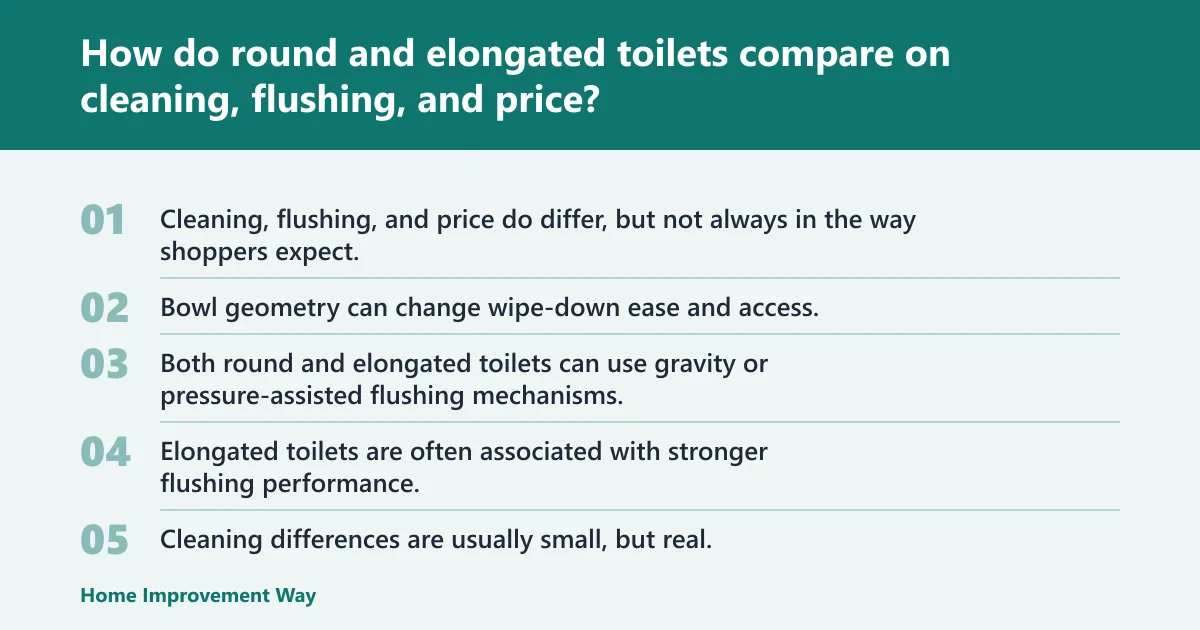
Cleaning, flushing, and price do differ, but not always in the way shoppers expect. Bowl geometry can change wipe-down ease and access, while flushing performance depends more on the model and flushing mechanism than on shape alone.
Both round and elongated toilets can use gravity or pressure-assisted flushing mechanisms. Elongated toilets are often associated with stronger flushing performance, but shape does not override the actual design of the flush system.
| Comparison factor | Round | Elongated | Winner |
|---|---|---|---|
| Cleaning access | Shorter front can be easier to reach in tight rooms | Longer bowl may leave slightly less access in cramped spaces | Round |
| Flush performance | Depends on the model and mechanism | Depends on the model and mechanism | Tie |
| Product price | Generally more affordable | Often about $50 more | Round |
| Total fit risk | Lower risk in small bathrooms | Higher risk if front clearance is tight | Round |
Cleaning and maintenance
Cleaning differences are usually small, but real. Bowl geometry affects wipe-down ease because access around the front edge changes with shape, and more compact bowls can leave a little more room for your hand and cleaning tools.
Do not expect a major maintenance gap. The better choice is the one that gives you enough space to clean the area without reaching awkwardly around nearby walls or cabinets.
Flush performance depends on the toilet, not the shape alone
Flush quality is controlled by the bowl design, trapway, tank, and flushing mechanism. Both shapes can use gravity or pressure-assisted flushing mechanisms, so you should compare the model rather than assume a shape will solve flushing issues.
Elongated toilets are often associated with stronger flushing performance, but that is not a universal rule. A well-designed round toilet can flush better than a poorly designed elongated one.
Price differences add up with installation
Round toilets are generally more affordable, and elongated toilets often cost about $50 more. That difference may be small on paper, but it matters when the rest of the job includes delivery, labor, and replacement parts.
If the bathroom also needs a different seat, that adds another line item. Seat costs vary, but the shape match is not optional.
Use this fit-and-choice worksheet
Use this worksheet before you buy. It turns the round-vs-elongated choice into a quick yes-or-no check instead of a guess based on the display floor or a product photo.
- Front-clearance check: Measure from the front edge of the planned toilet location to the nearest obstacle. If the room already feels tight, round gets the edge.
- Rough-in check: Measure from the finished wall to the center of the waste outlet. Most toilet rough-ins are 12 inches, but some are 10 inches or 14 inches.
- User-comfort checklist: Mark who uses the bathroom most. If adults use it often, elongated is usually the better comfort choice. If children or guests use it most, round often makes more sense.
- Seat check: Confirm whether the replacement seat must be round or elongated. Toilet seat fit must match the bowl shape.
- Budget check: Compare toilet price plus seat and installation. Round toilets are generally more affordable, and elongated toilets often cost about $50 more.
- Final decision: If the room is tight, choose round. If there is enough clearance and adult comfort matters more, choose elongated.
Choose round if… / Choose elongated if…
Round is the better pick when the bathroom is small, the front clearance is tight, the budget is limited, or the toilet serves a guest bath, kids’ bath, or another room where saving space matters more than extra seating length.
Elongated is the better pick when the bathroom has enough room, adults use the toilet often, comfort matters more than footprint, and you are willing to pay a little more for the added bowl length.
Choose round if…
- Your bathroom is short on floor space.
- The toilet sits close to a door, vanity, or tub.
- You want the lower-cost option.
- The room is a guest bath or child-focused bath.
Choose elongated if…
- Adult comfort is a priority.
- You have enough front clearance for the longer bowl.
- The bathroom is used often and space is not the main limit.
- You are fine paying more for a larger seating area.
Frequently asked questions
What is the difference between a round and elongated toilet?
A round toilet has a shorter, more compact bowl, while an elongated toilet has a longer oval bowl that extends farther forward. The main practical difference is that elongated toilets usually provide more sitting space, while round toilets save room in smaller bathrooms.
Will an elongated toilet fit in a small bathroom?
Sometimes, yes. An elongated toilet can fit in a small bathroom if the rough-in is correct and the front clearance still works with the door and nearby fixtures. If the room is very tight, a round bowl is usually the safer choice.
Are round toilets cheaper than elongated toilets?
Round toilets are generally more affordable. Elongated toilets often cost about $50 more, though total project cost also depends on installation, seat replacement, and any plumbing parts that need to be swapped during the job.
Which toilet bowl shape is easier to clean?
Round bowls can be a little easier to clean in tight bathrooms because the shorter front gives you slightly better access. The difference is usually small, though, and cleaning difficulty depends more on bathroom layout and bowl geometry than on shape alone.
Do round and elongated toilets flush differently?
Not by shape alone. Both round and elongated toilets can use gravity or pressure-assisted flushing mechanisms, and flush performance depends more on the specific toilet model. Elongated toilets are often associated with stronger flushing performance, but that is not guaranteed.
Sponsored / affiliate links. As an Amazon Associate I earn from qualifying purchases. I may earn additional commission from eligible campaigns.