Can You Use a Water Softener with a Well Pump and Pressure Tank?
You can usually use a water softener with a well pump and pressure tank if you install the softener after the pressure tank and size it for your well’s flow rate. Poor placement or an undersized softener can cause pressure swings, short cycling, fouled resin, or a pump that works harder than it should. This guide covers safe installation order, sizing checks, and the warning signs that your well system needs changes first.
Can you use a water softener with a well pump?


Yes, in most private well systems, a water softener can work with a pump and pressure tank. Put the softener downstream of the pressure tank, and make sure the system has enough stored water, flow, and drain capacity to handle regeneration without stressing the pump. Most manufacturers and extension guides place the softener after storage and before the house distribution line.
What makes a well system different from city water
A private well system usually relies on the well, pump, pressure tank, casing, and screen to move and store water. A submersible pump sits inside the well and pushes water upward. A jet pump is usually mounted above ground and pulls water by suction. In both cases, the pressure tank stores water under pressure and helps prevent the pump from turning on every time a faucet opens.
That difference matters for a softener. A city supply is often steadier than a well system, which cycles around a pressure switch setting such as 30/50 or 40/60 psi. Pump and tank makers note that those settings affect drawdown and pump start frequency, so placement and regeneration flow need more attention than they do on municipal water.
Well system installation order
The order often recommended is well pump to pressure tank, then softener, then the rest of the house plumbing. If iron treatment is needed, that equipment usually goes before the softener. The softener should be after the pressure tank so treatment does not sit inside the pump control loop, where it can short-cycle the pump. This matches manufacturer layout guidance for pressure tanks and softeners and helps keep the switch from reacting to treatment flow.
Picture a home with a submersible pump set for a 40/60 switch and a softener tied in ahead of the tank. Every softening demand can change the pressure reading the switch sees, and the pump may start and stop too often. That is hard on the pump and hard on the controls.
Can your well run a softener checklist
Use this checklist before installation. It gives you a practical pass-fail view of whether the well system is ready, borderline, or high-risk. The main question is not only whether the softener can fit, but whether the well can feed regeneration without pressure collapse, fouling, or drain trouble.
| Check | Yes means | No means |
|---|---|---|
| Pressure tank health | Tank holds pressure, water draw feels steady, and the pump does not short cycle | Tank is waterlogged, air charge is wrong, or the pump starts too often |
| Sediment | Water is fairly clear, with little grit in fixtures or filters | Sand, rust, or grit is visible and already clogging screens or aerators |
| Iron | Iron is low enough that the softener can handle it, or pretreatment is already planned | Iron is high, oxidized, or staining fixtures and resin fouling is likely |
| Well yield | Flow is steady enough to support regeneration without the pump starving | Yield is low and the well struggles during long draws or filling events |
| Drain capacity | Backwash and rinse water can discharge without backup or code issues | Drain is undersized, too far away, or unable to handle sustained flow |
Pass: all five checks are yes, or one is only slightly borderline and the softener manual still fits your pressure and flow conditions.
Borderline: one or two checks are weak, but the system can likely be corrected with pretreatment, a larger storage setup, or a different regeneration schedule.
High-risk: the tank is failing, sediment is heavy, iron is untreated, the well yield is low, or the drain cannot handle regeneration. Fix those first.
Does your pressure setup support regeneration?
Probably, if the tank is healthy and the well can keep up with the softener’s backwash and rinse demand. A softener regeneration cycle draws sustained water flow for backwash and rinse, so weak pressure recovery or frequent pump cycling can cause poor cleaning, resin fouling, or incomplete regeneration. Pump and tank manufacturers generally want the pressure tank to buffer those flows rather than let the pump chase every change.
How 30/50 and 40/60 settings affect cycling
Pressure switch settings shape how much water the tank can store between pump starts. A 30/50 psi switch setting is commonly associated with a higher drawdown fraction than 40/60 psi, because lower cut-in/cut-out settings let the tank deliver more usable water before the pump starts. Manufacturer charts vary by tank size, but the general rule is consistent: higher pressure settings reduce drawdown and increase cycling.
That matters during regeneration because the softener wants a steady flow. If the tank is too small, the system can lose pressure faster during backwash, and the pump may cycle more often than the softener or pump controls like. State extension bulletins and tank maker literature both point to matching tank size and switch settings to the home’s expected draw and start frequency.
| Hardness / iron / pressure setup | Estimated service flow | Regeneration flow / drain need | What it means for the well setup |
|---|---|---|---|
| Low hardness, iron under 1 mg/L, 30/50 or 40/60 psi, healthy tank | Typical whole-house demand with normal pressure recovery | Backwash and rinse at the softener’s rated flow; drain must handle the peak backwash rate | Usually safe if the softener is after the tank and the drain is properly sized |
| Moderate hardness, iron near the softener limit, 40/60 psi, smaller tank | Moderate flow, but pressure can dip faster during long draws | Backwash flow must not exceed the well’s short-term recovery; drain line should stay short and unobstructed | Borderline; add pretreatment or a larger tank if cycling is already frequent |
| High hardness, iron above softener guidance, higher pressure setting, low-yield well | Service flow may be fine at first, then fall off during large household draws | Regeneration may exceed well recovery and strain the drain if flow is sustained | High-risk; use iron treatment, storage changes, or a different treatment strategy first |
Why drawdown matters during backwash
Drawdown is the usable water stored in the pressure tank between pump starts. A larger, healthier tank gives the softener a better buffer during regeneration and normal household use. A small tank can still work, but it raises the risk that the pump will cycle during a long rinse or when another fixture opens at the same time. Pump makers commonly treat drawdown as a key sizing variable, not an afterthought.
Suppose a home runs a softener on a low-yield well with a small pressure tank and a 40/60 switch. If the softener starts its backwash at night and the tank is already weak, the pump may not keep pace. The result can be pressure drop, interrupted regeneration, or a cycle that never finishes cleanly.
Do you need a sediment or iron filter first?
Often yes, especially on wells with grit or visible iron. A sediment prefilter is often treated as nearly mandatory on wells because grit can wear the valve and coat resin. If iron is present, pretreatment may be needed before the softener, since oxidized iron can foul resin and reduce exchange performance. Extension services and water treatment associations generally advise matching pretreatment to the specific contaminant, not assuming the softener can solve it alone.
When grit calls for a sediment prefilter
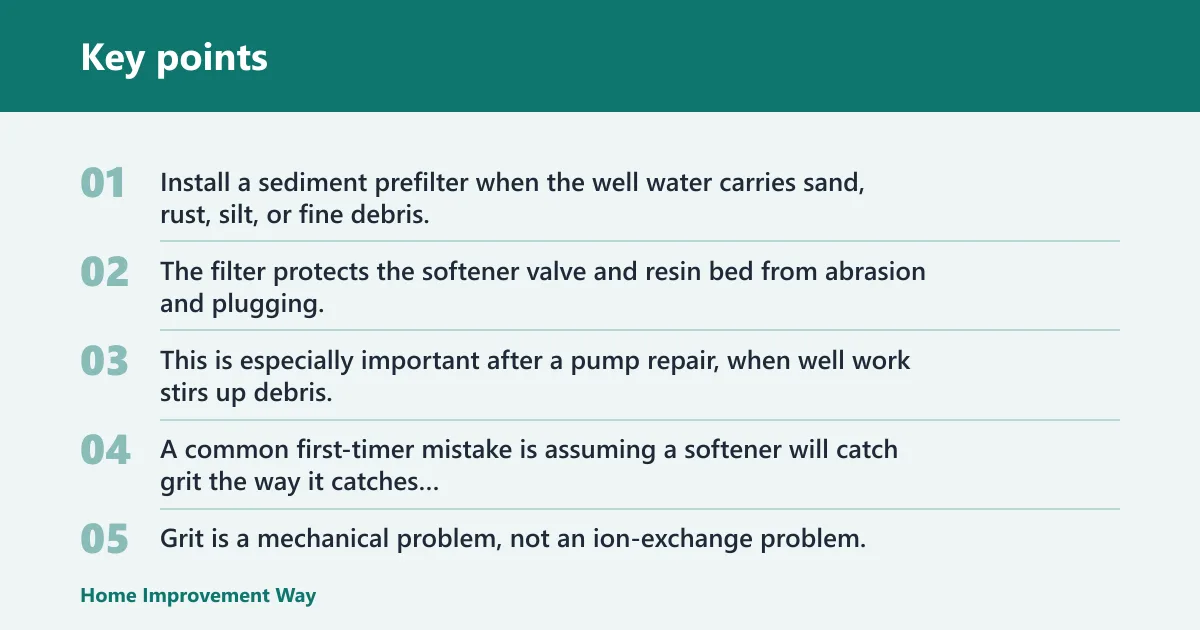
Install a sediment prefilter when the well water carries sand, rust, silt, or fine debris. The filter protects the softener valve and resin bed from abrasion and plugging. This is especially important after a pump repair, when well work stirs up debris, or when an older well already sends particles into the house line.
A common first-timer mistake is assuming a softener will catch grit the way it catches hardness. It will not. Grit is a mechanical problem, not an ion-exchange problem, so the softener is the wrong place to solve it.
When iron calls for pretreatment ahead of the softener
Softeners can remove dissolved iron when pH is above 6.7 and iron is under 5 mg/L. That is a common manufacturer and extension-service rule of thumb for dissolved iron, but it is not a guarantee that the softener should be the only treatment. Oxidized iron can foul resin, and heavier iron loading often belongs in an iron filter ahead of the softener.
If the water is already orange, metallic, or staining fixtures with solid particles forming in the line, pretreatment is usually the safer call. An iron filter before the softener reduces fouling risk and helps the softener stay in service longer.
When a softener alone is enough
A softener alone may be enough when the water has moderate hardness, low sediment, and dissolved iron within the range the manufacturer allows. In that case, the softener can handle hardness removal and some iron reduction without extra treatment ahead of it. Even then, the drain and regeneration settings still matter.
What can go wrong if placement is off?
Bad placement can create pump cycling problems, resin fouling, weak regeneration, and drainage trouble. The biggest mistake is putting treatment inside the pump control loop or installing a softener before the pressure tank. That can make the pump work against unstable pressure and shorten the life of both the pump and the softener valve.
Pump cycling problems
If the softener is plumbed before the pressure tank, the pump can short-cycle because the control loop no longer sees a stable storage buffer. Treatment inside the pump control loop can short-cycle the pump. That means more starts, more wear, and less stable pressure throughout the house.
Resin fouling and valve wear
Heavy sediment and oxidized iron are the main troublemakers. Sediment can clog the valve and coat the resin. Oxidized iron can foul resin in a softener. Once that happens, salt use goes up, cleaning gets weaker, and the softener may need service long before normal maintenance would suggest.
Weak regen performance
Regeneration needs enough flow to backwash and rinse the bed thoroughly. If the well yield is low, the tank is small, or the switch settings are too restrictive for the system, regeneration may start weakly or finish unevenly. Demand-initiated regeneration is recommended over fixed-clock cycling because it fits actual water use and is easier to align with low-demand hours.
Drain or discharge issues
The drain line matters because the softener has to send backwash and rinse water somewhere safe. If the drain is undersized or improperly routed, regeneration can back up, spill, or violate local plumbing rules. Plan the drain before final hookup, not after the softener is already in place. Follow the softener manufacturer’s drain-flow minimums and any local discharge requirements.
Well softener checklist
Use this install-order check before any final tie-in. It is the shortest way to confirm that the softener belongs in the system and that the well can support it without a storage or pretreatment upgrade first.
- Confirm the softener will sit after the pressure tank, not before it.
- Verify the pressure tank is healthy and matches the pressure switch setting.
- Check for sediment and decide whether a prefilter is needed ahead of the softener.
- Test for iron and decide whether an iron filter should go before the softener.
- Confirm the well yield can support regeneration flow without starving the pump.
- Confirm the drain can accept backwash and rinse water at the required flow.
- Set regeneration for low-use hours and use demand-initiated regeneration when possible.
Simple recommendation: standard well setups with a healthy tank, low sediment, manageable iron, adequate yield, and a proper drain are usually good candidates. Borderline systems should add pretreatment, a larger tank, or both before the softener goes in. High-risk systems should be corrected first.
Frequently asked questions
Can you use a water softener with a well pump and pressure tank?
Yes, usually. A softener works well with a well pump and pressure tank when it is installed after the tank and the well can support regeneration flow. The main limits are pressure stability, sediment, iron, yield, and drain capacity, not the pump type itself.
Does a water softener go before or after the pressure tank?
After the pressure tank. A softener on a well should sit after the pressure tank, because the tank stores water under pressure and helps avoid short cycling. Placing treatment in the pump control loop can shorten pump life and make pressure less stable.
Do I need a sediment filter before a softener on well water?
Often yes. A sediment prefilter is close to mandatory on wells when grit, sand, or rust is present. It protects the valve and resin from abrasion and clogging. If your water is very clean and the manufacturer allows it, the filter may be less urgent, but it is still common.
Will a softener overwork a low-yield well or small pressure tank?
It can. Low-yield wells can struggle to feed regeneration, and a small pressure tank leaves less buffer during backwash and rinse. If the pump already cycles often or pressure drops quickly, add storage, improve pretreatment, or rethink the regeneration plan before installing the softener.
Can a softener remove iron from well water too?
Sometimes. Softeners can remove dissolved iron when pH is above 6.7 and iron is under 5 mg/L. That said, oxidized iron can foul resin, so a softener is not the right answer for every iron problem. Heavier or oxidized iron often needs an iron filter first.
What happens if the softener is plumbed in the wrong spot?
You can get short cycling, pressure swings, weak regeneration, and faster wear on the pump and softener valve. The most common mistake is placing the softener before the pressure tank or inside the pump control loop. That setup disrupts the buffer the tank is meant to provide.
Sponsored / affiliate links. As an Amazon Associate I earn from qualifying purchases. I may earn additional commission from eligible campaigns.