Best Shutoff Valves for a Bathroom Remodel (2026): We Compared
For most bathroom remodels, the best shutoff valves are quarter-turn angle stops for sinks and toilets, with push-to-connect options when pipe access is tight. Choose the wrong valve, and you can trap leaks behind finished walls or make later repairs harder. This guide compares fixture-specific valves, replacement-friendly connection types, and leak-protection upgrades by remodel scope.
Quick comparison
| Product | Badge | Best for | Price | ||
|---|---|---|---|---|---|
 |
Vibrant Yard Co. LLC Lead-Free Brass Ball Shut Off Valve,Vibrant Yard Company | Our pick | 1/4-inch · lead-free brass · 200 PSI | $8.48
Price as of 22 Oct 2026
|
View |
 |
10 Pieces XFITTING 1/2" Compression Ball Valve – Full Port,XFITTING | Also great | 1/2-inch · UPC & NSF-61 certified · 600 PSI WOG | $65.90
Price as of 22 Oct 2026
|
View |
 |
Dante Products 1/2-inch Quarter-Turn Ball ValveDante | Also great | 1/2-inch · forged brass · CSA-certified | $13.89
Price as of 22 Oct 2026
|
View |
 |
1 Pcs Lead-Free Brass Mini Ball Valve Shut Off Switch, 1/4LitOrange | Pair with it | 1/4-inch compression · lead-free brass | $7.99
Price as of 22 Oct 2026
|
View |
 |
3/4 INCH PEX-B Ball Valves (2-Pack), Lead-Free Brass FullCorbi | Our pick | $13.99
Price as of 1 Nov 2026
|
View |
The main trade-off is simple: fixture shutoffs cost less and are easier to replace, while smart valves add automatic shutoff and remote control but take more work to install. Bathroom remodels often need both layers. A sink or toilet stop handles daily use; leak protection can sit at the fixture or at the main line.
How we chose
The comparison focuses on four things: fit at the fixture, access for installation and future replacement, pipe-size and connection compatibility, and leak-risk tolerance. It also separates manual valves from smart upgrades, because those solve different problems during a remodel.
For bathroom work, access matters as much as valve type. A valve that fits behind a vanity but cannot be serviced later is a poor choice if the shutoff sits behind drywall or deep inside a cabinet.
Angle stop shutoff valve: best for sinks and toilets
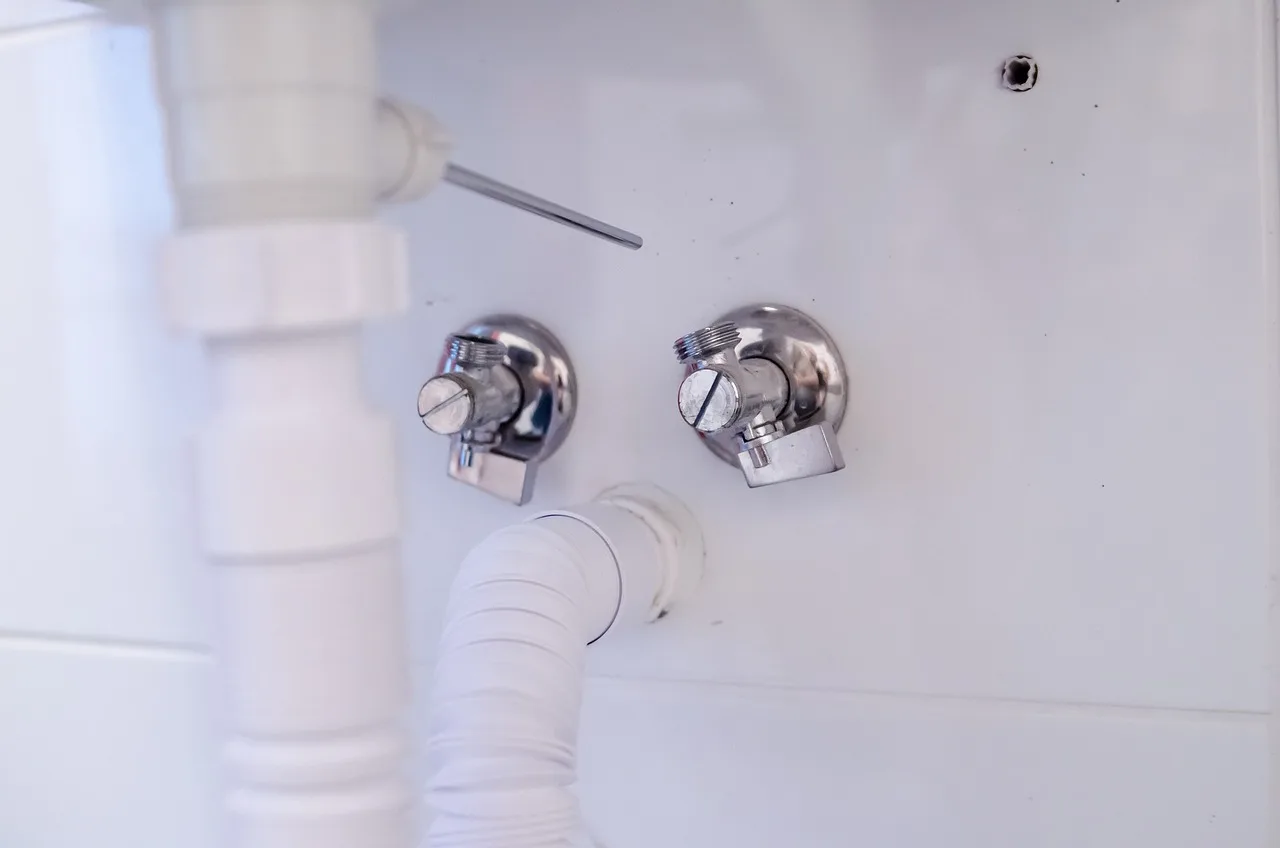
Quarter-turn angle stops are a common choice for bathroom sinks and toilet supply lines. For most remodels, a quarter-turn version is the better default because it opens and closes quickly, while multi-turn models are more common in older plumbing and can be harder to operate when parts wear.
Quarter-turn vs multi-turn operation
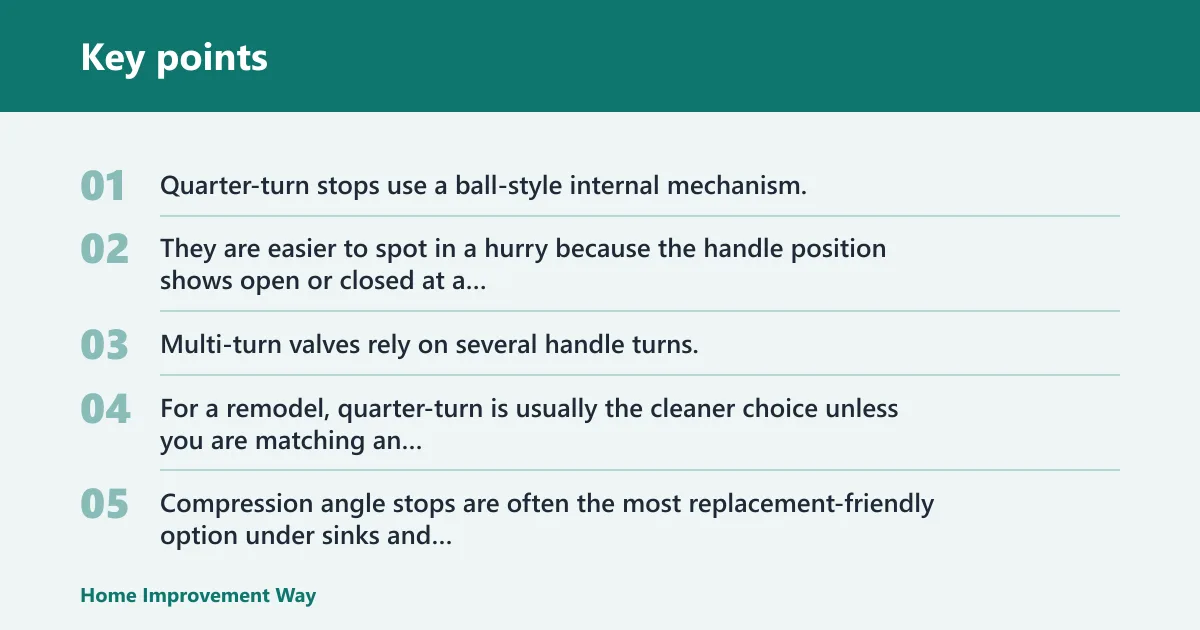
Quarter-turn stops use a ball-style internal mechanism. They are easier to spot in a hurry because the handle position shows open or closed at a glance. Multi-turn valves rely on several handle turns, which can give finer adjustment but are more likely to feel stiff after years of mineral buildup.
For a remodel, quarter-turn is usually the cleaner choice unless you are matching an existing older setup or the fixture layout leaves almost no room for a lever handle.
Compression, push-fit, sweat, and threaded versions
Compression angle stops are often the most replacement-friendly option under sinks and toilets, since they install without soldering and are easier to remove later. Push-fit versions are useful when access is awkward or the pipe needs a quick no-solder connection. Sweat valves are permanent and better when the pipe is already open and you want a clean, soldered joint.
Threaded versions show up in some retrofit setups, but they are less common at the fixture tailpiece than compression or push-fit. If the wall or cabinet gives you only a narrow opening, a connection style that can be replaced without cutting back the pipe is usually the safer remodel choice.
Common bathroom sizing and where each connection makes sense
Bathroom sink and toilet stops are commonly sized for the small supply lines at the fixture, not the main water line. The exact inlet and outlet size must match the pipe and the faucet or toilet connection. If the existing stop is corroded, frozen, or buried behind trim, replacement is usually smarter than reuse.
Use compression when you want a strong middle ground between easy install and easy replacement. Use push-fit when access is tight or the pipe is hard to prep. Use sweat only when the remodel already involves open piping and you want a permanent connection.
Ball valve: best for retrofit actuator pairing?
A ball valve is often the best base for a retrofit actuator because the actuator needs a handle it can physically clamp onto. Unlike a fixture stop, a ball valve is usually designed for a clean quarter-turn movement and a distinct handle shape, which makes it easier for an actuator to move reliably.
Why a ball valve is the usual base for retrofit actuators
Retrofit actuators work by turning an existing valve rather than replacing it. That means the underlying valve must move smoothly and have the right handle geometry. A corroded or sticky ball valve is a bad candidate, even if it technically fits the actuator.
If the remodel includes a new branch line feeding a bathroom or vanity cabinet, a ball valve can make later automation easier than a compact fixture stop. That is especially true when the valve sits where a larger actuator body can fit.
Handle clearance, orientation, and access checks
Handle clearance matters because the actuator needs room to sit around the handle and still clear the cabinet wall, pipe insulation, nearby framing, and the escutcheon. Orientation matters too; a sideways or upside-down handle position can block the actuator or make status visible in an awkward way.
If the valve is tucked close to a wall or hidden behind a supply box, measure the available space before you buy the actuator. A compatible valve can still fail the install if the handle cannot rotate through a full open-and-close cycle.
When a ball valve is better than a standard fixture stop
Choose a ball valve when the remodel includes an accessible branch line and you want a stronger base for future automation. Choose a standard fixture stop when the goal is simple under-sink or toilet service and you do not need a larger actuator body in the cabinet.
Say your vanity cabinet has open side access and the supply comes from a short exposed branch. A ball valve there can be a practical base for a later retrofit actuator, while a small angle stop is still the better answer directly at the faucet tailpiece.
In-line smart water shutoff valve: best for whole-line protection
An in-line smart water shutoff valve is installed into the plumbing line and can shut water off automatically when the system detects a problem. It is best when you want protection for the whole bathroom branch or the main supply path, not just one fixture.
Installed into the plumbing line and typically requires pipe cutting
These valves are not a simple swap at the fixture. The existing pipe usually has to be cut so the new valve body fits into the line, and some systems need professional installation. That makes them more disruptive than a manual angle stop or a retrofit actuator.
The installation burden is the main reason this option belongs in a remodel plan, not as a last-minute add-on. If the wall is open or the plumbing is already being altered, the cut is easier to justify.
Typical 3/4 inch and 1 inch sizes
One guide presents Flo by Moen as an in-line smart water monitor and shutoff in 3/4-inch and 1-inch pipe sizes. Frizzlife LP365 is also shown in 3/4-inch and 1-inch sizes. Those sizes fit common whole-home supply lines, not the small supply tubes at a sink or toilet.
Because size must match the line, this category is not for every bathroom remodel. It belongs where the bathroom branch ties into a larger supply path, or where you want leak protection upstream of several fixtures.
When a main-line install makes more sense than fixture-level shutoffs
Choose an in-line smart valve when the leak risk is high enough that you want automatic shutoff for the whole line, not just alerts at one sink. It also makes sense when the bathroom plumbing is already open and the remodel includes access to the supply line.
Suppose the bathroom sits below an upper-floor bath and water damage would spread through a finished ceiling. A main-line smart shutoff can protect more than one fixture, but it still does not replace the need for good fixture stops at the sink and toilet.
Retrofit valve actuator: best for no-cut upgrades
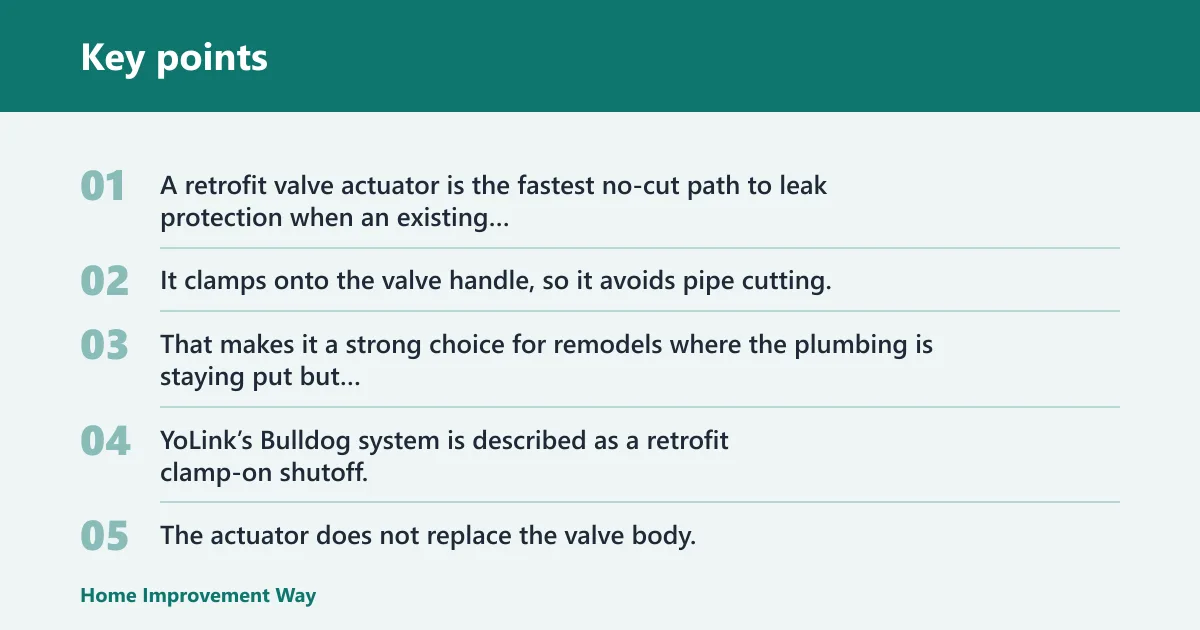
A retrofit valve actuator is the fastest no-cut path to leak protection when an existing ball valve is already in place and accessible. It clamps onto the valve handle, so it avoids pipe cutting. That makes it a strong choice for remodels where the plumbing is staying put but protection needs to improve.
How it clamps onto an existing ball valve
YoLink’s Bulldog system is described as a retrofit clamp-on shutoff, which fits the basic use case here. The actuator does not replace the valve body. It turns the existing handle, so the underlying valve must already be in good working order.
This is the key limitation: if the valve sticks, leaks, or has worn internals, adding a clamp-on actuator over a bad base does not solve the plumbing problem.
Compatibility limits based on handle geometry
Compatibility depends on the handle shape, handle length, clearance around the valve, and whether the actuator can grip the handle without hitting nearby pipework. Zooz Titan supports ball valves up to about 1.25 inches, which shows how actuator fit is tied to valve size and geometry.
For bathroom remodels, that matters most where a larger branch-line valve sits in a cabinet or utility space. If the handle points into a wall or sits too close to framing, a retrofit actuator may not have the room it needs.
When this is the fastest leak-protection upgrade in a remodel
Use a retrofit actuator when the remodel already has a usable ball valve and you want automatic shutoff without opening the plumbing. It is a good middle path between a cheap manual stop and a full in-line smart valve.
It is also the easiest option to combine with leak detector sensors. The sensor can alert you, and the actuator can close the valve if the system supports that pairing.
Leak detector sensor: best for point protection?
Leak detector sensors are a point-protection add-on, not a complete replacement for a shutoff valve. They work best under sinks, near toilet supply lines, behind vanity drawers, and around the base of exposed fixtures where first water contact is likely.
Placement under sinks and near fixtures
Put sensors where water will appear first, not where it will end up later. Under a sink, that usually means near the trap, supply stops, or the cabinet floor. Near a toilet, place the sensor where a fill valve leak or supply leak would reach it quickly.
Coverage is limited in hidden areas. If the leak starts inside a wall cavity or above the ceiling line, a point sensor may not see it soon enough to prevent damage.
Alerts-only vs paired shutoff setups
Some sensors only send alerts. Others pair with a valve that shuts water off after detection. This makes a big difference in response time. Alerts-only systems depend on someone seeing the message and acting, while paired shutoff systems can respond without delay.
That said, a sensor is still useful even without automatic shutoff. It can tell you that a valve is weeping, a supply line is failing, or a trap connection is wet before the problem reaches flooring.
Battery backup matters because a sensor without power cannot warn you. For bathroom remodels, that is especially important in vanity cabinets and basement utility areas where outlets may be limited or where a Wi-Fi bridge cannot sit nearby.
One guide compares 6 products in its 2026 ranking, and the broader smart-shutoff category includes point sensor-activated valves, valve body-activated systems that measure flow and pressure, and whole-line shutoffs. The right setup depends on whether you want alerts, automatic shutoff, or both.
Bathroom shutoff decision matrix
| Fixture type | Existing pipe material | Access space | Leak-risk tolerance | Recommended valve type | Connection style | Replacement path |
|---|---|---|---|---|---|---|
| Sink | Copper | Good cabinet access | Moderate | Quarter-turn angle stop | Compression | Direct swap during vanity work |
| Sink | PEX | Tight cabinet access | Higher | Quarter-turn angle stop | Push-fit or PEX-compatible compression | No-cut replacement if pipe end is clean and reachable |
| Toilet | Copper | Limited behind toilet | Moderate | Quarter-turn angle stop | Compression | Replace while toilet is off for flooring or trim work |
| Shower | Mixed interior piping | Wall open during remodel | Higher | In-line shutoff on accessible branch | Threaded or sweat, depending on pipe and code needs | Install before wall closure |
| Vanity cabinet | Ball valve already present | Room for actuator body | High | Retrofit actuator on existing ball valve | Retrofittable | No-cut upgrade plus sensor pairing |
| Laundry-adjacent bath | 3/4 inch or 1 inch supply line | Open utility access | High | In-line smart water shutoff | Threaded, sweat, or pro-grade line install | Cut and install during rough-in or major remodel |
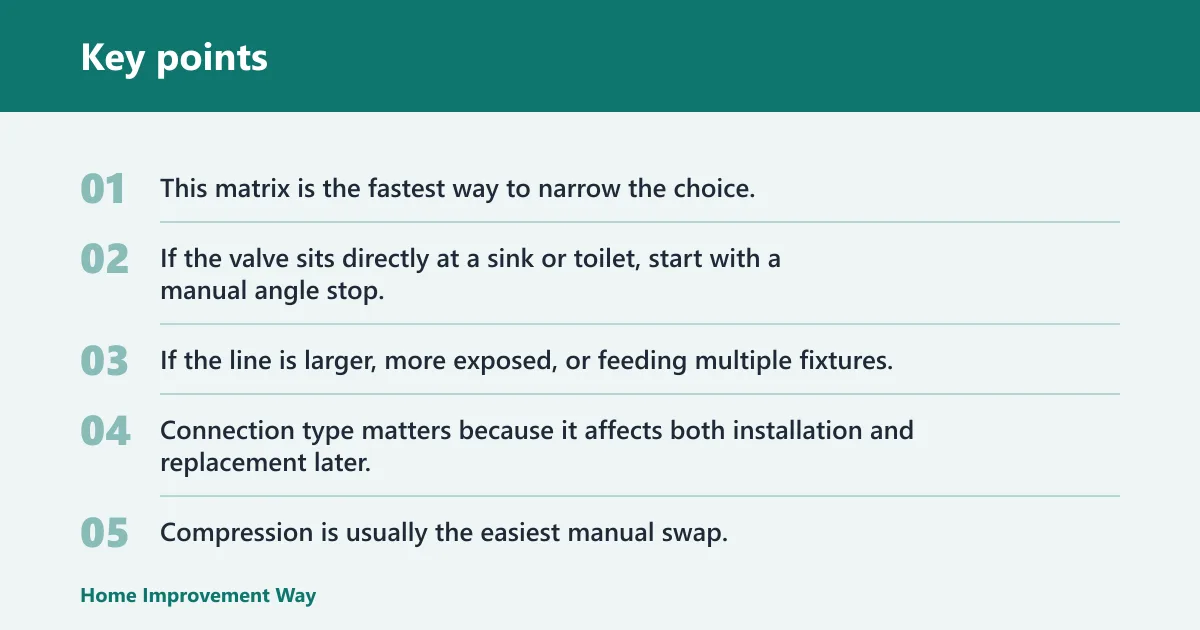
This matrix is the fastest way to narrow the choice. If the valve sits directly at a sink or toilet, start with a manual angle stop. If the line is larger, more exposed, or feeding multiple fixtures, move toward a line-mounted smart shutoff or a retrofit actuator on a compatible ball valve.
Connection type matters because it affects both installation and replacement later. Compression is usually the easiest manual swap. Sweat is more permanent. Push-fit is useful when access is tight. Threaded connections are serviceable, but they are not always the simplest path in a cramped bathroom cabinet.
Cost changes with scope. A simple manual replacement is the lowest-cost path when the plumbing is already exposed. A retrofit actuator costs more than a plain stop but avoids pipe cutting. An in-line smart shutoff costs the most in labor because it often needs cutting, fitting, and setup.
A common first-timer mistake is reusing a stuck stop because it still “sort of works.” If the valve turns hard, drips after closing, or shows green corrosion at the nut or stem, replace it during the remodel. That is the cleanest time to do it.
Picture a bathroom vanity with a tight cabinet corner and a copper supply line. A quarter-turn compression angle stop fits the remodel well because it is compact, serviceable, and easy to swap later. By contrast, a large actuator body would likely crowd the space.
Which one should you buy?
Start with a quarter-turn angle stop if your remodel centers on one sink or toilet and you want the simplest reliable fix. Choose push-fit when access is tight and you want a no-solder replacement path. Move to a retrofit actuator if you already have a compatible ball valve and want automatic shutoff without cutting pipe.
Choose an in-line smart shutoff when you want whole-line protection and the plumbing is already open enough for a pro-grade install. Add leak detector sensors under sinks and near fixtures when you want early warning, but do not treat them as a substitute for a real shutoff valve.
If your bathroom has older valves, poor access, or hidden corrosion, replacement during the remodel is usually the right call. If the line is 3/4 inch or 1 inch and you are protecting more than one fixture, a main-line smart valve deserves a closer look.
Frequently asked questions
What is the best shutoff valve for a bathroom remodel?
For most bathroom remodels, a quarter-turn angle stop is the best default for sinks and toilets. It fits common fixture connections, is easy to operate, and is simpler to replace later than older multi-turn valves. Use smart protection only when the remodel scope and access justify the extra install work.
Should I use a quarter-turn or compression shutoff valve under a sink?
Those are different attributes, not competing categories. Under a sink, a quarter-turn angle stop with a compression connection is often the best combination. Quarter-turn describes operation, while compression describes how the valve attaches to the pipe. That pairing is popular because it is compact and serviceable.
What type of shutoff valve is best for a toilet supply line?
A quarter-turn angle stop is usually best for a toilet supply line. It gives fast shutoff in a tight space behind the toilet and is easy to inspect by handle position. If the old valve is corroded or stiff, replace it during the remodel rather than leaving it in place.
Can I replace bathroom shutoff valves without cutting pipe?
Yes, often you can, if the existing valve uses a replacement-friendly connection such as compression or a push-fit style and the pipe end is in good condition. In-line smart shutoff valves are different; they usually require pipe cutting. The exact path depends on access and the existing pipe material.
What size shutoff valve do I need for a bathroom sink?
Bathroom sinks typically use small fixture supply connections, not the 3/4 inch or 1 inch sizes used on whole-home lines. The valve must match the pipe and the faucet connector. Check the existing stop, the supply line, and the connection type before you buy a replacement.
When should I choose a smart water shutoff instead of a manual valve?
Choose a smart water shutoff when leak risk is high, the access space is worth the added install effort, and you want automatic shutoff plus app alerts or remote control. For a single sink or toilet, a manual angle stop is usually enough. For broader protection, a line-mounted system makes more sense.
What is the difference between an in-line shutoff and a retrofit actuator?
An in-line shutoff replaces a section of pipe and becomes part of the plumbing line. A retrofit actuator clamps onto an existing ball valve and turns it without cutting pipe. The first is a plumbing install. The second is an add-on. They solve similar problems, but the install path is very different.
Do bathroom leak detectors work better than one whole-home shutoff?
They do different jobs. Leak detectors are better for spotting water at the exact fixture, especially under sinks and near toilet supply lines. A whole-home shutoff is better for stopping water automatically after detection. The strongest setup is often both: point sensors for warning and a valve for response.
How do I choose a shutoff valve for a bathroom remodel if I want leak protection?
Start with the fixture. Use a quarter-turn angle stop where the sink or toilet needs a simple service valve. Add a retrofit actuator when an existing ball valve is already compatible. Choose an in-line smart shutoff when you want automatic protection for a larger line, and place leak sensors where water would show first.
Sponsored / affiliate links. As an Amazon Associate I earn from qualifying purchases. I may earn additional commission from eligible campaigns.