Best Shutoff Valves for Laundry Hookups (2026): We Compared
For most laundry hookups, the best shutoff valve depends on space: use a quarter-turn ball valve in tight closets, a sweat or threaded ball valve for a full retrofit, and an integrated hammer-arrestor pair if water hammer or leak protection matters most. A poor valve pick can leave leaks, make the shutoff hard to reach, and turn a small drip into water damage. This guide compares valve types by installation scenario so you can choose the right laundry hookup valve fast.
Quick comparison
| Product | Badge | Best for | Price | ||
|---|---|---|---|---|---|
 |
Midline Valve XNW12 Dual Washing Machine Shut Off Valve;Midline Valve | Our pick | 1/2 in. SWT x 3/4 in. · Brass · Dual hot/cold | $22.29
Price as of 23 Oct 2026
|
View |
 |
Eastman Brass Outlet Box Blue Handle Washing Machine Valve,Eastman | Budget pick | 1/2 in. MIP x 3/4 in. · Brass · Cold-water valve | $10.18
Price as of 23 Oct 2026
|
View |
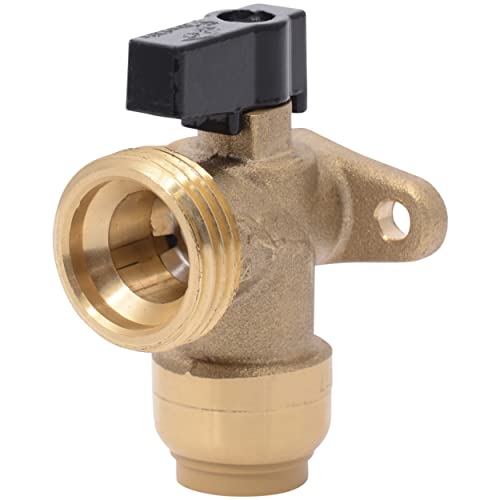 |
SharkBite 1/2 Inch x 3/4 Inch MHT Washing Machine AngleSharkBite | Also great | 1/2 in. x 3/4 in. · Push-to-connect · Angle valve | $12.68
Price as of 23 Oct 2026
|
View |
The safest first filter is your laundry layout, not the brand. Then match the pipe material, inlet thread type, and the amount of leak protection you want.
Use the table below to sort standard hookups, closet installs, retrofits, and higher-protection systems before you compare handles or finishes.
How we chose
We compared the three listed products and the valve types they represent using four checks: installation method, connection fit, shutoff style, and protection level.
We also weighed lead-free certification language, pressure ratings where published, and whether a valve makes sense for a standard washer box, a tight closet, or a retrofit with limited clearance.
One more filter mattered: the valve had to match the buying problem. A fast manual shutoff is not the same thing as floor-leak detection, and a smart valve is not the same thing as a simple hose-end replacement.
Laundry valve decision table
| Laundry setup | Pipe material | Connection style | Space constraints | Power needs | Leak-protection level | Safest purchase choice |
|---|---|---|---|---|---|---|
| Standard washer box with normal access | Copper or threaded stub-out | 1/2-inch inlet with 3/4-inch hose outlet; MNPT, MIP, FIP, or sweat may apply | Moderate | None | Manual shutoff only | Quarter-turn brass ball valve |
| Tight closet or crowded alcove | PEX, copper, CPVC, PE-RT, or approved system-specific fit | Push-to-connect inlet with 3/4-inch washer outlet | Limited reach and limited tool room | None | Manual shutoff only | Push-to-connect angle valve only if the exact model approves your pipe |
| Retrofit with two lines and a clean wall box | Existing laundry rough-in | Two separate hot and cold controls, often 1/2-inch inlet and 3/4-inch hose connections | Better when the box has room for both handles | None | Manual shutoff only | Dual shutoff valve |
| Flood-prone laundry area | Existing hose bib or supply stub-out | Sensor-and-valve kit or wall-mounted control set | Needs room for sensor placement | Batteries, hardwiring, or both depending on model | Automatic closure with alarm | Automatic leak shutoff kit |
| Want appliance-based automation and alerts | Existing supply connections | Smart controller with sensor and adapters | Often needs nearby space behind or beside the washer | Usually power and/or Wi‑Fi depending on model | Automatic closure plus app or text alerts on some models | Smart washer shutoff valve |
Best overall: quarter-turn ball valve
A quarter-turn ball valve is the best fit for most standard laundry hookups because it gives you fast on/off control without making the shutoff feel fussy. The Eastman brass outlet box valve fits the common washer pattern of a 1/2-inch MIP inlet and a 3/4-inch MHT hose connection, which makes it a practical pick for standard rough-ins.
This style is especially useful when you want quick emergency shutoff access and a clear cold-water handle. The brass body is a solid choice for corrosion resistance, and the quarter-turn action is easier to operate than older multi-turn valves.
The drawback is simple: it is still a manual valve. If you want the valve to close itself after a leak or while you are away, you need a sensor kit or a smart system instead.
Why it fits most standard hookups
For a normal washer box, a quarter-turn ball valve keeps the install straightforward. It is a common laundry supply valve style, and it avoids the slow, sticky feel that older compression valves can develop.
Crafty Home’s published guidance also points to a 1/2-inch by 3/4-inch setup as the standard laundry pattern, which matches the most common washer hose thread arrangement.
Where it falls short
It does not add leak detection. It does not close itself. It also depends on a clear handle path, so a cramped closet can make even a good manual valve awkward to reach.
If the existing valve stem is seized, the packing leaks, or the hose threads are damaged, replacement is safer than reusing the old body.
Best for tight spaces: push-to-connect valve
Use a push-to-connect valve when the supply lines are hard to solder or the laundry corner leaves very little room to work. SharkBite’s 1/2-inch by 3/4-inch angle valve is built for quick installs without tools, and the published fit list includes PEX, copper, CPVC, and PE-RT.
That makes it a strong retrofit option when you want to avoid an open-flame solder job or when the pipe ends are already tucked into a narrow cavity. It can also be mounted to a stud or joist, which helps in some cramped laundry layouts.
The drawback is compatibility discipline. Do not assume every push-to-connect model fits every pipe. HDPE is especially easy to misunderstand; only use it when the exact valve model and the pipe setup are approved together.
Best pipe-material matches
This style is useful when the pipe material is already known and listed by the valve maker. It works well for many retrofit jobs on copper or PEX, and some models also list CPVC and PE-RT.
For a homeowner replacing a valve behind a washer box, the appeal is speed and less disruption. The cost is usually modest compared with a full automatic system.
Common fit limits to check
Check the inlet type, the pipe outside diameter, and whether the manufacturer allows the exact pipe material without inserts or special adapters. A laundry valve that says “push-to-connect” is not automatically approved for every residential line.
Also confirm how much room you have for the body and hose turn radius. In a tight closet, the valve may fit while the hose and hand access do not.
Best for dual-line control: dual shutoff valve
Choose a dual shutoff valve when you want one fixture to manage both hot and cold supply lines. Midline Valve’s dual washing machine shutoff uses separate handles for hot and cold together, which can reduce confusion at the wall and make the laundry box look cleaner.
This is a sensible option for twin-line laundry hookups where the goal is simple manual control, not automation. The cast brass body is a plus for durability, and the product uses standard washer hose connections that suit common laundry setups.
The drawback is that a dual valve is still only as good as the user who closes it. It simplifies shutoff, but it does not protect against a burst hose if nobody is there.
When one lever makes sense
A dual valve helps when both lines live in the same opening and you want one organized assembly rather than two separate stops. That can reduce user error, especially if the hot and cold handles are clearly labeled.
It also helps when the laundry box is already set up for a tidy, paired connection and the installer wants fewer exposed parts.
When separate valves are better
Separate valves make more sense if the box layout is awkward, if one line needs future service more often, or if you want to isolate only hot or only cold during maintenance.
Suppose the cold line is in good shape but the hot line shows wear at the stem. In that case, separate control can make service easier and avoid disturbing the better line.
Best for leak protection: automatic shutoff kit
An automatic shutoff kit is the best choice when leak protection matters more than convenience alone. FloodStop uses a wall sensor that closes the valves automatically, and the kit includes audible and visual alarms on some versions, which gives you a real response to a floor leak rather than just a warning.
What the sensor does
This is different from a manual valve and different from a smart washer valve. The sensor is there to detect water where it should not be, then close the valve path for you.
That matters if a hose fails behind the washer or if water reaches the floor before anyone notices. The protection is about spill control at the room level, not just appliance behavior.
Power and alarm requirements
Automatic kits may need batteries, hardwiring, or both, depending on the model. Some add audible and visual alarms; some also rely on a wall-mounted sensor location that should stay clear and dry.
That extra hardware raises the price, but it also raises the protection tier. If the laundry room sits over finished space, that tradeoff is often easier to justify.
Which one should you buy?
Start with the laundry layout. If you have a standard washer box with enough room, buy a quarter-turn brass ball valve. If the line is tucked into a tight retrofit and you cannot or should not solder, a push-to-connect valve is the cleaner choice.
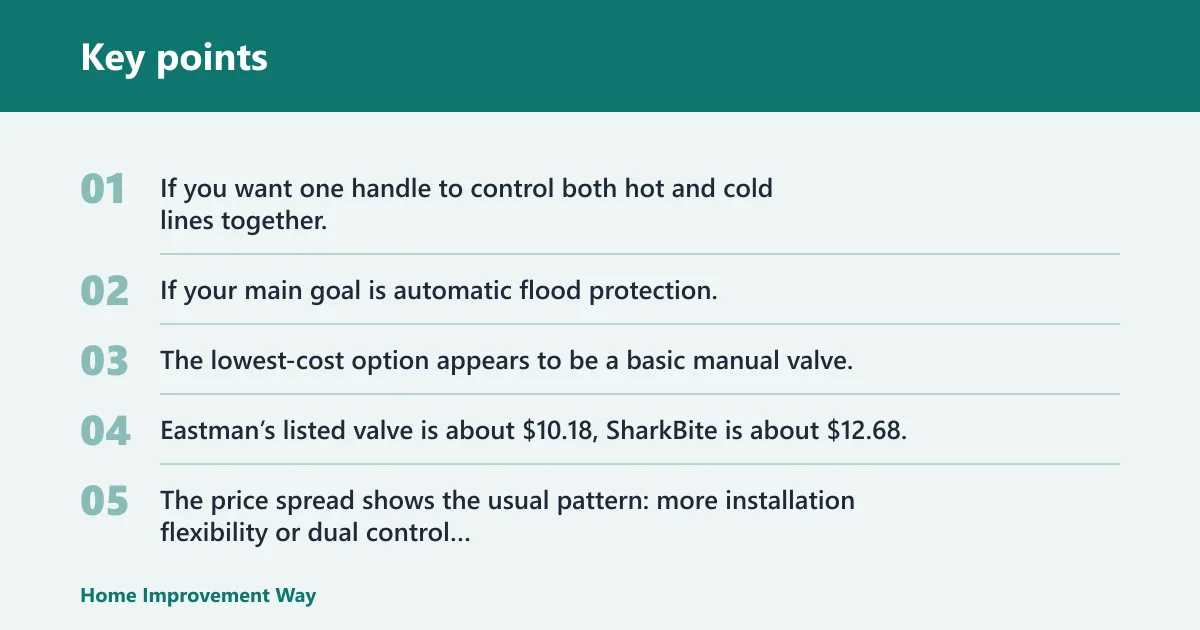
If you want one handle to control both hot and cold lines together, choose a dual shutoff valve. If your main goal is automatic flood protection, move up to a sensor kit or smart system instead of staying with a plain manual valve.
By budget
The lowest-cost option appears to be a basic manual valve. Eastman’s listed valve is about $10.18, SharkBite is about $12.68, and Midline Valve is about $22.29. The price spread shows the usual pattern: more installation flexibility or dual control costs more.
For the least expensive path to better protection, a manual quarter-turn valve is still the best starting point. For the highest protection, automatic kits cost more because they add sensors, alarms, and control hardware.
By protection level
Manual shutoff is the baseline. Floor-sensor closure is the next step up. Smart washer control is the highest convenience tier when you want alerts and appliance-linked behavior.
DryLine Home notes a smart valve that sends alerts over Wi‑Fi, and Watts has a smart option that sends text and email alerts. Those features are useful, but they are model-specific, so read the control method closely before buying.
By pipe material
For copper or threaded laundry stubs, a quarter-turn or sweat/threaded ball valve is a straightforward fit. For retrofit work where soldering is a problem, use a push-to-connect valve only if the exact model approves the pipe material you have.
Do not buy on “fits many pipes” alone. Confirm the inlet size, thread type, and whether the valve body is actually approved for your line.
Scenario examples
Say your washer sits in a narrow closet and the supply lines leave almost no room for a torch. A push-to-connect valve is usually the least disruptive path, as long as the exact model matches the pipe material and the hose thread size.
Suppose your laundry box is open and reachable, but you worry about burst hoses while you are away. A sensor-based automatic shutoff kit gives more protection than a manual valve alone, because it can close after a floor leak is detected.
Laundry valve fit and safety checks
Before you buy, confirm the inlet size, the hose-thread outlet, and the connection type. In laundry hookups, 1/2-inch inlet sizes and 3/4-inch hose-thread outlets are common, but the actual fitting can still be MNPT, MIP, FIP, or sweat depending on the stub-out or outlet box.
Lead-free certification matters too. It is a common buying criterion for plumbing valves and should be verified on the packaging or specs, especially when the valve ties into potable water lines.
Pressure ratings matter because washer hoses can be stressed by rapid shutoff. One manual valve in the sourced data is rated to 200 psi, while a Watts dual-control valve is listed at 180°F and 150 psi, and a bronze washer valve is listed at 200°F and 200 psi. Higher pressure ratings are useful when a valve must handle abrupt closure and hot-water service.
Water hammer is worth thinking about if your washer line snaps shut hard. A stronger valve body does not remove pressure shock by itself, so hose quality and arrestor placement still matter.
Replacement instead of reuse
- Replace the valve if the stem is seized or hard to turn.
- Replace it if the packing leaks, even after tightening is attempted.
- Replace it if the hose threads are stripped, cross-threaded, or damaged.
- Replace it if the valve body shows corrosion that could affect the seat or threads.
- Upgrade it if the laundry room would benefit from automatic leak protection instead of a manual stop.
Frequently asked questions
What is the best shutoff valve for a washing machine?
For most homes, a quarter-turn brass ball valve is the best starting point because it is quick to operate and works well on common laundry hookups. If you need automatic leak response, move up to a sensor kit. If the closet is tight, choose a push-to-connect valve that matches the pipe exactly.
Should I choose a manual or automatic laundry shutoff valve?
Choose manual if you want a simple, low-cost valve for everyday shutoff and easy emergency access. Choose automatic if you want the valve to close after a leak event or when you want stronger protection for a finished room. Automatic systems cost more and may need power or batteries.
What size shutoff valve do I need for a washing machine hookup?
Most washer hookups use a 3/4-inch hose connection, and 1/2-inch inlet sizes are common, but the exact inlet can be MNPT, MIP, FIP, or sweat. Match the valve to the existing stub-out or outlet box rather than guessing from the hose end alone.
Can I install a washer shutoff valve without soldering?
Yes, if you choose a push-to-connect valve and the exact model is approved for your pipe material. That is a common retrofit solution for copper, PEX, CPVC, or PE-RT. Do not assume HDPE compatibility unless the product documentation specifically allows it and the required fittings are in place.
Which washing machine valve is best for tight spaces?
A push-to-connect angle valve is usually the easiest choice in a tight space because it avoids soldering and reduces install time. It is especially helpful where the box or closet leaves little room for tools. Just verify the pipe material, hose thread, and mounting clearance before you buy.
Do automatic washer shutoff valves need power or Wi‑Fi?
Some do, and some do not. Battery power, hardwiring, Wi‑Fi, or a mix of those options can appear depending on the model. A smart valve may send text or email alerts, while a separate sensor kit may focus on closing the valves and sounding alarms rather than app control.
How do I know if my laundry shutoff valve fits PEX, copper, or CPVC?
Check the exact model listing and the labeled pipe compatibility, not just the marketing category. Push-to-connect valves often list specific materials such as PEX, copper, CPVC, and PE-RT. If your line is HDPE, confirm exact model approval and any required inserts or fittings before installation.
Is a dual hot-and-cold washer shutoff better than two separate valves?
A dual valve is better when you want one compact control point for both lines and less chance of mixing up the handles. Separate valves are better when service access matters or when one line needs independent shutoff. The better choice depends on box layout and how the laundry space is used.
What is the difference between a push-to-connect valve and a sweat valve?
A push-to-connect valve clamps onto an approved pipe without soldering, which is helpful in retrofits and tight spaces. A sweat valve is soldered in place, which can be very secure but requires more access and the right tools. The choice usually comes down to pipe type, space, and installation method.
When should I replace a washing machine shutoff valve instead of reusing it?
Replace it if the stem is seized, the packing leaks, the threads are damaged, or the body shows corrosion that could affect sealing. Replacement is also the better move when you want to upgrade from a plain manual stop to a valve with better leak protection, easier operation, or a cleaner fit.
Sponsored / affiliate links. As an Amazon Associate I earn from qualifying purchases. I may earn additional commission from eligible campaigns.