Do Pipes in Exterior Walls Freeze Faster?
Yes. Pipes in exterior walls usually freeze faster than interior runs because they sit in colder framing cavities, especially where insulation is thin, air leaks enter, or the pipe sits close to outside sheathing. A frozen pipe can stop water flow, burst, and flood walls, floors, or cabinets. This guide ranks the riskiest runs and explains what to do before a cold snap.
Why exterior wall cavities stay colder

Yes. Pipes in exterior walls lose heat to outside air through the wall cavity, so they cool faster than pipes inside conditioned rooms. That risk rises when insulation is missing or compressed, when air leaks appear around penetrations, and when the wall faces north. A heated house does not remove that cold-cavity risk.
Why wall cavities cool faster
Exterior wall plumbing sits close to framing, sheathing, and outdoor temperatures. Pipes in unheated crawl spaces, attics, and exterior walls freeze first, and the same pattern holds for wall runs that border cold outside air. Water freezes at 32°F, but pipe freezing depends on insulation, exposure, and location.
A pipe exposed to still, subfreezing air can freeze in approximately 1–4 hours. Uninsulated pipes exposed to temperatures below 20°F can start freezing within two to six hours. Insulated pipes generally freeze around 20°F, and insulated or buried pipes may take days or may not freeze.
What makes a heated house still vulnerable
Pipes can freeze even in a heated house if they are in exterior walls or unheated spaces. A room can feel warm while the wall cavity stays cold, especially behind cabinets, under sinks on outside walls, or near attic and rim-joist areas. Heat from the room does not always reach the pipe fast enough.
Suppose a kitchen sink sits on a north-facing wall and the cabinet back has a gap around the supply lines. The room thermostat may stay at a normal setting, yet the pipe can still cool toward freezing because the wall cavity keeps losing heat to the outside.
Which exterior-wall pipes freeze first?
The fastest-freezing runs are usually the cold-water lines on north-facing walls, pipes near penetrations, and lines hidden behind poorly insulated cabinets. Outdoor faucets, garage lines, crawl space supply lines, and exterior-wall runs face the greatest freeze risk. Hot water lines can freeze too if the wall cavity is cold enough.
North-facing walls and cold-water lines
North-facing walls get less solar warming, so they often stay colder through a freeze. Cold water lines are usually the first to show trouble because they carry colder water and are often used less often overnight. A line near an outside corner or drafty framing bay is more exposed than a centered interior run.
Kitchen and bathroom supply lines
Kitchen and bathroom supply lines often run through exterior walls because fixtures are placed there for layout convenience. Pipes behind sinks, tubs, and showers may be hidden by cabinets or tile, which can block warm room air. Those hidden sections need insulation and air sealing more than the visible tubing at the fixture.
Pipes near penetrations and poorly insulated cabinets
Pipe penetrations around the rim joist, hose bibs, vents, and utility chases can leak cold air into a wall cavity. Poorly insulated cabinets make the risk worse because the pipe gets less room heat. If the cabinet back is cold to the touch, that run deserves attention before the next freeze.
Exterior wall pipe risk ranking
This table ranks common pipe locations by freeze speed and failure risk. Use it to decide what to protect first. The higher rows usually need action before a forecasted cold snap, especially if the home has north-facing walls, air leaks, or any unheated adjacent space.
| Location | Typical exposure | Material sensitivity | Early warning signs | First prevention step |
|---|---|---|---|---|
| Outdoor faucets and hose bibs | Direct outdoor cold; often tied to exterior wall framing | High for copper and PEX near the wall; fittings can fail fast | Reduced outdoor flow; frost near the spigot; cold wall patch inside | Disconnect hoses and protect the faucet assembly |
| Exterior-wall cold-water supply lines on north-facing walls | Cold sheathing, thin insulation, low solar gain | High for metal pipe; still vulnerable for plastic if exposed | Slow fixture flow; cold spot on wall surface; repeated freeze point | Seal air leaks and add continuous foam insulation where accessible |
| Lines behind poorly insulated kitchen or bathroom cabinets | Cabinet backs block room heat; gaps often around sink penetrations | High where copper runs are long; PEX still depends on coverage | One fixture weakens before others; cabinet back feels unusually cold | Open the cabinet doors and insulate the exposed run |
| Pipe runs near rim joists, penetrations, or utility chases | Air leakage and cold framing create a fast cooling path | Moderate to high, depending on exposure | Drafts near the penetration; localized cold patch; repeating freeze | Seal the air gap before adding insulation |
| Garage lines and crawl space supply lines | Unheated spaces with colder air and longer cold exposure | High for metal pipe; plastic can still burst if cold exposure is long | Slower flow; cold pipe surface; freeze point near garage wall | Use insulation plus heat cable on the vulnerable section |
| Attic plumbing and attic-adjacent runs | Very cold ambient air, often with wind washing and thin insulation | High if metal is exposed; fittings and elbows are sensitive points | Frosty pipe sections; weak flow after a cold night | Protect the run with controlled heat cable and insulation |
How to read the ranking: treat the top rows as urgent before hard freezes, then work downward if time allows. A pipe that is both exposed and hard to reach usually needs the fastest intervention because it is harder to monitor once temperatures drop.
How pipe material changes freeze damage
Material changes both freeze speed and failure mode. Metal pipes freeze faster than plastic pipes. Copper conducts heat quickly, so it loses warmth fast and can split along its length when frozen. PVC and PEX behave differently, but neither is immune if the run is poorly insulated or exposed.
Copper pipe
Copper is common in older and exposed plumbing. It conducts heat quickly, which means it can cool down fast in an exterior wall. If it freezes, it may split along the length of the pipe rather than fail only at a joint, so the leak can be long and destructive when thawing starts.
PVC pipe
PVC can crack at fittings during freezing. That matters because a crack at an elbow or coupling may not look dramatic at first, yet it can open when water thaws and pressure returns. PVC is not a free pass for exterior-wall runs, especially at joints near cold air leaks.
PEX pipe
PEX appears in burst-damage risk descriptions because it can tolerate freezing better than brittle pipe in some situations, but it still depends on exposure and insulation level. A PEX line in a cold wall cavity can still freeze, lose flow, and fail at fittings or connections if the cavity stays cold long enough.
A common first-timer mistake is assuming “plastic pipe” means “no freeze problem.” The wall cavity still matters. A well-insulated PEX line behind sealed drywall is often less vulnerable than a copper line in a drafty exterior wall, but a bare PEX line near a cold penetration is still at risk.
What are the warning signs of a freezing pipe?
Warning signs often start before a burst. Look for reduced flow at one fixture, a cold spot on the wall surface, or a recurring freeze point after previous cold weather. A pipe can freeze without bursting right away, and damage often shows up during thawing rather than at the moment of freeze.
Reduced flow at one fixture
If one sink, tub, or shower slows while other fixtures still work, that run may be cooling toward freeze. A slow stream helps prevent pipes from freezing better than static water, so a sudden drop from normal flow to a trickle deserves attention. That symptom often points to a localized wall-cavity problem.
Cold wall spots and repeated freeze points
A cold patch on the wall near a sink, tub, or hose bib can mean the pipe area is losing heat fast. If the same spot freezes during each cold snap, the cause is usually the wall cavity itself: insulation gaps, air leaks, or a pipe placed too close to the exterior sheathing.
How do you keep exterior-wall pipes from freezing?
The best protection is layered: stop cold air, slow heat loss, and keep water moving during a hard freeze. Start with foam pipe insulation on exposed supply lines, then seal air leaks around penetrations, and add heat cable only where the risk is high enough to justify it.
Foam insulation and air sealing
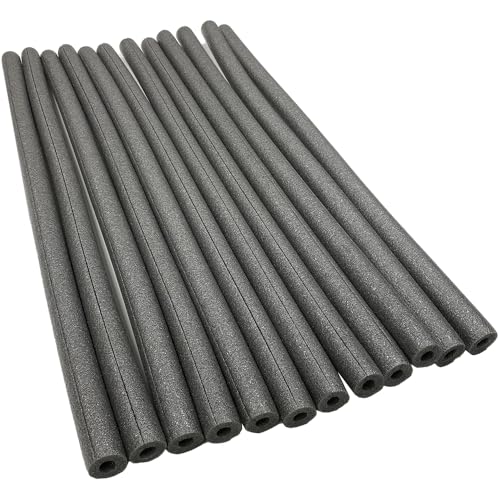
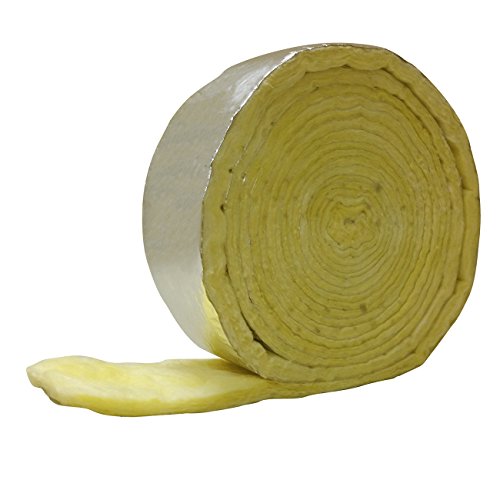
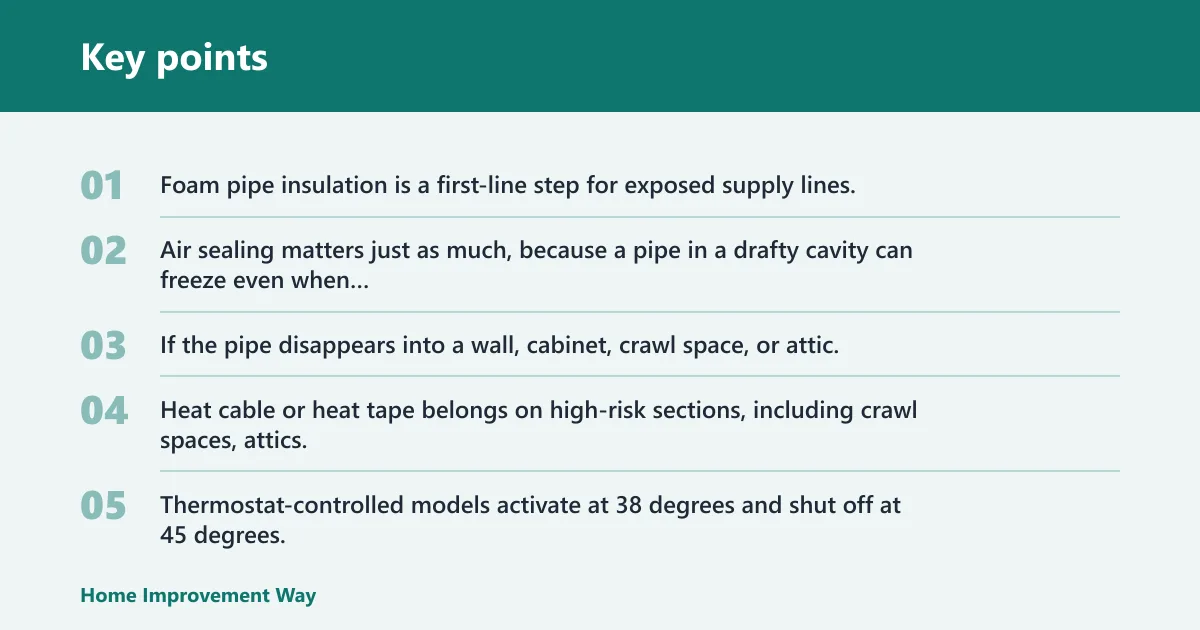
Foam pipe insulation is a first-line step for exposed supply lines, and it should cover vulnerable sections continuously. Gaps in the insulation leave cold spots. Air sealing matters just as much, because a pipe in a drafty cavity can freeze even when the room itself feels warm.
Do not stop at the visible section. If the pipe disappears into a wall, cabinet, crawl space, or attic, the hidden part may be the most vulnerable. That is where freeze risk often starts.
Heat cable on high-risk sections
Heat cable or heat tape belongs on high-risk sections, including crawl spaces, attics, and exterior walls. Thermostat-controlled models activate at 38 degrees and shut off at 45 degrees. Use products rated for the pipe and installation location, and follow the manufacturer’s instructions for overlap, spacing, and insulation compatibility.
Do not bury heat cable incorrectly inside tight insulation or cover it in a way the manufacturer forbids. Hidden installations matter here. A poorly installed cable can create a false sense of safety while leaving the coldest section unprotected.
Thermostat setting, cabinet access, and faucet drip
Keep the thermostat at no lower than 55 degrees when away. Open cabinet doors under sinks on exterior walls so room heat can reach the cabinet space. During a hard freeze, open the tap to a slight drip, about a pencil-lead thickness, so water keeps moving through vulnerable pipes.
Suppose the forecast calls for a hard freeze overnight and a bathroom sink sits on an outside wall. Set the thermostat to at least 55 degrees, open the cabinet doors, and let the faucet move to a slight drip. Those steps do not eliminate risk, but they lower it.
What should I do if pipes in an exterior wall start freezing?
Act fast. Open the fixture slightly, increase indoor heat if possible, and warm the room where the pipe runs without using open flame. If flow stops completely, the pipe may already be frozen. Shut off water if the line shows signs of cracking, swelling, or active leakage during thawing.
- Open the faucet connected to the suspected line.
- Raise the thermostat if the house is below the recommended level.
- Open cabinet doors on exterior-wall sinks.
- Warm the room and nearby wall area with safe heat.
- Check for leaks as soon as water flow returns.
Remember that a frozen pipe can burst and release 400 to 600 gallons per hour once pressure returns. If you hear water behind a wall, see bulging drywall, or find a wet cabinet base, shut off the main valve and call a plumber.
Frequently asked questions
Do pipes in exterior walls freeze faster than pipes inside the house?
Exterior-wall pipes often freeze faster because they sit in colder cavities that can lose heat to outside air. Interior pipes stay in conditioned space, so they are less exposed. The biggest risk is a wall run with weak insulation, air leaks, or a north-facing wall.
Will my pipes freeze in a heated house?
They can. A heated house does not protect pipes in exterior walls or unheated spaces. If the wall cavity is cold enough, the pipe can freeze even while the room feels comfortable. Cabinets, rim joists, and air leaks often explain why.
Why does hot water pipes freeze faster?
Hot water lines do not always freeze faster, but they can still freeze if they sit in a cold wall cavity. In some homes, hot lines are less used and may cool for long periods. Material, exposure, and insulation matter more than whether the line carries hot or cold water.
Which pipes are most likely to freeze in a house?
The highest-risk pipes are outdoor faucets, garage lines, crawl space supply lines, and exterior-wall runs. Within the house, north-facing wall lines, pipes near penetrations, and lines behind poorly insulated cabinets are especially vulnerable. Metal pipe is generally at higher risk than plastic pipe.
Can pipes freeze without bursting?
Yes. A pipe can freeze and stop water flow without bursting right away. Damage often shows up during thawing, when pressure returns and cracks open. That is why a no-flow fixture in cold weather should be treated as urgent even if nothing has leaked yet.
How quickly can pipes freeze in exterior walls?
In still, subfreezing air, a pipe can freeze in approximately 1–4 hours. Uninsulated pipes exposed to temperatures below 20°F can start freezing within two to six hours. Exact timing depends on insulation, airflow, pipe material, and how cold the wall cavity gets.
What temperature do pipes freeze at?
Water freezes at 32°F, but the pipe may freeze before the air reaches that point if the cavity is cold enough and the pipe loses heat quickly. Insulated pipes generally freeze around 20°F. That is why a thermostat set too low can still leave vulnerable runs exposed.
Are PVC pipes less likely to freeze?
PVC is generally less prone to rapid heat loss than metal pipe, but it can still freeze and crack, especially at fittings. PEX may tolerate freezing differently, yet both materials still depend on exposure, insulation, and location. Material helps, but it does not cancel wall-cavity risk.
How do I keep pipes in exterior walls from freezing?
Seal air leaks, insulate vulnerable sections with continuous foam pipe insulation, keep the thermostat no lower than 55 degrees when away, and use heat cable on high-risk runs where needed. During a hard freeze, let a faucet drip slightly so water keeps moving through the line.
Sponsored / affiliate links. As an Amazon Associate I earn from qualifying purchases. I may earn additional commission from eligible campaigns.