How Long Does It Take for Pipes to Freeze?
Uninsulated pipes can freeze in well under an hour in subzero, wind-exposed spaces, but many freezes take about 2 to 8 hours around 20°F to 32°F, and a full night is often enough in milder cold. A frozen line can split pipe walls and flood a room when it thaws. This guide breaks down freeze-time bands by temperature, location, insulation, and airflow so you can judge whether you have minutes, hours, or until morning.
How fast do pipes freeze?
Pipes do not freeze on a single clock. Freeze time depends on outdoor temperature, wind, exposure, insulation, pipe material, pipe diameter, and whether water is moving or stagnant. At the same air temperature, one line may stay open all night while another starts freezing in a few hours.
Why 32°F is not the real pipe-freeze threshold
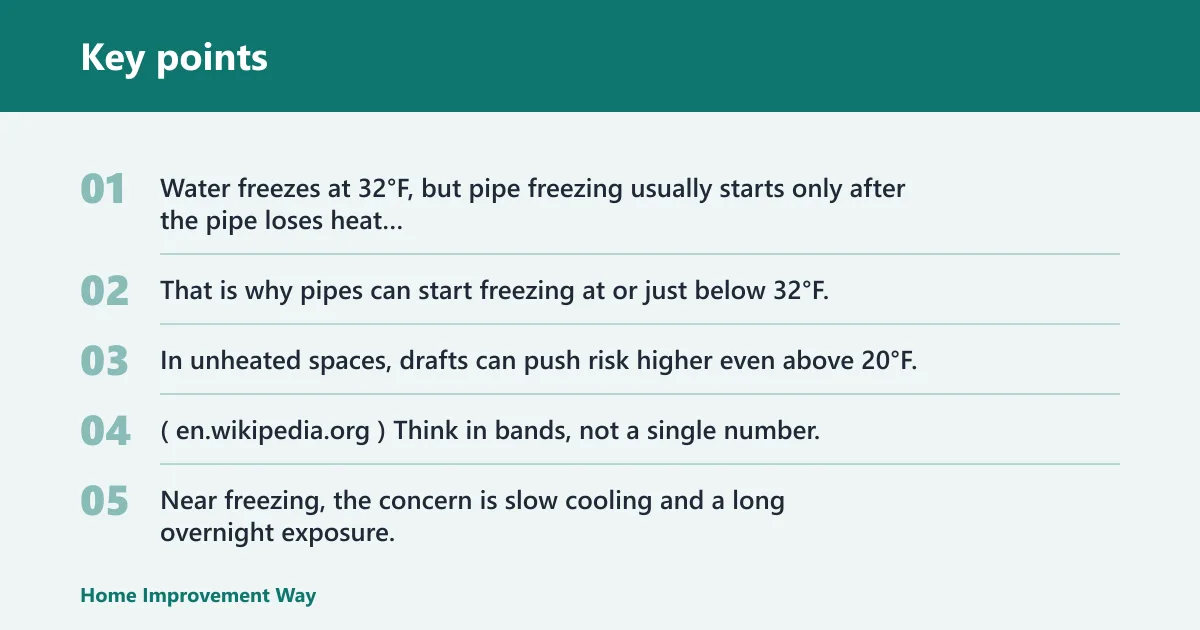
Water freezes at 32°F, but pipe freezing usually starts only after the pipe loses heat faster than the water inside can replenish it. That is why pipes can start freezing at or just below 32°F, yet the common danger zone is closer to 20°F or below. In unheated spaces, drafts can push risk higher even above 20°F. (Wikipedia)
Think in bands, not a single number. Near freezing, the concern is slow cooling and a long overnight exposure. In the teens, the risk climbs fast. Below 20°F, exposed, stagnant, uninsulated pipes can freeze in hours.
When freeze time is minutes, hours, or overnight
A pipe exposed to still, subfreezing air can freeze in approximately 1–4 hours. Some homeowners can see frozen pipes in as little as three hours with little or no insulation. With reasonable insulation, pipes in an unheated area could take as long as six hours to freeze. Pipes may freeze in 6 to 8 hours depending on weather, age, and other variables.
Suppose a 1/2-inch copper line runs through a garage wall with no insulation and a cold wind is pushing through a gap near the sill plate. That line can freeze much sooner than the main branch inside the house, because the cold reaches the pipe from several sides at once.
Why frozen pipes and burst pipes are different events
Freezing starts the problem, but it does not end there. Ice blocks flow and can create pressure between the blockage and a closed faucet or fitting. A pipe may freeze without bursting right away, and a burst pipe may not leak until thawing begins. That delay is why damage often shows up later.
A pipe that is frozen solid should be treated as urgent, even if no water is on the floor yet. Pressure can build while the pipe is still frozen, then release suddenly when the ice thaws.
What changes freeze time most?
Freeze time changes fastest with temperature, wind, and whether the pipe is protected from cold air. Material, diameter, and water movement matter too. The same house can have one line that stays open and another that freezes because it runs through an exterior wall or an unheated crawlspace.
Outdoor temperature bands that change the risk fast
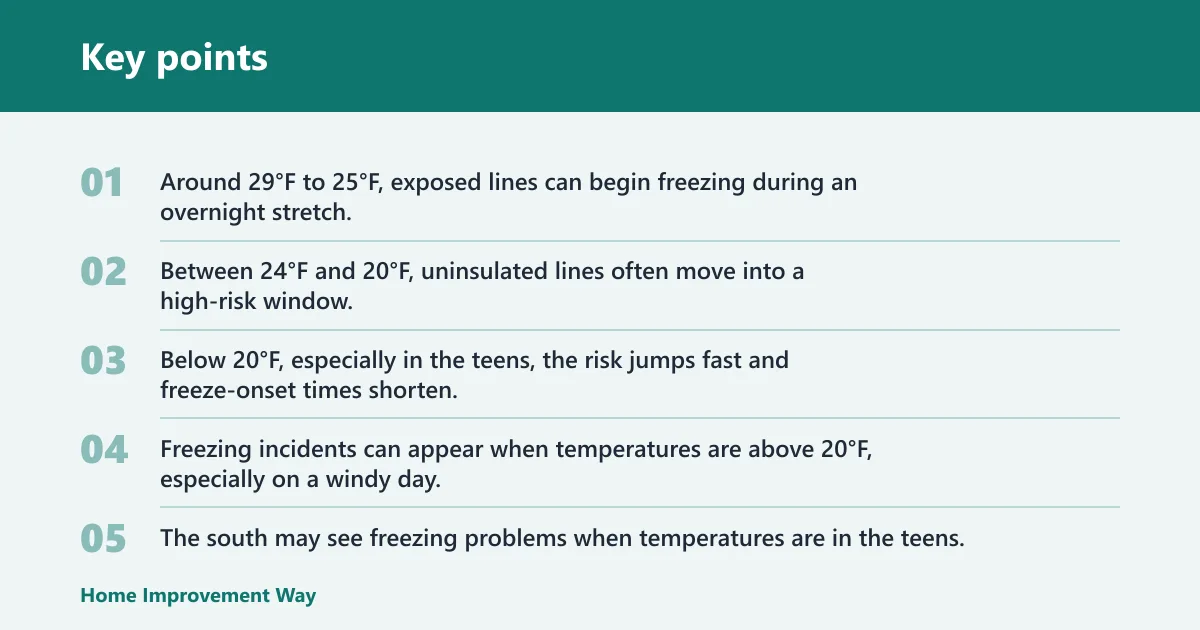
Below about 32°F, pipe risk starts. Around 29°F to 25°F, exposed lines can begin freezing during an overnight stretch. Between 24°F and 20°F, uninsulated lines often move into a high-risk window. Below 20°F, especially in the teens, the risk jumps fast and freeze-onset times shorten.
Freezing incidents can appear when temperatures are above 20°F, especially on a windy day. The south may see freezing problems when temperatures are in the teens, which is a reminder that climate zone alone does not protect a pipe if the line sits in a drafty, unheated space.
Pipe material, diameter, and water movement
Copper and other metal pipes lose heat faster than PVC or PEX because metal conducts heat more readily. That makes copper piping the most prone to rupture or break down, while PVC or PEX pipes are somewhat more resilient at lower temperatures than copper pipes. Material does not remove risk; it changes how quickly cold reaches the water and how likely the pipe is to split.
Smaller pipes freeze faster than larger ones because they contain less water and have a higher surface-area-to-volume ratio. Flow helps, too. Moving water delays freezing, while stagnant water freezes faster. A slow drip can reduce pressure and can help delay freeze conditions, especially during a cold overnight stretch.
Insulation, gaps, drafts, and wind
Insulation slows heat loss, but full coverage matters just as much as material choice. Foam sleeves, fiberglass wraps, and rubber insulation all work better when they cover the full run and fit tightly. Thin wrap, crushed sections, exposed fittings, or gaps at joints leave cold spots that can freeze first.
Wind and drafts create localized freeze points. Cold air infiltration around an attic hatch, rim joist, garage entry, or exterior wall cavity can chill a short section of pipe enough to start freezing even when the outside temperature is above the usual danger threshold.
How long do pipes take to freeze in a house?
Inside a house, the fastest freezes usually happen in unheated areas such as attics, garages, basements, crawlspaces, and exterior wall runs. Pipes in conditioned rooms are less exposed, but house construction can still leave them vulnerable if the line sits against sheathing, near vents, or in a draft path.
Why unheated spaces freeze first
Unheated spaces let outside conditions reach the pipe with less delay. A basement with open vents, a garage with a leaky door seal, or a crawlspace with wind moving through it can chill plumbing quickly. Buried or protected lines thaw more slowly, but they can also take days to freeze or may not freeze unless extremely cold temperatures persist.
Exterior walls, attics, garages, basements, and crawlspaces
Exterior-wall plumbing freezes sooner because the wall cavity sits closer to cold outdoor air. Attics and garages often lose heat faster than the main living space. Basements and crawlspaces vary, but uninsulated runs near foundation vents, sill plates, or drafty penetrations are common trouble spots.
Picture a bathroom supply line that runs through an exterior wall in a house built for a warmer climate. The indoor room may feel fine, but the pipe section inside the wall can still drop to freezing conditions because the wall cavity has little insulation and little heated air movement.
Why warmer-climate homes can still freeze
Homes in milder regions often have thinner insulation around plumbing, more pipes in exterior walls, and less protection in crawlspaces or garages. That means a shorter cold snap can create more risk than homeowners expect. A house does not need a long freeze season to have vulnerable plumbing.
Freeze risk matrix
Use this matrix as a decision aid, not a promise. A low rating still means watch the line. A high or urgent rating means act before the next cold period, because wind, drafts, and poor insulation can move a pipe one step worse than the air temperature alone suggests.
| Outdoor temperature | Insulated, interior wall, flowing | Insulated, exterior wall, stagnant | Uninsulated, interior wall, flowing | Uninsulated, exterior wall or drafty unheated space, stagnant |
|---|---|---|---|---|
| 32°F to 30°F | Low — monitor overnight; keep heat steady | Moderate — check for gaps and add insulation | Moderate, open cabinet doors; keep a slow drip if needed | High, seal drafts, warm the space, protect before nightfall |
| 29°F to 25°F | Moderate, watch exposed fittings and cold corners | High, add wrap, block drafts, and raise room heat | High, drip faucets and inspect vulnerable runs | Urgent, continuous heat, full insulation, and draft control |
| 24°F to 20°F | High, protect exterior-wall sections and unheated rooms | Urgent, expect freeze-onset in hours if uncorrected | High, increase flow and watch for early loss of pressure | Urgent, treat as a same-night freeze risk |
| Below 20°F | High, even insulated runs may freeze if exposed | Urgent, active protection needed now | Urgent, fast freeze possible in a few hours | Urgent, highest risk; act immediately |
Do insulated pipes take longer to freeze?
Yes. Insulated pipes usually take longer to freeze because insulation slows heat loss from the pipe surface. That delay can be the difference between a close call and a freeze during a single cold night. But insulation is not all-or-nothing; gaps, thin coverage, and exposed fittings still leave weak points.
Which insulation types slow heat loss?
Foam sleeves, fiberglass wrap, and rubber pipe insulation all reduce heat loss when they cover the pipe fully and stay intact. The material matters less than fit and coverage. A continuous layer is better than a patchy one, and thicker coverage generally slows heat loss more than a thin wrap.
How coverage and thickness change performance
Partial coverage can give a false sense of security. A pipe with insulation along the straight run but bare elbows, valves, or tees can still freeze at those exposed points. Thin wrap helps less than a full sleeve, especially where cold air moves around the pipe.
A common first-timer mistake is insulating the visible straight section and leaving the valve body bare. That short uncovered area often becomes the first freeze point because moving air can strip heat from a small, exposed metal surface very quickly.
Why gaps and exposed fittings still freeze
Cold air takes the path of least resistance. If the insulation has gaps, compression, or open ends, the pipe can lose heat much faster at those spots. Fittings also tend to cool faster because they have more exposed surface and often sit where framing leaves little room for a full wrap.
Do metal pipes freeze faster than plastic?
Usually, yes. Metal pipes, especially copper, transfer heat out of the water faster than plastic pipes. PVC and PEX are somewhat more resilient at lower temperatures than copper pipes, so they often buy more time before freeze onset. Material helps, but location and insulation still control the bigger risk.
Copper and other metal pipes
Copper piping is the most prone to rupture or break down among the common materials in this comparison. Metal conducts heat well, so cold reaches the water inside more quickly. That does not mean every copper line freezes fast, only that it gives cold a better path into the pipe wall and the water column.
PVC and PEX comparison
PVC and PEX tend to lose heat more slowly than copper, which can delay freezing. They are not freeze-proof. If water stays stagnant in an exposed, unheated location, plastic pipe can still freeze. The advantage is timing and resilience, not immunity.
What material means for burst risk
Material affects how a pipe responds after freezing begins. Copper is more prone to rupture or break down, while PVC and PEX are somewhat more resilient at lower temperatures. Even so, any pipe can fail if ice expansion and pressure build high enough, especially at joints or weak spots.
How long before a frozen pipe bursts?
There is no fixed burst time. A pipe can freeze without bursting right away, then split later as pressure rises or as thawing starts. The burst risk depends on how much of the line freezes, where the blockage forms, and whether pressure has a place to go.
Why pressure builds after freezing starts
As ice forms, it blocks flow and can trap water between the freeze point and a closed section of pipe. That trapped water has nowhere to expand. Pressure climbs until the pipe wall, fitting, or joint gives way. The result may not show up until the pipe thaws and water begins moving again.
Why some frozen pipes burst quickly and others do not
Some pipes split during the freeze because the blockage forms in a weak section or because pressure has nowhere to relieve. Others hold until thawing. The difference often comes down to material, wall thickness, fittings, and how much water remains trapped behind the ice plug.
What to do first if you find a frozen pipe
- Shut off the water if a split is likely or if water is already leaking.
- Open the nearest faucet so pressure has a place to go.
- Warm the pipe gently from the faucet end back toward the cold section.
- Use safe heat sources only, such as warm air or approved heating equipment.
- Do not use an open flame.
If the pipe is behind a wall, under a floor, or in a ceiling cavity, stop and call a licensed plumber if you cannot reach it safely. Hidden freezing can turn into hidden damage very quickly.
Frequently asked questions
How long does it take for pipes to freeze?
It depends on temperature, wind, insulation, and location. A pipe exposed to still, subfreezing air can freeze in approximately 1–4 hours, while insulated or buried pipes may take days or may not freeze unless extremely cold temperatures persist. Unheated, drafty spaces move the timeline much faster.
How long does it take for pipes to freeze in a house?
In a house, exposed lines in attics, garages, crawlspaces, basements, and exterior walls freeze first. With little insulation, some homeowners can see frozen pipes in as little as three hours. With reasonable insulation, an unheated area could take as long as six hours to freeze.
How long does it take for pipes to freeze at 32 degrees?
At 32°F, pipes do not all freeze on contact with the air. The freezing point of water is 32°F, but pipe freezing usually needs colder air or more exposure time. Pipes can start freezing at or just below 32°F, especially if wind, drafts, or poor insulation remove heat quickly.
How long does it take for pipes to freeze at 30 degrees?
At 30°F, freeze risk becomes more real for exposed plumbing, especially overnight. Insulated interior-wall lines may stay open, while uninsulated lines in drafty or unheated spaces can start freezing in a few hours. Wind and stagnant water make the timing shorter.
How long does it take for pipes to freeze at 20 degrees?
At 20°F and below, uninsulated pipes can freeze within 2 to 6 hours, and some can freeze faster if the air is still and the pipe is exposed. This is the common danger zone where homeowners should expect a real freeze timeline, not just a nuisance chill.
Can pipes freeze overnight?
Yes. Overnight freezing is common in exposed plumbing, especially when temperatures sit in the 20s or teens. A full night gives cold enough time to pull heat out of uninsulated pipes, and a windy night can make the risk worse even if the air temperature is not extreme.
How long does it take for pipes to freeze and burst?
Freeze onset and burst timing are different. A pipe may freeze in a few hours, then burst later when pressure builds or when thawing begins. There is no universal burst clock, so treat any frozen pipe as a leak risk until it is safely thawed and checked.
Sponsored / affiliate links. As an Amazon Associate I earn from qualifying purchases. I may earn additional commission from eligible campaigns.