How to Test Your Water Before Buying a Softener or Filter
Test the water first: a softener is often considered when hardness is about 7 grains per gallon (gpg) or higher, a filter when the test shows iron, chlorine, sediment, or other contaminants, and both when hard water comes with a separate contaminant issue. The 7 gpg benchmark is a common treatment threshold because 1 gpg equals about 17.1 mg/L as calcium carbonate, and a softener is generally used to address hardness minerals rather than taste or health contaminants. [EPA] [CDC] [NSF] Skip the test and you can end up paying for the wrong system, with scale still forming or water quality still poor. This guide shows which home test to use, how to read the results, and how to turn them into a softener, filter, or combo purchase.
In one minute: what test to buy


If you want the fastest path to the right system, start with hardness for city water and a certified lab panel for a private well. For nuisance complaints like spots, scale, or soap that will not lather, a hardness test is the first buy. For taste, odor, staining, or any well-water health concern, use a lab panel that matches the source water and symptom. The right report tells you whether you need a softener, a filter, both, or neither.
Start with the water source
Your source water tells you how broad the test should be. City water often needs a focused check for hardness and chlorine taste or odor, while a private well usually needs a wider panel because it can carry nitrates, bacteria, iron, and other contaminants that a softener will not remove. EPA and CDC both recommend testing private wells routinely and before choosing treatment, with a lab-based analysis for the contaminants relevant to the source and local risk. [EPA] [CDC]
City water: what to check first
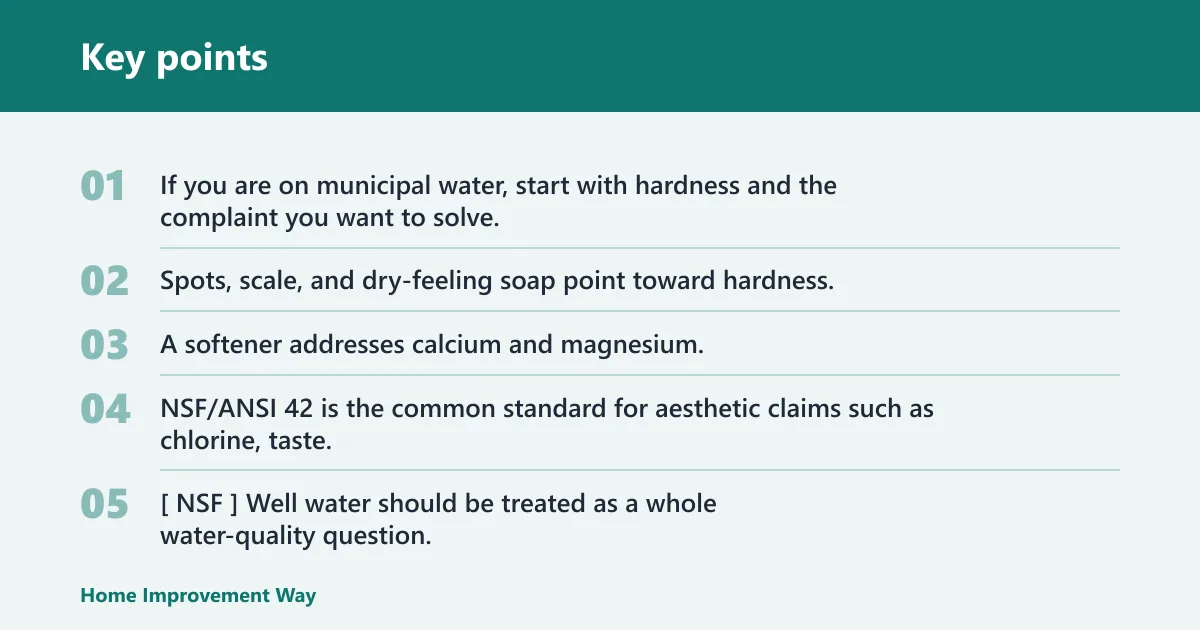
If you are on municipal water, start with hardness and the complaint you want to solve. Spots, scale, and dry-feeling soap point toward hardness, while chlorine smell or taste points toward a filter with a specific reduction claim. A softener addresses calcium and magnesium, but it does not automatically solve taste or disinfectant issues. NSF/ANSI 42 is the common standard for aesthetic claims such as chlorine, taste, and odor reduction. [NSF]
Private well: why the test list gets longer
Well water should be treated as a whole water-quality question, not a hardness question alone. At minimum, a certified laboratory water analysis should check hardness and typically include bacteria indicators, nitrate, iron, manganese, pH, and other source-specific concerns; the exact panel should reflect the well type, local geology, nearby land use, and any symptoms in the home. State extension programs commonly advise private-well owners to test on a routine schedule and whenever the water changes, with bacteria and nitrate among the priority checks for many wells. [EPA] [CDC] [state extension]
When symptoms point to more than hardness
Hardness symptoms are mostly household nuisance signs: scale on fixtures, soap that does not lather well, and white spotting on glass. Rust stains, cloudy particles, metallic taste, or a chlorine odor point to separate issues. A softener may still be part of the solution, but it should not be the first assumption. The right test separates nuisance concerns from health-related contaminants so you can choose the correct treatment category first.
Water test decision matrix

Use the table below to match the source water and symptom pattern to the test you should buy first. It keeps you from ordering a softener for an iron problem, or a filter when the main issue is hardness. The extra columns also help you translate a report directly into a purchase decision: softener, filter, both, or neither; point-of-entry or point-of-use; and the minimum certification to verify.
| Source water | Symptoms | Recommended test type | Key numbers to look for | What treatment it points to | Softener / filter / both / neither | Point-of-entry vs point-of-use | Minimum certification to verify |
|---|---|---|---|---|---|---|---|
| City water | Scale, soap that will not lather, spots on fixtures | Home hardness test kit first; lab if results are unclear | Hardness in gpg or ppm as calcium carbonate | Softener if hardness is 7 gpg or higher | Softener | Point-of-entry | NSF/ANSI 44 for the exact model |
| Private well | Scale plus unknown water quality | Certified laboratory water analysis | Hardness, nitrates, bacteria, iron, pH, sodium | Softener, filter, or both, depending on the report | Both or neither, depending on findings | Usually both: point-of-entry for hardness/whole-house issues, point-of-use for drinking-water contaminants if needed | Model-specific certification for each treatment: NSF/ANSI 44, 42, or 53 as applicable |
| Hard water only | Scale and poor soap performance | Hardness test kit or lab test | 7 gpg or higher, or the equivalent in ppm | Conventional softener | Softener | Point-of-entry | NSF/ANSI 44 |
| Hard water plus chlorine taste | Scale plus taste or odor complaint | Hardness test plus chlorine screening or lab | Hardness and measurable chlorine residual | Softener plus a filter with a chlorine reduction claim | Both | Softener at point-of-entry; chlorine filter can be point-of-entry or point-of-use depending on the claim | NSF/ANSI 44 for softener and NSF/ANSI 42 for chlorine reduction |
| Hard water plus iron or sediment | Scale, staining, particles, cloudy water | Certified lab panel for iron and suspended solids | Hardness, iron, sediment load, possible pH issue | Softener only if hardness is present; add iron or sediment filtration as needed | Filter or both | Usually point-of-entry for sediment/iron; point-of-use only if treating a single tap | NSF/ANSI 53 only if the exact reduction claim matches the contaminant; otherwise verify the specific contaminant standard or certifier listing |
| Any case with health-related contaminants | Well water or a known contaminant concern | Certified laboratory water analysis | Exact contaminant and its concentration | Filter with the right health-related reduction claim, sometimes with a softener too | Filter or both | Often point-of-use for drinking-water contaminants; point-of-entry only when the whole home needs treatment | NSF/ANSI 53 for the exact contaminant claim, plus the certifier directory listing for the exact model |
Use the report, not the symptom, to choose equipment. A filter needs a specific reduction claim for the contaminant you found, and a softener needs verified hardness. NSF notes that certification to a standard or protocol does not mean a system reduces every possible contaminant. When you are reading the report, keep an eye on how to read a water report so you can match each number to the right treatment category.
Can a cheap home test be enough?
A cheap kit can be enough for a first pass on hardness, especially if you are comparing water from the kitchen sink against the shower or a nearby tap. It is not enough when you need a purchase decision for well water, health-related concerns, or a system that must treat more than one problem. EPA and CDC both point private-well owners to laboratory testing when the goal is to understand the broader water quality picture, not just a quick screening result. [EPA] [CDC]
What strip kits can measure
In-home kits can give a basic hardness reading and sometimes a simple chlorine check. That makes them useful for quick screening and for confirming that a problem exists before spending more on a lab panel. They are practical when your question is narrow: hard or not hard.
What strip kits miss
Strip kits do not give the same detail as a certified laboratory water analysis. They are weaker for nitrates, bacteria, sodium, and other contaminants that matter in private wells. They also do not tell you whether a product is certified for the exact reduction you need.
When to upgrade to a certified lab
Upgrade to a lab when the home has a well, when anyone in the home has a health-related concern about the water, or when the result will determine a larger purchase. For wells, the recommended panel should reflect the likely risk: hardness, bacteria indicators, nitrate, iron, manganese, pH, and any local contaminant of concern. That is more useful than a single narrow screen. [EPA] [CDC]
Suppose a well sample shows 9 gpg hardness, elevated iron, and a bacteria concern. A strip kit may catch the hardness, but it will not tell you enough to choose the right treatment order. In that case, the lab report should drive the purchase, not the strip.
What hardness numbers mean
Water hardness is mainly dissolved calcium and magnesium. It is commonly measured in grains per gallon, ppm, or mg/L as calcium carbonate. One grain per gallon is approximately 17.1 milligrams per litre as calcium carbonate, which is the standard conversion used when comparing test results across sources. [EPA]
Hardness units: gpg, ppm, and mg/L
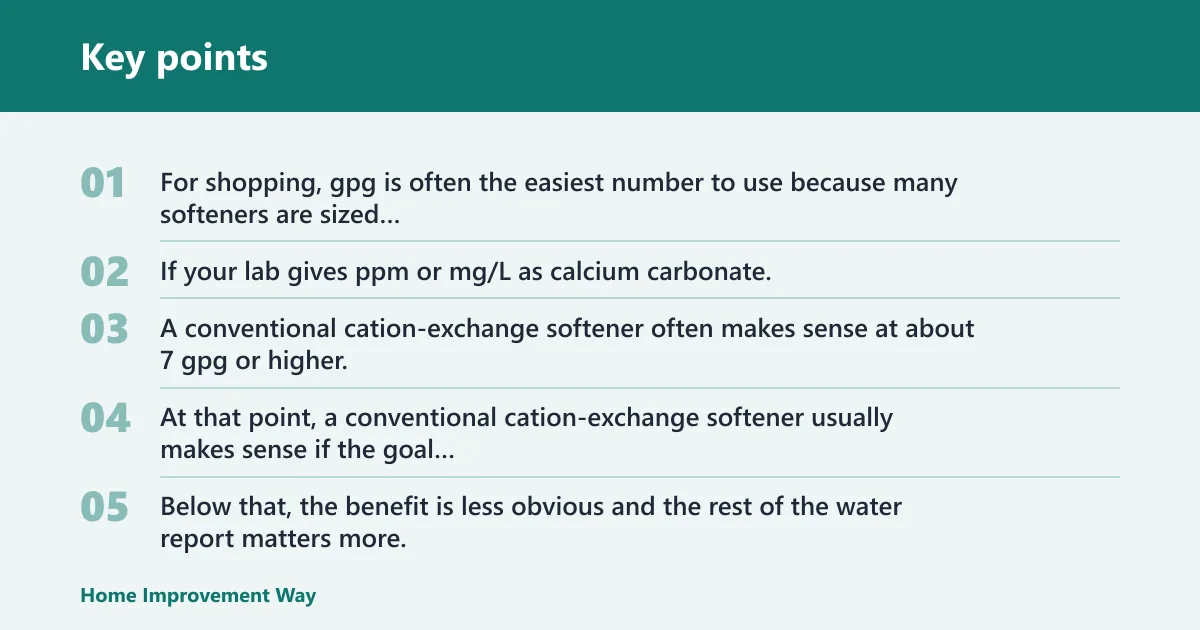
For shopping, gpg is often the easiest number to use because many softeners are sized that way. If your lab gives ppm or mg/L as calcium carbonate, you can compare directly using the printed value on the report or a simple conversion chart from the seller.
What level usually justifies a softener
A conventional cation-exchange softener often makes sense at about 7 gpg or higher. At that point, a conventional cation-exchange softener usually makes sense if the goal is to reduce scale and soap problems. Below that, the benefit is less obvious and the rest of the water report matters more.
Why hardness alone does not rule out other problems
Hardness may be the visible issue, but it may not be the only issue. If a report also shows chlorine, iron, sediment, or bacteria, the system choice changes. A softener is for hardness; it is not a general purifier.
What a softener can and cannot fix
A water softener uses ion exchange to swap hardness minerals for sodium or potassium ions. It is built for calcium and magnesium, and NSF/ANSI 44 sets requirements for residential cation-exchange softeners. That is why the exact model matters, not just the product category. [NSF]
Brine tank, salt, drain, and regeneration
A conventional softener needs a brine tank, salt or potassium chloride, a drain, and periodic regeneration. Many systems use a metered controller, which regenerates after measured water use rather than on a fixed calendar. Reserve capacity and power-loss behavior still matter, because the unit has to keep up with demand and recover correctly after outages.
Problems a softener will not solve
A softener does not automatically remove chlorine taste, sediment, bacteria, or other health-related contaminants. It also is not the answer when the real issue is iron staining or a sediment load that clogs fixtures. If a report points to one of those, the next purchase should be a filter selected for that problem.
What a filter can and cannot fix
A filter should be chosen by the contaminant claim, not by the word filter on the box. A filter may use carbon, sediment media, reverse osmosis, or UV, but it only solves the issue named in its performance claim. It does not automatically soften water.
Choose by contaminant claim, not by product type
NSF/ANSI 42 covers aesthetic claims such as chlorine and taste or odor reduction. NSF/ANSI 53 covers reductions for contaminants with health effects. If a product does not list the exact claim you need, it should not be treated as a match for your water report. Check the certifier directory for the exact model before you buy. [NSF]
Carbon, sediment, reverse osmosis, and UV
Carbon filters are common for chlorine taste and odor. Sediment filters help with particles and cloudy water. Some point-of-use systems, including properly selected reverse-osmosis units, can reduce dissolved solids at a drinking-water tap. UV is used for certain microbial concerns, but it does not soften water.
Do you need a softener, a filter, or both?
Use the lab or kit result to separate hardness from everything else. If hardness is the only issue, a softener is the cleanest answer. If the report shows another contaminant too, you may need both systems in sequence or a single point-of-use filter for drinking water plus a softener for the rest of the house.
Hard water only
If hardness is 7 gpg or higher and no other issue shows up, a softener is usually the right buy. That is the straightforward case. You should still match the model to the home’s peak service flow and verify NSF/ANSI 44 certification for the exact unit.
Hard water plus chlorine taste
If the water is hard and tastes or smells like chlorine, a softener alone is not enough. Add a filter with an NSF/ANSI 42 chlorine reduction claim, or choose a treatment setup that includes both functions. The claim has to be on the exact model, not on a similar one.
If the water has hardness plus iron, sediment, or a health-related contaminant, treat the problem in the right order. A softener can address hardness, but a separate filter may be needed for iron, particles, or a contaminant covered by NSF/ANSI 53. For a well, that order should come from the lab report.
A common first-timer mistake is buying a softener because the fixtures are stained brown. If the stain is iron and the report does not show enough hardness to justify ion exchange, the softener will not solve the stain. The correct move is to match the system to the contaminant, not the stain color.
Sizing and certification checks before you buy
Before purchase, confirm certification, capacity, and flow. Total capacity is not the same as peak service flow, and the home needs both to be right. A unit that is certified for the claim but too small for the home can still disappoint at high demand.
NSF/ANSI 44 for softeners
For a softener, look for NSF/ANSI 44 and verify the exact model in the certifier’s directory. The standard covers residential cation-exchange softeners. The model-specific listing matters because certification for one configuration does not automatically carry over to every version of the product line.
NSF/ANSI 42 and 53 for filters
For filters, use the claim first and the standard second. NSF/ANSI 42 is for aesthetic claims like chlorine and taste or odor reduction. NSF/ANSI 53 is for reductions tied to health effects. If a filter does not show the exact claim and standard you need, keep looking.
Peak service flow, capacity, and demand-initiated regeneration
Peak service flow is separate from total capacity. It should match simultaneous household demand, because pressure drop matters when several fixtures run at once. Demand-initiated regeneration is usually better than a fixed schedule because it regenerates after measured water use, but reserve capacity and power-loss behavior still need a check before you buy.
- Identify the source water: city or private well.
- Test hardness first if the complaint is scale or soap problems.
- Order a certified lab panel when the source is a well or the water report affects health-related choices.
- Separate hardness from taste, sediment, iron, and microbial concerns.
- Match the result to a softener, a filter with the right claim, or both.
- Confirm the exact NSF/ANSI standard, model listing, peak flow, and regeneration behavior before purchase.
Frequently asked questions
How do I test my water before buying a water softener?
Start with a hardness test, because a softener is for calcium and magnesium hardness. A home kit can screen the water, but a certified laboratory water analysis is the better choice for wells or unclear results. Buy only after you know whether hardness is at or above 7 gpg.
What water test do I need for a softener versus a filter?
A softener decision starts with hardness. A filter decision starts with the contaminant you want to remove, such as chlorine, sediment, or a health-related contaminant. If you are on a well, a lab panel can cover both categories at once so you do not buy the wrong system.
Can I use a cheap home test kit, or do I need a lab test?
A cheap kit is fine for a basic hardness check and can help confirm a likely problem. Use a certified lab when the home is on a well, when the water report affects health-related concerns, or when you need data for nitrates, bacteria, sodium, iron, or pH-related issues.
What should I look for in a water report before buying treatment?
Look for hardness first, then check whether other contaminants are present. For city water, chlorine taste or odor may matter. For wells, watch for iron, nitrates, bacteria, sodium, and pH-related concerns. The right treatment follows the report, not the symptom alone.
How do I know if I need a softener, a filter, or both?
If hardness is the only problem, a softener is the usual choice. If the report also shows chlorine, sediment, iron, or a health-related contaminant, a filter with the right reduction claim may be needed too. Some homes need both because one device cannot solve every issue.
Which contaminants cannot be fixed by a water softener?
A softener does not solve chlorine taste, sediment, bacteria, or most health-related contaminant concerns. It also does not automatically fix iron stains unless the product is specifically designed and certified for that job. For anything beyond hardness, choose a filter with the exact performance claim.
Sponsored / affiliate links. As an Amazon Associate I earn from qualifying purchases. I may earn additional commission from eligible campaigns.