Water softener vs reverse osmosis: which fits your home?
Choose a water softener for hard water that is harming plumbing and fixtures; choose reverse osmosis for cleaner-tasting drinking water at one tap, or both if you need both jobs handled. Using the wrong system can leave scale in pipes or untreated water at the tap, which raises repair costs and leaves taste or mineral problems unresolved. This guide explains how each system works, when city or well water needs one or both, and how to compare cost, maintenance, and installation.
This guide is part of our Water softener and filtration guide series.
Water softener vs reverse osmosis: the core trade-off
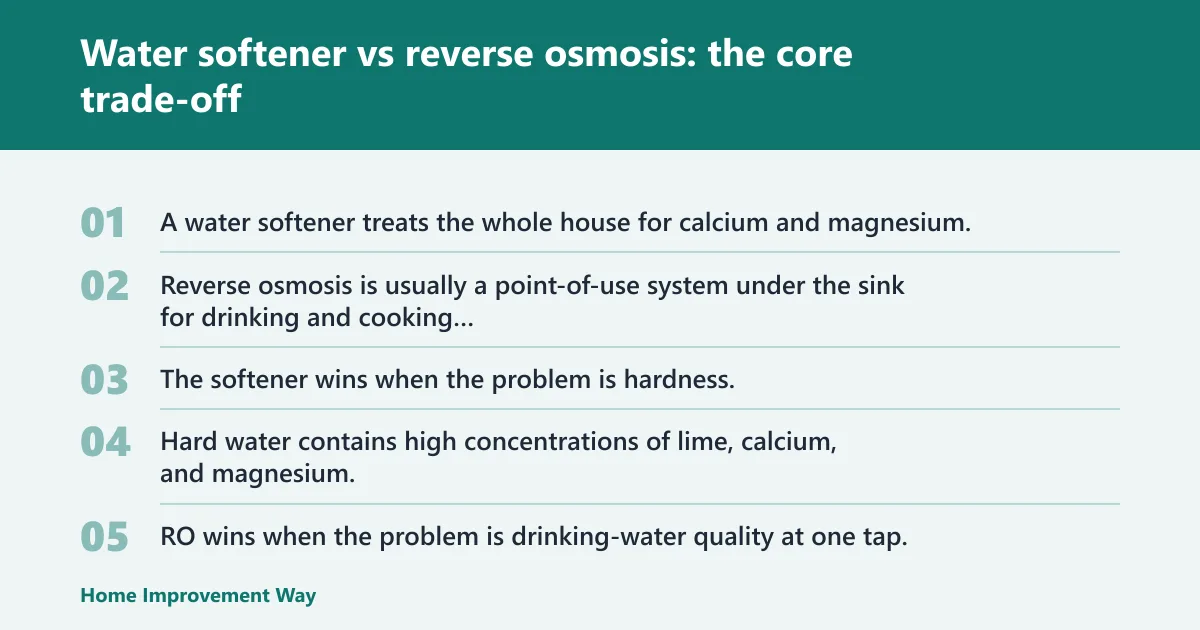


A water softener treats the whole house for calcium and magnesium, which are the hardness minerals linked to scale and soap problems. Reverse osmosis is usually a point-of-use system under the sink for drinking and cooking water, where a semi-porous membrane and carbon prefilter target dissolved contaminants and taste issues.
| Factor | Water softener | reverse osmosis: when each system makes sense | Winner |
|---|---|---|---|
| Main job | Removes hardness minerals by ion exchange, usually with salt, to control scale and soap issues throughout the home. | Forces water through a semi-porous membrane to improve drinking water at one tap. | Water softener |
| Coverage | Whole-house treatment. | Usually point-of-use under a sink. | Water softener |
| Best-fit use | Best for scale on plumbing, fixtures, appliances, dishes, and soap performance. | Best for lead, arsenic, chlorine taste and odor, and lower dissolved solids in drinking water. | Tie |
| Water produced as waste | No reject stream from the softening step itself. | Leaves wastewater, usually 5%-15% of the water taken into the system. | Water softener |
| What it does not target | Does not target lead, arsenic, chlorine taste and odor, or most other chemical contaminants. | Targets drinking-water contaminants and taste issues, but is not a whole-house hardness solution. | Tie |
| Installation fit | Best when hardness is affecting the whole home. | Usually installed under the kitchen sink for drinking and cooking water. | Tie |
| Maintenance and operating burden | Used for the home-wide hardness problem; the article notes it can reduce scale stress on plumbing and fixtures. | Whole-house use is a poor fit because the reject water stream increases operating cost and complexity, and hard water can load the membrane faster and raise upkeep. | Water softener |
| Combined-system role | Often the first step in a combined layout: softener first for the home. | Often the second step: RO at the kitchen sink after softening, with carbon prefiltration. | Tie |
Why the table points in different directions
The softener wins when the problem is hardness. Hard water contains high concentrations of lime, calcium, and magnesium, and those minerals are what leave scale and soap residue behind.
RO wins when the problem is drinking-water quality at one tap. It uses a membrane and usually a carbon prefilter, so it can address taste, odor, and several dissolved contaminants that a softener does not target.
Neither system is a universal fix. If you need scale control and better drinking water, the right answer is often a combined layout instead of a forced choice.
📊 Pure water has a neutral pH of 7. Source: USGS.
How a water softener works and when it makes sense
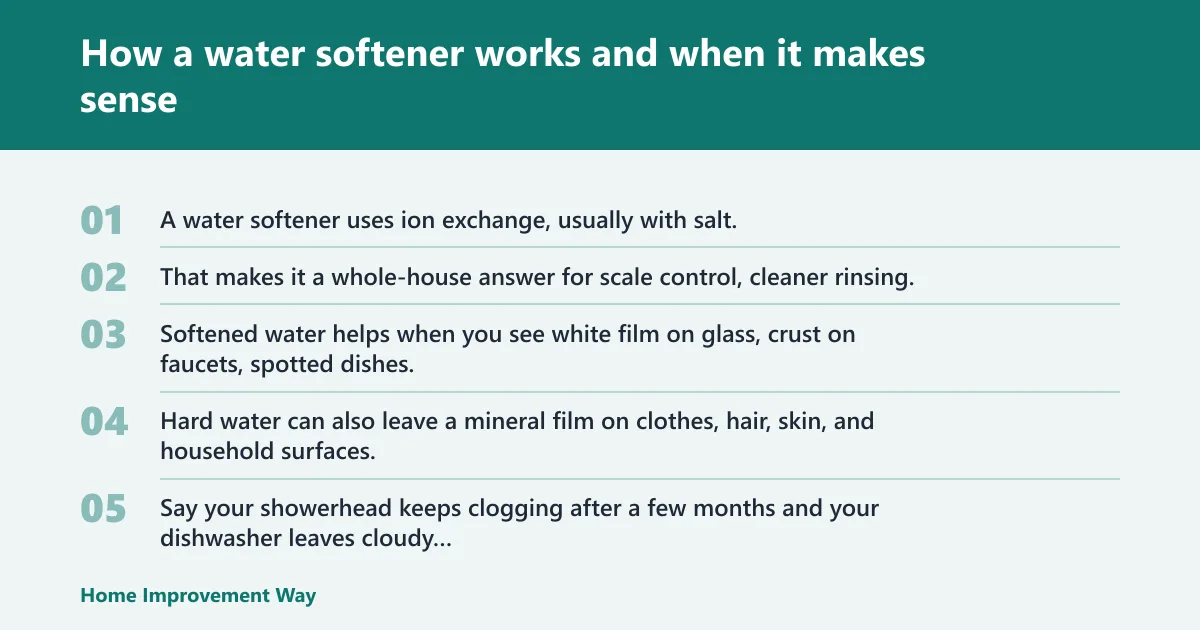
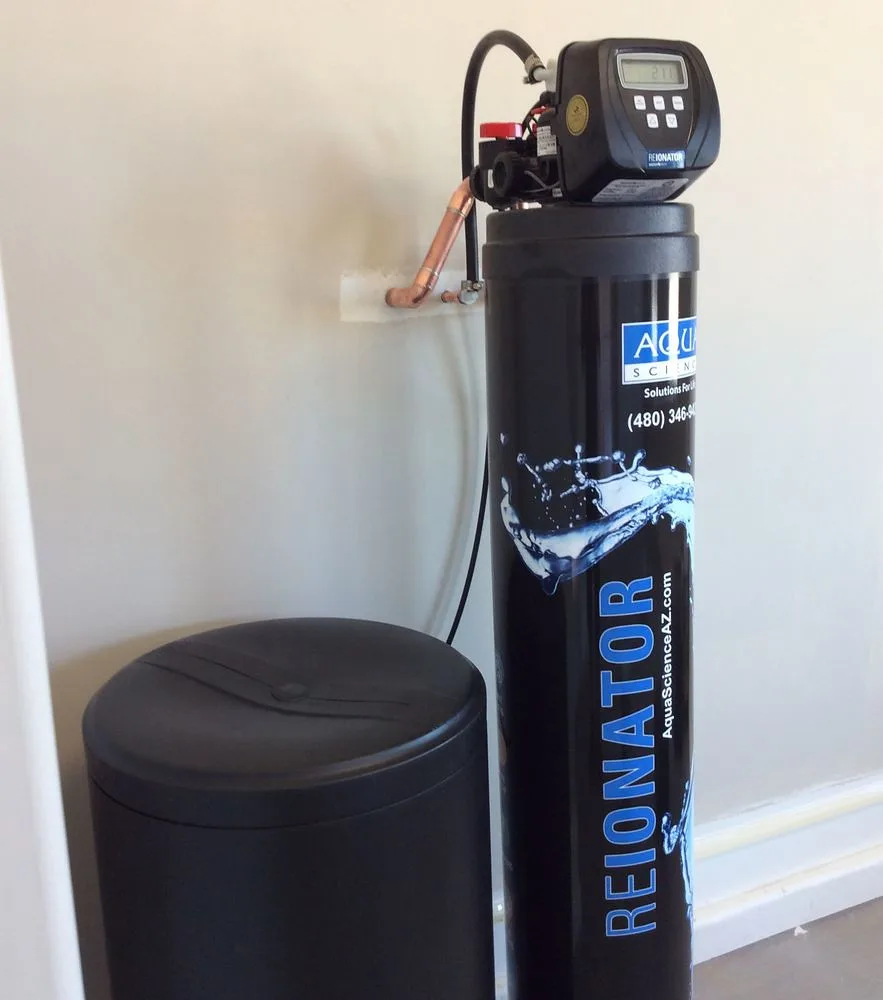
A water softener uses ion exchange, usually with salt, to remove calcium and magnesium from the water supply. That makes it a whole-house answer for scale control, cleaner rinsing, and fewer hardness-related deposits on plumbing and fixtures.
Best use cases: scale control and better soap performance
Softened water helps when you see white film on glass, crust on faucets, spotted dishes, or reduced soap lather. Hard water can also leave a mineral film on clothes, hair, skin, and household surfaces, so the benefit reaches beyond plumbing.
Say your showerhead keeps clogging after a few months and your dishwasher leaves cloudy glassware. That points to hardness minerals, not a drinking-water taste issue, and a softener addresses the source across the house.
What a softener does not remove
A softener is not a catch-all filter. It does not target lead, arsenic, chlorine taste and odor, or most other chemical contaminants, so it should not be the only approach when the goal is cleaner drinking water.
That distinction matters on both city water and well water. A home can have hard water and still need separate treatment for drinking-water contaminants at the tap.
How reverse osmosis works and when it makes sense
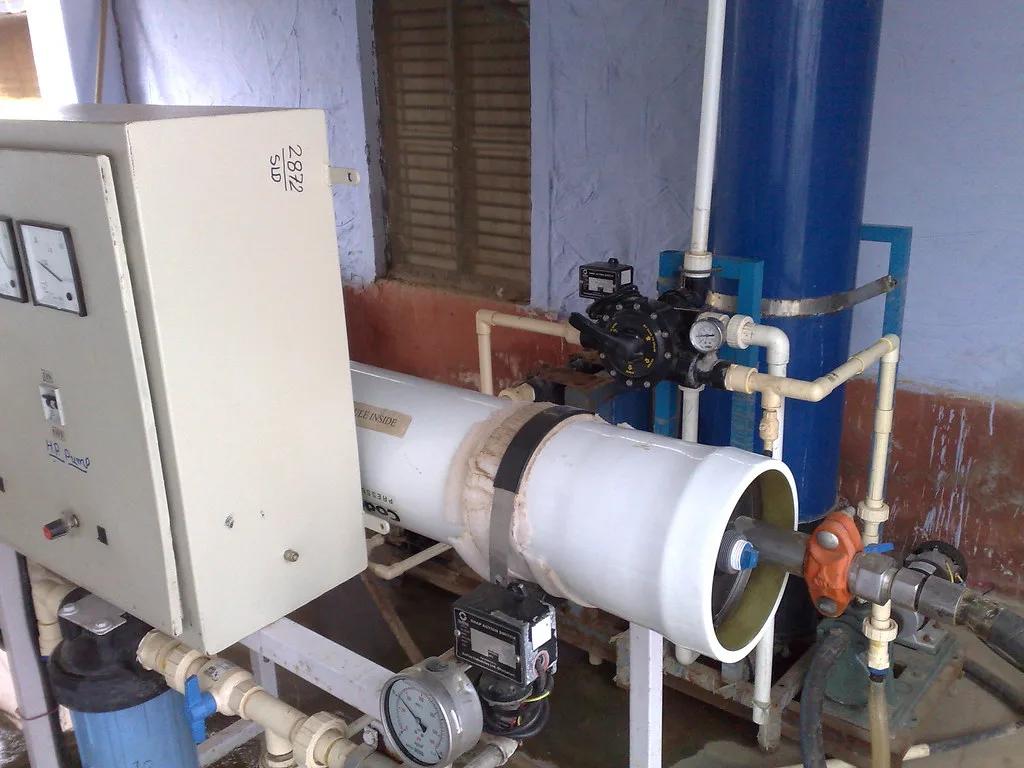
Reverse osmosis pushes water through a semi-porous membrane to reduce dissolved contaminants at a single point of use. It is usually installed under the kitchen sink for drinking and cooking water, and it often includes activated carbon before the membrane to remove contaminants more effectively.
Best use cases: drinking and cooking water at one tap
RO is a drinking-water tool. It fits well when you want to cut taste and odor problems, lower total dissolved solids as a taste issue, or address contaminants such as lead and arsenic at the kitchen faucet.
Chlorine matters here for two reasons. City water often contains it, and activated carbon protects the RO membrane from chlorine damage while also helping with taste and smell.
What reverse osmosis removes that a softener does not
RO can remove materials that matter at the tap, including some contaminants such as lead and arsenic. It can also reduce chlorine taste and odor and lower dissolved solids, which is why it is commonly chosen for drinking and cooking water rather than whole-house hardness control.
The membrane is the key. Water passes through it, while many dissolved contaminants stay behind in the reject stream.
What does a reverse osmosis system remove that a softener does not?
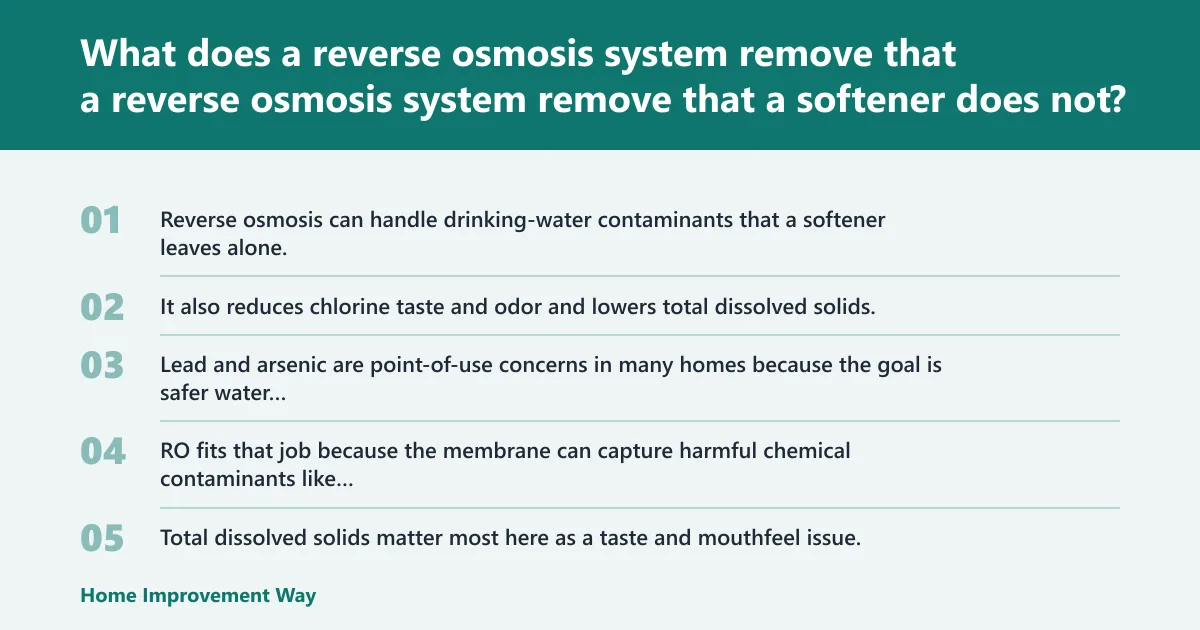
Reverse osmosis can handle drinking-water contaminants that a softener leaves alone, including lead and arsenic. It also reduces chlorine taste and odor and lowers total dissolved solids, which can improve the flavor of water used for drinking, coffee, and cooking.
Lead and arsenic at the kitchen tap
Lead and arsenic are point-of-use concerns in many homes because the goal is safer water for drinking and food prep. RO fits that job because the membrane can capture harmful chemical contaminants like those, while a softener is aimed at hardness minerals instead.
Taste, odor, and dissolved solids as a drinking-water issue
Total dissolved solids matter most here as a taste and mouthfeel issue, not as a complete safety test. Water with lower TDS can taste cleaner, but TDS alone does not tell you whether a supply is safe or which contaminants are present.
Why chlorine matters for RO prefiltration
Chlorine is common in municipal water and can damage an RO membrane if it reaches it untreated. That is why RO systems are often paired with activated carbon, which removes chlorine and helps protect the membrane while also improving taste and odor.
What water problems does a softener solve best?
A softener solves hardness-related problems best: scale buildup, soap waste, and mineral spotting. It is the right tool when the goal is to protect plumbing, fixtures, and appliances from calcium and magnesium deposits throughout the home.
Scale on fixtures, appliances, and plumbing
Hard water causes lime scale buildup inside appliances and shortens their lives. That can affect water heaters, dishwashers, shower fixtures, and any plumbing surface that sees repeated heating or evaporation.
Soap efficiency and spotting on dishes and glass
Hard water interferes with soap performance, so you use more detergent for the same result and still get spotting or residue. A softener fixes the mineral cause, which is why it is a whole-house solution rather than a kitchen-only one.
Why hardness is a whole-house problem
Because water flows to bathrooms, laundry, appliances, and outdoor spigots, hardness shows up everywhere. Treating only the kitchen would leave scale and soap problems in the rest of the home.
Should I install RO at one sink or for the whole house?
For most homes, reverse osmosis belongs at one sink, not the whole house. It is designed for drinking and cooking water, and the reject water stream makes whole-house use a poor fit unless the goal and plumbing design are very specific.
Why point-of-use usually wins
RO systems are built around a membrane and carbon prefilter, so the treated water is best reserved for drinking, cooking, and maybe coffee or ice. That keeps maintenance focused where the water quality benefit matters most.
Why whole-house RO is usually a poor match
RO leaves wastewater, often a noticeable portion of the water taken into the system. On a whole-house scale, that waste stream increases operating cost and complexity, and very hard water can load the membrane faster and raise upkeep.
A common first-timer mistake is treating every water problem the same
A home may need hardness control at the entry point and better drinking water at the kitchen sink. If you try to make one system do both jobs, you often spend more and still leave one problem unresolved.
Can you combine a softener and reverse osmosis system?
Yes. A combined setup often makes the most sense when you want whole-house hardness control and better drinking water at the kitchen sink. In that layout, the softener treats the incoming water first, then RO is used on a smaller portion for drinking and cooking.
Why softener first, RO second is common
Softening first can help reduce scale stress on the RO membrane and the rest of the house plumbing. Then the RO unit can focus on taste, odor, TDS, and contaminants such as lead and arsenic at the tap.
When combined systems are worth it
Choose both when your water has calcium and magnesium that are causing scale, but you still want cleaner drinking water at the kitchen sink. That combination is especially sensible for city water with chlorine or for well water with separate hardness and drinking-water concerns.
How to choose the right system for the problem
| Common water problem | Recommended system |
|---|---|
| White scale on faucets, showerheads, or inside appliances | Softener only |
| Soap that will not lather well, cloudy glassware, mineral film on fixtures | Softener only |
| Lead concern at the kitchen tap | RO only |
| Arsenic concern in drinking water | RO only |
| Chlorine taste or odor in drinking water | RO only |
| Hard water plus drinking-water contaminants at one sink | Both |
| Hard water throughout the house and better tasting water at the kitchen sink | Both |
| Water issue outside hardness, taste, odor, or point-of-use contaminants | Neither |
Three-step homeowner checklist
- Decide whether the main problem is scale and soap performance, drinking-water quality, or both.
- Pick the treatment point: whole-house for hardness, kitchen sink for drinking water, or both if each problem needs its own fix.
- Check whether chlorine, lead, arsenic, or other dissolved contaminants change the answer, and plan for carbon prefiltration if you choose RO.
Choose Water softener if… / Choose reverse osmosis if…
Choose a water softener if your main problem is scale on plumbing, appliances, fixtures, or dishes. Choose it if soap performance is poor across the home, or if you want one treatment point to handle hardness minerals throughout the house.
Choose reverse osmosis if your main problem is drinking-water quality at one tap. Choose it if you want a kitchen solution for lead, arsenic, chlorine taste or odor, or lower dissolved solids for drinking and cooking.
Choose both if you need hardness control and better drinking water. That is the most practical setup when city or well water has calcium and magnesium plus a separate concern at the faucet.
Choose neither if your problem is outside these jobs, such as sediment control, iron staining, or microbial treatment. Those need different equipment.
Frequently asked questions
Do I need a water softener or reverse osmosis?
Choose a softener if hard water is causing scale, poor soap performance, or mineral spotting throughout the home. Choose RO if your main goal is better drinking water at one tap. If both problems exist, a softener plus an RO unit at the kitchen sink is often the cleanest setup.
What does a reverse osmosis system remove that a softener does not?
RO can address lead, arsenic, chlorine taste and odor, and lower total dissolved solids at the tap. A softener mainly targets calcium and magnesium. That is why RO is a drinking-water tool, while a softener is a whole-house hardness-control tool.
Can reverse osmosis replace a water softener?
Usually no. RO is not a whole-house substitute for hardness control because it is typically installed at one sink and creates wastewater during operation. It can improve drinking water, but it will not stop scale throughout the plumbing system the way a softener does.
Should I install RO at one sink or for the whole house?
For most homes, one sink is the right choice. RO is commonly used for drinking and cooking water, and the reject water stream makes whole-house use inefficient and expensive to operate. Whole-house hardness control is better handled by a softener.
What water problems does a softener solve best?
A softener solves calcium and magnesium problems best. That means less scale in appliances and plumbing, better soap lather, and fewer spots or mineral films on dishes, glass, fixtures, and surfaces. It is the right tool for hardness-related damage, not drinking-water purification.
Can you combine a softener and reverse osmosis system?
Yes, and that is often the best answer when both scale control and better drinking water matter. The softener treats the whole house first, then RO polishes water at the kitchen sink. This pairing is common when you want one system for plumbing protection and another for tap water quality.
Sponsored / affiliate links. As an Amazon Associate I earn from qualifying purchases. I may earn additional commission from eligible campaigns.