Can a Water Heater Freeze? Signs, Causes, Fixes
Yes, a water heater can freeze, but the tank usually freezes only after the room drops below 32°F (0°C) and the inlet, outlet, or nearby supply lines freeze first. A poor thaw can crack pipes, rupture the tank, and flood the space. This guide shows how to tell which part is frozen before you thaw anything.
This guide is part of our Frozen Pipes: How to Prevent, Thaw and Fix Them series.
Can a water heater freeze?


Yes. Water freezes at 32°F (0°C), and that risk rises when the heater sits in an unheated garage, crawlspace, basement corner, or exterior closet. The heater itself may freeze, but the more common failure point is a connected line or fitting, especially after prolonged cold or a power outage.
Tank water heaters store a large volume of water, so a frozen tank or frozen connections can create enough expansion pressure to crack metal, split fittings, or burst nearby piping. Rheem notes that many heaters are installed in garages, crawl spaces, or other unheated areas, which is why location matters as much as outdoor weather. (Wikipedia)
What usually freezes first
The first freeze point is often a pipe or nearby supply line rather than the tank itself. It is usually the inlet pipe, outlet pipe, or a nearby supply line that feeds the heater. If those lines freeze, hot water stops even though the tank itself may still be intact.
A partially frozen line can still pass a little water. That can make the problem look like a weak heater or a bad thermostat. A full freeze usually means no flow at all, or only a slow trickle from the hot side.
Freeze-risk diagnostic table
| Water heater type | Installation location | Most likely freeze point | First safe action |
|---|---|---|---|
| Tank water heater | Garage | Exposed inlet/outlet lines or nearby supply piping | Stop using the heater, open a hot faucet, and warm the line gradually with a hair dryer |
| Tankless water heater | Crawlspace | Feed lines and internal passages near the unit | Shut off power or gas if needed, then thaw slowly per manufacturer instructions |
| Tank water heater | Exterior closet | Shutoff valves, fittings, and short exposed piping | Check for frost, then warm only the exposed piping; do not use a torch |
| Tank water heater | Garage during a winter power outage | Tank jacket, inlet line, and pressure-relief area if the space drops for hours | Restore safe heat to the space if possible, then inspect for leaks before restarting |
| Tankless water heater | Exterior wall or unheated utility closet | Internal passages plus the feed and outlet lines | Follow the unit’s freeze-protection guidance, then thaw exposed piping slowly |
How do you tell if it is frozen?
A frozen water heater usually shows up as no hot water, very weak hot-water flow, or strange gurgling and knocking sounds from the line. Frost on exposed piping is another clue. If the cold tap works normally but the hot tap is dead, the freeze point is likely on the hot side or at the heater connection.
Do not assume every loss of hot water means the tank itself is frozen. A nearby supply pipe can block flow before the heater does. If you see water after thawing, that points to cracking, split fittings, or damage to the pressure relief valve.
For example, a garage water heater may lose hot water after a couple of nights below freezing, while the cold tap in the laundry sink still runs normally. That pattern points first to the heater’s inlet or outlet connection, not necessarily the tank shell.
Clues that point to supply piping instead of the heater
- The cold water supply elsewhere in the house still works normally.
- Only fixtures near the heater are affected.
- Frost shows on a short exposed run, shutoff valve, or flex connector.
- The heater makes no recovery noise because water is not moving through it.
What should I do if my water heater freezes?
Start with safety, not speed. Shut off power to an electric unit or set a gas unit to the manufacturer’s safe-off position if you need to work near it. Then open a hot faucet to relieve pressure before thawing. Use a hair dryer or similar safe heat source and warm the frozen area gradually.
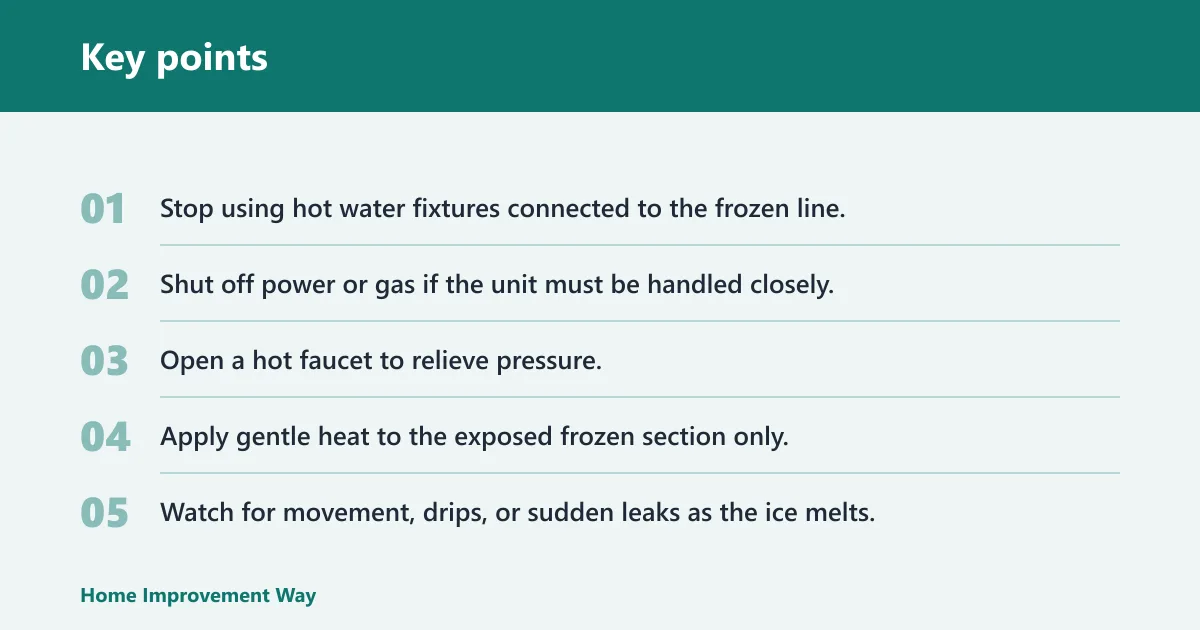
Do not use open flames, torches, or any direct flame heat. AFM advises against that because rapid heating can damage pipes and fittings, and it raises fire risk. If the space is very cold, try to warm the room first so thawing happens more evenly.
- Stop using hot water fixtures connected to the frozen line.
- Shut off power or gas if the unit must be handled closely.
- Open a hot faucet to relieve pressure.
- Apply gentle heat to the exposed frozen section only.
- Watch for movement, drips, or sudden leaks as the ice melts.
- Inspect the pressure relief valve, nearby fittings, and piping after flow returns.
A common first-timer mistake is to turn the thermostat up and assume the heater will clear itself. A thermostat setting around 120°F is a common safe and efficient setting, and AFM lists that target. It is not a substitute for insulation, heat in the space, or thawing a frozen line.
Can a tankless water heater freeze?
Yes. Tankless water heaters hold less water than tank models, so they are less likely to freeze in the tank itself, but they are not freeze-proof. The same source notes that tankless units still have freeze risk in the feeding water lines, and their internal components can freeze in extreme cold.
Many tankless models include built-in freeze protection, but that protection depends on power, correct installation, and the unit’s own limits. A power outage can disable electric freeze protection, and prolonged subfreezing conditions can still freeze exposed piping or parts in a crawlspace or exterior wall.
Why crawlspaces and exterior walls are higher risk
Those spaces often stay colder than the rest of the house. Even if outdoor air is only briefly below freezing, a drafty crawlspace or closet can remain cold long enough for water in exposed lines to freeze. Ambient temperature matters as much as the outdoor forecast.
AFM recommends keeping the space above 50°F (10°C). The Water Nerd recommends keeping the thermostat at 55°F or higher. Those figures are best read as prevention targets, not guarantees.
Can a gas water heater freeze?
Yes. A gas water heater can freeze in the tank, the inlet or outlet connections, or the vent-adjacent piping if the installation sits in a cold, unheated space. The fuel type does not remove freeze risk. Location, insulation, and air temperature matter more than whether the unit is gas or electric.
Gas units add one more caution: when thawing or restarting, follow the manufacturer’s instructions for gas valves, venting, and ignition sequence. If you smell gas, leave the area and contact the utility or a qualified professional before doing anything else.
Can a hot water heater freeze in the winter?
Yes, and winter is the most common time for the problem. A water heater can freeze in winter when the surrounding temperature stays below 32°F (0°C) for long enough, especially during a prolonged cold spell or a power outage. The heater may lose hot water before any visible damage appears.
That is why winter prep should focus on the space around the heater, not only the tank. If the room stays warmer than the piping, the lines may still freeze first. If the heater is in a garage or exterior closet, that risk is much higher.
Use prevention on both the appliance and the piping. A water heater insulation blanket can help reduce heat loss from tank models, and The Water Nerd recommends one for prevention. AFM also recommends insulating the tank and pipes, especially within 6 feet of the heater.
Pipe insulation matters on exposed hot and cold lines, particularly near the heater and in drafty spaces. Heat tape or heat cable can also be used on exposed water lines, but it must be installed and used exactly as the manufacturer directs. That is especially important for gas and tankless models.
Keep the thermostat near 120°F for normal operation, but do not rely on it as freeze protection. If the heater sits in an unheated area, raise the temperature of that space when possible. If a winter outage is common in your area, plan for backup heat or a way to monitor the room temperature.
Suppose a tankless unit in an exterior closet starts losing hot water after a night when the closet dropped below freezing. The first safe move is not to turn the setting higher. It is to check for frozen exposed lines, then thaw them slowly while keeping the unit off or in the safe state listed by the manufacturer.
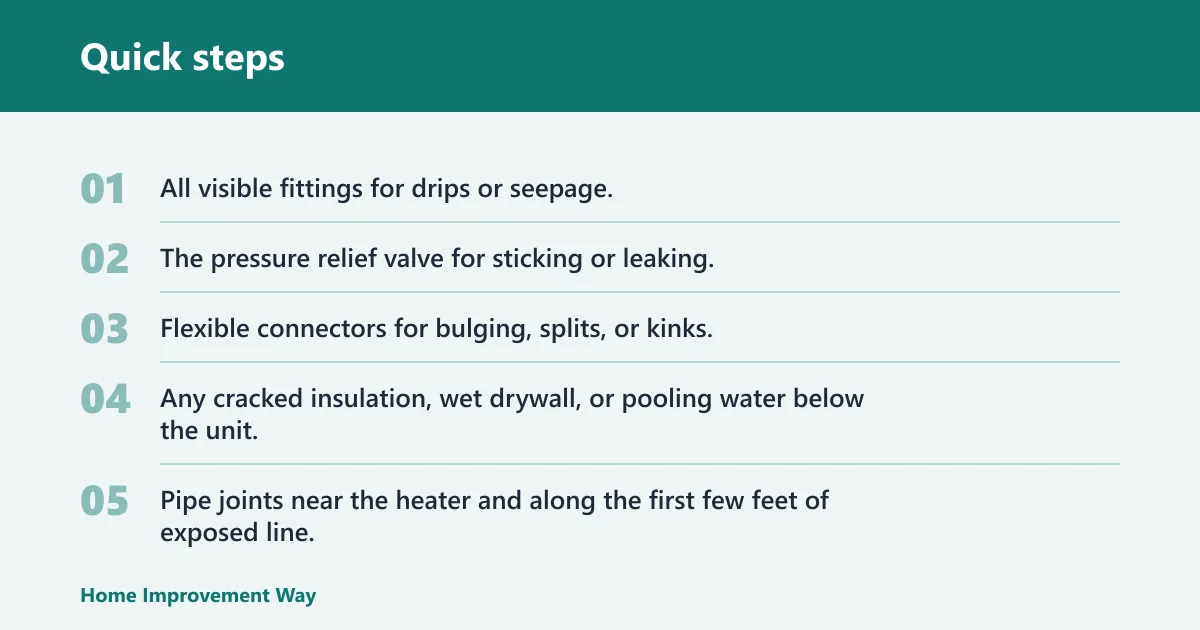
What to inspect after thawing
- All visible fittings for drips or seepage.
- The pressure relief valve for sticking or leaking.
- Flexible connectors for bulging, splits, or kinks.
- Any cracked insulation, wet drywall, or pooling water below the unit.
- Pipe joints near the heater and along the first few feet of exposed line.
If a leak starts after thawing, stop and call a plumber. That can mean a cracked tank, split fitting, or damaged pressure relief valve. A heater that froze once is also worth checking for insulation gaps, exposed piping, and weak spots that will freeze again.
Frequently asked questions
Can a water heater freeze in cold weather?
Yes. Water can freeze at 32°F (0°C), and the risk rises when the cold lasts long enough for the heater room to cool below freezing. A space that stays above freezing most of the day can still be cold enough overnight for lines or fittings to freeze.
Can a water heater freeze and burst?
Yes. Ice expansion creates intense internal pressure, and that pressure can crack a tank, split fittings, or rupture piping. A burst may not happen at the first freeze. It often shows up after thawing begins, when a cracked part starts leaking under pressure.
Will a water heater freeze in a garage?
It can. Garages are common exposure points because they are often unheated and swing colder than the house. A garage tank usually freezes first at the exposed piping or connections, especially if the garage door leaks cold air or the heater sits against an outside wall.
Sponsored / affiliate links. As an Amazon Associate I earn from qualifying purchases. I may earn additional commission from eligible campaigns.
 Water Flow Control Shut Off Valve with Brass Adjustable Hand Level Water Pressure Regulator for Hand Held Shower Head & Bidet Sprayer, Brushed Nickel Water Saver G1/2
 Faucet Hose Connector, 39 Inch Length Faucet Water Supply Lines 2 PCS Braided Stainless Steel 3/8" Comp x 1/2" Comp for Bathroom Kitchen Sink Faucet (1 Pair)