Can You Put Insulation Over Heat Tape?
Sometimes, but only if the heat tape label says it can be covered and the insulation type and thickness match that product. Done wrong, covered heat tape can overheat, fail early, or leave pipes frozen. This guide explains when insulation is allowed, what insulation is acceptable, and what to check before you cover the cable.
This guide is part of our Frozen Pipes: How to Prevent, Thaw and Fix Them series.
Heat tape insulation guidance by product type
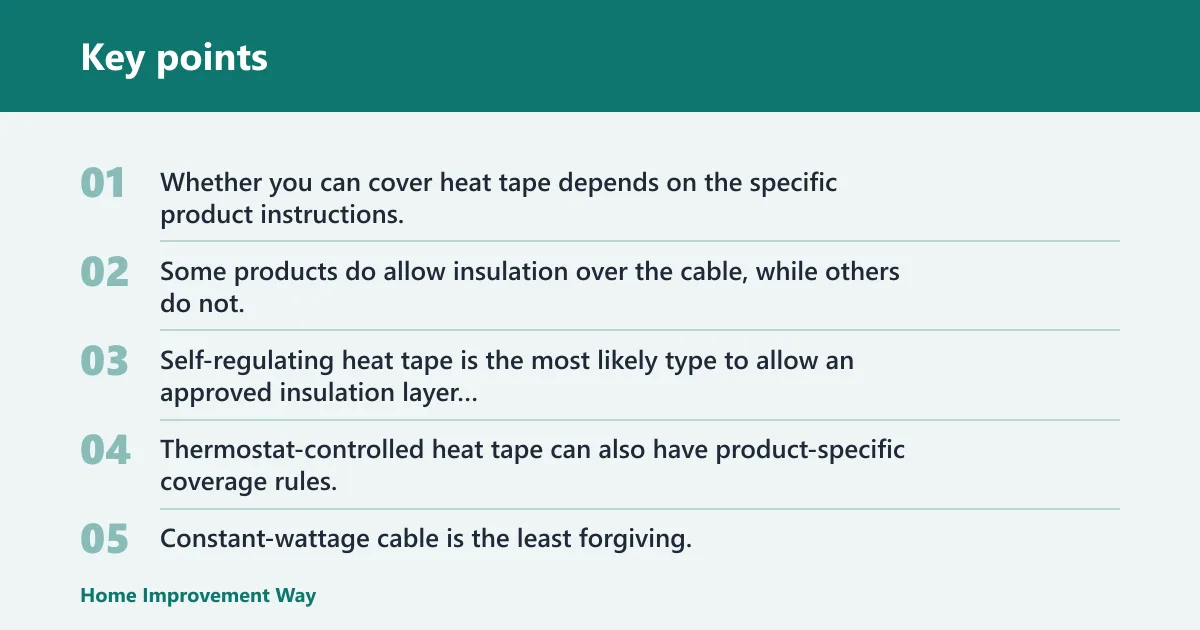

Whether you can cover heat tape depends on the specific product instructions. Some products do allow insulation over the cable, while others do not, and the instruction sheet controls the decision for that exact cable, pipe material, and installation method.
Short answer by product type
Self-regulating heat tape is the most likely type to allow an approved insulation layer because it changes output as temperatures change. Thermostat-controlled heat tape can also have product-specific coverage rules. Constant-wattage cable is the least forgiving, so check its manual before you cover anything.
When insulation is allowed
Coverage is allowed only when the manufacturer says so in the installation instructions. Some product guidance allows only fiberglass or another non-flammable material over heat tape, and some manufacturers recommend half-inch fiberglass insulation in certain applications. That is a product rule, not a universal rule.
Picture a basement supply line with self-regulating cable and a label that explicitly allows fiberglass wrap. That setup may be acceptable if the cable is installed as directed, the joints are left accessible, and the insulation thickness matches the instructions. A different cable may forbid that same setup.
When to stop and check the manual
Stop and verify the manual any time the cable crosses a valve, splice, end seal, or plastic pipe, or when you are dealing with an older cable of unknown type. If the cable has been damaged, soaked, or patched, do not cover it until it has been inspected or replaced.
How heat tape and insulation interact
Insulation can help hold warmth in the pipe, but it can also hold heat around the cable itself. That matters most where the cable overlaps, turns tightly, or crosses fittings. The risk is not only the pipe surface, it is the heat concentration around the cable path.
Where overheating risk is highest
Overheating is most likely at end seals, splices, valves, and any spot where the cable is bunched, overlapped, or wrapped too tightly. Those areas already run warmer than straight sections. Add a tight sleeve or a thick wrap, and heat has fewer places to escape.
Why seams and overlaps matter
Seams can create thicker pockets of insulation, and those pockets can raise the temperature around a cable. If the pipe has tees, unions, or shutoff valves, those points often need special treatment. Leave the cable and the insulation installed exactly as the manual shows, not as a generic pipe wrap.
Say your crawlspace pipe has two elbow joints and a valve near the meter. A cable that is fine on a straight run may not be fine where it bends and doubles back. The manual may allow insulation on the straight section but still require open access at the valve and end seal.
Which heat tape type do you have?
Do not apply one rule to every cable. Self-regulating, thermostat-controlled, and constant-wattage products behave differently, and the installation instructions may differ just as much. If the package or label does not make the type clear, look for the model number and confirm the manual before covering anything.
Self-regulating heat tape
Self-regulating heat tape adjusts output as temperature changes, so it is often considered safer than constant-wattage cable in some use cases. Even so, it may still require manufacturer-approved insulation, and some manuals still limit the type or thickness of insulation that can go over the cable.
Thermostat-controlled heat tape
Thermostat-controlled heat tape uses a thermostat to control heating, and modern heat tape often stays plugged in and heats only when needed. That does not mean every thermostat-controlled system can be buried under insulation. The cable manual, thermostat setup, and pipe material still decide what is allowed.
Constant-wattage cable
Constant-wattage cable is the least flexible option here because it continues to produce heat at a fixed rate. Typical heat tape burn rate is cited as six to nine watts per foot, so extra insulation can create a hotter environment around the cable if the product was not made for that coverage.
Can you use foam pipe insulation?
Foam pipe insulation varies by material and fire rating, so do not treat it as the default choice just because it fits over the pipe. Some manuals may allow a specific foam product, but many do not.
Why foam is the risky default
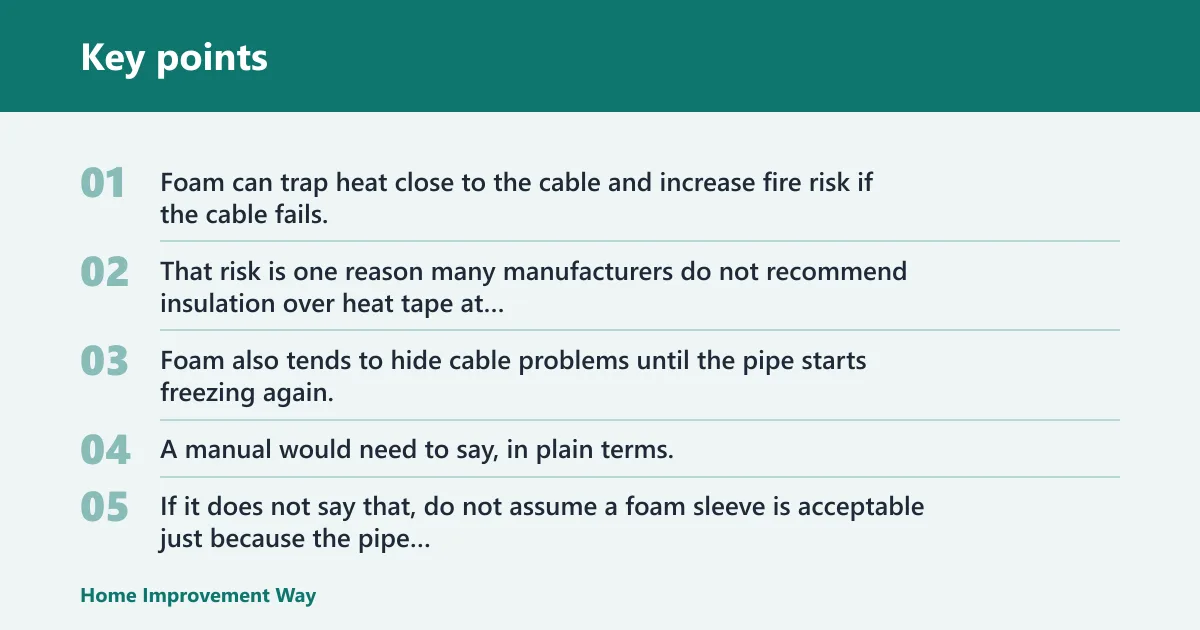
Foam can trap heat close to the cable and increase fire risk if the cable fails, overheats, or is installed incorrectly. That risk is one reason many manufacturers do not recommend insulation over heat tape at all. Foam also tends to hide cable problems until the pipe starts freezing again.
When a manual may allow foam
A manual would need to say, in plain terms, that a specific foam sleeve is approved for that cable and that installation method. If it does not say that, do not assume a foam sleeve is acceptable just because the pipe is indoors or because the cable is self-regulating.
How to handle existing foam sleeves
If foam is already installed, check whether the cable is running through it, under it, or taped to the pipe beside it. If the cable is hidden and the manual does not allow that arrangement, remove or open the foam where needed so the approved parts of the system remain visible and accessible.
Suppose a homeowner already wrapped about a 1-inch foam sleeve over a cable on a PVC line in a utility room. If the product instructions do not explicitly allow foam coverage on that model, the safer move is to open the sleeve or replace it with the approved material rather than assume the fit is acceptable.
Can you use fiberglass insulation?
Fiberglass insulation is often the better option when a manual allows coverage. It is non-flammable compared with foam sleeves, and some manufacturers recommend half-inch fiberglass insulation in certain applications. Even then, the exact thickness, placement, and moisture details still have to match the product instructions.
Thickness and coverage limits
Do not add extra thickness just because the pipe is exposed to cold air. Some manuals allow only a specific thickness, and some manufacturer instructions allow half-inch fiberglass insulation. More material is not better if it blocks heat shedding or covers a section that needs inspection access.
Vapor barrier and moisture control
Fiberglass is often paired with a vapor barrier when the manual calls for one. That helps limit moisture buildup around the pipe assembly. Moisture matters because wet insulation loses performance and can create new problems around seams, end seals, or any area where the pipe passes through colder space.
Can I insulate this heat tape?
Use this checklist before you cover any cable. Every answer should be yes before you install insulation over heat tape. If any item is no or uncertain, stop and verify the product manual or replace the cable before continuing.
| Check | Yes | No | What to verify |
|---|---|---|---|
| 1. Cable type is known | □ | □ | Confirm self-regulating, thermostat-controlled, or constant-wattage. |
| 2. Manual allows insulation | □ | □ | Look for explicit approval, not a general assumption. |
| 3. Insulation material is approved | □ | □ | Use the material named in the instructions, often fiberglass or another non-flammable option. |
| 4. Thickness matches the instructions | □ | □ | Use the exact thickness stated in the manual, such as half-inch where specified. |
| 5. Wet-location rating is suitable | □ | □ | Check whether the cable is listed for damp or wet locations. |
| 6. Plastic pipe rule is clear | □ | □ | Confirm whether PVC or similar pipe is approved with this exact product. |
| 7. Thermostat requirement is met | □ | □ | Use the control method the manual requires for the pipe type and location. |
| 8. GFCI power is in place | □ | □ | Plug into a grounded GFCI outlet when required or recommended. |
| 9. End seals have clearance | □ | □ | Leave end seals, splices, and terminations accessible and uncovered as directed. |
| 10. Inspection access remains | □ | □ | Make sure you can check the cable later without removing the whole wrap. |
What should you check before covering the pipe?
Check the product label, the certification, and every service point before you bury the cable under insulation. Modern heat tape should be UL or CSA certified, but listing alone does not confirm that the cable is approved to be insulated. You still need the manual to verify that the cable may be covered. Those checks matter, but they do not override the manual.
UL listing and product label
Look for the exact product identification and a certification mark that matches the application. The label should also tell you whether the cable is self-regulating, thermostat-controlled, or constant-wattage. If the label and the manual disagree, the manual wins for installation details.
End seals, splices, and valves
End seals and splices should remain visible, protected, and installed exactly as the manual directs when the manual says they must remain accessible. Valves are another trouble spot because they often need room for inspection and future service. Do not pack insulation tightly around these parts unless the manual says that is acceptable.
Access for future inspection
Heat tape should be checked regularly, especially if it is old, patched, or has been in a wet area. If the cable looks cracked, discolored, or water-damaged, replace it instead of covering it.
Heat tape should not be submerged in water. If the pipe area has standing water, chronic leaks, or a wet crawlspace, solve that problem first. Covering a wet or damaged cable with insulation hides the failure and can make the electrical risk harder to spot.
Frequently asked questions
Can you put insulation over heat tape?
Usually only if the manufacturer says you can. Some products allow a specific insulation type and thickness, while others do not. Check the exact manual, the pipe material, and the cable type before you cover anything.
Do you put insulation over heat tape?
Not as a default. The right answer depends on the product instructions. Some systems allow fiberglass or another non-flammable layer, while foam is a poor default choice because it varies by material and fire rating. If the manual is silent, do not cover the cable.
Can you put pipe insulation over heat tape?
Sometimes, yes, but only with an approved pipe insulation material and an approved installation method. Fiberglass pipe insulation is the more common non-flammable option when a manual allows coverage. The thickness and the way seams, valves, and end seals are handled still have to match the instructions.
Can you put foam insulation over heat tape?
Usually not, unless the product manual explicitly allows that exact foam material. Foam pipe insulation varies by material and fire rating, so it is not the safest default over heat tape. If foam is already installed, verify whether the cable is allowed under it before leaving it in place.
Can you put fiberglass insulation over heat tape?
Often, yes, if the manufacturer approves it. Half-inch fiberglass insulation over heat tape in certain applications, and some require only fiberglass or another non-flammable material. Keep end seals, splices, and inspection points accessible, and follow any limits on thickness.
Can you put insulation around heat tape?
You can only do that when the product instructions allow it. Some manufacturers do not want insulation directly over heat tape because it can trap heat. If the cable is on plastic pipe, in a wet location, or near valves and end seals, the manual becomes even more important.
Sponsored / affiliate links. As an Amazon Associate I earn from qualifying purchases. I may earn additional commission from eligible campaigns.