Can You Use Heat Tape on PVC Pipe?
Yes, but only if the heat tape is listed for plastic pipe and paired with a thermostat; self-regulating cable is the safer choice for PVC, while constant-wattage tape can overheat it. Bad installation can warp the pipe, damage fittings, or leave you with a burst line after a freeze. This guide explains when PVC is compatible, which product to buy, and how to install it without deformation.
This guide is part of our Frozen Pipes: How to Prevent, Thaw and Fix Them series.
PVC pipe decision table


Use this table to match the pipe type, location, and product choice before you buy anything. The safest answer changes with the pipe’s job and where it sits, especially where the pipe is exposed, damp, or hard to inspect.
| Pipe type | Location | Recommendation | Required heat tape type | Insulation allowed? | Main failure risk |
|---|---|---|---|---|---|
| PVC supply line | Exposed outdoors | Conditional yes | Self-regulating heat cable rated for plastic pipe, with thermostat | Only if the label allows it | Softening at hot spots, especially at elbows and valves |
| PVC supply line | Crawl space | Conditional yes | Self-regulating heat cable rated for plastic pipe, on a GFCI outlet | Only if approved by the manufacturer | Overheating under insulation or at cable crossings |
| PVC supply line | Inside a wall | No | Do not install heat tape here | No | Hidden deformation, fire risk, and no way to inspect the run |
| PVC drain pipe | Exposed outdoors | Usually no, unless a manufacturer specifically allows the use and the run is exposed and inspectable | Only a product labeled safe for that pipe and setup | Only if approved | Drain lines are often larger, sloped, and harder to heat evenly |
| PVC drain pipe | Crawl space | Usually no for typical homeowner installs | Not a default choice | Only if explicitly approved | Trapped heat near fittings and inaccessible sections |
| PVC drain pipe | Inside a wall | No | Do not install heat tape here | No | Enclosed heat build-up and hidden damage |
| Black plastic pipe | Exposed outdoors | Often yes if the pipe and tape are both rated for it | Self-regulating cable rated for plastic pipe | Only if the label permits it | Overheating if the pipe is covered too tightly or the cable crosses itself |
| Black plastic pipe | Crawl space | Conditional yes | Self-regulating cable with thermostat and GFCI protection | Only if approved | Heat trapped under insulation or near supports |
| Black plastic pipe | Inside a wall | No | Do not install heat tape here | No | Inaccessible failure and concealed overheating |
Can you use heat tape on PVC pipe?
Yes, if the product is specifically labeled for plastic pipe and installed the way the manufacturer requires. Self-regulating cable is the safer choice for PVC because its output drops as it warms, while constant-wattage tape needs much tighter control and a thermostat to limit hot spots.
Short answer for PVC supply lines
PVC supply lines can use heat tape only when the run is exposed, inspectable, and the tape is approved for plastic pipe. Supply lines are pressurized, so overheating is a bigger problem at elbows, valves, unions, and any place where cable crosses itself or insulation changes.
Short answer for PVC drain lines
PVC drain lines are a weaker candidate for heat tape. They are often unpressurized but may be longer, sloped, and harder to heat evenly. If the pipe is inside a wall, buried, or boxed in, the safer answer is no because hidden heat can deform the pipe without being noticed.
When the answer is no
Do not use heat tape on PVC that is enclosed in a wall, buried, or otherwise inaccessible. Do not use it on brittle, sun-damaged, or visibly cracked pipe until those sections are replaced. If the run has solvent-cement joints that already look stressed, added heat can push a weak spot into failure.
What kind of heat tape is safe?
The safest choice for PVC is self-regulating heat cable listed for plastic pipe. It adjusts output as the pipe warms, which lowers the chance of a hot spot at fittings or overlaps. Constant-wattage heat tape can work only with much tighter control and temperature regulation.
Self-regulating heat cable
Self-regulating cable is the preferred option for PVC because it reduces electrical flow as it warms. That behavior matters on plastic pipe, where a single crossing, tight wrap, or insulated section can trap heat. It is still not universal, so the label has to mention plastic pipe.
Constant-wattage heat tape
Constant-wattage tape gives off fixed heat output, so it carries more overheating risk on PVC. If a manufacturer allows it at all, use a thermostat or temperature regulator and keep the installation very controlled. Without that control, the pipe can soften long before the user notices a problem.
Thermostat or temperature regulator
A thermostat or temperature regulator lowers the risk of overheating when the product is not self-regulating. For PVC, that control matters because the pipe begins softening around 140°F, reaches its structural distortion point near 158°F, and Schedule 40 PVC has a listed max continuous temp of 140°F.
Why PVC needs extra caution
PVC is less forgiving than metal pipe. It can soften, deform, or melt if it is heated too much, and the danger is not only the tape itself. Trapped heat at fittings, overlaps, and insulation transitions can create a localized failure even when the rest of the line seems fine.
Softening temperature and melt risk
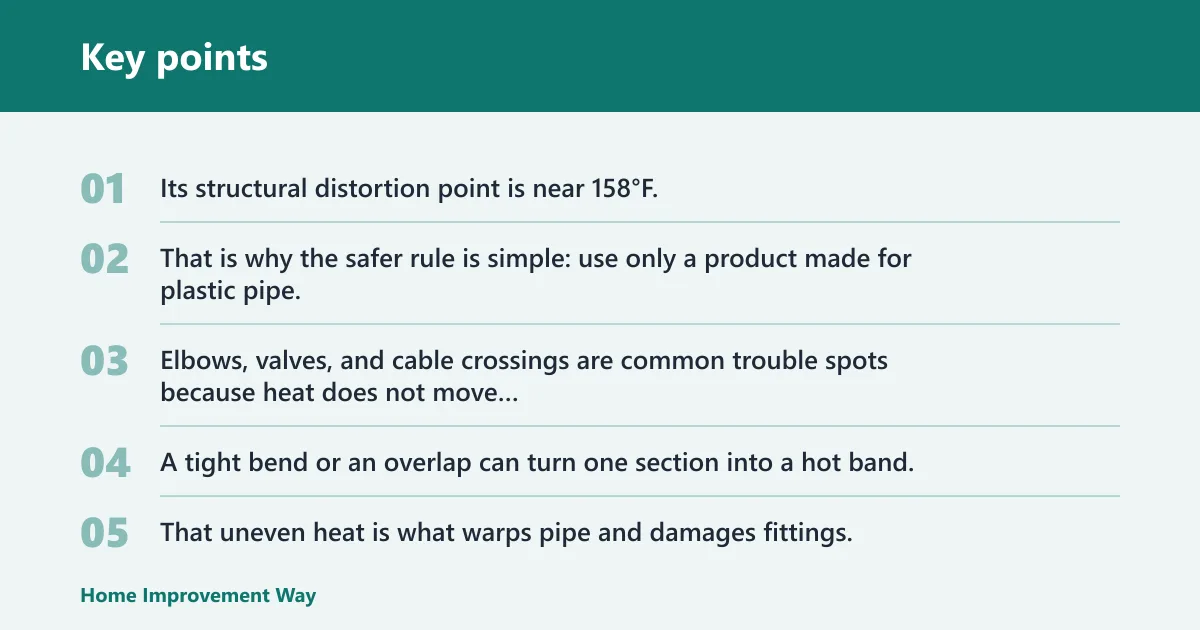
PVC pipe starts softening around 140°F. Its structural distortion point is near 158°F, and a product table may list standard PVC at about 176°F for softening in some references, which shows how much published values can vary. That is why the safer rule is simple: use only a product made for plastic pipe.
Hot spots at elbows, valves, and overlaps
Elbows, valves, and cable crossings are common trouble spots because heat does not move evenly there. A tight bend or an overlap can turn one section into a hot band, while the rest of the line stays cooler. That uneven heat is what warps pipe and damages fittings.
Say your 1-inch PVC supply line runs along a basement wall and passes through a valve before turning upward. If the cable crosses itself at the valve body, that small overlap can heat much more than the straight run, even though the rest of the pipe feels only mildly warm.
Solvent-cement joint concerns
Solvent-cement joints depend on sound plastic around the fitting. If the joint is already aged, sun-damaged, or brittle, added heat can stress the connection and make a leak more likely. Replace weak sections first instead of trying to warm around a bad joint.
Can you use heat tape on PVC pipe outside?
Yes, if the pipe is exposed outdoors and the heat cable is listed for plastic pipe. Outdoor exposure is one of the more common use cases because the pipe is visible and easier to inspect. The setup still has to follow the label, the thermostat instructions, and the outlet requirements.
Exposed outdoor pipe only
Outdoor use is generally acceptable only on exposed piping that can be inspected and maintained. If the pipe is hidden behind siding, buried, or wrapped where you cannot see the full run, the risk rises fast. Outdoor-rated and indoor-rated products should not be swapped.
When insulation is allowed
Foam pipe insulation can help, but only if the heat tape manufacturer says it is allowed with that exact product. Insulation can improve freeze protection, yet it can also trap excess heat if the cable is not rated for covered use. Never assume every plastic-pipe cable is insulation-safe.
Why buried or enclosed pipe is different
Buried pipe, pipe inside a wall, and pipe boxed in by finishes are poor candidates because they are hard to inspect and harder to cool if something goes wrong. Heat tape should be used only on exposed piping, not in walls. Hidden heat can deform the pipe, and you may not notice until the line fails.
How to install it safely
Follow the manufacturer instructions exactly. That means using the right pipe rating, the right power source, the right fastening method, and the right coverage pattern. The goal is even contact, no hot spots, and no trapped heat around fittings or insulation transitions.
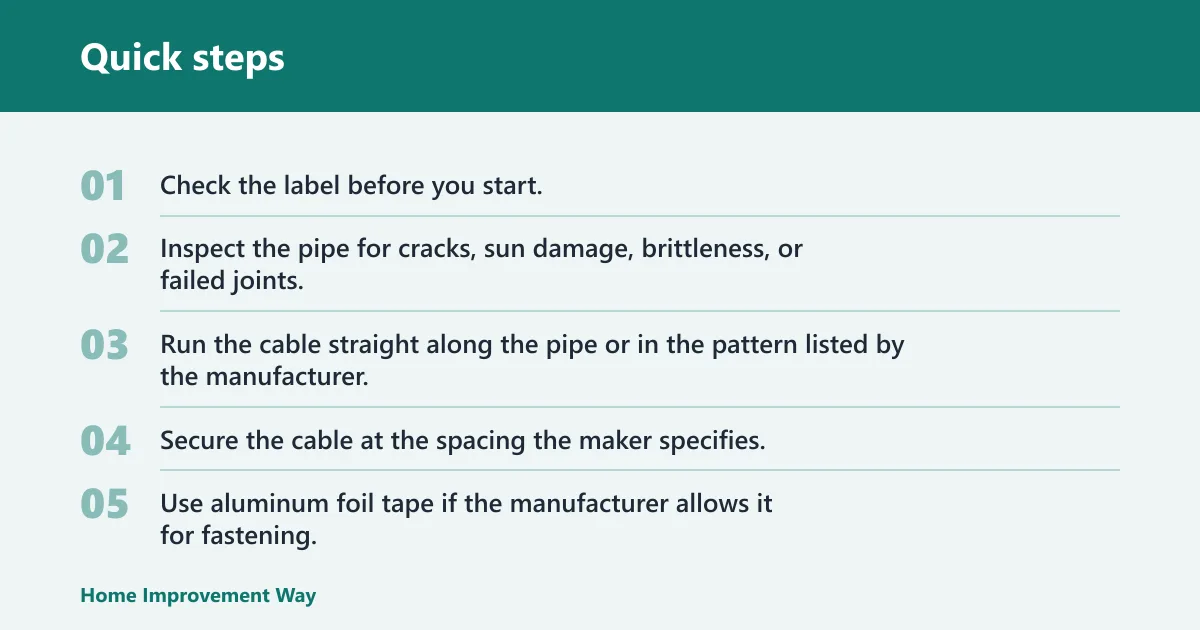
- Check the label before you start. Confirm that the product is labeled safe for PVC or plastic pipe and, if needed, approved for insulation.
- Inspect the pipe for cracks, sun damage, brittleness, or failed joints. Replace damaged sections first.
- Run the cable straight along the pipe or in the pattern listed by the manufacturer. Do not wrap it over itself.
- Secure the cable at the spacing the maker specifies. Hunker says to secure heat tape at least every 2 feet.
- Use aluminum foil tape if the manufacturer allows it for fastening, because it improves thermal contact. Do not use duct tape as a substitute for approved fastening.
- Plug the unit directly into a three-prong GFCI outlet. Hunker says never to use an extension cord with heat tape.
- Add insulation only if the product label permits it, and keep vents, valves, and other hot spots from being buried too tightly.
Avoid tight wrapping and overlap
Never wrap heat tape over itself. Do not bunch it at elbows or valves. A tight wrap can create a hot spot that deforms PVC before the thermostat has a chance to limit the damage. If the pipe changes direction, keep the cable layout smooth and even.
Use a GFCI outlet
A GFCI-protected outlet is part of the safer electrical setup, especially in damp crawl spaces and basements. The outlet should be a direct three-prong connection, not an extension cord chain. That setup reduces electrical hazard where water exposure is more likely.
What to do before winter hits
Inspect the pipe before freezing weather starts. PVC that is already brittle or sun-damaged is a bad candidate for heat tape until the damaged section is replaced. Also confirm that the product is rated for the place where you plan to use it, such as outdoors or indoors.
A common first-timer mistake is buying roof de-icing cable instead of pipe heat tape. Those products are not the same. Roof cable is made for a different surface and a different heat pattern, so do not assume it is safe on PVC water lines.
Replace damaged sections first
If the pipe has cracks, chalking from sun exposure, or soft spots near old solvent-cement joints, fix those issues before adding heat. Heat tape is freeze protection, not a repair for weak PVC. A damaged line under heat is still a damaged line.
Confirm indoor versus outdoor ratings
Indoor-rated and outdoor-rated products generally should not be swapped. Outdoor use adds moisture, temperature swings, and more exposure at the power connection. Indoor cable may not have the same jacket or plug protection, so the rating has to match the setting exactly.
Frequently asked questions
Can you use heat tape on PVC pipe in the winter?
Yes, winter is exactly when many homeowners add it, but only on exposed PVC that is rated for plastic pipe and only with the correct installation. Cold weather does not make a bad product safe. You still need a thermostat, a GFCI outlet, and careful routing.
Can you use heat tape on plastic pipes?
Sometimes, yes. Plastic pipe includes more than PVC, so the label has to say it is safe for the exact pipe material. Self-regulating cable is usually the better choice because it lowers output as the pipe warms, which helps limit hot spots and deformation.
Can you use heat trace on PVC pipe?
Yes, if “heat trace” means a pipe-specific heating cable that is listed for plastic pipe. The key is not the name but the rating and the installation. A product meant for roof de-icing, or one without a plastic-pipe listing, should not be used on PVC.
Can you use heat tape on PVC drain pipe?
Only in limited cases, and usually not as a default homeowner fix. Drain lines are often harder to heat evenly and may be hidden or sloped in ways that trap warmth near fittings. If the drain pipe is inside a wall or buried, the safer answer is no because hidden heat can deform the pipe.
Can you put heat tape around PVC pipe?
You can put it along the pipe only if the manufacturer allows that layout, but you should not wrap it tightly around the pipe unless the product is specifically designed for that method. Tight wraps, overlaps, and cable crossings can create hot spots that deform PVC.
Can you put heat tape in PVC pipe?
No. Heat tape is generally placed on the outside of the pipe, and only when the pipe is exposed and the product is rated for that use. Inside-the-pipe placement is not the same as freeze protection on the exterior, and it creates a very different safety problem.
What kind of heat tape is safe for PVC pipe?
Self-regulating heat cable rated for plastic pipe is the safer choice. It is better than constant-wattage tape because it reduces output as the temperature rises. If you use a product that is not self-regulating, a thermostat or temperature regulator becomes much more important.
Sponsored / affiliate links. As an Amazon Associate I earn from qualifying purchases. I may earn additional commission from eligible campaigns.