How Long Does It Take for Frozen Pipes to Thaw on Their Own?
A frozen pipe may thaw on its own in rough hours-long ranges once the surrounding space warms, but the wait depends on pipe location, exposure, airflow, insulation, and whether heat is actually reaching the frozen section. If you still have no water after several hours, or if the pipe remains exposed to freezing conditions, treat it as a burst-pipe risk and act quickly.
How long do frozen pipes take to thaw?
Most how long it takes pipes to freeze situations thaw in hours, not minutes, once the area around the pipe warms up. The timeline can stretch much longer if the pipe is in a wall, under insulation, or still sitting in very cold air. Pipes near indoor heat may recover sooner than lines in garages, crawl spaces, attics, or exterior walls.
Thaw timeline by location
| Pipe situation | Likely passive thaw range | Warning signs to watch | Stop waiting and call a plumber |
|---|---|---|---|
| Unheated exposed pipe | 1 to 6 hours after the space warms | No water, icy residue, or a pipe that stays cold after the room warms | If no flow returns after several hours, or if you see a bulge, crack, or dampness |
| Lightly insulated basement pipe | 3 to 12 hours | Trickle flow, whistling, banging, or clanking noises | If the flow stays weak, changes suddenly, or the pipe is in a finished wall nearby |
| Interior cabinet pipe | 1 to 6 hours | Cold cabinet space, no water at the faucet, or a slow return of flow | If the cabinet area warms but the line stays frozen, or if you notice moisture under the sink |
| Pipe inside a wall | More than a day, and sometimes not at all without help | Noise in the wall, a damp wall surface, or visible damage on nearby trim or drywall | If there is no flow, if the wall shows wet spots, or if you cannot inspect the pipe directly |
What changes thaw time?
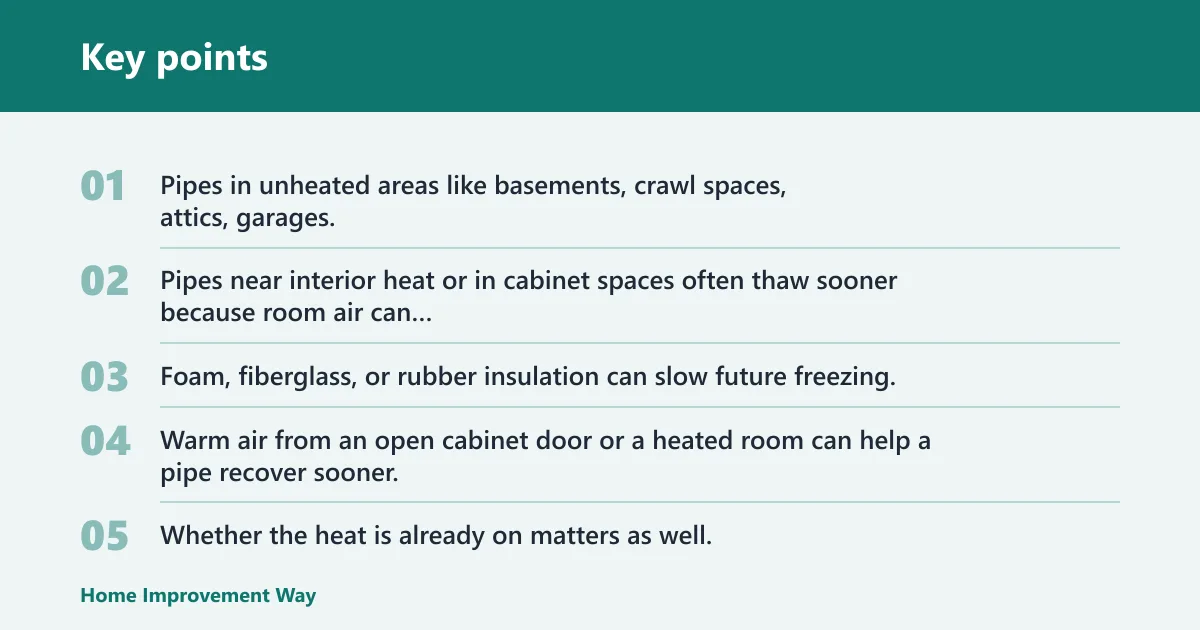
Pipe location matters most. Pipes in unheated areas like basements, crawl spaces, attics, garages, and exterior walls lose heat fast and may stay frozen longer. Pipes near interior heat or in cabinet spaces often thaw sooner because room air can reach them.
Insulation and airflow change the pace too. Foam, fiberglass, or rubber insulation can slow future freezing, but it does not fix a current freeze. Warm air from an open cabinet door or a heated room can help a pipe recover sooner, especially near a faucet.
Whether the heat is already on matters as well. If the home is cold, a frozen pipe may stay frozen even after outdoor temperatures rise. If the heat is already running, the pipe may thaw gradually as nearby surfaces warm, so indoor conditions matter as much as the weather outside.
Water freezes at 32°F / 0°C, and freezing water expands enough to create damaging pressure inside pipes. Family Handyman notes that this pressure can become extreme as ice forms, which is why a pipe can fail even if the blockage seems small. (Familyhandyman)
Can a frozen pipe thaw on its own?
Yes, a frozen pipe can thaw on its own if the temperature around it rises and the pipe is still intact. The risk is that thawing can reveal or worsen a crack, so passive thawing only makes sense when you can watch the line closely and reach the shut-off quickly if needed.
When passive thawing is still plausible
how to thaw frozen pipes fast is usually a question of access and monitoring. Passive thawing is more reasonable when the pipe is exposed, easy to inspect, and in a space that is warming up. A cabinet pipe under a sink may thaw if you open the door, warm the room, and crack the faucet just enough to let water move and give meltwater an exit.
Say your kitchen faucet is dry, but the cabinet feels much warmer after the thermostat comes up. If the line is visible and dry, you can monitor it for a few hours while keeping the cabinet doors open and the room warm. That is very different from waiting on a pipe hidden in drywall.
When passive thawing is too risky to wait
Do not keep waiting if the frozen section is inside a wall, if you hear water moving where it should not, or if any part of the pipe looks swollen or split. Frozen water expands by about 9%, and pressure can rise enough to rupture a weak spot away from the ice itself. (Familyhandyman)
Frozen pipes do not always burst, but when they do, the damage can happen fast. If you cannot inspect the pipe, or if the line is hidden and still unresponsive after the space warms, treat the situation as higher risk and move toward shut-off and repair.
How can you tell if it already burst?
A burst pipe often shows up as a change in pressure, noise, or visible moisture, but the break may be away from the freeze itself. If water is gone completely, if you hear whistling or banging, or if the wall or ceiling nearby feels damp, assume the pipe may already be failing and stop waiting.
Signs of a frozen pipe
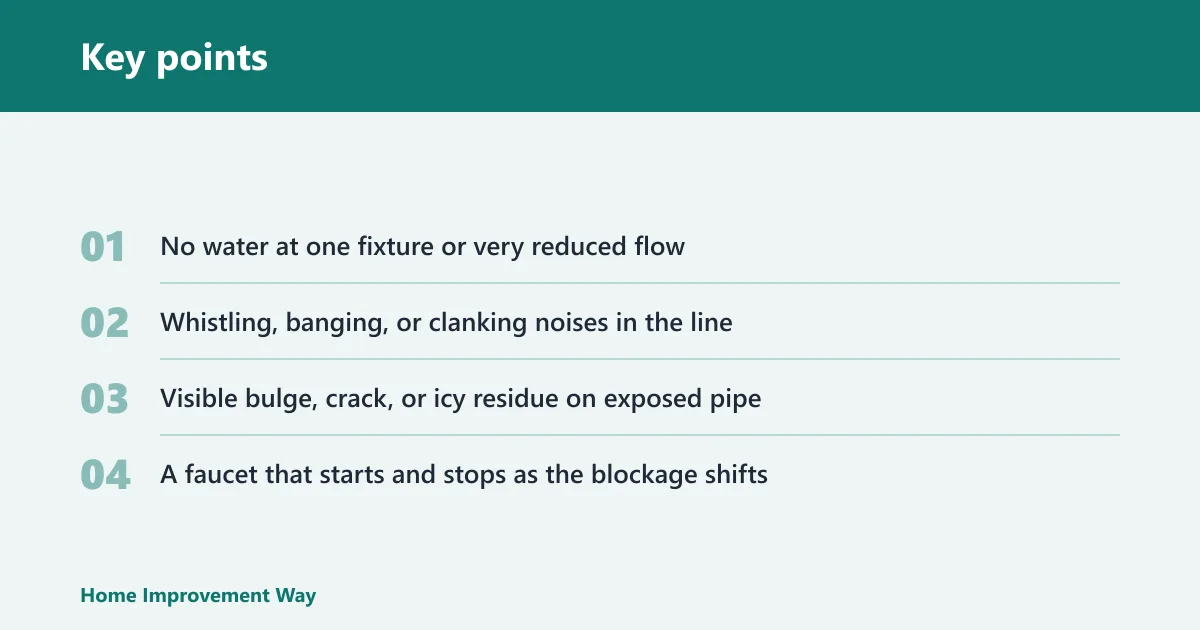
- No water at one fixture or very reduced flow
- Whistling, banging, or clanking noises in the line
- Visible bulge, crack, or icy residue on exposed pipe
- A faucet that starts and stops as the blockage shifts
A hidden break may not show at the freeze point. Look for damp drywall, peeling paint, water stains, a soft floor near the wall, or water sound behind surfaces. If a pipe is inside a wall, any wet spot near that wall is a reason to stop passive thawing and move to the shut-off valve.
Picture a laundry room pipe in an exterior wall that has been frozen since morning. The faucet finally gives a weak trickle, then the wall below it starts to dampen. That change can mean the pipe cracked during thawing, even though the freeze seemed to be clearing.
When to shut off the main water valve
Shut off the main water valve if you see clear leak signs, cannot inspect the pipe, or suspect a burst behind a wall. The main water shut-off valve stops water flow to the house and limits damage when a line fails. Before winter, make sure you know where it is, because emergencies are not the time to search.
You will usually find the main water shut-off valve in a basement, garage, laundry room, utility closet, or yard. If you do not know its location, find it now and clear the path to it. When a pipe bursts, the seconds it takes to locate the valve can matter.
What should you do while waiting for frozen pipes to thaw?
While you wait, keep the area warm, open the faucet slightly, and watch for any sign that the pipe is failing. Use gentle heat only on exposed pipe, start near the faucet and move toward the freeze, and stop immediately if you smell something hot, see water, or find a split in the line.
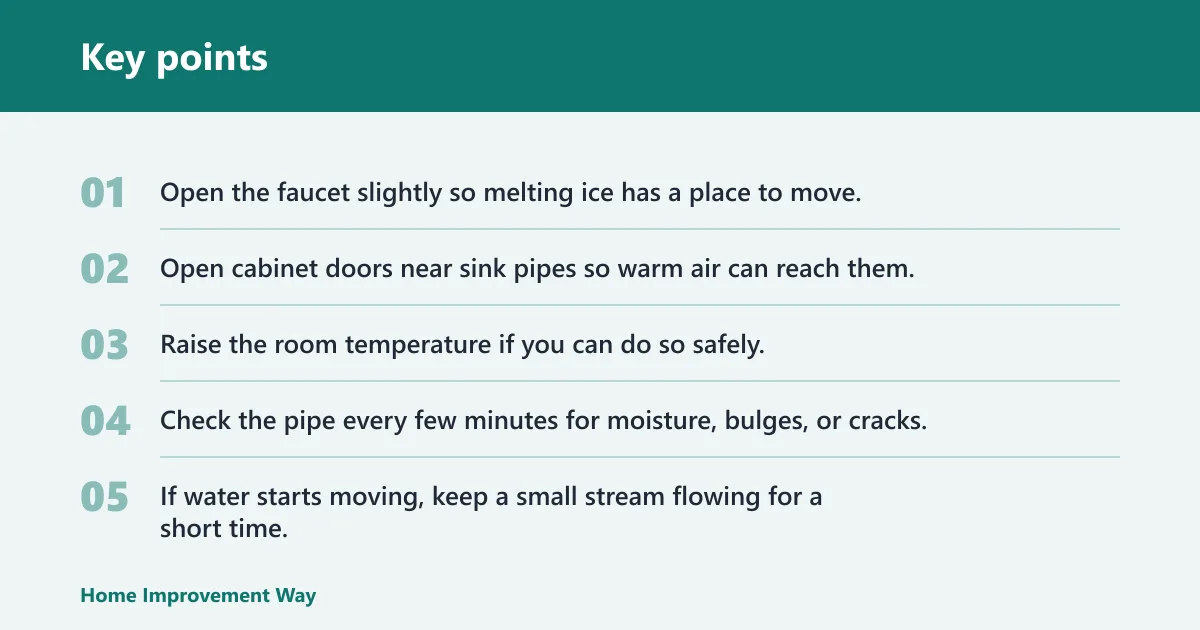
- Open the faucet slightly so melting ice has a place to move.
- Open cabinet doors near sink pipes so warm air can reach them.
- Raise the room temperature if you can do so safely.
- Check the pipe every few minutes for moisture, bulges, or cracks.
- If water starts moving, keep a small stream flowing for a short time.
- Call a plumber if the pipe is hidden, still frozen, or shows damage.
Safe thawing methods and where to start
A hair dryer is a common choice for exposed pipes because it gives controlled heat. A heat gun can work too, but only with caution, since it can overheat one spot quickly. Warm towels or hot water can help on accessible sections, and heat tape is useful for prevention or for some exposed runs after the pipe is thawed and dry.
Start near the faucet and work toward the freeze. That direction gives melting water an escape path and lowers pressure in the line. Do not heat the middle of a frozen section first if the faucet end is still blocked.
What not to use
Do not use an open flame, torch, charcoal heater, or any method that can scorch the pipe or nearby materials. Do not point a space heater at paper, boxes, fabric, or insulation. If a pipe is in a wall, stop and call for help instead of trying to force heat through the surface.
Pipe insulation can help prevent the next freeze, but it will not thaw an active blockage by itself. Use foam, fiberglass, or rubber insulation after the pipe is dry and working again, especially in unheated areas.
How long does it take for pipes to freeze?
Freeze time depends on the pipe’s exposure, but a rough estimate is several hours of sustained cold exposure, and sometimes less for vulnerable locations. Pipes in unheated or windy spaces can freeze faster, while pipes with nearby heat or more insulation may take longer. Because the exact timing varies so much, the safest framing is that freezing can happen surprisingly quickly once heat loss starts.
In many homes, the highest-risk spots are exterior walls, basements, crawl spaces, garages, and attics. If those areas cool quickly, the line may freeze before the rest of the house feels cold. That is why a pipe can stop flowing even when the thermostat still seems reasonable.
What temperature do pipes freeze at?
Water freezes at 32°F / 0°C, and that is the point where pipes can begin to lose flow. The exact freeze risk depends on how much moving air reaches the pipe, how much insulation surrounds it, and how long the cold lasts. A pipe can freeze before the entire room feels frigid.
Outdoor exposure matters as much as the air temperature reading. Wind, gaps in insulation, and contact with cold framing can all speed heat loss, so a pipe in a drafty or unheated area may freeze even when the rest of the home feels only moderately cold.
Frequently asked questions
How long does it take for frozen pipes to thaw on their own?
A frozen pipe may thaw on its own in rough hours-long ranges if the surrounding space warms up, but the wait can be much longer for pipes in walls, crawl spaces, or garages. If you still have no water after several hours, treat the line as a burst risk and inspect it closely.
Will frozen pipes thaw if I just leave the heat on?
Sometimes they will, especially if the pipe is near interior heat and not hidden in a wall. Leaving the heat on is only part of the answer. Open cabinet doors, keep a faucet slightly open, and watch for leaks or sudden pressure changes while the line warms.
How can I tell if a frozen pipe has already burst?
Look for moisture, wet drywall, a bulge, a crack, or water stains near the pipe route. Noise can help too: whistling, banging, or clanking may mean pressure is changing in the line. If the pipe is hidden and you see any sign of water, shut off the main valve right away.
Should I turn off the water if my pipes are frozen?
Turn off the main water supply if you suspect the pipe has burst or if you cannot inspect the frozen section and the risk looks high. If the pipe is visible and intact, you can often monitor it while thawing. The key is to stop water fast if a crack opens during thawing.
Can frozen pipes thaw without bursting?
Yes, many frozen pipes thaw without bursting, especially if they are still intact and thaw slowly. The risk rises when the pipe has already weakened, when the freeze is in a wall, or when thawing happens suddenly. That is why steady monitoring matters from the moment flow drops or stops.
Sponsored / affiliate links. As an Amazon Associate I earn from qualifying purchases. I may earn additional commission from eligible campaigns.