Water Softener and Filtration Guide for Your Home
Test first: hardness above 7 grains per gallon points to a softener, chlorine, sediment, or iron points to filtration, and many homes need filter-first, softener-second staging. I have seen this go wrong many times. Put the equipment in the wrong order and you foul resin, miss the real contaminant, and spend thousands on short-lived appliances and plumbing repairs. This guide shows how to read the symptoms, compare city-water and well-water setups, choose treatment order, and size each stage correctly.
Start with the water test, not the equipment


What to test before buying anything
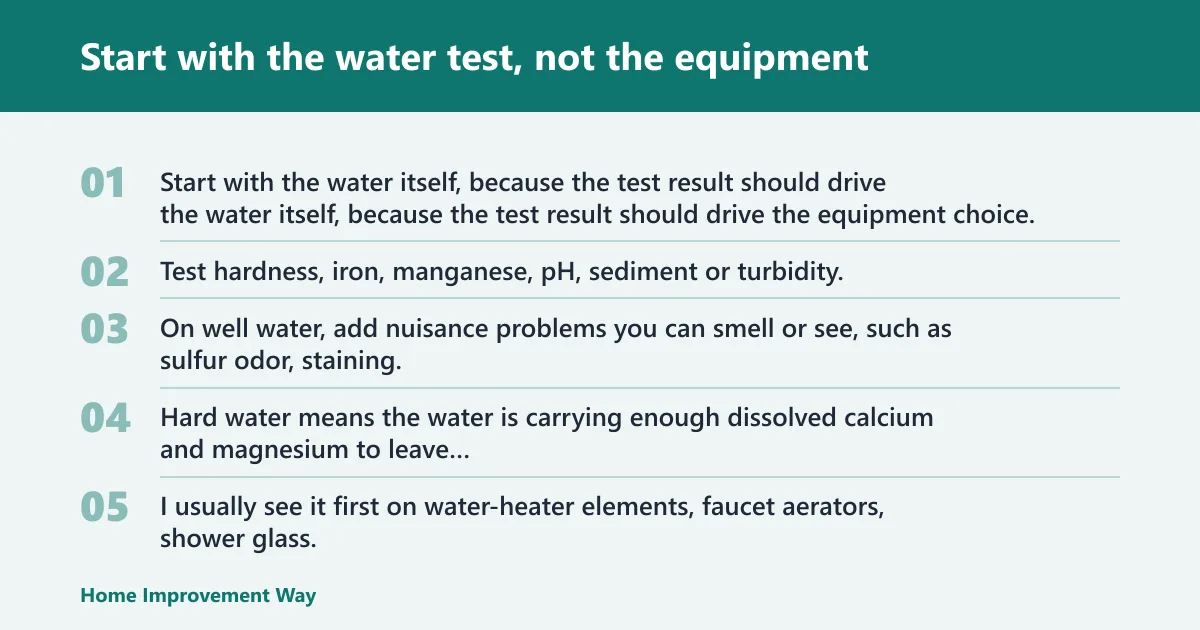
Start with the water itself, because the test result should drive the equipment choice. Test hardness, iron, manganese, pH, sediment or turbidity, and source-specific issues such as chlorine or chloramine for city water. On well water, add nuisance problems you can smell or see, such as sulfur odor, staining, or recurring grit.
Hard water means the water is carrying enough dissolved calcium and magnesium to leave scale where it dries or gets heated. I usually see it first on water-heater elements, faucet aerators, shower glass, and inside kettles. Weak soap lather and spots on dishes also point to hardness, but symptoms alone are not enough to size a system.
When an in-home kit is enough and when to use a certified lab
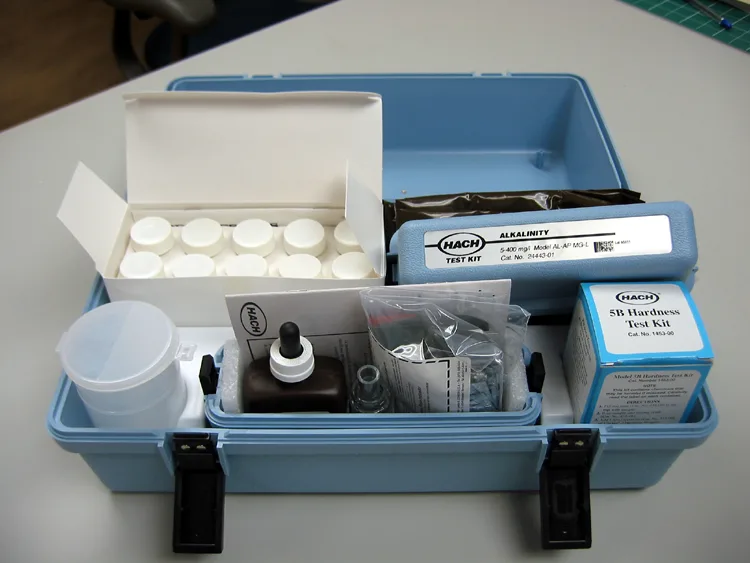
In-home hard-water test kits cost about $15 to $35. They work well for a first pass when the main question is, “Do I have hardness, and is it mild or clearly heavy?” They also help check whether a softener is still working after installation.
A certified water-testing laboratory can provide a full report for about $100. I think that money is well spent when the home uses well water, when iron staining is present, when chlorine or chloramine treatment needs confirmation, or when more than one symptom shows up at once.
How city water and well water change the test list
City water usually pushes the list toward chlorine or chloramine, taste, odor, and hardness. Sediment can still show up, especially after main work, but disinfectant residual is the bigger clue because it affects carbon filter choice and can shorten resin life if left unchecked.
Well water usually pushes the list toward sediment, iron, manganese, pH, sulfur odor, and hardness. The order matters more on a well because raw water can foul downstream equipment fast. A softener placed ahead of iron or grit control often becomes the sacrificial part.
How to read results for hardness, iron, sediment, chlorine, and pH
Read the report as a sequence problem, not a shopping list. Water hardness above roughly 7 grains per gallon often points toward considering a water softener. Any visible grit, cloudy water, recurring clogged aerators, or pressure-drop complaints push sediment filtration ahead of the softener.
Iron changes the stack. If staining, metallic taste, or orange-brown deposits match the test, treat iron before assuming the softener can carry the load. Chlorine or chloramine points toward whole-house filtration on city water. Low pH can affect media choice and equipment life, so it belongs in the plan before final sizing.
📊 About 85 percent of American households have hard water. Source: How Does a Water Softener Work?.
Matching system type to specific water quality goals
Different water problems require distinct hardware. A water softener specifically targets calcium and magnesium ions to prevent scale buildup on fixtures and inside pipes, but it does not remove dissolved solids, chlorine, or contaminants affecting taste. Conversely, a reverse osmosis system filters out these impurities for cleaner drinking water but does not address hard water issues in the rest of the house.
If your main concern is protecting plumbing investment from limescale, a softener is the priority. If your goal is improving tap water taste or removing specific dissolved minerals at a single point of use, reverse osmosis is the better fit. Many households eventually need both systems working in tandem to handle hardness at the source and refine quality at the faucet. For a detailed breakdown of how these technologies differ in function, removal capabilities, and maintenance requirements, explore the water softener vs RO comparison.
What does a water softener do and what does a filter do?
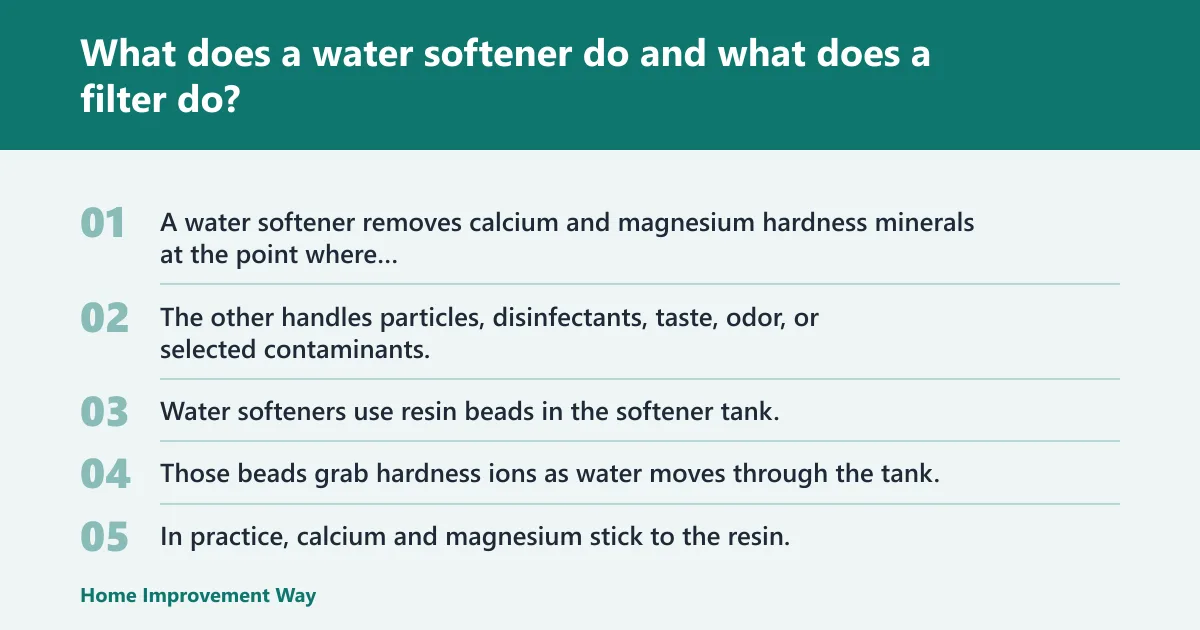
A water softener removes calcium and magnesium hardness minerals at the point where water enters the house by sending water through ion-exchange resin, while a whole-house filter targets contaminants such as chlorine, chloramine, sediment, and other source-specific issues depending on the media. One handles hardness. The other handles particles, disinfectants, taste, odor, or selected contaminants.
What a water softener removes and how ion exchange resin works
Water softeners use resin beads in the softener tank. Those beads grab hardness ions as water moves through the tank. In practice, calcium and magnesium stick to the resin, and sodium or potassium already on the beads swaps into the water in their place.
The resin has finite capacity. Once the resin is loaded, the system has to regenerate. Regeneration begins automatically when the system reaches a preprogrammed setting. The paired brine tank can be filled with salt pellets or potassium chloride pellets, and that brine restores the resin for the next service cycle.
A softener is usually installed where the main water line enters the home so it treats all indoor fixtures and appliances. That protects the water heater, dishwasher, washing machine, shower valves, and hot-water lines from scale buildup over time.
What a whole-house filter removes and how media choice changes the result
A whole-house water filter treats all incoming water, and what it removes depends on the filter media chosen. Carbon media can target chlorine, chloramine, taste, and odor. Sediment filters catch grit and debris. Specialty media can address selected nuisance contaminants when the test points that way.
This is where many buying mistakes happen. A carbon tank does not remove hardness minerals. A sediment cartridge does not solve chlorine taste. An iron filter is chosen for iron type and concentration, not because the box says “whole house.”
What neither system solves on its own
A softener generally does not remove chlorine, chloramine, sediment, lead, or bacteria on its own. A whole-house carbon filter does not soften hard water. If the home has more than one problem, it needs a stack in the right order, not one oversized box with a broad label.

How do I know if I need a softener, a filter, or both?
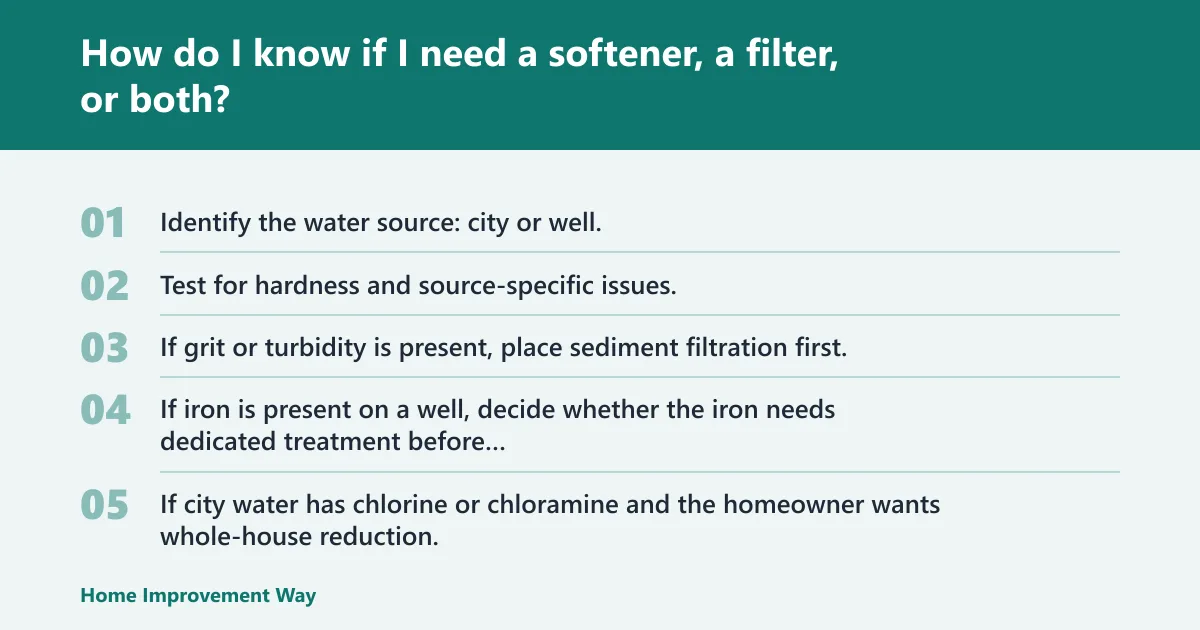
Choose based on the main problem shown by the test and the symptoms. Hardness points to a softener, chlorine or chloramine points to filtration, visible grit needs prefiltration, and iron often needs its own stage. Many homes need both because hardness and another contaminant show up together.
Symptoms that point to hardness
Scale on fixtures, white crust on kettle elements, film on shower glass, weak soap lather, and stiff laundry all point to hard water. About 85 percent of American households have hard water, so it is common, but common does not mean harmless.
Hard water can reduce water heater efficiency, leave deposits in fill valves, and shorten the life of dishwashers, coffee makers, and tankless heat exchangers. The damage is usually slow, which is why many homeowners miss it until an appliance repair call.
Symptoms that point to chlorine, sediment, iron, or other contamination
Pool-like odor at the tap points to chlorine. A medicinal or chemical taste on city water can point to chloramine treatment or a related taste issue. Grit in the tub, cloudy water, or recurring clogged aerators point to sediment. Orange, brown, or black staining pushes the diagnosis toward iron or manganese.
When one system is enough and when a staged setup makes sense
If the test shows hardness only, a softener-only setup can make sense. If the test shows chlorine only and hardness is low, a whole-house carbon filter may be enough. Once hardness combines with chlorine, sediment, or iron, staged treatment usually makes more sense than asking one device to do everything.
A fast decision path for city water versus well water
- Identify the water source: city or well.
- Test for hardness and source-specific issues.
- If grit or turbidity is present, place sediment filtration first.
- If iron is present on a well, decide whether the iron needs dedicated treatment before the softener.
- If city water has chlorine or chloramine and the homeowner wants whole-house reduction, place the right carbon stage where the manufacturer allows and where flow demand can be met.
- Size each stage by service flow, hardness load, and maintenance burden.
Choose treatment order before you choose brands
When a sediment filter goes before the softener
Sediment filtration belongs ahead of the softener when visible grit shows up in a glass, when water is cloudy, when faucet aerators keep plugging, or when pressure drops after heavy water use. In those cases, prefiltration is required, not optional.
The reason is simple. Grit loads the resin bed, scratches valve seals, and shortens cartridge and appliance life downstream. A sediment filter does not have to be installed in every home, but the triggers above make the case.
Where carbon filtration belongs in a city-water setup
Carbon placement depends on water conditions and the limits of the equipment. In many city-water homes with chlorine or chloramine concerns, whole-house carbon is placed ahead of the softener so disinfectants and taste issues are reduced before water reaches the resin. That can help limit resin damage from chlorine exposure.
Some setups place carbon after the softener to protect service flow or simplify maintenance. The deciding factors are source chemistry, valve and media limits, and whole-house flow demand. This is why testing and sizing come before brand comparison.
How iron treatment changes the order on well water
Well water with iron needs a pause before softener selection. Some dissolved ferrous iron can be handled along with hardness in certain cases, but heavy iron, ferric iron, or recurring staining often calls for a dedicated iron filter before the softener.
That order keeps iron from fouling the ion exchange resin. Once resin is iron-fouled, softening capacity falls, pressure can suffer, and regeneration will not fully restore performance.
Common order mistakes that cause resin fouling or pressure loss
The three mistakes I see most often are these: putting a softener before a needed sediment stage, asking carbon media to fix hardness, and sizing filter housings too small so the house sees pressure drop at showers and tub fills. Wrong order is expensive because it hides the real fault until parts wear out.
Decision matrix: match test results to the right system stack
Practical decision matrix
| Test result or symptom | Recommended stack and order | What each stage solves | What it does not solve | Maintenance notes |
|---|---|---|---|---|
| Hardness only; scale, spots, weak lather; no chlorine smell; no grit | Point-of-entry water softener with brine tank | Softener removes calcium and magnesium hardness minerals by ion exchange; protects heater, fixtures, and appliances | Does not remove chlorine, chloramine, sediment, iron staining, lead, or bacteria | Check salt or potassium chloride level; verify regeneration setting; watch for hardness return |
| Hardness plus chlorine on city water; pool-like odor; scale still present | Whole-house carbon filter, then water softener | Carbon stage reduces chlorine taste and odor; softener removes hardness | Carbon does not soften water; softener does not remove chlorine | Monitor carbon media life and pressure drop; keep brine tank filled; confirm service flow can handle peak demand |
| Hardness plus sediment; visible grit, cloudy water, clogged aerators, pressure-drop complaints | Sediment prefilter, then water softener; use cartridge or backwashing sediment stage based on loading | Prefilter protects resin and valves from grit; softener removes hardness | Sediment stage does not remove dissolved hardness; softener does not catch all grit once resin is loaded | Track cartridge change frequency or backwash performance; rising pressure drop means the housing is too small or the filter is overloaded |
| Hardness plus iron on well water; orange staining, metallic taste, resin fouling risk | Iron filter first when iron type or loading demands it, then water softener | Iron filter handles iron burden; softener removes remaining hardness and may polish small residual iron in some setups | Softener alone is a poor choice for heavy iron; iron stage does not remove hardness | Choose iron treatment by iron type and concentration; inspect for staining return and pressure loss |
Why this matrix prevents the wrong stack
This matrix keeps the homeowner from buying a “whole-house” label instead of a treatment sequence. It ties symptoms to exact order, shows what each stage actually does, and points out what each stage leaves behind. That last part matters because disappointment usually starts with assumed removal, not actual removal.
What’s the difference between city water and well water treatment?
City water treatment usually starts with chlorine or chloramine, taste, odor, and hardness, while well-water treatment often starts with sediment, iron, manganese, sulfur odor, pH, and hardness. City systems are usually simpler. Well systems usually need tighter sequencing, more testing, and more upkeep because raw water changes more.
Typical city-water priorities
City water often needs hardness control plus whole-house reduction of chlorine or chloramine if taste, odor, or resin protection is part of the goal. Sediment is sometimes seasonal or tied to utility work, so a sediment stage may be optional unless symptoms show up.
Typical well-water priorities
Well water often needs sediment handling first, then iron or manganese treatment if the lab report and stains support it, then softening if hardness remains. Sulfur odor and low pH can change media choice, tank sizing, and maintenance steps.
Maintenance burden and tradeoffs by water source
City-water systems often mean fewer stages, but carbon media still ages out and pressure drop still needs attention. Well-water systems ask more from the owner: sediment cartridge changes or backwash checks, softener salt loading, occasional sanitizer steps if the system design calls for them, and closer watch on staining or odor changes.
Softener discharge also needs a proper route to the home wastewater system where local plumbing rules allow it. That part is easy to overlook during shopping, yet it affects where tanks can be placed and how serviceable the setup will be.
How do I size a water softener for my home?
Size a softener from three inputs used together: hardness level, household water use, and the resin’s working capacity between regenerations. House size alone is a poor shortcut. A system that is too small regenerates too often, while one sized without regard to flow demand can still disappoint at busy fixtures.
Use hardness, household water use, and resin capacity together
Start with hardness in grains per gallon from the test. Then estimate daily water use from the number of people and how the house is actually used. From there, match a softener whose resin capacity can cover the daily hardness load with reasonable reserve between regenerations.
That reserve matters. A softener sized too tightly can reach exhaustion early, sending hard water into the house before the next cycle. A giant unit picked only for low regeneration frequency can leave water sitting too long between cycles in low-use homes.
How regeneration frequency affects salt use and performance
Ion exchange resin captures hardness ions, but only until its capacity is spent. Regeneration begins automatically when the system reaches a preprogrammed setting. If the settings are wrong, the unit may use extra salt, regenerate too often, or wait too long and leak hardness into service.
What the brine tank does and when potassium chloride makes sense
The brine tank stores the pellets used during regeneration. The brine tank can be filled with salt pellets or potassium chloride pellets. Salt is more common. Potassium chloride is usually considered when sodium addition is a concern or when homeowner preference pushes that direction.
Sizing mistakes that shorten resin life or waste salt
Ignoring chlorine on city water can shorten resin life. Ignoring iron on well water can foul resin. Ignoring real household flow can leave the home with soft water on paper and poor shower performance in practice. Good softener sizing is about capacity and flow, not one or the other.
How should I size a whole-house filter and prefilter?
Size whole-house filters by actual service flow and acceptable pressure drop, then match the media to the contaminant. The most common complaint with whole-house filtration is not bad water quality. It is low pressure from housings that are too small, overloaded cartridges, or media tanks that cannot keep up with peak demand.
Flow rate, service flow, and why pressure drop matters
A filter can have the right media and still be the wrong filter if the housing is too small for the house. Showers, tubs, irrigation fill, and laundry can overlap. If the filter cannot pass that flow without major restriction, the house will feel starved even when the water is clean.
That is why service flow belongs in every buying decision. Pressure-drop monitoring also matters after installation. A clean filter and a loaded filter can behave very differently, so plan enough housing and media volume to avoid nuisance restriction.
Choosing cartridge versus backwashing sediment filtration
Cartridge sediment filters work well where grit loading is light to moderate and predictable. They are simple, easy to inspect, and easy to replace. Backwashing sediment filters fit better where sediment loading is heavier or frequent enough that cartridge changes become a chore and a cost problem.
What prefilter should go before a water softener
The right prefilter is the one that matches the type and amount of particulate present. If the home has occasional grit after city main work, a simple sediment cartridge may be enough. If the home has recurring turbidity, visible debris, or frequent pressure-drop complaints, move up to a more durable sediment stage.
How to avoid undersized housings and nuisance maintenance
Do not size a whole-house filter by bedroom count alone. Look at fixture count, tub fill rate, body sprays, irrigation demands on shared plumbing, and whether the house has a large soaking tub or multiple showers used together. Those real loads reveal whether a compact housing is a fit or a future complaint.
Where should softened water be filtered at point of use?
Most homes benefit from whole-house treatment at the entry point, then targeted point-of-use filtration at the kitchen sink for drinking and cooking. That layout protects plumbing and appliances while giving better tasting water where it matters most, without forcing every gallon in the house through fine drinking-water media.
Whole-house treatment versus kitchen-sink drinking-water filtration
Softened water is fine for bathing, cleaning, and protecting appliances, but many homeowners still want a separate drinking-water filter at the kitchen sink. That small point-of-use stage is a practical place to improve taste, handle refrigerator fill, and avoid overbuilding the whole-house stack.
When to leave outdoor lines unsoftened
Outdoor hose bibs and irrigation lines are often left unsoftened. That saves salt and softener capacity on water that does not need scale protection. It also keeps the system focused on indoor fixtures, the water heater, and appliances where hard-water damage is expensive.
Common plumbing layouts that make maintenance easier
Good layouts include a bypass at each major stage, clear access for cartridge changes, and enough space around the brine tank to load pellets without a wrestling match. Keep the kitchen drinking-water filter easy to reach, because easy service gets done. Hidden service gets postponed.
Frequently asked questions
Do I need both a water softener and a whole-house filter?
Many homes do. If the water test shows hardness plus chlorine, chloramine, sediment, or iron, a staged setup usually works better than one device alone. A softener handles hardness. A whole-house filter handles the specific contaminant the test identifies, provided the media is chosen for that job.
Can a water softener remove chlorine from city water?
No. A water softener removes hardness minerals by ion exchange and does not remove chlorine from city water. If chlorine taste, odor, or resin protection is part of the goal, use a whole-house filter with media intended for chlorine or chloramine reduction.
What contaminants does a whole-house water filter remove?
A whole-house filter can remove chlorine, chloramine, sediment, and some other contaminants depending on the media inside it. It does not remove everything by default. The right answer comes from matching the filter media to the water test, source water, and required service flow.
What should be tested before buying a softener or filter?
Test hardness, iron, manganese, pH, and sediment or turbidity first. On city water, also test for chlorine or chloramine concerns. On well water, include nuisance issues tied to staining, odor, or grit. A basic kit is useful, but a certified lab report is worth the cost for mixed symptoms.
What prefilter should go before a water softener?
A sediment prefilter should go before a softener when there is visible grit, cloudy water, recurring clogged aerators, or pressure-drop symptoms that point to particulate loading. Use a cartridge style for lighter sediment and a backwashing style when loading is heavier or more constant.
Can hard water damage plumbing and appliances?
Yes. Hard water causes scale buildup that can reduce water heater efficiency, narrow passages in valves and aerators, leave deposits on heating elements, and shorten appliance life over time. The damage is often gradual, which is why many homeowners do not connect it to hard water until repairs start.
Sponsored / affiliate links. As an Amazon Associate I earn from qualifying purchases. I may earn additional commission from eligible campaigns.