Water Softener Repair vs Replace: How to Decide
Repair a water softener if the fault is a valve, injector, seal, or timer issue and the unit is under 10 years old; replace it if the resin is exhausted, the tank leaks, or the same failure keeps returning. Choosing wrong can leave hard water untreated and add repeat service calls that cost more than a new system. This guide shows how to judge failure type, age, hardness test results, repeated breakdowns, and household demand.
Repair or replace: the core trade-off
The choice turns on where the fault lives. If the failed part is isolated and the resin, tank, and control head still have useful life, repair keeps costs lower without buying a full new system.
| Decision factor | Water softener repair | replace | Winner |
|---|---|---|---|
| Up-front cost | Usually lower if the failed part is isolated | Higher at the start, but includes a full new system | Water softener repair |
| Age fit | Best when the unit is under 8 to 10 years old | Better when the unit is 10 to 15 or more years old | tie |
| Failure pattern | Good for a valve, timer, seal, injector, or drain-line issue | Better for repeated breakdowns or multiple worn parts | tie |
| Long-run efficiency | Can stay efficient if the resin and valve still perform well | Often better if the old unit uses more salt or regenerates poorly | replace |
| Best use case | Single-part failure on a system that still matches the home | Exhausted resin, cracked tank, or a softener that no longer fits demand | tie |
Up-front cost
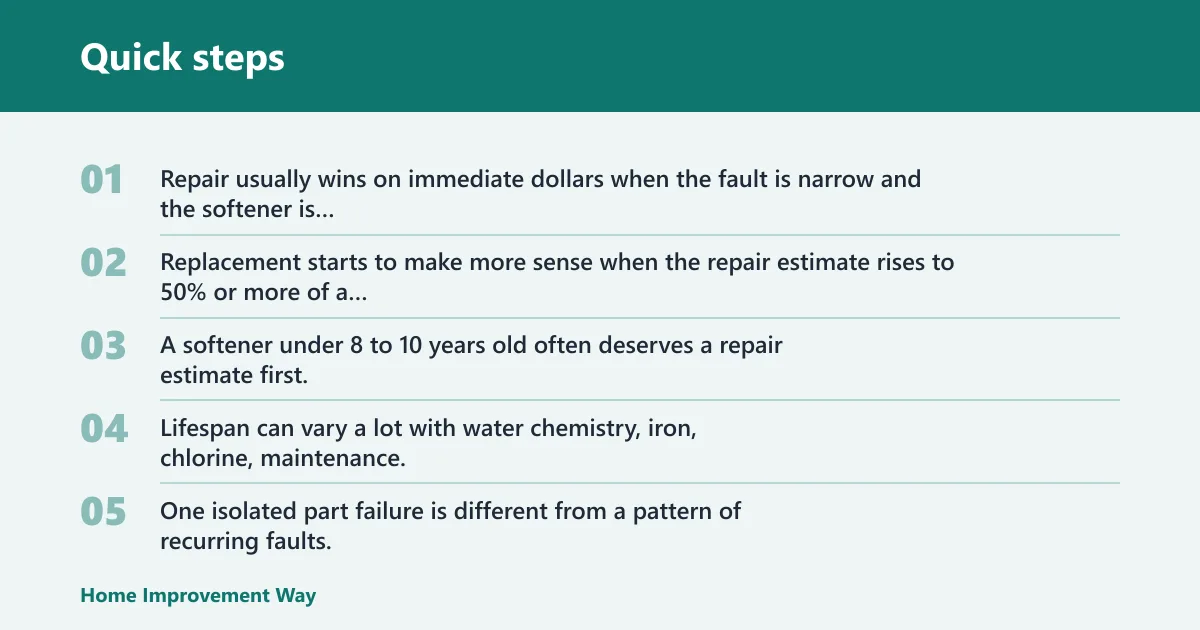
Repair usually wins on immediate dollars when the fault is narrow and the softener is otherwise healthy. Replacement starts to make more sense when the repair estimate rises to 50% or more of a comparable new system and the unit has already had other service calls.
Age fit
Age is a guide, not a verdict. A softener under 8 to 10 years old often deserves a repair estimate first, while a unit at 10 to 15 or more years old is closer to the end of its practical life. Lifespan can vary a lot with water chemistry, iron, chlorine, maintenance, and household usage.
Failure pattern
One isolated part failure is different from a pattern of recurring faults. Repeated breakdowns within 12 to 18 months usually point to a system that is past the point of economical repair.
Long-run efficiency
A repair does not help if the softener still wastes salt or regenerates poorly. If the resin is tired or the valve cannot cycle cleanly, the household may keep paying for extra salt, extra water, and extra service calls.
Best use case
The right answer is the one that matches the failure mode. A sound tank, solid resin bed, and a clean valve body are repair territory; a cracked tank or exhausted resin bed may justify replacement, though resin replacement alone is often a viable repair on an otherwise sound unit.
Water softener problems by failure mode
Break the diagnosis into parts. That keeps plumbing issues separate from true softener failure and makes it easier to see whether the fix is small or system-wide.
Control valve or head unit issues
The control valve, or head unit, manages regeneration and water flow. It is a common repairable component, but damage to the motor, gears, circuit board, or transformer can make replacement more practical than a piecemeal fix.
Resin bed exhaustion or fouling
The resin bed, made of resin beads, is the core softening media. It often lasts about 10 to 15 years, but age, fouling, iron loading, or contamination can leave it unable to exchange hardness ions well enough to solve the problem.
Brine tank, bypass valve, and drain line problems
The brine tank stores salt or potassium chloride and supports regeneration. Salt bridging and mushing can stop brine from forming correctly, while a bypass valve leak or a clogged drain line can create symptoms that look like softener failure even when the resin is still fine.
A cracked tank is a practical replacement trigger. If the vessel itself is compromised, cleaning or a small part swap will not restore safe, reliable service.
Repair or replace?
Start with the symptom, then identify the failed part, then judge the rest of the system. A softener that needs a valve service is not the same as one with hard water returning, a failed resin bed, and a cracked tank.
| Symptom | Likely failed part | Repair likely | replace likely | What to check next |
|---|---|---|---|---|
| No regeneration cycle | Control valve, timer, motor, transformer | Yes | No, unless the head is badly damaged | Check display, power, and whether the valve motor turns |
| Water still feels hard after service | Bypass valve leak, resin bed failure, wrong regeneration setting | Sometimes | Often, if resin is exhausted or the unit is undersized | Test hardness at the tap and confirm the bypass position |
| Salt level stays high | Brine line issue, injector clog, control valve fault | Yes | Only if multiple parts are failing together | Inspect the brine tank for bridging, mush, and blocked tubing |
| Water around the tank or head | Fitting leak, seal failure, cracked tank | Yes for fittings and seals | Yes for a cracked tank | Dry the area and find the exact leak point before deciding |
| Drain backs up during regeneration | Drain line clog or improper routing | Yes | No, unless the valve or tank is also failing | Trace the drain line for kinks, blockage, or backflow |
What to check next before you decide
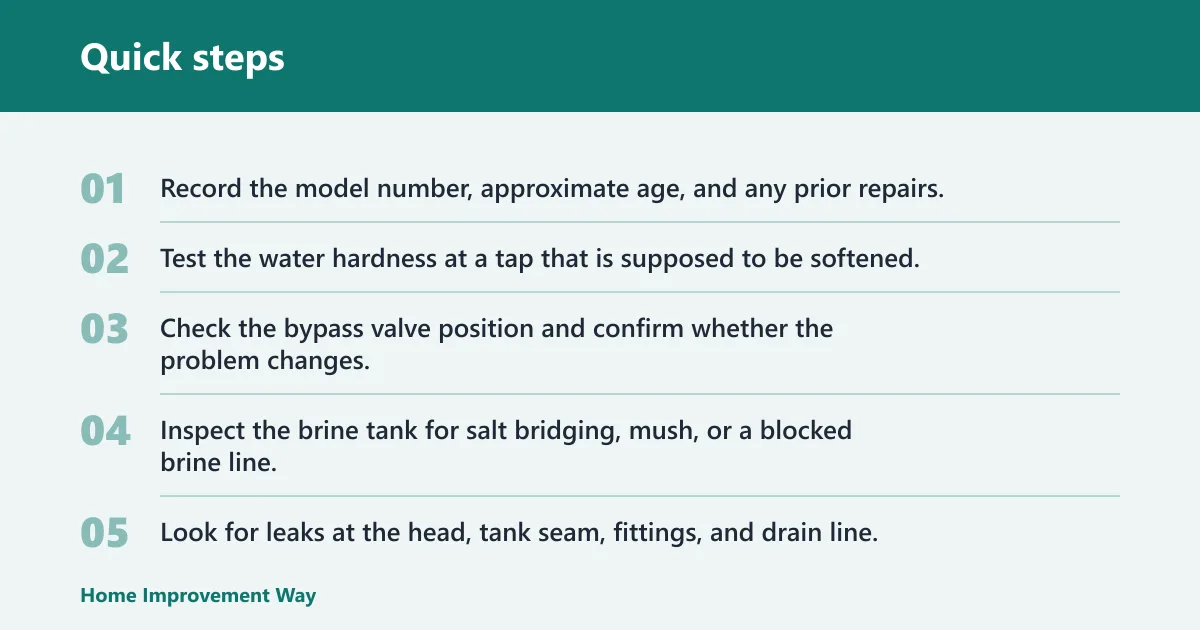
- Record the model number, approximate age, and any prior repairs.
- Test the water hardness at a tap that is supposed to be softened.
- Check the bypass valve position and confirm whether the problem changes.
- Inspect the brine tank for salt bridging, mush, or a blocked brine line.
- Look for leaks at the head, tank seam, fittings, and drain line.
- Ask whether the household has grown or the plumbing layout changed since installation.
How old is too old?
Under 8 to 10 years, repair is often the first move if the failed part is isolated. At 10 to 15 or more years, replacement usually makes more sense, especially if the resin is worn or the softener has needed repeated service. Actual lifespan varies a lot with water chemistry, iron, chlorine, maintenance, and usage.
Under 8-10 years
A younger softener still has a reasonable chance of coming back with a targeted repair. That is especially true when the tank is sound, the resin is not exhausted, and the valve problem is the main fault.
10-15 years and beyond
At this age range, the chance of multiple worn parts rises. If the resin bed is nearing the end of its life or the head unit has failed in more than one area, replacement is usually the cleaner decision.
Why age is only one factor
Age alone should not decide the job. A well-maintained system may still be worth repairing, while a younger unit with a cracked tank, repeated leaks, or a damaged control head may already be past practical repair.
When does hard water mean replacement?
Hard water returning does not always mean the whole softener is dead. It can point to bypass leakage, resin exhaustion, an undersized unit, or a regeneration fault, so the hardness reading should be checked before any replacement call.
Check the hardness reading first
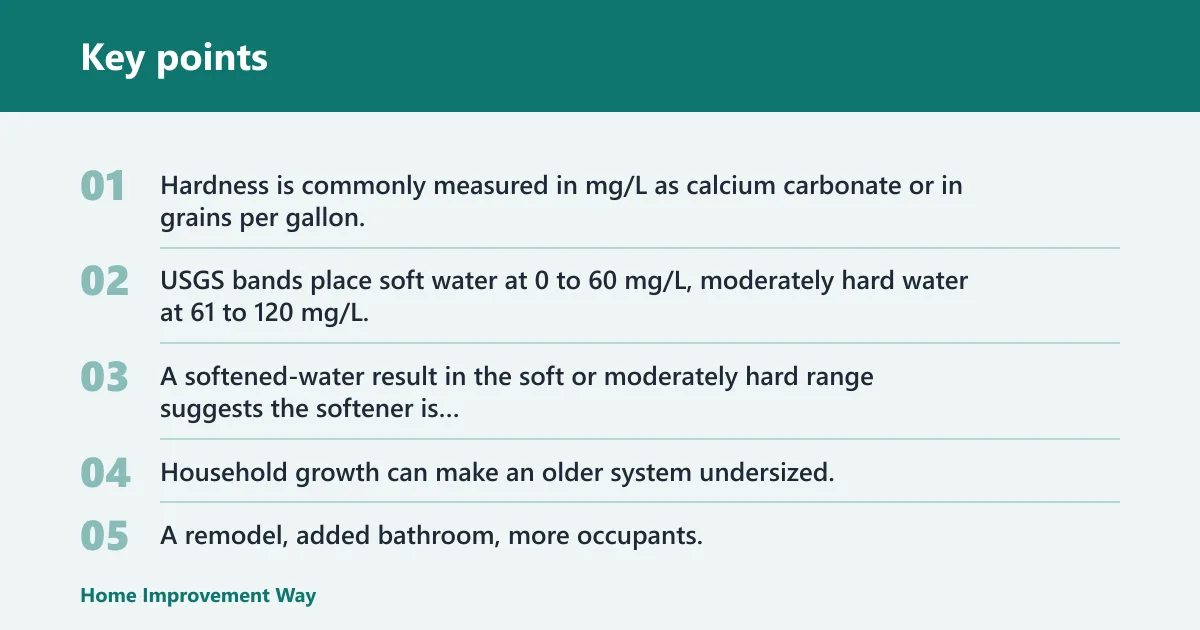
Hardness is commonly measured in mg/L as calcium carbonate or in grains per gallon. USGS bands place soft water at 0 to 60 mg/L, moderately hard water at 61 to 120 mg/L, hard water at 121 to 180 mg/L, and very hard water above 180 mg/L. A softened-water result in the soft or moderately hard range suggests the softener is still working, while water in the hard range or higher means performance has failed.
Spot undersizing after household changes
Household growth can make an older system undersized. A remodel, added bathroom, more occupants, or higher water use can push a unit that once worked well beyond its capacity.
Say your home went from three people to five, and the softener now regenerates more often while the shower still leaves soap film. That pattern can mean the system is simply too small for current demand, not that every part has failed.
Separate softener failure from plumbing problems
A bypass valve that is partly open can send untreated water around the softener and mimic failure. A drain line that backs up or is routed poorly can also interrupt regeneration and leave hardness untreated.
Softener repair table
Use this scorecard to separate a short repair from a likely replacement. Add the points, then compare the total with the evidence from the tank, resin, valve, and hardness reading. This is a heuristic, not an industry-standard method.
| Factor | 0 points | 1 point | 2 points |
|---|---|---|---|
| Age score | Under 8 years | 8 to 10 years | Over 10 years |
| Repeat failure score | No prior failures | One prior service call in 12 to 18 months | Two or more breakdowns in 12 to 18 months |
| Resin and tank condition score | Resin works, tank intact | Resin weak or brine tank needs cleaning | Resin bed failed or tank cracked |
| Household size change score | No change in water demand | Minor increase in demand | Clear growth or remodel has raised demand |
Score 0 to 2 points: repair is usually the better first move. Score 3 to 4 points: compare the repair estimate with the age and hardness reading before deciding. Score 5 to 8 points: replacement is often the safer call.
Choose Water softener repair if… / Choose replace if…
Choose Water softener repair if the system is under 8 to 10 years old, the fault is confined to a valve, timer, injector, seal, drain line, or brine line, and the tank and resin bed still test as sound. Choose replace if the unit is 10 to 15 or more years old, the resin bed is worn out, the tank is cracked, or repeated failures are stacking up.
Choose Water softener repair if…
The control valve still has one clear fault and the rest of the system is healthy. The bypass valve, drain line, and brine tank can be serviced, the hardness test shows the unit should still solve the problem, and the repair price is 50% or more of a comparable new system.
Choose replace if…
The softener keeps breaking down within 12 to 18 months, the resin bed is exhausted, or the tank is leaking. Replacement also fits better when household demand has grown enough that the old unit is undersized or when the control head is damaged beyond practical repair.
Picture a 9-year-old unit with a stuck valve and no other defects. Repair makes sense. Now suppose the same home has a 14-year-old softener, a tired resin bed, and two service calls in the last year. Replacement is the cleaner choice.
Frequently asked questions
Is it cheaper to repair a water softener or replace it?
Repair is usually cheaper up front when the fault is a single part, such as a valve, timer, seal, injector, or brine line. Replacement becomes the better value when the estimate is 50% or more of a comparable new system, but the unit is old, inefficient, or repeatedly failing.
How old should a water softener be before replacement makes more sense?
Repair is usually worth considering when the unit is under 8 to 10 years old. Replacement is usually favored when it is 10 to 15 or more years old, especially if the resin is worn, the tank leaks, or the control head has failed.
What water softener problems can actually be repaired?
Common repairable problems include a bad control valve, timer, motor, transformer, injector, seal, brine line, or drain line. Salt bridging, mushing, and bypass valve leaks can also be corrected if the rest of the system is still in good condition.
When is the resin bed too damaged to fix?
If the resin bed is exhausted from age, fouled, or no longer softens water after correct servicing, replacement is usually more practical than repair. Resin replacement alone is often a viable repair on an otherwise sound unit, but a failed resin bed can still justify replacing the whole softener.
How do I know if a leak means a small repair or a full replacement?
Leaks at fittings, seals, or the head often point to a repairable part. A cracked tank is different and usually means replacement. If the leak comes with other age-related problems or repeat failures, replacement becomes more sensible.
What signs mean my water softener is undersized for my home now?
Frequent regeneration, hard water returning after service, and a household that now uses more water than it did at installation all point toward undersizing. Household growth or a remodel can make an older unit too small even when the hardware still works.
Sponsored / affiliate links. As an Amazon Associate I earn from qualifying purchases. I may earn additional commission from eligible campaigns.