Should You Shut Off the Water When Leaving for a Winter Vacation?
Shut off the main water if you’ll be gone more than a few days and any part of the home may drop below about 55°F; if the house stays heated and monitored, leaving water on can be acceptable. A frozen pipe can split and send water through drywall, flooring, and framing. Here’s how to decide, with exceptions for wells, water heaters, and partially winterized homes.
Winter vacation water decision


For a short winter trip, the right move depends on whether heat stays on, whether the plumbing is exposed, and how long the home will sit empty. The longer the absence, the more the recommendation shifts from “monitor it” to “shut it down and drain what you can.”
Weekend trip
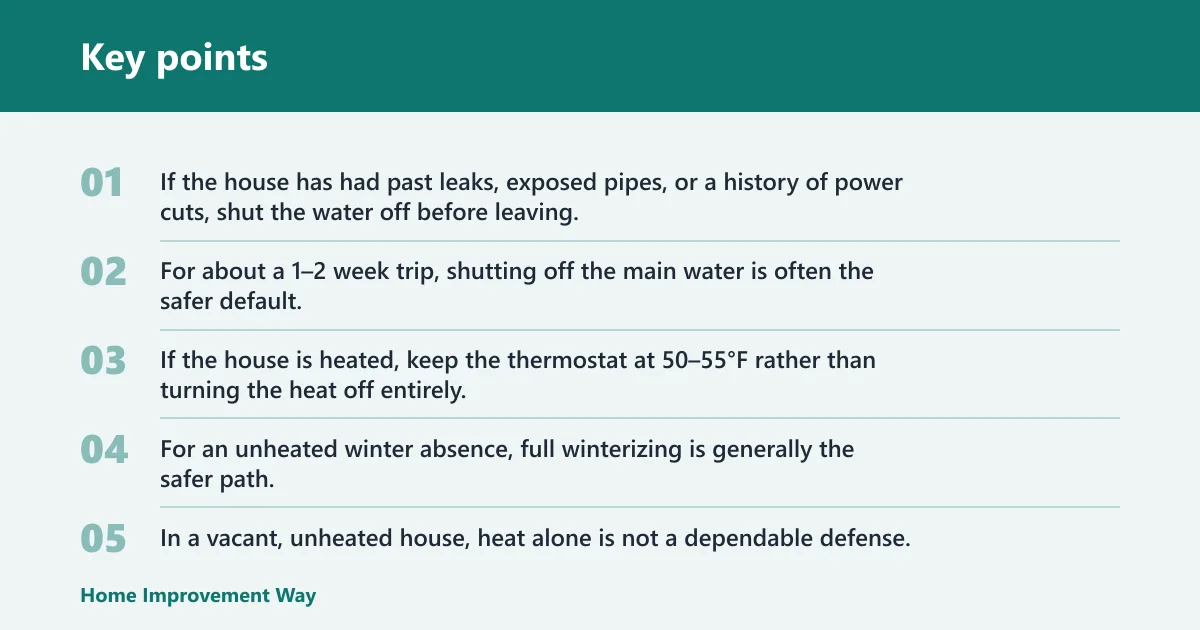
For a weekend away, keeping the heat on at 50–55°F is usually enough if the home is in good condition, the thermostat is reliable, and the main shutoff valve is known and reachable. If the house has had past leaks, exposed pipes, or a history of power cuts, shut the water off before leaving.
1–2 week vacation
For about a 1–2 week trip, shutting off the main water is often the safer default. That cuts the chance that a supply-line failure will run for hours or days while the home is empty. If the house is heated, keep the thermostat at 50–55°F rather than turning the heat off entirely.
Month-long vacancy
For about a month-long vacancy, it is generally recommended to shut off the main water and plan for at least partial draining. A valve shutoff reduces leak risk, but trapped water can still freeze in branches, fixture bodies, water heaters, and exterior lines. This is also the point where insurance or vacancy-policy rules may matter.
Unheated winter absence
For an unheated winter absence, full winterizing is generally the safer path. Shut off the water, drain the system as far as practical, empty exposed fixtures, and treat hidden branches and exterior walls as freeze points. In a vacant, unheated house, heat alone is not a dependable defense.
Water shutdown comparison matrix
This table separates three choices that are often blurred together: shut off only, shut off plus drain, and keep the heat at 50–55°F. Use it as a decision aid, not a substitute for your home’s own layout, local climate, or insurer’s vacancy rules.
| Departure scenario | Best-fit choice | Required steps | Highest-risk fixtures | Return-to-service sequence |
|---|---|---|---|---|
| Weekend trip | Keep heat at 50–55°F or shut off only if the home is leak-prone | Set thermostat, test main valve ahead of time, disconnect hoses, place leak sensors under sinks and by the water heater | Exterior-wall pipes, hose bibs, water heater connections | Check for leaks, open main slowly if shut off, verify hot water before normal use |
| 1–2 week vacation | Shut off plus selective draining | Close main valve, open faucets, flush toilets, drain hose bibs, power down or set vacation mode on water heater | Outdoor hose bibs, supply branches, single-handle faucets, toilet fill valves | Reopen main slowly, purge air at faucets, confirm water heater tank is full, test toilets and fixtures |
| Month-long vacancy | Shut off plus drain | Close main valve, drain fixtures and heater, empty exposed lines, consider compressor blowout for stubborn branches | Exterior walls, basement runs, water heater, well pressure tank if present | Slow repressurizing, leak check at every fixture, fill and restart water heater only after full tank is confirmed |
| Unheated winter absence | Shut off plus drain, or full winterization | Close main valve, drain the system, empty well equipment if used, blow out trapped water where needed | All lines in exterior walls, exposed attic or crawlspace runs, water heater, well pump and pressure tank | Professional or careful step-by-step restore, inspect for split lines, verify pump and heater operation, watch for hidden leaks |
Should you shut off the water when leaving for a winter vacation?
Yes, if the house will be empty more than a few days and any part of it may cool below 55°F, shut off the main water. That moves the biggest risk away from an uncontrolled leak while you are gone. If the home stays heated and checked remotely, leaving water on can still be reasonable.
When shutoff alone is enough
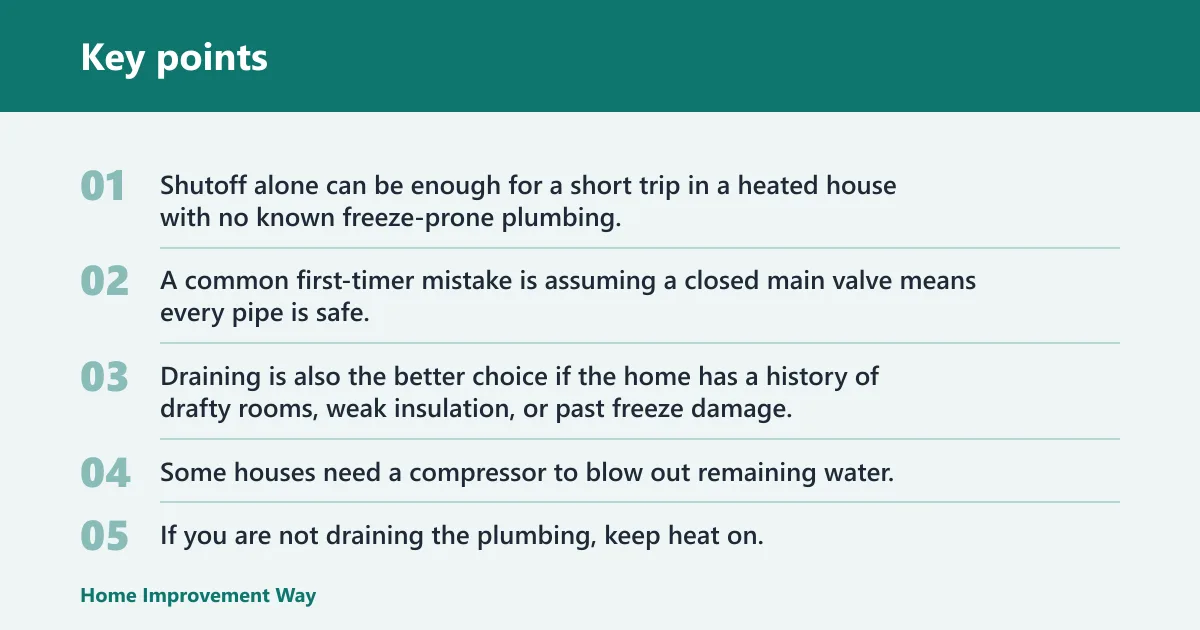
Shutoff alone can be enough for a short trip in a heated house with no known freeze-prone plumbing. The main valve reduces leak risk in an empty house, and that matters because a line failure can release water by the hundreds of gallons per day. Still, it does not empty the system.
A common first-timer mistake is assuming a closed main valve means every pipe is safe. Water can remain trapped in branches, toilet tanks, faucet bodies, and sections near exterior walls, so shutoff alone is a leak-control move, not full freeze protection.
When you also need draining
You need draining when the trip is long enough that the house may lose heat, the thermostat may fail, or the plumbing includes outdoor runs and exposed walls. Draining is also the better choice if the home has a history of drafty rooms, weak insulation, or past freeze damage.
Some houses need a compressor to blow out remaining water. That is most useful in low spots, long branches, and other sections that do not clear by gravity alone. It is not always needed for a weekend away, but it becomes more useful as the vacancy gets longer.
When heat should stay
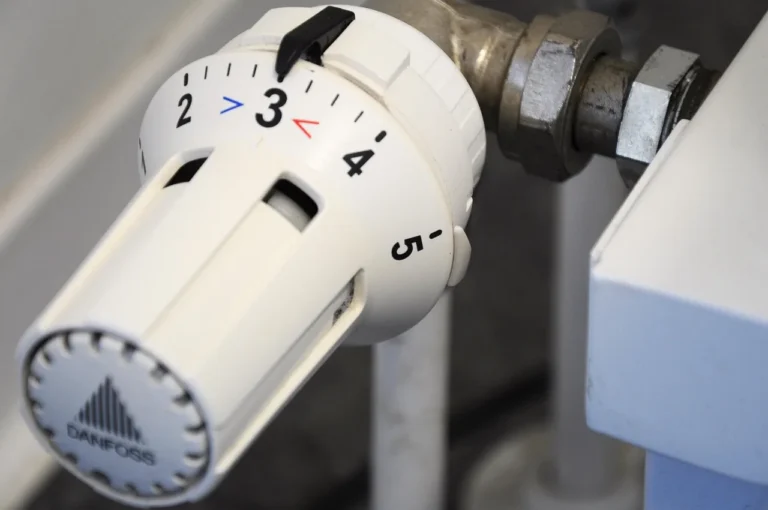
If you are not draining the plumbing, keep heat on. The standard empty-house temperature guidance is 50–55°F, and leaving the heat on at least 50 degrees helps prevent freeze damage. Lower settings raise the odds that a cold snap will reach the plumbing before the room air warms it back up.
Leak sensors add a second layer when water stays on. Place them under sinks and near the water heater so they can send text or app alerts if a small leak starts. They do not stop freezing, but they can shorten the time water runs unnoticed.
What temperature should you leave your house at in winter while you’re away?
Set a heated vacant house to 50–55°F. That is the standard empty-house range, and it gives the home some protection without wasting heat the way a full comfort setting would. If the thermostat is lower than that, freeze risk rises, especially in exterior walls and drafty corners.
Why very low settings raise risk
Standard thermostats usually only go down to 55 degrees at the lowest. A low-temperature thermostat can go down to 35 degrees, but a lower setting is not the same as real winter protection. Cold rooms, wind-driven infiltration, and dead air in cabinet spaces can still let pipes freeze.
Say your upstairs hallway sits at 52°F while a kitchen sink is on an outside wall. The room temperature may look acceptable, yet the cabinet interior can run colder than the hallway. That is why cabinet doors, exposed branches, and wall cavities matter more than the thermostat number alone.
When a lower-temperature thermostat still is not enough
A lower-temperature thermostat is only one tool. It cannot protect pipes if the power fails, the furnace stops, or the home loses circulation at the exact time a cold front arrives. If that risk is real, shut off and drain instead of trusting a very low setpoint.
How to winterize plumbing
Winterizing is the right move when the home will sit empty long enough for freeze risk to build, or when the home will be unheated. The order matters: shut off supply first, then relieve pressure, then handle fixtures, heater, and any well equipment.
Main shutoff valve
The main water shutoff should be turned off before departure. If it has not been used in a while, test it ahead of time so you are not discovering a stuck valve on the day you leave. In a municipal system, the main is usually inside the home or at the meter. In a well system, the sequence includes the pump.
- Find the valve. Locate the main shutoff and make sure it turns freely before departure. If it is stiff or inaccessible, fix that before you rely on it in a cold-weather trip.
- Close the supply. Turn the valve fully off before leaving. That stops fresh water from feeding a new leak while the house is empty.
- Relieve pressure. Open a faucet after the main is off so pressure drops in the line. This reduces the amount of water left ready to escape if a trapped section splits.
Faucets, toilets, and hose bibs
After shutoff, open all faucets so trapped pressure can escape. For single-handle faucets, move the handle to the middle so both hot and cold sides can vent. Flush toilets once and disconnect any supply-side attachments or bidet hoses that could hold water.
Disconnect garden hoses from exterior faucets and leave no hose attached. Freeze exposure is higher outdoors, and a hose left on a bib can hold water in the spigot and behind the wall. Outdoor lines often need extra winterization because they cool faster than indoor runs.
- Open every faucet. Open hot and cold fixtures after the main is shut off. On single-handle units, set the handle in the middle so both sides vent.
- Flush and drain toilets. Flush once to lower the tank level, then remove or drain any supply attachment. For long absences, a more complete drain is safer than leaving full tanks in a cold home.
- Disconnect outside hoses. Remove every garden hose from hose bibs. Store them indoors if possible so water does not freeze in the hose and conduct cold back to the spigot.
Water heater and well system
Turn off or lower the water heater before leaving. Electric units are usually shut down at the breaker; gas units are set to vacation mode or turned off at the control. For longer absences, drain or flush sediment before leaving, but do not re-energize the heater until the tank is full on return.
If the home uses well water, turn off power to the pump and drain the pressure tank separately. A pressure tank can still hold water after the main fixtures are emptied. If you are winterizing fully, the well system must be fully emptied because trapped water can freeze in the tank, lines, or pump-related plumbing.
- Shut down the heater. Turn electric units off at the breaker or set gas units to vacation mode. This prevents the heater from cycling while the house is empty.
- Drain or flush sediment. For longer absences, drain some or all of the tank as recommended by the manufacturer. Sediment left in the bottom can harden over time and should be flushed when the system is back in service.
- Separate well equipment. If the home uses a well, turn off pump power and drain the pressure tank. Do not assume a housewide valve has emptied the tank or the pump side.
Blowout method for stubborn lines
An air compressor or blowout method is used to clear remaining water from difficult sections. It requires adapter fittings and works best on branches that do not drain on their own, such as long exterior runs or low spots. Some houses need this extra step; others do not.
Picture a basement laundry line that slopes slightly back toward the machine. A simple drain may leave a pocket of water in that branch. A careful blowout clears that pocket, which matters when the line runs through a cold wall or an unheated space.
Highest-risk fixtures and lines
The most freeze-exposed parts of a house are not always the most obvious ones. Exterior walls, outdoor hose bibs, and water heater branches see the most trouble because they hold water in colder spots for longer periods.
Exterior walls
Pipes in exterior walls are the highest-risk indoor runs. They may still freeze even if the heat stays on, especially if the home has poor insulation, cabinet cavities that block warm air, or rooms with wind exposure on one side.
Cabinet interiors matter here. If the sink is on an outside wall, opening the cabinet doors can help heat reach the plumbing, but it is not a substitute for draining when the house will be unheated.
Outdoor hose bibs
Exterior hose bibs deserve separate attention because they are directly exposed to outdoor cold. Disconnect every hose, close and drain the line if the fixture design allows it, and add winterization steps if the bib is not frost-proof.
Water heater and supply branches
The water heater and the supply branches feeding it can hold a lot of residual water. That means a shutoff at the main does not protect the tank or all branch lines from freezing. A returned-on heater can also be damaged if the tank is not full before power or gas is restored.
Shut off water checklist
Bringing the house back online deserves the same care as shutting it down. Open the system slowly, confirm the heater is full before re-energizing it, and check every fixture before assuming the plumbing is normal again.
- Inspect visible piping. Look for split fittings, dripping joints, and water stains before turning anything back on. A frozen line may fail in a spot that was hidden during the vacancy.
- Open the main slowly. Repressurize the system gradually so trapped air and weak joints are less likely to fail. If the home has a well, bring the pump back according to the system’s normal sequence.
- Bleed air at fixtures. Open faucets one at a time and let air escape until the flow steadies. This helps clear air pockets that can make fixtures spit or run weakly.
- Confirm the heater is full. Do not re-energize an electric or gas water heater until the tank is full. Running a heater dry can damage the unit or its controls.
- Test toilets and appliances. Flush toilets, run sinks, and check any connected appliances for normal fill and drain behavior. Watch the first few minutes closely for slow leaks.
If the home was vacant for a while, check it every 2–4 weeks while it is still empty. That can catch a thermostat failure, a power outage, or a small leak before it becomes major damage. A smart thermostat helps only if it still has power and signal.
Frequently asked questions
How long can you leave the water on when you go on vacation in winter?
There is no universal limit. For short absences in a heated, monitored home, leaving water on can be fine. Past a few days, especially with freeze risk, the safer move is to shut off the main water and consider draining branches, fixtures, or the heater if the trip gets longer.
Do I need to shut off the main water if I keep the heat on?
Usually yes for longer absences, because heat alone does not stop a supply-line failure from flooding an empty house. If the stay is brief and the home is dependable, some owners leave water on with the thermostat at 50–55°F. Leak sensors help, but they are not a substitute.
What temperature should I leave my house at in winter while I’m away?
Set the home to 50–55°F. That range is the standard empty-house guidance and helps prevent freeze damage. Lower settings increase risk, and standard thermostats usually only go down to 55 degrees at the lowest, so check your controls before you leave.
Should I drain my pipes before leaving for a winter trip?
Drain them if the absence is long, the home will be unheated, or the plumbing includes exposed exterior-wall runs. Shutoff alone leaves water trapped in branches and fixtures. For stubborn sections, an air compressor and the right adapter fittings can clear what gravity leaves behind.
What if my house uses well water—should I turn off the pump too?
Yes. With a well system, shut off power to the pump and drain the pressure tank separately. If you are winterizing fully, the system needs to be emptied more completely than a municipal setup because water can remain trapped in the tank or pump-related lines.
Should I leave faucets open after shutting off the main water?
Yes. Open faucets after the main is shut off to relieve pressure, and move single-handle faucets to the middle. That helps empty the line pressure and reduces the amount of water left behind in the plumbing. It does not replace draining where freeze risk is high.
What should I do with the water heater before leaving for winter vacation?
Turn it off or set it to vacation mode before leaving. For longer absences, drain or flush sediment as needed, and on return do not restore power or gas until the tank is full. That sequence protects the heater and keeps it from running dry.
Sponsored / affiliate links. As an Amazon Associate I earn from qualifying purchases. I may earn additional commission from eligible campaigns.