3 Best Filters for City Water (2026): Based on Specs and Reviews
For city water with chlorine and sediment, a common setup is a sediment prefilter around 5–20 microns, then catalytic carbon or carbon block sized for your peak flow and chlorine level; choose whole-house when every faucet, shower, and appliance needs treatment, and use point-of-use when only drinking water matters. Bad sizing causes chlorine taste, clogging, pressure loss, and shorter cartridge life. This guide shows how to match filter order, micron rating, carbon type, and maintenance intervals to your water test and household flow.
Quick comparison
| Product | Badge | Best for | Price | ||
|---|---|---|---|---|---|
 |
3M Aqua-Pure AP900 Series Whole House Water FiltrationAqua-Pure | Our pick | Whole house · 100,000 gal · 1-inch ports | $421.18
Price as of 31 Oct 2026
|
View |
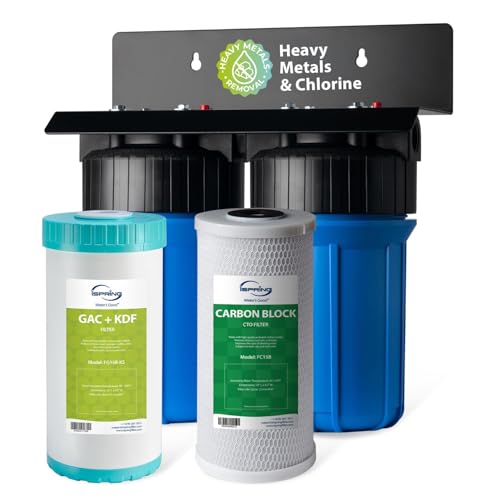 |
iSpring WGB21B-KS 2-Stage Heavy Metals Whole House WateriSpring | Upgrade pick | 2-stage · 50K gal · 1-inch ports | $199.99
Price as of 31 Oct 2026
|
View |
 |
Advanced Home Water Test Kit | Well or City | EPA CertifiedTap Score | Also great | Lab test kit · 116 analytes · city or well | $269.00
Price as of 31 Oct 2026
|
View |
The table below is a setup map, not a brand list. The right order depends on whether your report shows free chlorine or chloramine, and whether sediment is light enough to skip a prefilter.
If you have a 2-bath home with normal municipal pressure, a smaller whole-house carbon setup may be fine. If you have a 4-bath home, older pipes, or low pressure, flow rate and pressure drop become the first sizing filters.
How we chose
We compared systems on four setup issues that change results: chlorine type, sediment load, peak flow in GPM, and certification or published performance data. We also separated whole-house treatment from drinking-water-only needs so lead and PFAS do not get pulled into the wrong decision.
NSF/ANSI 42 matters for chlorine-reduction claims. NSF/ANSI 53 matters when a system claims lead or other contaminant reduction. Also use the manufacturer-listed stage order, media type, capacity, and flow rate where those details are provided.
The short list below favors systems that fit common city-water problems without forcing you into oversized pressure loss. That means a sediment-first setup when debris is present, carbon sized to contact time, and catalytic carbon when chloramine is the disinfectant.
SpringWell CF1: best for chloramine and high flow
The SpringWell CF1 fits homes that need a whole-house answer for chloramine-treated city water and want higher flow at the same time. It is a 4-stage setup with sediment, KDF 85, activated carbon, and a post-filter, and the page says it removes chlorine and chloramine.
Its 1,000,000-gallon rating and 9+ GPM flow rate make sense for larger homes that still want usable pressure at multiple fixtures. The KDF stage helps in multi-stage municipal-water systems, especially when paired with carbon.
The tradeoff is that this setup is more than a basic chlorine-only filter. If your water report shows free chlorine only and your home is small, you may be paying for chloramine-oriented media you do not need.
Aquasana Rhino EQ-1000: best for chlorine and long life
The Aquasana Rhino EQ-1000 is the better fit when your report shows free chlorine rather than chloramine and you want a long-life whole-house system. It is listed with a 1,000,000-gallon media life, and the related WH-1000 data sheet reports free-chlorine reduction over 97%.
The WH-1000 version is listed at 7-10 GPM, so it is better matched to moderate household demand than to very high simultaneous use. That range works better when you are sizing for a smaller or mid-size home and want chlorine reduction without jumping to a much larger system.
The limitation is simple: published free-chlorine data is not the same as a lead or PFAS solution. If those contaminants are your concern, you still need point-of-use treatment at the drinking tap.
iSpring WGB32B: best budget chlorine-and-sediment setup
The iSpring WGB32B is the budget pick for homeowners who want a straightforward chlorine-and-sediment setup without moving into a chloramine-focused system. It is a 3-stage option with a 15 GPM flow rate and a 100,000-gallon capacity.
That flow rating gives it room for larger households than many low-cost systems, and the 3-stage layout keeps the setup simple. For city water with visible sediment and chlorine taste, that combination can be enough when chloramine is not part of the report.
The drawback is capacity. A 100,000-gallon system will usually need more frequent replacement than the million-gallon class of systems, so the lower upfront cost can trade off against maintenance cadence.
Do you need a sediment filter first?
Yes, if your water report or plumbing shows rust, sand, or visible debris. A sediment prefilter placed before the main carbon stage helps keep the carbon from clogging, reduces pressure drop, and protects chlorine performance when the incoming water carries particles.
This is where many homeowners get the order wrong. Carbon can be the right chemistry, but sediment can still load the media so fast that chlorine taste returns early and flow drops before the carbon itself is exhausted.
Visible rust, sand, or debris
If you see orange specks in a tub, grit in aerators, or cloudy flush water after utility work, start with sediment filtration. A common whole-house choice is 20-micron prefiltration when debris is moderate, then tighter 5-micron protection when the supply is dirtier or the plumbing is older.
Older plumbing and pipe scale
Older galvanized lines, scale inside plumbing, and disturbed mains can send solids into the house even when the city supply is otherwise treated well. In that case, a sediment stage before carbon is not optional. It is the part that keeps the rest of the system from loading too quickly.
When sediment shortens carbon life
A loaded sediment stage can look like a pressure problem first and a water-quality problem second. If shower pressure drops, the filter housing fills with debris, or chlorine taste returns sooner than expected, the sediment stage may be forcing the carbon to do two jobs at once.
Best city-water setup by water report and home size
| Water report or home condition | Recommended stage order | Media type | Minimum GPM | When to add point-of-use filtration |
|---|---|---|---|---|
| Chlorine-only | Sediment if needed, then carbon | Carbon block or granular activated carbon | 7 GPM | Add at the kitchen tap for lead, PFAS, or taste-sensitive drinking water |
| Chloramine-heavy | Sediment, then catalytic carbon, then polish stage if included | Catalytic carbon, often with KDF media upstream or paired | 9+ GPM | Add drinking-water filtration if the goal includes lead or PFAS, not just chloramine |
| Visible sediment | Sediment prefilter, then main carbon stage | 5-micron or 20-micron sediment media, then carbon block | 7 GPM | Add at the tap only if the water report also shows lead or PFAS concerns |
| Low-pressure homes | Prefilter first, then lowest-pressure-drop carbon option | Carbon with conservative pressure loss, often fewer stages | 7 GPM minimum, higher if multiple bathrooms are used at once | Add point-of-use only after you preserve shower and appliance pressure |
| Older plumbing | Sediment prefilter, then carbon, then optional KDF | Higher-capacity sediment media plus carbon | 9+ GPM if the home is 3 to 4 bathrooms | Add at the drinking tap if lead or PFAS is part of the report |
Can a whole-house carbon filter remove chlorine from city water?
Yes, whole-house carbon can remove chlorine from city water when the media is sized correctly and contact time is sufficient. Carbon block and granular activated carbon are the common formats, and both depend on water moving slowly enough through the media for adsorption to do its job.
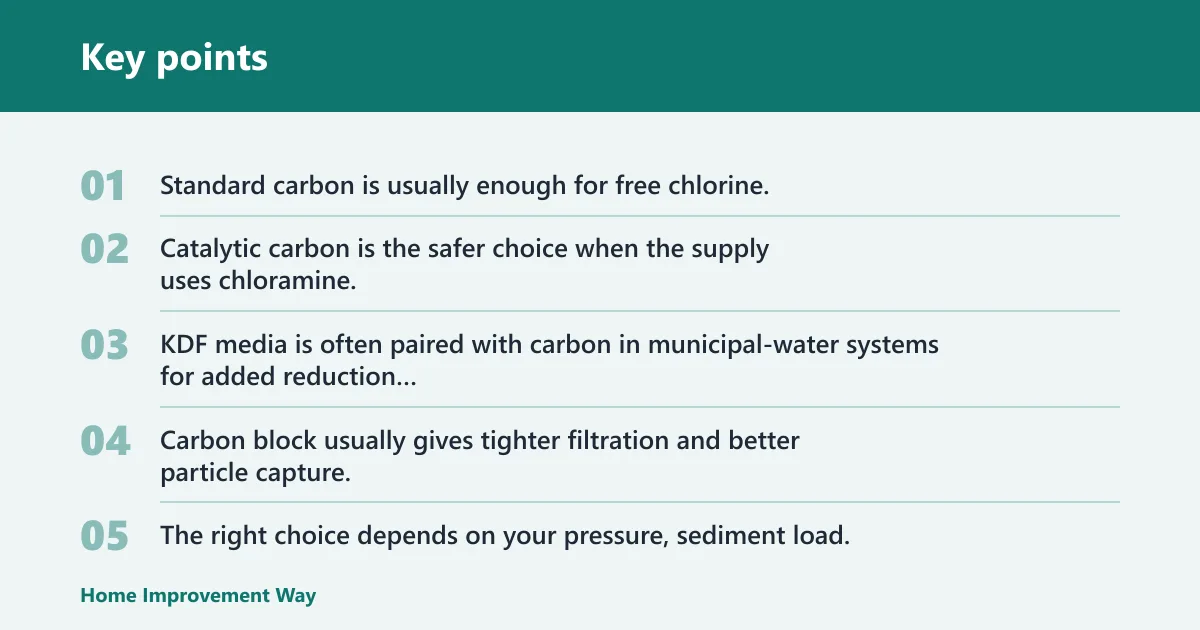
Standard carbon is usually enough for free chlorine. Catalytic carbon is the safer choice when the supply uses chloramine, because chloramine is harder to reduce with ordinary carbon alone. KDF media is often paired with carbon in municipal-water systems for added reduction support.
Carbon block versus granular activated carbon
Carbon block usually gives tighter filtration and better particle capture, while granular activated carbon can offer lower resistance in some housings. The right choice depends on your pressure, sediment load, and whether the main goal is chlorine taste or a broader treatment stack.
Why contact time matters
Carbon only works if water spends enough time in the media bed. If you push too much flow through a small system, chlorine may not fully reduce, and the water can still smell or taste like disinfectant at high-demand fixtures such as showers or tubs.
What chlorine breakthrough looks like
Chlorine breakthrough usually shows up as taste or odor returning before the cartridge should be done. A pressure drop can point to sediment loading, while a return of disinfectant smell at the same time can mean the carbon stage is being overwhelmed by flow or debris.
Which one should you buy?
Choose the system that matches your water report first, then your home size. For chloramine-treated municipal water, SpringWell CF1 is the clearest fit among the three listed systems. For free chlorine and long service life, Aquasana Rhino EQ-1000 makes sense. For a lower-cost chlorine-and-sediment setup, iSpring WGB32B is the budget option.
If your home is 3 to 4 bathrooms and you regularly run showers, laundry, and fixtures together, favor the higher-flow options. If the home is smaller and your supply is stable, a 7-10 GPM system may be enough. If sediment is visible, do not skip the prefilter just to save a stage.
Say your city report shows free chlorine only, but a sink aerator keeps filling with orange grit after main repairs. In that case, a sediment stage before carbon is the right sequence. If you reverse the order, the carbon can clog early and you lose both pressure and chlorine performance.
Suppose your neighborhood has chloramine and a 4-bath house with two people showering while the dishwasher runs. That is when a catalytic carbon setup with 9+ GPM or more headroom makes more sense than a small chlorine-only filter that looks cheaper upfront.
Point-of-use filtration still matters when the target is lead or PFAS at the drinking tap. Whole-house treatment is for every faucet, shower, and appliance. Drinking-water filtration is the better place to handle contaminants that do not need whole-home treatment.
Frequently asked questions
What is the best water treatment setup for city water with chlorine and sediment?
The best setup is usually a sediment prefilter first, then carbon sized to your peak flow and chlorine level. If the water report shows chloramine instead of free chlorine, use catalytic carbon rather than standard carbon. Add point-of-use filtration only when the drinking water also needs lead or PFAS reduction.
Do I need a sediment filter before a whole-house carbon filter?
If your water has visible rust, sand, or pipe debris, yes. Sediment catches the particles that would otherwise clog carbon media and cut pressure. If your water is clean and the plumbing is newer, a sediment stage may still help, but it is less urgent than in older homes.
How do I know if my city water has chloramine instead of chlorine?
Check your utility water quality report or ask the city utility directly. Some utilities also post seasonal disinfectant changes. Do not guess based on smell alone, because chlorine and chloramine can both produce a treatment odor, but they call for different carbon media.
What flow rate do I need for a whole-house filter system?
Match the system to peak household demand, not average use. A 2-bath home often needs less flow than a 4-bath home, especially if several fixtures run at once. If pressure is already marginal, choose a setup with lower pressure drop and enough GPM headroom.
Do I need lead or PFAS filtration too, or just chlorine and sediment removal?
Only add lead or PFAS treatment if your water report, local risk factors, or drinking-water goals call for it. Those concerns usually belong at the kitchen tap, not the whole house. Whole-house carbon is mainly for chlorine, chloramine, odor, and sediment management.
Which setup is best for a home with low water pressure?
Start with the fewest stages that solve the problem, then size for pressure drop. In low-pressure homes, a sediment prefilter plus one well-sized carbon stage is often better than a heavier multi-stage system. If you also need chloramine removal, catalytic carbon is the better media to prioritize.
Sponsored / affiliate links. As an Amazon Associate I earn from qualifying purchases. I may earn additional commission from eligible campaigns.