Why Is My Frost-Free Spigot Leaking Inside the House in Winter?
A frost-free spigot that leaks inside the house in winter usually has a failed washer, packing nut, or a split pipe behind the wall; if water keeps coming after you shut off the valve, treat it as freeze damage. Let it keep leaking, and you can rot framing, stain drywall, and send water into insulation or the crawlspace. This guide shows how to tell a simple faucet repair from hidden freeze damage, and what to check before you make the leak worse.
Why is my frost-free spigot leaking inside?
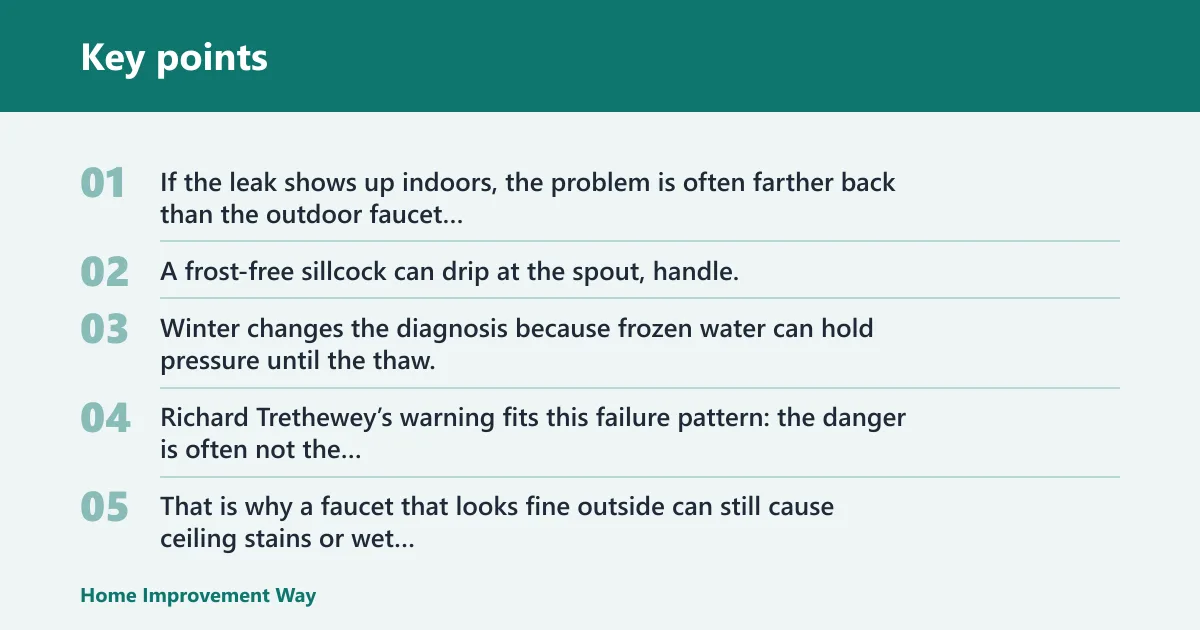

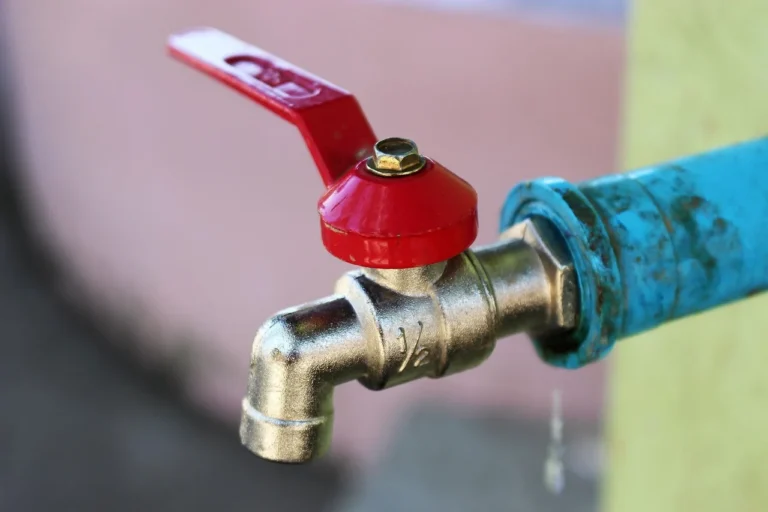
If the leak shows up indoors, the problem is often farther back than the outdoor faucet face. A frost-free sillcock can drip at the spout, handle, or vacuum breaker and still be repairable, but water appearing in the wall cavity or rim joist after use points to a split tube, cracked body, or freeze damage behind the wall.
Winter changes the diagnosis because frozen water can hold pressure until the thaw. Richard Trethewey’s warning fits this failure pattern: the danger is often not the freeze itself but the thaw, when hidden cracks start leaking into the wall. That is why a faucet that looks fine outside can still cause ceiling stains or wet insulation indoors.
Leak diagnosis table
| Symptom | Most likely failure | Immediate next step | DIY-safe or call a plumber now |
|---|---|---|---|
| Drips when off | Worn stem washer, O-ring, or packing nut | Close the indoor shutoff, then inspect the handle and stem | DIY-safe if the leak stays at the faucet body |
| Leaks at handle only when on | Packing nut or stem seal leak | Tighten the packing nut slightly, then replace the packing material if needed | DIY-safe if there is no wall moisture |
| Water appears indoors after turning it on | Split supply tube, cracked body, or failed solder/thread joint behind the wall | Shut off the indoor valve and check the wall cavity and rim joist | Call a plumber now |
| Sprays from the top cap | Failed anti-siphon vacuum breaker | Stop using the faucet and inspect the top cap and hose setup | DIY-safe if the spray is only at the breaker and the wall is dry |
Most outdoor faucet leaks come from one of three locations: the spout, the handle area, or the anti-siphon vacuum breaker. A spray from the top cap points to a failed anti-siphon vacuum breaker, which is especially relevant on modern sillcocks built with backflow protection. If the water is indoors instead, do not keep staring at the outdoor drip.
How do frost-free spigots fail?
A frost-free sillcock moves the shutoff deep inside the heated wall, usually with a stem about 8 to 18 inches long. When turned off, it drains by gravity, but only if the body slopes slightly downward toward the exterior. A standard hose bib keeps more water near the cold side, so it has a higher freeze-burst risk.
Shutoff location and gravity drain
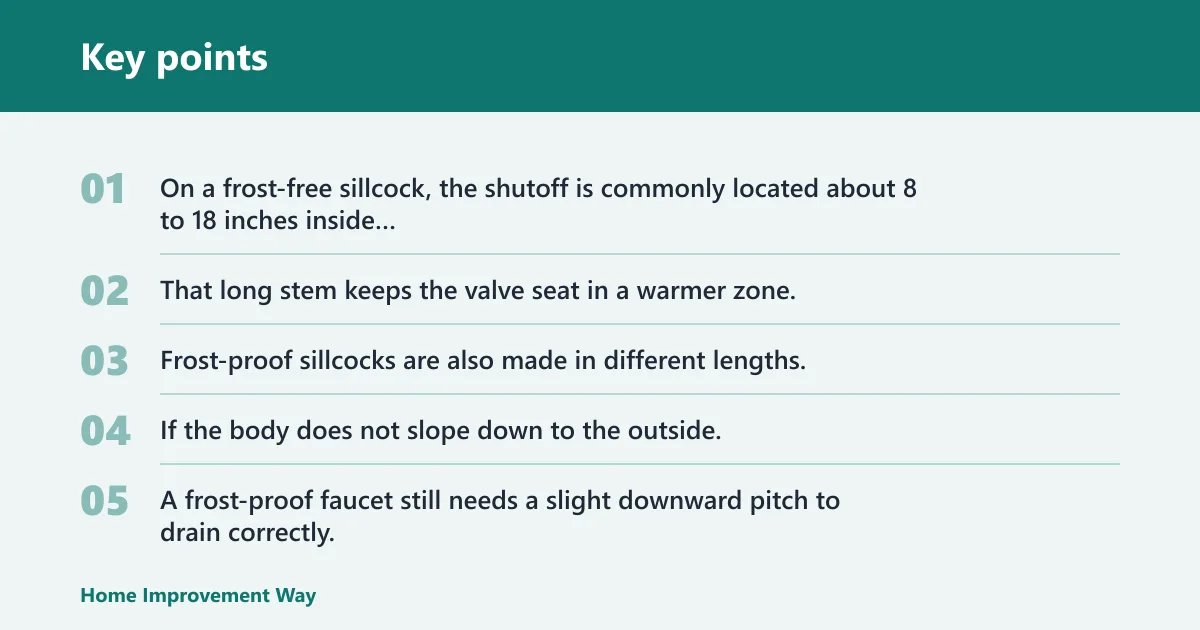
On a frost-free sillcock, the shutoff is commonly located about 8 to 18 inches inside the heated wall. That long stem keeps the valve seat in a warmer zone, but it does not protect a badly pitched or badly sized install. Frost-proof sillcocks are also made in different lengths, from 6 to 14 inches deep or long, and they must be ordered to match wall thickness.
If the body does not slope down to the outside, water can remain in the tube instead of draining out. A frost-proof faucet still needs a slight downward pitch to drain correctly. A mis-pitched install can leave a wet section in the wall, which becomes a freeze point.
Hose attachment and blocked drainage
A garden hose left attached can block drainage and defeat the drainage design of a frost-free sillcock. Water stays trapped in the exposed section, and that trapped water can freeze first. Disconnecting the garden hose before the first hard freeze is the main prevention step.
Say your sillcock looks normal in October, but the hose stays attached to the vacuum breaker through a cold snap. The line may not drain fully, and the first thaw can reveal a split that was invisible from outside.
Vacuum breaker failure
An anti-siphon vacuum breaker protects the water supply from backflow. If it fails, it can spray from the top cap, especially when the hose is attached and pressurized. That symptom points to a top-side part problem, not automatically to freeze damage.
Still, a top-cap leak can coexist with a hidden wall leak. If the spray stops when the hose is removed but indoor moisture remains, the deeper problem is likely separate.
Freeze damage in the stem or supply tube
A leaky exterior hose connection can signal pipe splitting from winter freezing, and the standpipe can split inside the wall and look fine from the outside. A short-body standard hose bib is often more vulnerable because water can sit in the exposed pipe section. A frost-free unit can still freeze and burst if installed wrong or left with a hose attached.
A common first-timer mistake is to assume any dribble at the spout means a washer only. If water is showing up behind drywall, in the basement ceiling, or at the rim joist, that is a different failure path.
What should you check inside first?
Start inside the house before opening drywall. Find the indoor shutoff valve that feeds the exterior spigot and close it before any testing or repair. It is often in a basement, crawlspace, or utility room. Then inspect the wall cavity or rim joist for moisture, staining, or rot.
Find and close the indoor shutoff valve
- Locate the valve that controls the exterior line.
- Turn it fully off before touching the outdoor faucet.
- Open the outdoor spigot briefly to relieve pressure and see whether the drip stops.
- Watch the indoor side for fresh moisture, staining, or a musty smell.
If the leak continues after the indoor valve is closed, the defect may be on the faucet side of that valve or in the line that remains full. If the leak stops outside but water still appears inside when the faucet is turned on, treat it as a hidden split until proven otherwise.
Look at the wall cavity or rim joist
Outdoor hose repair protects hidden rot inside rim joists. That means the inspection should not stop at the exterior escutcheon or siding. Look for soft drywall, damp framing, water trails on the basement ceiling, or staining on the rim joist near the sillcock.
Water showing up in the basement ceiling or behind the rim joist means stop DIY. Hidden water can soak insulation and wood long before the outdoor faucet looks wrong.
Look for staining, dampness, or rot
Small stains and a dry-looking exterior can still hide a cracked supply tube. The wall cavity may show the first real evidence. If the area is wet only when the faucet runs, that points toward a split behind the wall rather than a simple face-level drip.
Can you repair it or should you replace it?
Replace a washer, O-ring, or packing nut when the leak stays at the spout or handle and the wall stays dry. Replace the whole frost-free sillcock when the body is cracked, freeze-damaged, or the length does not match the wall thickness. A wall leak after use usually moves the decision toward replacement and inspection, not a minor trim-part fix.
Replace a washer, O-ring, or packing nut
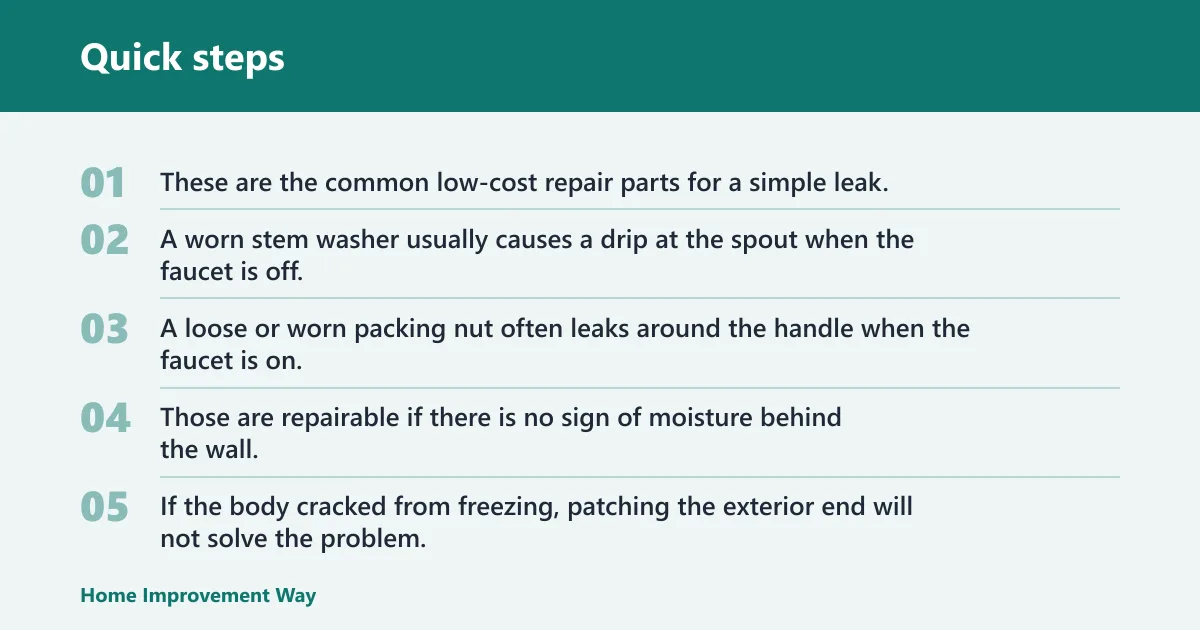
These are the common low-cost repair parts for a simple leak. A worn stem washer usually causes a drip at the spout when the faucet is off. A loose or worn packing nut often leaks around the handle when the faucet is on. Those are repairable if there is no sign of moisture behind the wall.
Replace the sillcock if the body cracked
If the body cracked from freezing, patching the exterior end will not solve the problem. Modern frost-free hose bibs shut off deep inside heated basement walls, but the stem and body still need to be intact. A split body or split standpipe means the whole assembly should come out.
When the crack is hidden, the outside may still look clean. That is why an apparently minor leak after winter can still require full replacement.
Match the new length to the wall thickness
Replacement frost-free sillcocks come in multiple lengths and inlet styles, including sweat, threaded, and push-to-connect. The new one must match the wall thickness so the shutoff lands in the heated space and the body can pitch slightly downward to the exterior. Too short, and the valve may sit too far out in the cold wall. Too long, and the trim can fit poorly or the pitch can be wrong. (Thisoldhouse)
If the original unit never drained well, suspect a length or slope problem as much as a worn part. Correcting the new length matters as much as choosing the right connection type.
What if the hose was left attached?
A hose left attached can keep the sillcock from draining fully and trap water in the exposed section of pipe. That trapped water can freeze, split the tube, and then leak indoors after the thaw. Disconnect the hose before the first hard freeze, and remove any quick-connect fittings that still hold water.
Why the line may not drain
Frost-free sillcocks depend on gravity drainage. If the hose end stays pressurized or plugged, the water cannot escape the body the way it should. A hose on the faucet can also mask a slow vacuum breaker leak until the line freezes.
How this leads to freeze bursts
Once water stays in the cold section, expansion can crack the tube or fitting. The failure may not show until the thaw, when the line refills and sends water into the wall cavity. That is why a hose connection is more than a convenience issue in cold weather.
What to disconnect before the first hard freeze
Remove the garden hose, spray nozzle, splitter, timer, and any adapter left on the faucet. Then shut off the indoor supply if the line will not be used until spring. A frost-free spigot still needs that winter setup to work as designed.
Frequently asked questions
Why is my frost-free spigot leaking inside the house in winter?
A leak that shows up inside usually means the problem is behind the wall, not just at the faucet face. The most common causes are a split supply tube, cracked body, or failed joint after freezing. If the leak continues after you shut off the indoor valve, treat it as hidden damage.
Does a leaking outdoor faucet inside the wall mean the pipe froze?
Often, yes. A hidden leak after winter can mean the pipe split during a freeze and started leaking at thaw. It can also mean the faucet was installed with the wrong slope or the hose stayed attached. If water reaches the wall cavity or rim joist, stop DIY and inspect inside first.
Why does my frost-free hose bib leak only when I turn it on?
That symptom often points to a leak under pressure, such as a packing nut, O-ring, or a crack that opens only when water flows. If the leak is only at the handle or top cap, the faucet body may still be repairable. If water appears indoors, the problem is deeper than the trim parts.
What happens if I leave a hose attached to a frost-free spigot?
The hose can block drainage and leave water trapped in the exposed section of the faucet. That trapped water can freeze and split the pipe, even if the shutoff is inside the heated wall. Remove the hose before the first hard freeze to keep the drain path open.
How do I tell if my frost-free sillcock is installed wrong?
Red flags include a faucet that does not slope slightly downward to the outside, a body that sits in the wrong wall depth, or repeated freezing despite normal use. Frost-proof sillcocks must be ordered to match wall thickness. If the length is wrong, drainage can fail and leaks can repeat after winter.
When should I replace a leaking frost-free hose bib instead of repairing it?
Replace it when the body is cracked, the stem is freeze-damaged, the wall thickness does not match the unit, or water appears indoors after use. Repair parts like a washer, O-ring, or packing nut only make sense when the leak stays at the faucet itself. Hidden wall moisture means replacement and inspection.
Why does my outdoor faucet leak after winter but look fine outside?
Because the damaged section may be inside the wall. The standpipe can split and still leave the exterior trim looking normal. That is why winter leaks need an inside check at the shutoff valve, rim joist, and wall cavity before you assume a small exterior repair will solve it.
Sponsored / affiliate links. As an Amazon Associate I earn from qualifying purchases. I may earn additional commission from eligible campaigns.