Does Homeowners Insurance Cover Frozen Pipes?
Homeowners insurance usually covers frozen pipe damage if the pipe bursts from a sudden, accidental event and you took reasonable steps to keep the home heated and maintained. It often denies claims tied to neglect, vacancy, or a long-term maintenance problem. Missed steps can turn a repairable leak into water damage, mold, ruined flooring, and a denied claim. This guide explains what is usually paid, what is usually denied, and which records can change the outcome.
When insurers approve or deny frozen pipe claims
Usually, yes, if the freeze and burst were sudden and the home was reasonably heated. Standard homeowners insurance is built around sudden and accidental loss language, so the claim often turns on what happened before the pipe failed, not just on the damage after it failed. If the house was left cold, coverage can be denied.
What insurers usually mean by sudden and accidental
Insurers often pay when a frozen pipe bursts without a long warning period and the loss is tied to a covered water event. A standard Michigan homeowners policy covers sudden water damage when a frozen pipe bursts. The policy then responds to the water damage that follows, not to every cost connected to the pipe itself.
What the policy usually does not pay
Most policies do not pay to replace the frozen pipe itself unless another part of the policy or a specific endorsement applies. They also do not pay for outside flooding under standard homeowners coverage. If the damage came from floodwater entering from outside, that is a separate claim under flood insurance, not a burst-pipe claim.
Frozen pipe claim decision table
| Scenario | Likely coverage outcome | Common insurer objections | Documents to gather |
|---|---|---|---|
| Occupied, heated home | Often covered for sudden water damage from the burst | Was the heat left on? Was the pipe insulated or exposed to an unusual cold snap? | Thermostat records, photos of the burst area, plumber invoice, damage photos, utility bill |
| Occupied home with furnace failure | Often covered if the failure was sudden and reported promptly | How long was the heat out? Did the owner delay repairs or fail to monitor the house? | HVAC repair receipt, service call record, temperature logs, messages showing prompt reporting |
| Vacant, unheated home | High denial risk | Was the dwelling vacant or unoccupied? Was the heat shut off? Was the system drained? | Move-out date, inspection records, shutoff and drain proof, utility shutoff notice, caretaker log |
| Winterized vacant home | More likely covered if winterization steps were documented | Did the owner actually drain the system and maintain a safe minimum temperature where required? | Winterizing receipt, photos of drained fixtures, thermostat setting proof, property check notes |
What homeowners insurance may pay
When the claim is accepted, the payment often runs through several parts of the policy. Dwelling coverage can pay for structural repairs such as drywall, ceilings, flooring, trim, cabinetry, and insulation. Personal property coverage can pay for contents damaged by burst-pipe water. Loss of use coverage can help if the home becomes unlivable.
Access costs also matter. If a contractor has to open a wall or floor to reach the failed pipe, those tear-out and access costs are generally covered as part of the water-loss repair work. That does not mean every trade call is covered, but the cost of reaching the source is often part of the claim.
Picture a house of about 1,800 square feet where a pipe in an exterior wall bursts overnight during a cold snap. The insurer may pay to replace wet drywall, stained ceiling sections below the leak, damaged carpet, and a ruined sofa, but not the broken pipe itself unless the policy terms or an endorsement say otherwise.
Does homeowners insurance cover frozen pipes bursting?
Usually, the burst is what makes the claim work. A frozen pipe that merely freezes, without causing water discharge, may not create the same covered loss. Once the pipe bursts and water escapes suddenly, many policies treat the resulting damage as a covered water loss, subject to exclusions and the facts of occupancy and heating.
Why the burst matters
Freezing alone is a mechanical problem. Burst-related water damage is the insured event many policies are designed to handle. That distinction matters because insurers often separate the plumbing repair from the damage caused by released water. The stronger claim is the one that shows a sudden pipe failure, not a slow, known leak.
Pipe repair versus water damage
Homeowners insurance usually responds to the mess the water makes, not the broken pipe as a standalone repair item. That means drywall removal, insulation replacement, wet flooring, ruined cabinets, and drying work may fall inside the claim. The pipe replacement itself often remains an out-of-pocket expense unless another policy term applies.
Common denial reasons
Insurers often deny frozen-pipe claims when the home was left cold, when the dwelling was vacant or unoccupied, or when winterization steps were skipped. They also look for maintenance issues such as a known furnace problem left unresolved, a long period without heat, or a history of repeated freezing in the same spot.
What makes frozen pipe claims get denied?
Denials usually come from preventable conditions, not from the burst alone. Vacancy, lack of heat, and poor winterization are the most common trouble spots. Insurers also expect reasonable care. If the loss looks avoidable, or if the paperwork shows the homeowner did not maintain the home, the file can move from covered to denied fast.
Vacant or unoccupied home rules
Most policies exclude damage from a pipe that froze while the dwelling was vacant or unoccupied. That risk is higher for snowbirds, second homes, cabins, and rental properties between tenants. Some policies contain a heat-maintenance requirement. Others expect the owner to shut off and drain the water supply if the property will sit empty.
Heat off or thermostat too low
Coverage can be denied if the pipe froze because the house was left cold. Keeping the thermostat at a safe minimum of 55°F is common guidance for winter protection, but it is not a guarantee. The key is whether heat was maintained in a reasonable way and whether the owner can prove it.
Missing winterization steps
Winterization matters because it shows reasonable care. Shutting off the water, draining pipes, opening faucets, and arranging periodic checks can help support a claim. Failing to do those things in a vacant home may give the insurer a clean denial path. For some properties, simply keeping the heat on may be enough; for others, full shutdown is the safer route.
Neglect and maintenance obligations
Homeowners have a maintenance duty. Reasonable care means taking preventive steps before cold weather arrives, especially around exterior walls, crawl spaces, attics, and uninsulated plumbing runs. A pipe that freezes in a wall during a cold snap can still be covered, but not if the facts show avoidable neglect.
Frozen pipe coverage evidence checklist
A strong claim file answers two questions: did the pipe fail suddenly, and did you take reasonable steps to protect the home? Gather proof quickly. The more time passes, the easier it becomes for an insurer to argue that the loss was preventable or that the damage got worse after the first break.
- Take photos and video of the burst area, standing water, wet drywall, flooring, and any damaged contents.
- Save the plumber’s report, invoice, and any notes about where the pipe froze or burst.
- Keep HVAC service records, furnace repair receipts, and thermostat or smart-home logs if available.
- Save utility bills or account activity that show heat was on during the cold period.
- Document occupancy with travel records, caretaker notes, rental records, or inspection logs.
- Collect winterization proof, including drain steps, shutoff receipts, or property-check records.
- Write down when you first noticed the problem and when you notified the insurer.
- List all damaged items separately so contents coverage is not missed.
A common first-timer mistake is cleaning up too quickly before documenting the loss. Photograph everything first, especially the ceiling below the leak, the inside of the wall if opened, and any damaged furniture or boxes. Then call the insurer and the plumber right away if the leak is still active.
What if the home was vacant or winterized?
Vacant and winterized homes are treated differently from occupied homes. If the home was empty, the claim depends heavily on whether the policy required heat to remain on or allowed shutdown and drainage instead. For snowbirds, landlords, second homes, and cabins, the paper trail matters as much as the damage itself.
Snowbirds and second homes
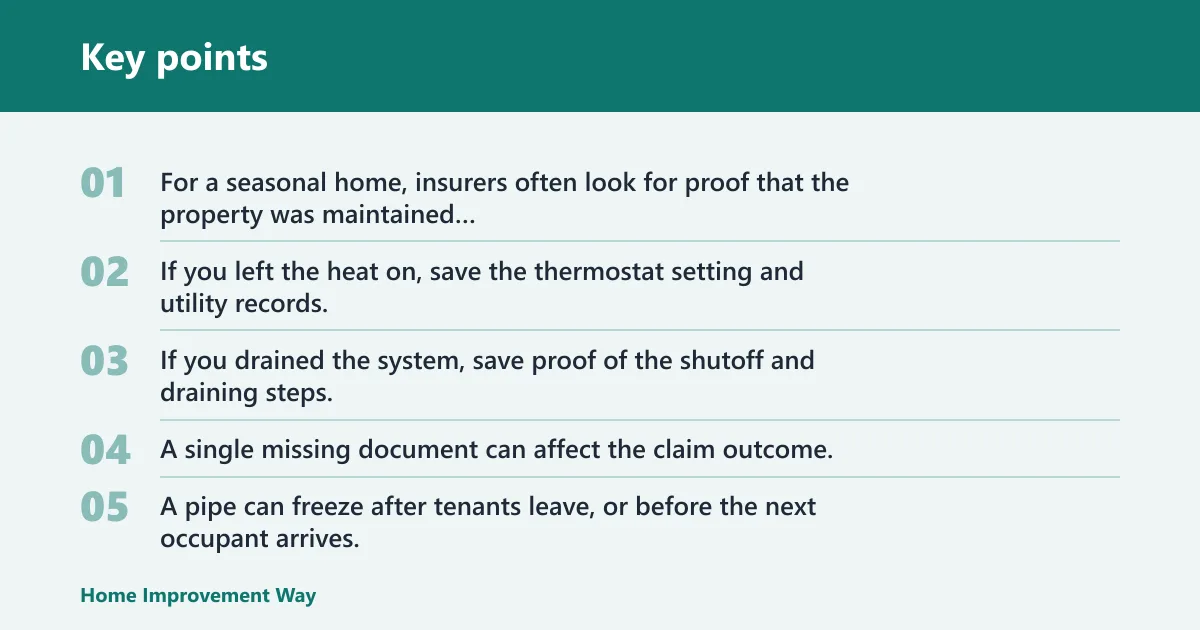
For a seasonal home, insurers often look for proof that the property was maintained between visits. If you left the heat on, save the thermostat setting and utility records. If you drained the system, save proof of the shutoff and draining steps. A single missing document can affect the claim outcome.
Landlords and rental properties
Rental homes create a timing problem. A pipe can freeze after tenants leave, or before the next occupant arrives, and the occupancy status may control the claim. Landlords should keep inspection logs, maintenance records, and vacancy dates. Those records can show that the property was not abandoned and that winter steps were taken.
Cabins and seasonal homes
Cabins often sit in the high-risk zone because they are unoccupied for long stretches and may be exposed to colder conditions. Keeping heat on or fully winterizing the plumbing can make the difference between a covered claim and a denied one. Exterior walls, crawl spaces, and exposed runs deserve special attention.
Shut off and drain option
Shutting off and draining the system is a common winterizing step for vacant homes. F9 says keeping heat in the building or shutting off and draining the water supply can satisfy the exception in some cases. That does not override the policy by itself, but it can support coverage when the insurer reviews whether you took reasonable care.
How frozen pipe claims differ from flood and water backup claims
Frozen pipe losses and flood losses are not the same. Flood insurance is a separate policy from homeowners insurance, and it covers outside flooding rather than a burst pipe inside the home. Water backup coverage is also separate. It may help with backed-up pipes or sump pumps, but it does not fix the pipe itself.
Lemonade says homeowners insurance generally covers water damage caused by something sudden or accidental, and that burst pipes can damage both the home and belongings. It also says standard homeowners insurance does not cover flooding from the outside. Water Backup Coverage, where offered, can cover damage from backed-up pipes or sump pumps, but it is an add-on, not a substitute for frozen-pipe protection.
What parts of the home policy may apply
Dwelling coverage is the main piece for structural repair. Personal property coverage can pay for damaged contents. Loss of use coverage can help with temporary housing if the house is not livable. These parts often work together on the same claim, but only after the insurer accepts that the loss fits the policy and is not barred by an exclusion.
That split matters for budgeting. A homeowner may face a deductible, plus the pipe replacement itself, plus cleanup and mitigation work before the larger claim payment arrives. If the loss is large enough to displace the family, additional living expenses may also be part of the file. Those costs can add up quickly.
Realistic out-of-pocket split
- Pipe repair: often paid by the homeowner unless another term applies.
- Water cleanup and drying: often part of the covered claim if the loss is accepted.
- Tear-out and access: generally covered when needed to reach the failed pipe.
- Remediation and rebuild: may be covered if caused by the sudden water loss.
- Deductible: usually comes out of the settlement.
- Additional living expenses: may apply if the home cannot be lived in during repairs.
Does homeowners insurance cover frozen pipes or frozen water pipes?
Yes, often in the same way. The claim usually turns on whether the freeze led to a sudden burst and whether the home was properly heated and maintained. The wording may sound different, but insurers usually focus on the same facts: sudden water damage, occupancy, heat, winterization, and proof that the loss was not due to neglect.
Frequently asked questions
Does homeowners insurance cover frozen pipes?
Usually yes, if the pipe burst suddenly and the home was reasonably heated and maintained. Insurers often pay for the resulting water damage, not the pipe itself. Claims tied to vacancy, turned-off heat, or poor winterization are more likely to be denied.
Does homeowners insurance cover frozen pipe damage?
Often yes for the damage caused by released water, including drywall, flooring, trim, cabinetry, insulation, and damaged belongings. The broken pipe itself is usually treated differently. The claim is stronger when you can show the loss was sudden and not caused by neglect.
Does insurance pay for the pipe itself or only the water damage?
Most homeowners policies pay for the resulting water damage, not the pipe itself. That means cleanup, drying, tear-out, and rebuilding may be covered, while the plumbing repair can remain out of pocket. Read the policy’s exclusions and water-loss terms closely.
What if my house was left cold and the pipes froze?
That is a common denial risk. Coverage can be denied if the pipe froze because the house was left cold. The insurer will likely ask about heat settings, vacancy, and winterization. Proof that you maintained heat or properly drained the system can matter a lot.
Does State Farm homeowners insurance cover frozen pipes?
Coverage depends on the specific policy terms and the facts of the loss, not just the carrier name. State Farm policies, like other standard homeowners policies, are generally evaluated on sudden water damage, occupancy, heating, and winterization. Ask for the exact policy language on frozen pipes.
Sponsored / affiliate links. As an Amazon Associate I earn from qualifying purchases. I may earn additional commission from eligible campaigns.