Can a Refrigerator Water Line Freeze?
Yes. A refrigerator water line can freeze, but repeated freezes usually point to too much cold air reaching the line or reservoir, not a one-time tube problem. Ignoring it can leave you without water or ice and can crack plastic parts. This guide shows how to find the cause fast and fix the right part.
This guide is part of our Frozen Pipes: How to Prevent, Thaw and Fix Them series.
Which refrigerator line freezes first?
Yes. A refrigerator water line can freeze when the compartment or the nearby water path gets colder than expected, especially around the dispenser line, ice-maker feed line, or reservoir. The fridge may still seem normal for food storage, so the problem often goes unnoticed until water flow stops.
The refrigerator water line is usually plastic or copper tubing that carries water from home plumbing to the refrigerator. A frozen line can stop the water dispenser, and it can also stop the ice maker. On some models, the freeze happens near a water reservoir rather than in the visible line.
What freezes first: dispenser line or ice-maker line?
Either one can freeze first. The dispenser line often shows the problem as no water at the door, while the ice-maker feed line often shows up as no ice production. Some refrigerators have both paths, and a freeze in one path does not always mean the other is blocked too.
Why the fridge can seem normal while water stops
A refrigerator can still keep food cold while the water system freezes. The cabinet temperature may be close to normal overall, but one cold spot around a vent, reservoir, or line can be too cold for water flow. That is why a freezer or refrigerator can feel “fine” and still lose dispensing.
What a frozen line usually tells you
A frozen line often points to a cold-air control problem, not just a tube problem. Too-cold settings, poor airflow, worn door seals, or a clogged filter can all push the system toward freezing. If the line keeps freezing after a thaw, look for the reason the cold may be concentrating in one area.
Why does a refrigerator water line freeze?
A refrigerator water line usually freezes because the refrigerator is set too cold, air is not moving evenly, or the water path is being restricted. The line itself may be fine, but the conditions around it are not. Recurring freezes are the strongest clue that the root cause is elsewhere.
Temperature set too low
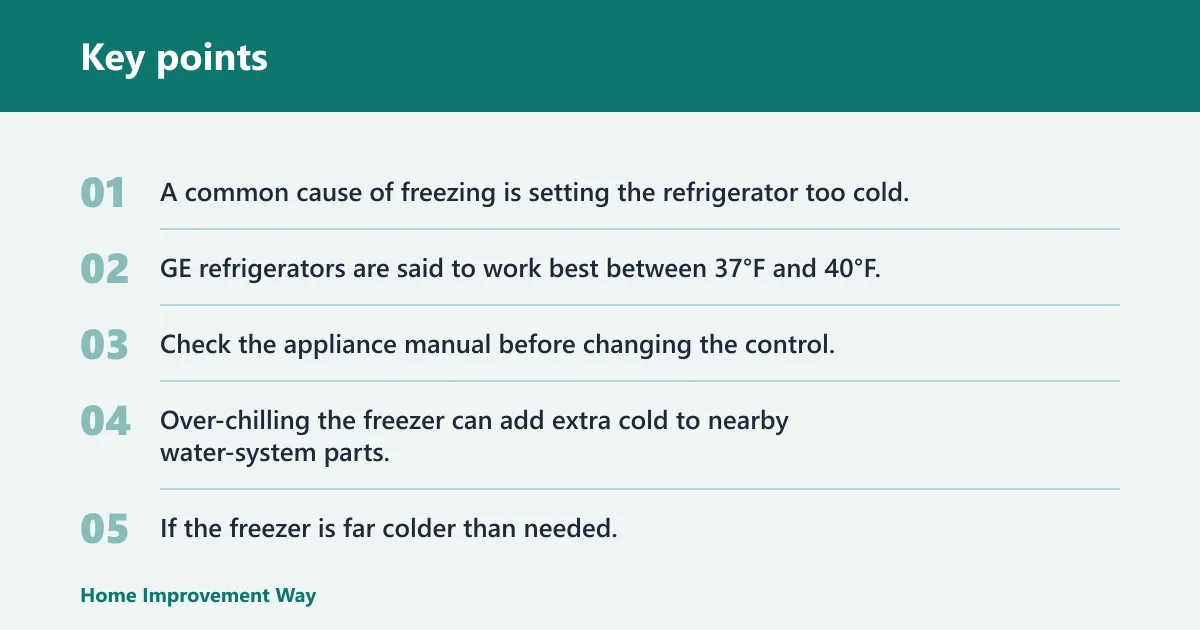
A common cause of freezing is setting the refrigerator too cold. GE refrigerators are said to work best between 37°F and 40°F, and a setting below that can chill the water line enough to ice up. Check the appliance manual before changing the control, since some models label settings differently.
The freezer temperature matters too. Over-chilling the freezer can add extra cold to nearby water-system parts, especially on models where the line or reservoir runs close to the coldest section. If the freezer is far colder than needed, the refrigerator water path may freeze even when food still looks normal.
Cold-air leaks from door seals or vents
Damaged door seals can let the refrigerator pull in extra cold air and run longer than needed. Cracks, gaps, or a door that does not close tightly can create uneven temperatures, which may freeze the line. Blocked vents can do the same thing by creating cold pockets instead of even airflow.
Check both interior and exterior vents. Poor airflow can chill the line too much, especially if the refrigerator is pushed tight against a wall or stored in a garage, basement, or along an exterior wall. Those locations can make the machine run colder than the kitchen temperature suggests.
Filter, kink, or reservoir restrictions
A water filter can restrict flow when clogged, so it belongs in the first round of troubleshooting. A restriction does not always freeze the line by itself, but it can make low flow look like a freeze. The same is true for a kinked, cracked, or pinched line.
Some refrigerators also use a water reservoir. On certain models, that reservoir can be part of the freeze path or a place where flow slows enough to look like a frozen line. If the refrigerator has a reservoir, include it in the inspection instead of focusing only on the visible tubing.
How do you tell if the line is frozen?
You can usually narrow it down by symptom. No water, no ice, intermittent flow, or visible frost near the line each points to a different next step. Start with the dispenser, the ice maker, and the water path separately so you do not miss the real restriction.
No water only
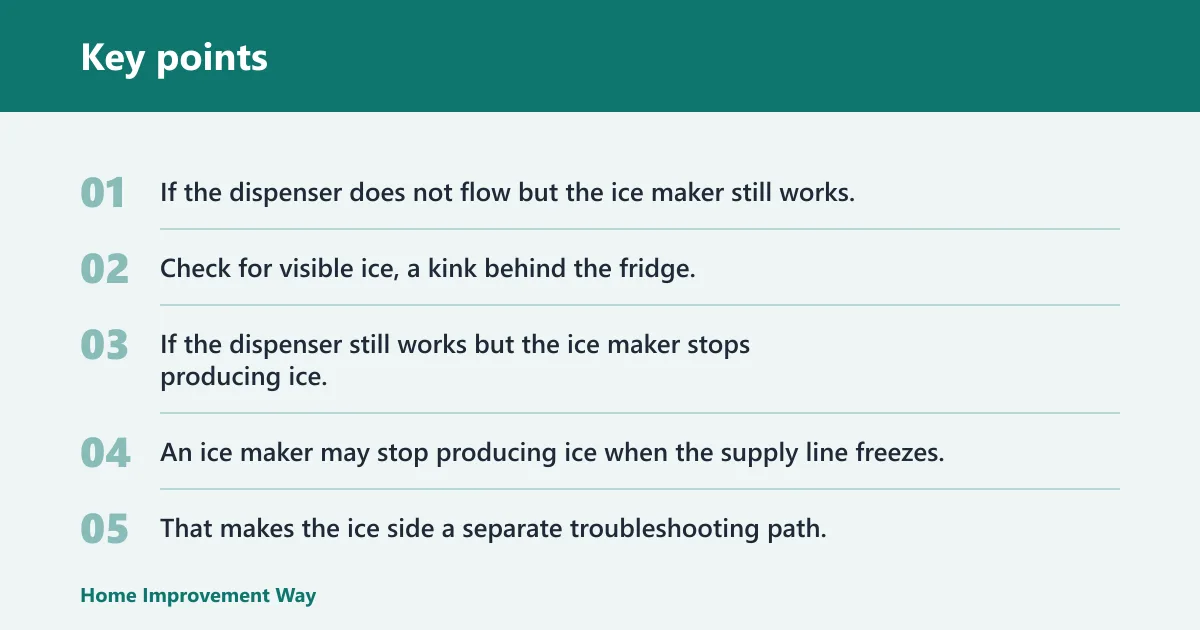
If the dispenser does not flow but the ice maker still works, the dispenser line or dispenser-side reservoir path is a better suspect than the entire water system. Check for visible ice, a kink behind the fridge, or a clogged filter before assuming the line has burst or the valve has failed.
No ice only
If the dispenser still works but the ice maker stops producing ice, the ice-maker feed line may be frozen. An ice maker may stop producing ice when the supply line freezes, and on some models it has an additional water line. That makes the ice side a separate troubleshooting path.
Both failed or flow is intermittent
If both the dispenser and ice maker fail, the problem is more likely upstream: a main supply restriction, a bad inlet valve, a frozen reservoir, or a temperature issue affecting the whole water system. Intermittent flow can also mean the line is partially frozen and thawing between uses.
Say your refrigerator dispenses a short burst of water at 38°F, then stops again after a few minutes. That pattern often points to a partial freeze or a restriction that closes as the line chills back down, not to a fully broken tube.
Signs of a leak, crack, or refreeze
A frozen refrigerator water line can leak or burst if the ice expands inside plastic tubing or pushes on a weak fitting. Look for damp flooring, drips near the rear panel, or a water line that feels brittle. If the same spot refreezes after each thaw, the line may be damaged or poorly insulated.
Water line freeze matrix
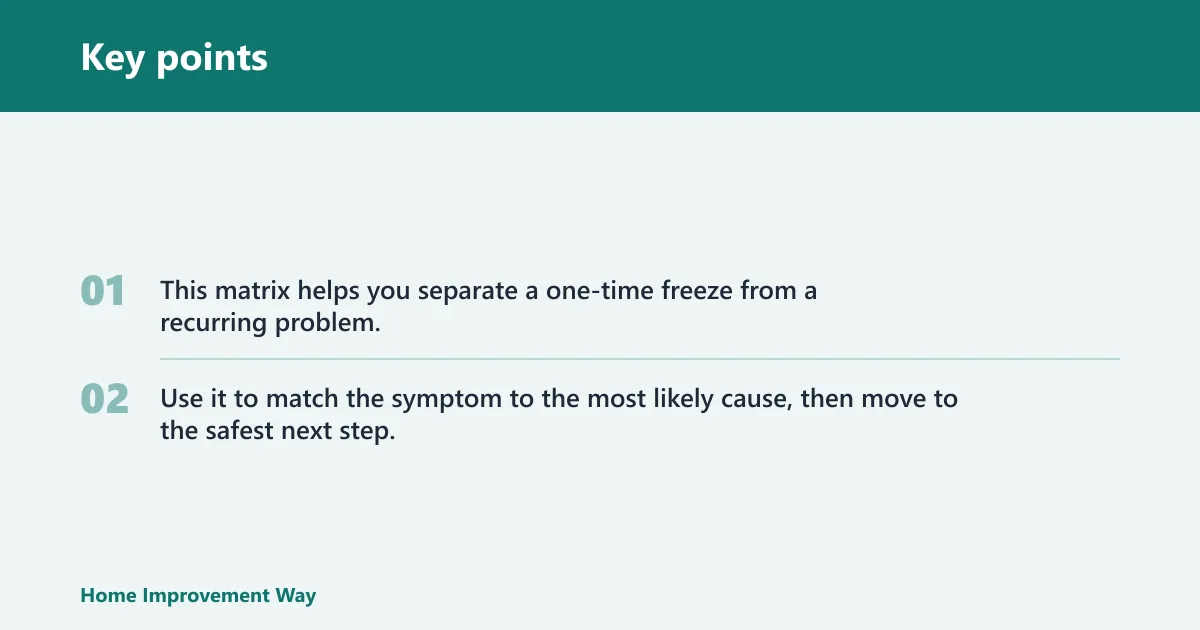
This matrix helps you separate a one-time freeze from a recurring problem. Use it to match the symptom to the most likely cause, then move to the safest next step.
| Symptom | Likely cause | Simple homeowner check | Safe thaw method | When to call a technician |
|---|---|---|---|---|
| No water only | Frozen dispenser line, clogged filter, kinked tubing, or blocked reservoir path | Check the filter date, look for bends behind the fridge, and inspect for ice near the dispenser line | Use a hair dryer on low or gentle heat, kept at a distance, on accessible tubing only | If the line stays blocked after thawing or the cabinet wall feels cold in one spot |
| No ice only | Frozen ice-maker feed line or ice-maker valve issue | Confirm whether the dispenser still flows and inspect the line feeding the ice maker | Wrap the area with a warm-water cloth and thaw gradually | If the ice maker still will not fill after thawing or the fill valve will not open |
| Both failed | Main supply restriction, frozen reservoir, very cold setting, or inlet valve fault | Check temperature settings, seals, vents, and the filter before replacing parts | Leave the refrigerator and freezer doors open briefly to raise temperature gradually, then thaw accessible areas | If both paths fail after a careful thaw or the compressor seems to run nonstop |
| Intermittent flow | Partial freeze, weak airflow, or a filter that is beginning to clog | Run a short dispense test after checking vents and filter condition | Gentle heat only; do not concentrate heat on one spot | If flow returns and then freezes again within a day or two |
| Recurring refreeze | Cold-air control problem, poor insulation, damaged seals, thermostat issue, or defrost problem | Compare actual settings to the manual, inspect seals, and check room placement | Thaw once, then correct the cold-air problem before putting it back into service | If the same line refreezes after a proper thaw and settings check |
How do you safely thaw the line?
Use gentle heat only, and only on accessible sections. A hair dryer should be kept at a distance to avoid overheating components, and a warm-water cloth wrap is another safe method. Do not use open flame, boiling water, or anything that can deform plastic tubing or fittings.
- Unplug the refrigerator if you need to work near wiring or behind panels.
- Pull the appliance out enough to inspect visible tubing, the filter area, and the rear connections.
- Use a hair dryer on low or gentle setting, moving constantly and keeping it at a distance.
- Or wrap the exposed line with a warm-water cloth and let the heat transfer gradually.
- If needed, leave the refrigerator and freezer doors open briefly to raise the temperature slowly.
- Stop as soon as water flow returns, then dry the area and check for leaks.
Protect plastic tubing and fittings while you thaw. Do not aim heat at one spot for long, and do not force a frozen valve or connector. A common first-timer mistake is trying to speed things up with very hot air; that can soften tubing before the ice has fully melted.
After thawing, run a short flow check before normal use. Dispense a small amount of water into a cup, then watch for steady flow, odd noises, or drips. If the line refreezes quickly, the issue is not solved yet.
How do you stop repeat freezes?
Repeat freezes usually mean the refrigerator is too cold in one area or air is being trapped around the water system. Start with temperature settings, then inspect seals, vents, and filter condition. If the line remains exposed, add insulation where the cold is hitting it directly.
Set fridge and freezer temperatures correctly
Check the refrigerator temperature setting against the manual. A typical safe range is 37°F to 40°F, and settings that are too cold can freeze the line. If the freezer is colder than necessary, adjust it as well so it does not drive extra cold into nearby parts.
Inspect seals, vents, and filter
Door seals should close tightly with no obvious cracks or gaps. Keep interior and exterior vents clear so air can move evenly. Replace a clogged filter instead of waiting for the line to freeze again, because a restricted filter can make the problem look worse than it is.
Add foam pipe insulation where exposed
Foam pipe insulation is an affordable prevention material. You can cut it to fit the line and use it on sections that are exposed to cold air. It will not fix a bad seal or a faulty control, but it can reduce repeat freezing on vulnerable runs of tubing.
Picture a refrigerator in a basement where the room stays cool all winter. If the fridge is set a little too cold and the line runs near a rear vent, the dispenser may freeze even though the food compartment still seems acceptable. In that case, the room location matters as much as the appliance setting.
When is it more than a frozen line?
If the line keeps freezing after a correct thaw and a temperature check, look beyond the tubing. A faulty inlet valve, thermostat, or defrost problem can keep the water path too cold or too slow to recover. Recurring freezes are the clue that the appliance is not regulating temperature or airflow correctly.
Signs of an inlet valve problem
A weak or faulty inlet valve can reduce fill volume and make the line more likely to freeze again. If the dispenser flow is weak, the ice maker fills inconsistently, or the problem returns quickly after thawing, the valve should be considered. That is especially true when the filter is new and the tubing is clear.
Signs of a thermostat or defrost issue
A defective thermostat may fail to cycle the compressor off. That can drive the cabinet colder than intended, which increases the chance of line freeze-up. If frost builds up in the wrong area, or the refrigerator seems to run almost nonstop, the control system may need service.
Some problems look like a frozen line but are actually a defrost or airflow issue. If vents are clear, seals are sound, the filter is fresh, and the line still refreezes, do not keep thawing the same spot over and over. That pattern points to a deeper repair.
When recurring freezes need service
Call a technician when the line refreezes after a careful thaw, the refrigerator may not hold the recommended temperature range, or water flow stays weak even after the filter and seals check out. Also call for help if you see cracking, repeated leaks, or a line that disappears inside a sealed cabinet panel.
Frequently asked questions
Can a refrigerator water line freeze?
Yes. A refrigerator water line can freeze when the cabinet or nearby water path gets too cold. That can stop the dispenser, the ice maker, or both. If it happens more than once, look for a temperature, airflow, seal, or filter problem instead of only thawing the tube.
Can an ice maker water line freeze?
Yes. An ice maker water line can freeze and stop the ice maker from filling. On some models, the ice maker has its own feed line, so the dispenser may still work. If ice production stops first, inspect that feed path, the filter, and the temperature settings.
Why does my refrigerator water line freeze?
The most common reasons are a refrigerator set too cold, poor airflow, damaged door seals, or a clogged filter. In some kitchens, a garage, basement, or exterior-wall location makes the problem worse. If the line keeps freezing, the refrigerator is usually too cold in one area.
How do I tell if my fridge water line is frozen?
No water from the dispenser, no ice from the maker, or intermittent flow are the main clues. Check for visible ice, a kinked tube, a clogged filter, or cold spots near vents and reservoirs. If the problem returns after thawing, treat it as a recurring control issue.
What temperature should a refrigerator be to prevent freezing?
A typical safe range is 37°F to 40°F. Check the appliance manual because controls vary by model. If the refrigerator is set below that range, the water line can freeze even when food storage seems normal. The freezer should also avoid unnecessary over-chilling.
How do you safely thaw a frozen refrigerator water line?
Use a hair dryer on a low or gentle setting, kept at a distance, or wrap the line with a warm-water cloth. Thaw only accessible sections, then check flow before normal use. Avoid open flame and very hot air, which can damage plastic tubing and fittings.
Sponsored / affiliate links. As an Amazon Associate I earn from qualifying purchases. I may earn additional commission from eligible campaigns.
 Water Flow Control Shut Off Valve with Brass Adjustable Hand Level Water Pressure Regulator for Hand Held Shower Head & Bidet Sprayer, Brushed Nickel Water Saver G1/2
 Rocky Mountain Goods Shower Flow Control Adapter – 1/2 Inch IPS – Chrome Plated ABS – Water Saver Valve to Adjust or Shut Off Shower Water