How to Keep a Sump Pump Discharge Line From Freezing
Keep a sump pump discharge line from freezing by giving it a continuously sloped, insulated path, using a larger pipe where code allows, and moving the outlet beyond the frost-prone area. If water can sit in the line, it can freeze. A frozen line can trip the pump, flood the basement, and burn out the pump from repeated cycling. This guide shows how to identify whether the freeze is in the outdoor run, the wall penetration, or the outlet, then choose the right fix for your layout.
Why discharge lines freeze
A sump pump discharge line carries pumped water away from the foundation. It freezes when standing water remains in the pipe after a pump cycle, and the most exposed sections are the ones above grade and the sections buried too shallow for local frost depth. A standard residential line buried 12 to 18 inches sits inside the frost zone all winter in many cold areas.
The outlet location matters too. The article’s freeze pattern can begin at the exit point, along above-grade sections, or at the rim joist. In places with deep frost, such as the Twin Cities, a shallow run is vulnerable for a long stretch of the season. Minneapolis commonly has a cold February, with average temperatures around the mid-20s at the high and low teens at the low, along with several snow days, so freeze conditions can hold for days at a time.
Standing water in the line
If the line does not drain fully between cycles, the leftover water is the part that freezes first. That often starts with a low spot, a sagging hose, a buried section with poor fall, or a valve that holds a pocket of water in place after the pump shuts off.
Above-grade hose exposure
Flexible hose and exposed pipe cool quickly in wind. Once the outer wall reaches freezing, a thin water layer can ice over, then close the passage farther inside. Insulation helps here, but it works best on sections that are already close to draining fully.
Shallow burial and cold outlet sections
Shallow buried pipe can sit inside the frost zone. A discharge that pops out near the foundation is also exposed to cold air, drifting snow, and meltwater that refreezes at the exit. Minnesota rules reference frost-depth requirements under MN Rules 1303.1600, and some northern Minnesota counties require 60 inches for frost depth.
What if the pump runs but water does not discharge outside?
Start with the outlet and work back toward the pump. If the pump runs but water does not appear outside, the cause may be a frozen discharge line, a stuck or misbehaving check valve, a clogged impeller, or a failed pump. A frozen line can cause the pump to run continuously against a blocked line, a condition often called dead head, where pressure builds and flow stops.
Check for a frozen line first
Look for ice at the outlet, a bulged hose, frost on an exposed section, or a line that feels hard and unusually cold in one spot. If the discharge runs outside but nothing comes out, that freeze may be farther down the line than the visible outlet. The line may also freeze first where it leaves the house.
Check the valve before assuming the pump failed
A check valve holds water in the line after pump shutoff. That is its job. But if it sticks or traps water in a poor layout, the remaining water can freeze. Verify that the valve opens and closes properly, points in the right direction, and is not packed with debris or installed where drainage is poor.
Check the pump and impeller if the line is clear
If the discharge path is open and thawed, a clogged impeller or dead pump becomes more likely. A pump that hums, trips a breaker, or moves very little water needs attention before repeated cycling causes more wear. Do not keep forcing a pump to run against a blocked line.
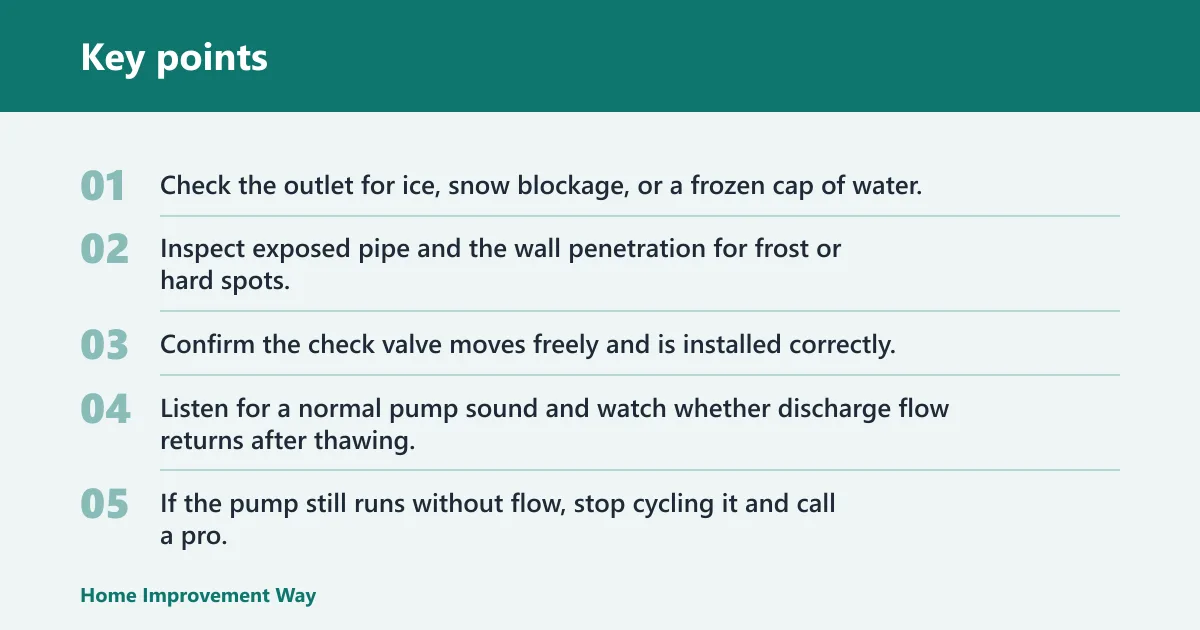
Common diagnosis sequence
- Check the outlet for ice, snow blockage, or a frozen cap of water.
- Inspect exposed pipe and the wall penetration for frost or hard spots.
- Confirm the check valve moves freely and is installed correctly.
- Listen for a normal pump sound and watch whether discharge flow returns after thawing.
- If the pump still runs without flow, stop cycling it and call a pro.
Say your pump runs after a thawing rain, but the only wet spot is a frozen outlet elbow 8 feet from the house. That points to a freeze in the discharge run, not a failed basin pump. Suppose the outlet is clear, but the line is a shallow buried hose that stays cold the whole way out; that points to layout, not pump capacity.
Which freeze fix fits your discharge line?
Use this decision table to match the symptom pattern to the layout. The right fix depends on where the water sits, how much pipe is exposed, and whether the line can drain fully between cycles.
| Setup type | Symptom pattern | Best fix | Materials needed | When to call a pro |
|---|---|---|---|---|
| Above-grade hose | Ice forms on exposed sections; outlet freezes first; pump shuts off, then restarts with no flow | Replace flexible hose with rigid pipe where practical, insulate exposed sections, and add self-regulating heat cable on vulnerable runs | Insulation, self-regulating heat cable, weather-rated outlet protection, fittings that match the pump discharge | If the hose route is long, cramped, or near electrical service |
| Shallow buried pipe | Line freezes during extended cold; water backs up after the pump cycle; outlet seems clear but flow stops farther in | Correct the drainage path, bury deeper where possible, or retrofit to 2-inch rigid PVC in a cold-climate layout | 2-inch rigid PVC, proper couplings, solvent cement if the system is PVC, excavation tools | If the trench must cross utilities, concrete, or tight property boundaries |
| Long horizontal run | Repeated freeze-ups after several dry cycles; standing water remains in low spots; the pump dead heads during freeze events | Regrade the run so it drains fully between cycles, remove dips, and consider upsizing the pipe | Leveling tools, replacement pipe, fittings, hangers or supports | If the slope cannot be corrected without major excavation |
| Freezing outlet near foundation | Ice starts where the line exits the wall or at the rim joist; outside line looks short but still freezes | Add a freeze guard or IceGuard-type fitting and extend discharge farther from the house if the layout allows | Freeze guard fitting, matched adapters, discharge extension materials | If the wall penetration must be rebuilt or the discharge ties into a complex buried run |
How do you thaw a frozen sump line?
Thaw the system from the outside in, starting at the outlet and the most exposed section of pipe. Stop cycling the pump if it keeps running against a blocked line, because repeated dead head operation can overwork the motor. If you cannot open the line safely or the freeze is inside a wall or buried section, call a pro.
Start with the outlet and exposed sections
Check the discharge opening for ice, snow, and trapped slush. Warm the outlet area first, then move to the visible pipe that leaves the foundation. Gentle heat from a safe source is better than forcing the pump to cycle against a frozen block.
Do not keep forcing the pump to run
If the pump is running and water still will not move, continuing to cycle it can turn a freeze into a motor problem. A blocked line keeps the pump under maximum pressure with zero flow. Shut the system down until the blockage is cleared if the outlet remains frozen.
Hidden freezes inside buried pipe, behind the rim joist, or in a difficult wall penetration usually need more than a quick thaw. A repeated freeze may mean the slope is wrong, the line is too shallow, or the outlet placement is too close to the foundation.
Should you use insulation or heat tape?
Insulation helps on exposed discharge sections, and heat cable or heat tape can add freeze protection where the pipe still sees cold air. The better choice depends on whether the line drains well. If water can stay trapped, insulation alone will not solve the problem. On vulnerable sections, insulation and self-regulating heat cable can work together.
Insulation for exposed pipe
Insulation is the first simple step for above-ground sections. It slows heat loss and helps protect short exposed runs near the foundation, around elbows, and at the wall penetration. BDB says to insulate the intake and discharge line to avoid freezing, and to keep the home temperature above 55°F to reduce freezing risk.
Heat cable on vulnerable sections
Self-regulating heat cable is one of the three fixes identified for cold-climate discharge lines, along with correct slope and upsizing to 2-inch rigid PVC. It is used on exposed discharge sections that still freeze after insulation. Follow the manufacturer’s instructions for routing, overlap limits, and power connection, because plumbing heat cable is not installed the same way on every product.
Safe installation limits
Do not wrap heat cable in a way that traps heat against a fitting, insulation, or another cable run unless the manufacturer says the product allows it. Keep it away from moving parts and electrical hazards. If you are unsure whether the cable is rated for wet locations, exposed discharge pipe, or the specific pipe material, check the listing for your model.
When should you upgrade the discharge run?
Upgrade the run when freezing keeps returning, when the pipe holds water after each cycle, or when the outlet sits too close to the house. A retrofit makes the most sense when the layout itself is the problem. In cold-climate work, 2-inch rigid PVC is often the better upgrade than a long flexible hose.
2-inch rigid PVC retrofit
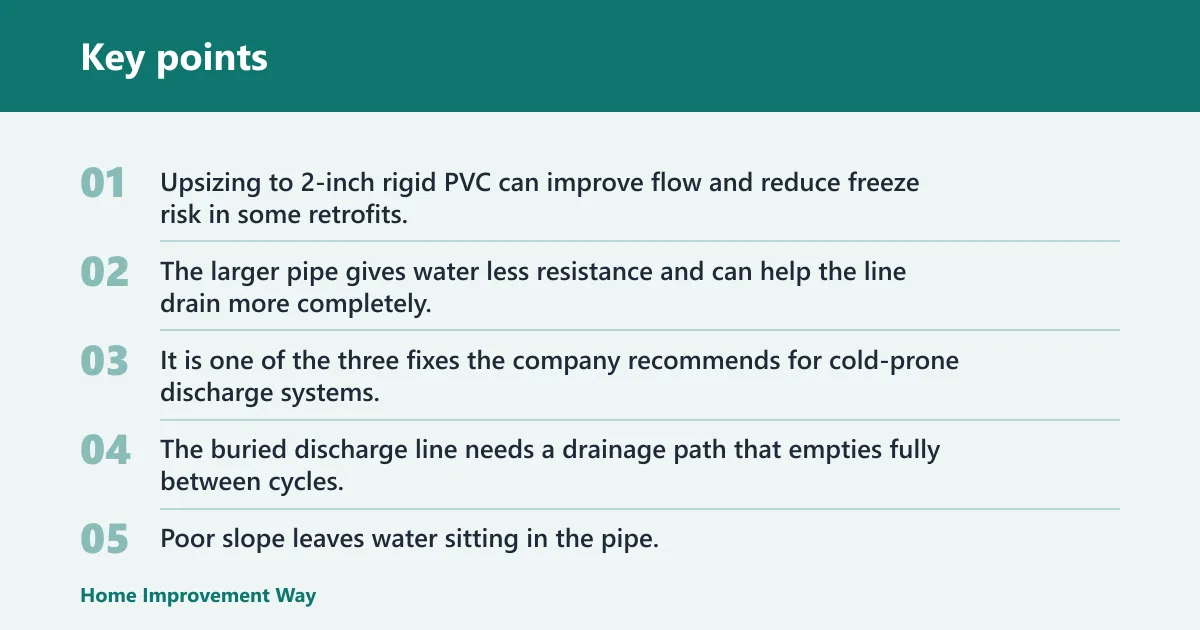
Upsizing to 2-inch rigid PVC can improve flow and reduce freeze risk in some retrofits. The larger pipe gives water less resistance and can help the line drain more completely. It is one of the three fixes the company recommends for cold-prone discharge systems, but the fit must still match the pump and the existing layout.
Correct slope and drainage path
The buried discharge line needs a drainage path that empties fully between cycles. Poor slope leaves water sitting in the pipe, and that standing water becomes ice in cold weather. Do not slope the line back toward the sump basin. The goal is a path that lets the line clear without sending water back to the pump.
Freeze guard or IceGuard-type fitting
A freeze guard or IceGuard-type fitting is useful when the line freezes near the foundation but you still need a way for water to escape. It relieves water near the house instead of forcing the system to dead head. It is an alternative, not a cure for a bad buried run, and it may be a better fit when a longer discharge path is not practical.
Battery backup during winter outages
A battery backup sump pump matters in winter because storms can bring both cold and power loss. If the main pump cannot run, water can rise fast while the discharge line is already at risk of freezing. A backup unit reduces freeze-related failure risk during outages because it keeps pumping when mains power fails.
How far should a sump pump discharge line extend from the house? Far enough that discharged water will not run back to the foundation, refreeze at the exit, or pool near the wall. If you are choosing an outlet location, use the manufacturer’s guidance for your setup and local code requirements rather than guessing at a distance.
Frequently asked questions
How do I prevent a sump pump discharge line from freezing?
Keep the line draining fully, insulate exposed sections, and move the outlet away from the foundation so water cannot sit in the pipe. If the run stays exposed to cold air, add self-regulating heat cable and verify the check valve is not trapping water. In severe climates, a 2-inch rigid PVC retrofit may be the better fix.
Why does a sump pump discharge line freeze?
It freezes because water remains in the line after the pump stops, then the exposed pipe cools below freezing. Shallow burial, above-grade hose sections, and outlet areas near the foundation are the most vulnerable. A stuck valve or poor slope makes the problem worse by leaving more standing water in the pipe.
What should I check if my sump pump runs but water doesn’t discharge outside?
Check the outlet first, then the exposed pipe, then the check valve, and finally the pump itself. A frozen line can cause dead head, but a stuck check valve, clogged impeller, or failed pump can look similar. If the pump keeps running against a blocked line, stop cycling it until you clear the cause.
Should you insulate the discharge line or use heat tape?
Use insulation on exposed discharge sections first, then add self-regulating heat cable if the line still freezes. Insulation slows heat loss, while heat cable actively protects the vulnerable section. Follow the manufacturer’s instructions for routing and electrical connection, and do not treat heat cable as a fix for bad slope or standing water.
How far should a sump pump discharge line extend from the house?
It should extend far enough that water will not return to the foundation or freeze right at the outlet. The exact distance depends on your site, grade, and local code, so use the manufacturer’s guidance and local requirements. If the outlet is still freezing, add a freeze guard or extend the run farther.
How do I unfreeze sump pump line?
Start at the outlet and warm the exposed sections first. Do not keep the pump cycling against a blocked line. If the freeze is inside buried pipe, behind the rim joist, or in a place you cannot reach safely, stop and call a pro. Repeated freeze-ups usually mean the layout needs a permanent fix.
Sponsored / affiliate links. As an Amazon Associate I earn from qualifying purchases. I may earn additional commission from eligible campaigns.