Best Setup for Hard Well Water with Iron (2026): Research Shows
This guide is for homeowners on private wells who have both hardness and iron, especially when staining, rust, flow loss, or resin fouling is showing up.
For hard well water with iron, treat iron before the softener if the iron is soluble or oxidized: use oxidation plus a sediment or iron filter first, then a water softener; if iron is low and pH is at least 7, a softener with iron-rated resin may be enough. WQA and university extension guidance generally place softeners only within a low-iron range, and many manufacturers specify conservative iron limits for resin protection, often around 3 ppm for softener-only use; above that, iron treatment belongs ahead of softening. This guide maps the right sequence by iron type, hardness, and pH so you can choose the correct system order.
Methodology: This article is organized around field-relevant well water variables: whether the iron is ferrous or ferric, whether iron bacteria or sediment are present, how hard the water is, and what the pH is doing. The thresholds below are aligned to consumer education, state extension recommendations, university well-water programs, NSF/ANSI product context, and manufacturer engineering docs that describe when softeners and iron media are likely to foul. When the water is complex, test results from a certified lab are the right starting point, not strip-only screening.
Short answer: The best setup is usually sediment first if grit is present, iron removal second, and softening last. That order protects valves, keeps iron out of the resin bed, and leaves the softener to do the job it is built for: calcium and magnesium removal.
Match your iron and hardness treatment to the test results
The best setup depends on what your water test shows, not one fixed order. Well water can carry iron, hardness minerals, sediment, and bacteria, and treatment needs to match the water chemistry, household use, and flow rate. University extension well-water programs consistently recommend testing before treatment selection, and consumer education similarly emphasizes matching treatment to the contaminant profile rather than buying by symptom alone.
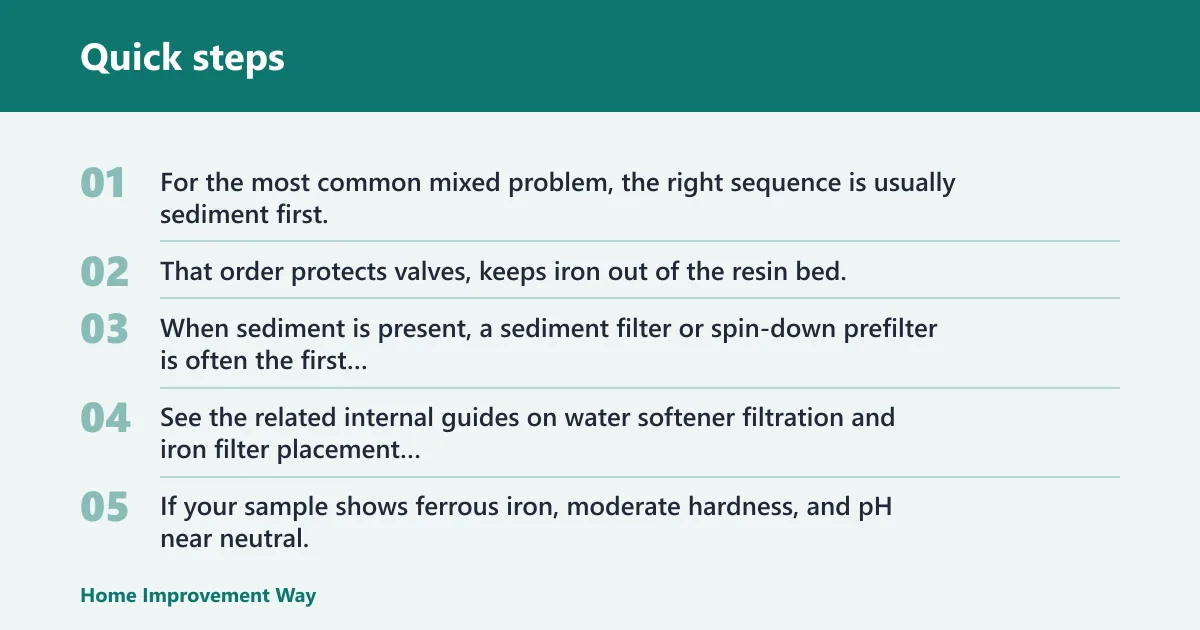
For the most common mixed problem, the right sequence is usually sediment first, iron removal second, and softening last. That order protects valves, keeps iron out of the resin bed, and leaves the softener to do the job it is built for: calcium and magnesium removal. When sediment is present, a sediment filter or spin-down prefilter is often the first safeguard; when it is not, that stage can be skipped. See the related internal guides on water softener filtration and iron filter placement for the same sequence logic.
Top pick by common test results
If your sample shows ferrous iron, moderate hardness, and pH near neutral, an air injection oxidation filter before the softener is often the cleanest setup. If the water shows visible rust, turbidity, or iron bacteria, start with sediment capture and use a stronger iron treatment before softening. For pH-sensitive systems, review pH correction before final sizing, because low pH can change oxidation performance and media life.
Say your well water has clear water iron that turns orange after standing, plus soap scum and scale. A prefilter may not be needed if the water is not gritty, but an iron filter before the softener usually is. If the water arrives already orange, do not assume the softener can clean it up; visible rust is a sign that ferric iron or particulate iron is already in play.
Why treatment order matters
Sequence matters because each stage has one job. A single tank is not enough for complex well water problems, and a treatment train works best when each unit handles one specific issue in order. That is why manufacturer engineering docs for softeners and iron media typically separate hardness exchange from iron removal and particulate capture.
When iron reaches a softener first, it can coat the resin, reduce exchange capacity, and shorten service life. When sediment reaches an iron tank first, it can blind the media, reduce backwash performance, and create low-flow complaints. Field symptoms of resin fouling include reduced soft water run length, rust-colored beads on service calls, and harder water returning sooner than expected.
When a softener alone is not enough
A softener alone may work only for very small amounts of ferrous iron, and the iron limit is low enough that many homes with staining will exceed it. Softener-only iron handling is commonly limited to around 3 ppm or less, depending on resin and water conditions; above that, plan on a dedicated iron stage ahead of softening. If iron is already visible, if bacteria are present, or if pH is low, a softener-only setup is the wrong starting point.
Hardness is different. Calcium and magnesium are what the softener is designed to remove, and hardness is what causes scale buildup and soap scum. Iron is a separate problem, and treating both in one tank is where sequencing mistakes start. For households on private wells, it is also the point at which a certified lab test becomes more useful than strip screening alone.
Quick comparison
| Product | Badge | Best for | Price | ||
|---|---|---|---|---|---|
 |
21 in 1 Water Tester for Drinking Water, 120 Testing Stripsbestprod | Our pick | 21-in-1 · 120 strips · well water test kit | $25.95
Price as of 28 Oct 2026
|
View |
 |
Waterdrop WHF3T-FG 3-Stage Whole House Water Filter SystemWaterdrop | Pair with it | 3-stage · whole-house · iron-manganese filter | $329.99
Price as of 28 Oct 2026
|
View |
 |
48,000 Grain Whole House Water Softener with DigitalDeepure | Upgrade pick | 48,000 grain · metered · whole-house softener | $499.00
Price as of 28 Oct 2026
|
View |
 |
AIO Air Injection Oxidizing Well Water Filter System | 12"Oceanic Water Systems | Also great | 12×52 · AIO · iron-sulfur-manganese filter | $1,329.99
Price as of 28 Oct 2026
|
View |
The fastest fit is usually the setup that matches the iron form first, then hardness, then flow. If the test shows clear-water iron at a manageable level, a chemical-free oxidation filter plus softener is often the cleanest sequence; if iron is high or bacteria are present, move to a stronger oxidation setup. For threshold decisions, check a certified lab report before buying if the water has a sulfur odor, staining, or a history of well issues.
Treatment order checklist
Short answer: Use this order to avoid resin fouling and underperforming filters. It follows the same sequence most extension resources and manufacturer docs imply for mixed well-water problems.
- Check iron type: ferrous, ferric, or iron bacteria.
- Check hardness and pH before sizing equipment.
- Note sediment, grit, turbidity, and any sulfur odor.
- Match the treatment order to the failure risk.
Step-by-step: 1) If grit or sand is present, install a sediment prefilter first. 2) If iron is dissolved or already oxidized, place the iron treatment next. 3) Put the softener last so it sees cleaner water. 4) If pH is low, correct pH before or alongside iron treatment, because low pH can interfere with some oxidation systems. 5) If iron bacteria is suspected, get a lab test and consider professional treatment planning before equipment purchase.
Best setup by test result
| Test result | Recommended sequence | When a softener can be used alone | When a prefilter is required | Red-flag failure cases |
|---|---|---|---|---|
| Ferrous iron, low to moderate hardness, pH at least 7 | Optional sediment prefilter if grit is present, then air injection oxidation iron filter, then softener | Only when iron is very low and the softener resin is iron-rated | Yes, if sand, dirt, or turbidity is present | Resin fouling, orange staining, low exchange capacity, poor regeneration |
| Ferric iron, visible rust particles, any hardness | Sediment capture first, then iron treatment or oxidation, then softener | Rarely; visible iron is usually too much for a softener alone | Usually yes, because ferric iron behaves like particulate rust | Media blinding, clogged valves, pressure drop, stained fixtures |
| Iron bacteria, moderate to high hardness, pH variable | Shock chlorination or stronger oxidation, then sediment control, then iron removal, then softener | Almost never; bacteria and slime can clog media and fixtures | Yes, especially if slime, grit, or orange/brown buildup is present | Recurring slime, fouled media, odor return, valve clogging |
| Iron above 7–10 PPM, hardness present, low pH | Chemical oxidation or peroxide injection, contact time or filtration, then softener | No, not a safe choice for major iron loads | Usually yes, if any sediment or oxidized iron is forming | Premature resin failure, poor iron removal, unstable performance, low pH incompatibility |
Ferrous iron is dissolved and invisible when first drawn, then turns orange or brown after it contacts oxygen. Ferric iron is already oxidized, so it shows up as orange or red water and often needs filtration or another iron treatment before softening. Iron bacteria can create slime that may clog pipes, valves, and filter beds, and shock chlorination is often a temporary corrective step rather than a guaranteed long-term fix by itself. Photos in field service manuals typically show ferrous water as clear-at-draw sample jars, ferric iron as rusty particles or tea-colored water, resin fouling as sticky brown beads, and iron bacteria as gelatinous orange slime in the tank or toilet reservoir.
Do you need an iron filter before a softener?
Short answer: Yes, in most homes with meaningful iron staining, the iron filter should come before the softener. A softener treats hardness minerals, not major iron loads, and it can foul quickly if iron reaches the resin bed first. This is consistent with general consumer guidance and common manufacturer engineering limits for iron exposure.
When an iron filter should come first
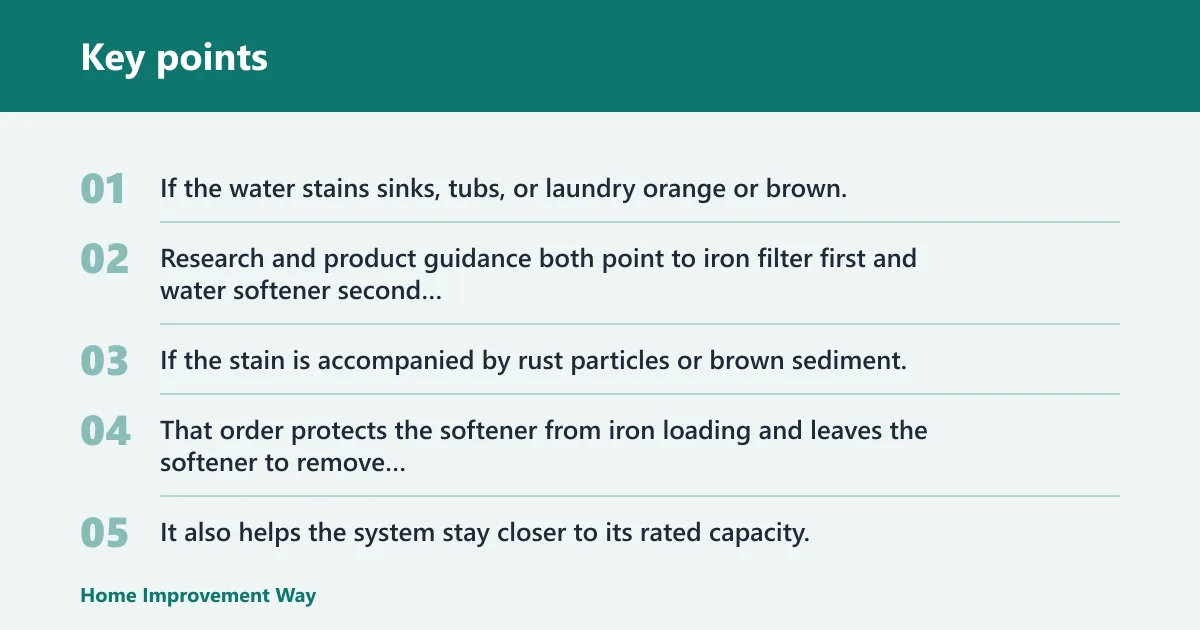
If the water stains sinks, tubs, or laundry orange or brown, start with iron removal ahead of softening. Research and product guidance both point to iron filter first and water softener second for iron plus hardness. If the stain is accompanied by rust particles or brown sediment, treat that as ferric iron or particulate iron, not as a softener-only issue.
That order protects the softener from iron loading and leaves the softener to remove calcium and magnesium. It also helps the system stay closer to its rated capacity, which matters when the house has multiple fixtures running at once. For multi-fixture homes, this is where proper flow sizing matters as much as chemistry.
When a softener can handle only trace iron
A softener can remove only small amounts of ferrous iron, up to about 3 PPM, and even then performance depends on the resin and the rest of the water chemistry. Low iron, neutral pH, and no visible particles are the best conditions for that shortcut. Consumer education and manufacturer resin specs both support the same practical point: iron tolerance exists, but it is limited and conditional.
A common first-timer mistake is buying a softener for orange staining and assuming the resin will sort it out. If the iron is already oxidized or the water is turbid, the softener is the wrong first stage. Visible orange water, reddish toilet tank rings, and sticky brown residue are field signs that the iron is already beyond softener-only territory.
When a prefilter is required before either unit
If the well water carries sand, grit, or turbidity, a whole-house sediment prefilter should come first to protect downstream media and valves. That prefilter can be a spin-down unit or a cartridge style, depending on particle load and service habits. For homes where particles are intermittent, a sediment filter is often the least expensive way to protect the rest of the train.
Sediment protection matters because rust particles and grit can clog faucet aerators, reduce backwash flow, and blind an iron tank. If backwash flow is weak, even a good iron filter can underperform. In those cases, the correct fix is usually filtration order and sizing, not trying to force more work through the softener.
Air injection oxidation filter: best for moderate iron
Short answer: An air injection oxidation, or AIO, filter is a common chemical-free choice for moderate iron. It works by using air to oxidize dissolved iron, then backwashing the oxidized particles out of the tank. This is often the cleanest fit when the water is otherwise stable and pH is workable.
How AIO works
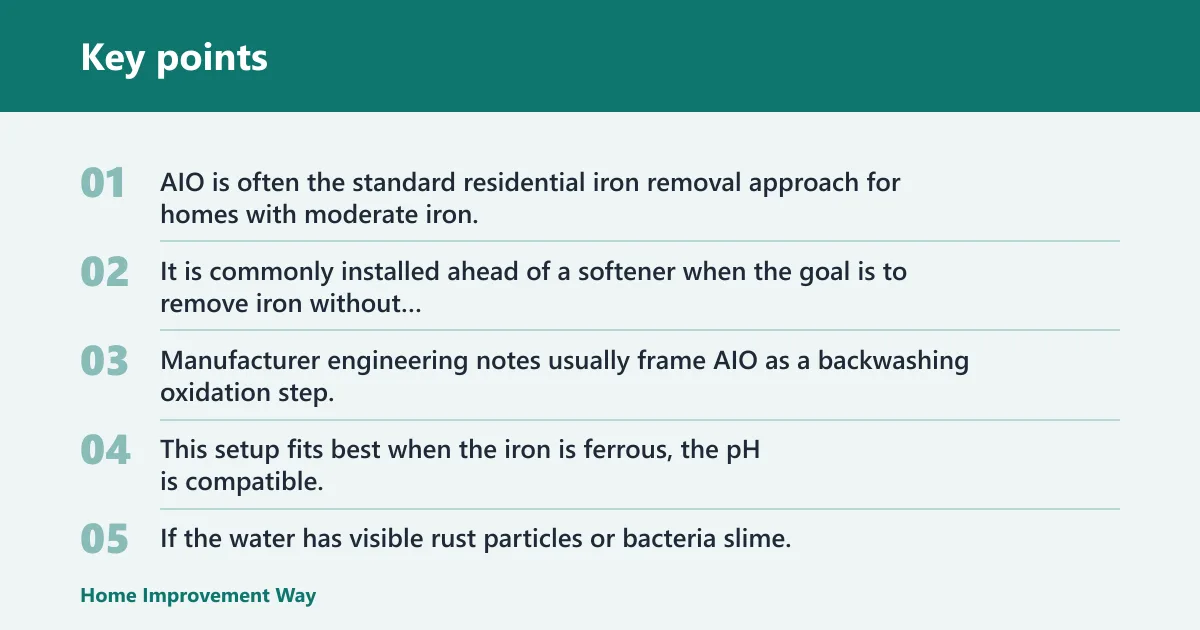
AIO is often the standard residential iron removal approach for homes with moderate iron. It is commonly installed ahead of a softener when the goal is to remove iron without adding chemical dosing equipment. Manufacturer engineering notes usually frame AIO as a backwashing oxidation step, not a hardness solution.
This setup fits best when the iron is ferrous, the pH is compatible, and the well can provide enough flow for backwash. If the water has visible rust particles or bacteria slime, the AIO may need help from sediment control or a stronger treatment. If the pH is too low, add pH correction rather than expecting the iron bed to compensate.
Where it fits in the treatment train
The usual order is sediment first if needed, AIO second, softener third. That sequence keeps grit out of the oxidation tank and keeps iron out of the resin bed. It also matches the way many well-water programs describe treatment trains: remove particulate load first, then oxidation/filtration, then softening.
Because each unit has one job, you avoid mixing hardness removal with iron removal inside the same tank. That matters when the water changes seasonally or the well produces varying sediment. It is also the easiest sequence to service and troubleshoot.
What water tests can rule it out
If the water shows ferric iron, heavy turbidity, or iron bacteria, an AIO-only approach is often not enough. Low pH can also create compatibility problems for some iron systems, so pH testing should happen before buying equipment. A certified lab report is especially valuable when the water has iron plus manganese, hydrogen sulfide, or microbial concerns.
Flow rate matters too. A system that cannot backwash fully will not clean the media bed well, and that leads to pressure loss and earlier service calls. In the field, under-backwashed iron media often looks compacted, stained, and slow to recover after regeneration.
Chemical oxidation setup: best for high iron
Short answer: Chemical oxidation is the stronger choice for high or stubborn iron problems. It is also the better fit when iron bacteria or iron plus sulfur odor is part of the picture.
Peroxide or chlorine injection basics
These systems inject an oxidant, then use contact time and filtration to remove the oxidized iron. The method is more complex than AIO, and it needs chemical management and routine upkeep. It is usually the right answer when the simple backwashing iron tank is being asked to do too much.
For higher iron loads, chemical oxidation is often the more appropriate path. That is also where the limits of a softener become obvious: resin fouls, salt use rises, and iron removal becomes inconsistent. Manufacturer docs for iron treatment systems commonly treat this as the point where more engineered oxidation is preferred.
When iron bacteria changes the choice
Iron bacteria can create slimy orange or brown buildup and may clog pipes and fixtures. In that case, shock chlorination or a stronger oxidation strategy often comes before filtration and softening. Field guidance often notes that bacteria-related slime can keep reappearing unless the well, plumbing, and treatment train are addressed together.
Because bacteria can keep reappearing if the well and plumbing are not treated correctly, a simple softener is not a real fix. The system has to address the biological load first, then the dissolved and particulate iron. If the slime returns after cleaning, that is a sign to re-test and reconsider the treatment order.
Why this option needs more maintenance
Chemical dosing systems add tasks: monitoring chemical supply, checking injection performance, and keeping contact tanks or filters clean. That is the tradeoff for handling extreme iron or mixed contamination more reliably. The upside is broader treatment capability; the downside is more upkeep and a larger setup footprint.
If the house has low pressure, limited backwash capacity, or a small well yield, this route may need professional sizing. The wrong pump, tank, or valve setup can make the treatment train unstable. In that scenario, the better move is usually to size the whole system around the worst water condition, not the average day.
Which one should you buy?
Short answer: Start with the test result, then choose the simplest sequence that still protects the softener. Budget-first buyers should look at sediment filtration only if grit is present, then an AIO iron filter before a softener when iron is moderate and pH is workable. If the water chemistry is uncertain, get a lab test before selecting equipment.
For mixed iron and hardness, the best choice is usually an iron-removal stage first and a metered softener second. For higher iron, iron bacteria, or iron plus sulfur, move up to chemical oxidation instead of trying to stretch a softener past its limits. That rule is the same whether you are comparing products or designing a whole-house train.
Based on the product details, this article highlights options such as a 21-in-1 test kit for checking hardness and pH; a whole-house filter for general particulate protection; a softener for hardness; and an AIO unit for moderate iron. Each has a drawback: testing strips are not a lab report, the Waterdrop system still needs correct sizing, the Deepure softener cannot solve major iron on its own, and the Oceanic unit is not a fit for every high-iron or bacteria problem.
Picture a home with 8-inch orange stains in the toilet tank, soap that barely lathers, and a well that also spits a little sand after heavy rain. The right order is sediment first, iron removal second, softener third. If the sand is ignored, the iron media can clog before it ever gets a chance to work.
Suppose the water is clear in a glass at first draw, then turns rusty after a minute, and the pH test comes back at 6.4. That leans away from a softener-only answer and toward iron treatment first, with pH considered before final equipment sizing. This is exactly the kind of case where a lab test is more useful than a strip-based guess.
Bestprod 21 in 1 water tester: best for upfront testing
This kit is for the homeowner who needs a fast read on hardness, pH, and other common well water markers before buying equipment. It is the most direct way to screen for whether you may need iron treatment or a hardness-only solution.
What stands out is the breadth of testing and the included reading guide and data sheets. The drawback is that strips are a screening tool, so they are useful for direction but not a substitute for a full lab report when the water is complex.
Waterdrop whf3t-fg: best for iron and sediment
This is a fit for homes that need whole-house particulate protection along with general sediment reduction. The multi-stage design and whole-house format make it better suited to a treatment train than a single faucet filter.
Its main advantage is that it can protect plumbing and appliances before the softener sees the water. The drawback is that it still has to match the home’s sediment level and flow demands, so it is not a universal answer for every well.
Deepure 48,000 grain softener: best for hardness
This softener is aimed at homes that need reliable hardness removal for multiple bathrooms. It is the right final stage when calcium and magnesium are the main issue and iron has already been handled upstream.
The metered control helps it regenerate based on use rather than a fixed calendar. The drawback is simple: it treats hardness, but it should not be asked to solve major iron problems by itself.
Oceanic water systems aio filter: best for moderate iron
This AIO unit fits homes with moderate iron, sulfur odor, or manganese where a chemical-free oxidation stage is preferred. It is the kind of filter that belongs before a softener in a treatment train for many well systems.
The advantage is automatic backwashing, which lowers day-to-day effort compared with a chemical feed system. The drawback is that it is still a chemistry-dependent solution, so heavy iron, iron bacteria, or low pH can push the setup past its comfort zone.
FAQ
Short answer: These are the most common planning questions for hard well water with iron. If your result does not fit one of these, use the checklist above or get a lab test.
What is the best water treatment setup for hard well water with iron?
The best setup is usually sediment first if grit is present, then iron removal, then a softener. For moderate ferrous iron, an air injection oxidation filter before the softener is often the best fit; for higher iron, iron bacteria, or stubborn sulfur combinations, chemical oxidation is the stronger choice.
Do I need an iron filter before a water softener?
In most mixed iron-and-hardness homes, yes. A softener can handle only small amounts of ferrous iron, but major iron loads can foul the resin, reduce capacity, and leave stains behind. Putting the iron stage first protects the softener and improves long-term performance.
Can a water softener remove iron from well water?
Only in a limited way. A softener removes calcium and magnesium, and it can tolerate only small amounts of ferrous iron, up to about 3 PPM. If the iron is visible, particulate, or bacteria-related, you need a dedicated iron treatment stage before the softener.
What kind of iron filter works best for well water?
For moderate ferrous iron, an air injection oxidation filter is often the best residential choice because it is chemical-free and usually works well before a softener. For higher iron, iron bacteria, or iron plus sulfur, chemical oxidation with filtration is the stronger option, though it needs more maintenance.
How do I know whether I have ferrous or ferric iron?
Ferrous iron is dissolved, so the water may look clear at first draw and then turn orange or brown after exposure to air. Ferric iron is already oxidized, so it appears as orange or red water or particles right away. Testing for iron type helps pick the right sequence.
What iron level is too high for a softener alone?
A softener is only suitable for small amounts of ferrous iron, and about 3 PPM is the common upper limit cited for that use. Above that, or whenever the iron is already visible, the resin can foul quickly and the system can stop behaving like a true iron solution.
Should I test pH before choosing a well water treatment system?
Yes. pH affects whether some iron systems will work properly and whether the water chemistry will support oxidation or backwashing. It should be tested with hardness and iron so the treatment train is sized around real conditions, not guesses.
What treatment order should I use for sediment, iron, and hardness?
The usual order is sediment first, iron removal second, and softening last. That sequence keeps grit out of the iron tank, keeps iron out of the resin, and lets the softener focus on hardness minerals only. If sediment is absent, the first stage may be skipped.
When should I get a lab test instead of using strips?
Get a certified lab test when the water has staining, odor, slime, recurring pressure loss, or when iron, manganese, sulfur, and pH may be interacting. Strip tests are useful for screening, but a lab result is more reliable for final sizing and for deciding whether iron bacteria or corrosion is part of the problem.
Sponsored / affiliate links. As an Amazon Associate I earn from qualifying purchases. I may earn additional commission from eligible campaigns.